Hellwig 1780 – Venturini 1797 – Giacometti 1801 – Hellwig 1803 – Opiz 1806 – Firmas-Périès 1809 – Reiswitz Sr. 1812
Opiz’s Kriegsspiel introduces many innovations to the formula of Hellwig and I would consider it a full-fledged wargame – the only oddity is that unit move and shoot only in orthogonal and diagonal directios. Intriguingly, Opiz claims the game was designed and played around 1760, which would make it the earliest wargame. It is indeed very different from Hellwig’s. Reiswitz Sr takes Opiz’s claim at face value, and it is possible that he knew something we don’t.
I can’t check the translation, but the OCR went well.
The original has been uploaded here.
Johann Ferdinand Opiz — The Opiz War Game (Halle 1806)
War Game,
a Contribution to the Education of Future and to the Entertainment of Even the Most Experienced Tactician
Described in Detail by the Inventor Johann Ferdinand Opiz, Imperial and Royal Bohemian Revenue Office Inspector at Časlau, Actual Member of Several Academies and Learned Societies.
Published by his son G. E. Opiz.
With Illustrations and an Illuminated Copper Plate.
Halle,
Hendel’s Publishing House. 1806.
Editor’s Foreword.
The present essay should already have been submitted to the public in print two years ago, had not partly the domestic circumstances of the author, partly the prevailing conditions of the time, prevented its publication; and perhaps it would have fallen entirely into oblivion under the unfavourable circumstances of my father, who is bound by his office to a place where he lives entirely outside any direct contact with the literary world, had I not, through my repeated and persistent entreaties, brought it about that it was at last placed entirely at my free disposal. I therefore resolved, on my travels, which I am presently undertaking as a practising visual artist, to await an opportunity to bring this little work to press. This opportunity then presented itself with the present publisher, and so the public now receives herewith the description of this war game, which certainly deserves to attract attention alongside those already published; for however much Hellwig’s and Venturini’s war games recommend themselves by their original invention, as well as in every other respect, the present one will nonetheless also merit its place, having already distinguished itself through the thoroughly observed analogy with the nature of the subject it seeks to imitate in play, as well as through the ease with which its rules may be grasped — not merely entitling it to stand beside the others, but enabling it, for these very reasons, to fulfil the twofold purpose of instruction and entertainment better than any other known work; for, as stated, however much fairness demands that we do justice to the two war games mentioned above, the one nonetheless rests too heavily on arbitrary rules that make it too similar to chess, while the other requires in turn calculations too complex which, however instructive they may always be, yet too greatly impede the purpose of every game, namely entertainment. The present war game, however, can aptly hold the middle ground between the two. It is in all respects an imitation of nature, and the players are thereby so little constrained by arbitrarily determined rules that, if fortune favours them as it does in actual warfare, they can carry out all military operations according to their own freely chosen plan; the rules themselves, though numerous by the nature of this game, are yet, by reason of the thoroughly observed analogy with reality, so readily comprehensible and so easily committed to memory, that anyone who possesses even a superficial knowledge of tactics — indeed, even only mature judgment — can, after playing a few times, make them fully their own. Moreover, it will at all times be very beneficial, and even necessary for the avoidance of every dispute, which arises so often and so easily in games, to be, be: that players, when actually playing, should always have a copy of this description to hand, so that by means of the convenient index they may easily settle any disputed question.
More in commendation of this essay than it falls to me to say will be found in the letter appended in place of a preface — a letter from a judge more competent by virtue of his position — just as from the game descriptions appended to that letter, drawn from actual play, one can not only confirm my foregoing assertions but also form a clear idea of the close imitation of real warfare that this game achieves.
In the work itself I permitted myself no alterations, and any thoughts that seemed to me still necessary by way of practical explanation of the game, or as essential additions, I have merely appended below as notes. In the preface, as in the appendix, however, I accordingly omitted various things that could either hold no interest for the readers themselves, or no longer seemed appropriate to me for the present moment of publication.
July 1806.
G. E. Opiz.
—
Preface.
At the repeated urging of a young officer of the Imperial-Royal Line Infantry Regiment, Baron Frehlich, No. 28, who applies himself with great zeal to the acquisition of useful knowledge, I had resolved two years ago to describe in detail a tactical board game invented by me (which I had always called my war game), and to draw up the rules necessary for playing it. His letter of invitation, dated 5 July 1803, I here append in place of a preface. It establishes the true vantage point from which the value of this game can best be judged.
the purpose of this letter is to renew my repeated entreaties with all possible emphasis, and to request you — as a man who is of use not only to the State, which we both serve, through his official duties, but also to that same State and to the literary world through his learned works — to benefit the great public, and especially the military public, and soon (what a glorious calling!) through some work worthy of public notice, a work befitting the far-sighted, inventive genius you possess.” —
You can doubtless tell from this prologue where my attention is directed? — Yes! precisely upon that subject which is of the highest interest not only to me but to every soldier, and for whose public disclosure I have virtually “entreated you verbally on countless occasions — of whose utility and importance I have repeatedly (as I believe) sufficiently convinced you — namely, your excellent tactical board game.” “Your greatest objections and arguments, which you never cease to put forward against my entreaties, consist mainly in a doubt you harbour: whether perhaps a work similar to yours may already be known to the public? — This doubt, forgive me, is truly very easily resolved.” “In order to dispel this doubt, it was my most pleasant duty, during my leave in Vienna in the months of January and February 1802, to enquire most diligently both among various friends of the military arts and in several bookshops of the imperial capital. You believed, in Joh.
Christian Ludw. Hellwig’s Essay on a Tactical Game Built upon Chess, 2 vols. Leipzig 1780 and 1782. large 8vo., to find a similarity with your war game, and your wish joins with mine to become acquainted with this Hellwig work. I therefore searched for it not only at the Imperial-Royal Court Library and the Vienna University Library, but also in several distinguished bookshops of Vienna, and found it nowhere.” —
Rather than rejoicing, inflamed by a certain literary vanity, that this work was so unknown in Vienna, you regretted, in our correspondence at that time, that you could not obtain any review of it from me.” “Yes! even if Hellwig’s game were to be found in most bookcases and were even commonly played, I would still see no “sufficient reason why your game could not also be presented to the public, especially when it is considered that even the title page of Hellwig’s work points to something very different from your game. Hellwig’s game is a tactical game built upon chess, perhaps also to be played on a larger chess board. Yours has absolutely no similarity with a chess game, just as your game board has absolutely no similarity with a chess board.” —
Your game board consists of a freely chosen terrain, painted in various ways and divided into squares, furnished with forests, rivers, lakes, ponds, mountains of various heights and slopes, fortresses, towns, villages, defiles, ravines, etc., upon which one places one’s troops — which are divided into battalions and cavalry divisions —
together with the remaining pieces representing numerous other things essential to an army, positioned according to one’s own judgment, and with which one is free to operate according to fixed rules entirely suited to tactical method. Evolutions and the effect of fire are determined proportionally among the troops. Nearly every possible object encountered in military operations, as well as every case and obstacle that can arise, appears here. Skirmishing takes place, engagements and battles are fought, castles and fortresses are besieged, conventions are even concluded, and entire campaigns are conducted.” —
What a difference! What an incomparably greater, far superior advantage compared with chess! — which, though it exercises the mind in thinking to an extraordinary degree, does not in the least “teach the soldier the many often incredible obstacles to an operation.” —
In your game, one must not only direct one’s attention to the position and movements of the troops, but must calculate many more moves than are necessary in chess proper — the movements of both one’s own and the opposing troops, artillery, pontoons, magazines, etc. — for here too the magazines have an influence on operations, since desertion can set in at a certain specified distance from them. — But what gives your game the greatest resemblance to a military operation is this: that the outcome of the players’ dispositions does not always follow their wishes, but often turns on the less favourable chance of the dice throws. — This distinctive feature of your game is a particularly splendid “original idea that, in a truly purposeful manner, lends your game a certain degree of perfection. — For thus it is in real warfare. A coup is not always executed according to the dispositions of even the most experienced and boldest commander; rather, the effect of fire from both sides and a thousand other chance occurrences often give those dispositions a skewed or even an unfortunate outcome.” “You will recall that in our penultimate game you besieged one of my castles situated in the mountains for quite some time in vain, because — the dice being unfavourable to you — you could neither destroy the provisions nor the ammunition stores of this castle, and consequently could not, with your right wing, which was stronger than my left, advance without the utmost danger; for I kept my main force in the centre and on the right wing, in order with the “latter across the river, take your fortress lying in the plain in the rear from the mountain side, and then unite that same wing with the centre advancing on the plain, and thereafter to besiege your fortress with a part of the combined troops — whose capture would have made me master of three-quarters of the board. — Unfortunately, however, the dice throw in the siege of my castle ultimately fell upon the destruction of the provisions. The castle was thereupon summoned once more, the dice affirmed the summons, and now my castle fell into your hands. This misfortune induced me to withdraw my already weaker left wing under the guns of my water fortress, and to cover it in this way until I could bring up a reinforcement of troops from the centre, partly by water on boats, partly by land, in order to save the withdrawn corps, and indeed “the fortress itself, and to hold the opposite bank.” —
The greatest loss from the capture of that castle was suffered by my observation corps stationed forward in the mountains (which lay between your centre and your right wing), which consisted of 2 light and 5 fusilier battalions, together with 2 cavalry divisions. Since this corps had only a single pass open for retreat, the mountains rising on either side being unscalable and also occupied by your troops here and there, my corps could march neither in front nor in several columns, but only in a single column through the defiles, so it came about that 3 battalions and 1 cavalry division, which formed the rearguard, were taken prisoner. The remaining troops of the corps suffered such considerable losses that I had to withdraw them to rest and recuperate. — I had indeed several “times attempted to scale the steep heights surrounding my corps, but for the most part the dice were against me. Only for one or another battalion did the dice throw occasionally fall favourably as regards scaling. These alone I dared not risk posting up there.” —
In this incident you played a true masterstroke, following Scipio’s maxim: one should build one’s enemies a golden bridge to ease their flight; — namely, by not blocking the only pass left open to me. — Fear itself takes up arms when all hope has vanished. When one knows oneself lost without rescue, one falls into despair, and despair produces the most reckless courage. So too would my troops have sought to scale the heights under the heaviest, most effective fire, for as long as “the dice throw had remained unfavourable to them. But then a considerable part of your army (in the centre), whose strength lay solely in its position and not in the number of its troops, would very likely have been captured.” —
Folard, who translated Polybius, says: Of all wars, none is more arduous and cunning, and at the same time more dangerous, than war in the high mountains, etc. — Proof of this proposition is offered by your war game itself, as can be seen from the example above.” “You will doubtless also recall another incident which proves the same proposition. In our third game, I advanced with my left wing into a high mountain range in order to fall upon your flank, and with a “corps volant upon your rear, but forgot to occupy a pass consisting of only a single square. The consequence of this oversight was that I had an extremely arduous retreat, which was all the more dangerous in that I also had to cross a river in the plain. Fortunately, however, I had beforehand already as a precaution ordered a portion of my pontoons there.” “I could adduce several more similar accounts and thereby furnish the most evident proofs that your game represents a true theatre of war, just as I drew your attention after nearly every completed game to actual military events known to me, recounting to you cases from certain affairs in the last war in Italy that I had personally witnessed, which bore great resemblance to the cases that arose in your game. In our penultimate game, was it not so? — I lured you out of “your positions secured by mountains, valleys, ravines, and forests into the plain. Already your vanguard and a part of your army moved forward. I did here on the board exactly what the immortal hero and commander of the Austrian armies had done there, in luring the French out of the mountains onto the plain of Novi, whereupon the victorious, glorious battle of Novi, attended by so many advantages, had taken place on 15 August 1799. But you noticed my intention (to attack you with my superior army) and withdrew in good time back into your advantageous position. By this my plan was foiled.
By the fact that in your game one may not always place one’s confidence in one’s knowledge, experience and intrepidity but must often leave one’s enterprises to chance, one also learns the swiftly changing, unforeseeable vicissitudes of military fortune, becomes more cautious in one’s undertakings, calculates every possible move, and gradually forms oneself — good military books in hand — playing, into a minor tactician who, in time, on the greater theatre of Mars, will not only be able to grasp all incidents and events more readily, but will also be capable of undertaking minor operations himself.
[WargamingScribe: The paragraph above includes a footnote starting after “intrepidity” and spread across two pages] Do not be startled by the term: intrepidity. It too is necessary in our game for every player possesses ambition and always wishes for the best outcome on his own part. But since he must genuinely strain all his intellectual faculties in order to execute his plans, and yet cannot always be certain whether, for all his foresight, he will achieve his end, he must often expose his pieces to all manner of dangers and even advance boldly against them.
I assure you that many an idea which had previously seemed obscure to me developed itself clearly to me on your board.”
“Is this not intrepidity? — This excellent war game, which so greatly occupies the mind and at the same time affords very pleasant entertainment, will certainly serve not only the cadets of military academies and the officers of the army as a purposefully greater education, but also the officers and generals who possess knowledge in all branches of the art of war as a most agreeable entertainment. — For military educators it provides great assistance in making intelligible the principles, rules, and subjects they have theoretically expounded to their cadets, by being able to show and demonstrate everything to them, as it were put into practical execution and made tangible, whereby ideas form themselves in a not only very easy but also very pleasant manner, gradually and inevitably (even at the stage of “youth and childhood).” —
In the study of military history also, this game is a great aid to forming a more readily comprehensible picture of the main events. Since one can choose any freely composed landscape sketch as the terrain for your game, one can also employ actual situations — just as I myself am now minded to draw up the terrain of Mantua and Peschiera on Lake Garda along the Mincio, and then another situation of the well-known bloody theatre between Tortona, Alessandria, Bosco, and Novi as far as Seravalle. A teacher of the military arts can possess several boards representing regions that differ essentially from one another in character, and make use of them to serve the “various purposes of his instruction.” “Now, noble friend! here you have my judgement on your excellent war game. I believe I have sufficiently convinced you, albeit with my modest understanding, of its utility and importance. I therefore reiterate my encouragements, my ardent entreaty, to submit without delay to the press the detailed description of this game together with its detailed rules, and the various drawings and plans belonging thereto — as a contribution to the education of cadets in military academies and institutes, — to the intellectual entertainment of the true defenders of the fatherland, — as well as to the common good.” “Every stranger and acquaintance who has hitherto had occasion to see this game “expressed the wish that it should become generally known. This same wish was expressed by my staff officers and other officers when I gave them even a merely sketched account of this game.” “Do you perhaps hesitate to submit the description of your game to the press out of concern that some game similar to yours, unknown to us, may have been published somewhere — who knows when? — Then I answer: it is scarcely conceivable that two original works should be entirely similar to one another. Moreover, a work fully similar to yours would certainly be far too important not to have become better known. My researches in Vienna are my guarantee that no work similar to yours has yet become known to the public.” “If you delay any longer and perhaps share your thoughts, as is your custom, with one or another of your correspondents, then eventually a game entirely similar to yours may well appear in the bookshops — just as happened with one of your works, the secret police treatise, which was presented to the world as an invention of the French minister of state, Count de Vergennes, and published in print at Eisenach in 1793, thereby drawing you into a paper war to assert your rightful claim to the honour of the invention — which you did, and on a satisfying basis, fully defending yourself in the Reichsanzeiger, where the most complete proof was furnished that the said secret police treatise was thoroughly your own invention, indeed your own essay, communicated to a friend of yours ten years earlier.” —
Now I know of only one further obstacle — namely your complete literary chronicle of Bohemia, with which you so diligently occupy yourself in your few moments of leisure. But since you have only completed the sixth volume of this work, which will probably extend to more than twelve volumes, and since I cannot let my zeal and desire for the public good be restrained, and consequently have too little patience to wait, as you wish, for the completion of this your splendid literary work — I therefore once more most solemnly urge you: withhold your excellent tactical board game no longer from the public. Certainly! I shall not rest but shall continue to importune you with this earnest entreaty, while remaining at the same time always with complete veneration your, etc.
L. v. P.
—
I wish for nothing more than that the public — and the military world in particular — may receive the present essay just as the game itself has hitherto won the approval of every military man who had occasion to see it at my home and form a sufficient idea of it: for then I would find in this favourable reception sufficient compensation for the sacrifice of the few hours of leisure which I, as a man entrusted with an important and very time-consuming public office, am able to devote to such works. Časlau, August 1803.
J. F. Opiz.
—
Contents.
- Invention. . . . . . p. 41.
- The Utility of this Game. . . — 42.
- Difference from Chess. . . — 43.
- Terrain, or the Actual Form of the Game Board. — 43.
- True Scaled Representation of Such a Game Board. — 44.
- Main Division of the Game Board. . — 46.
- How to Set Up the Game Board. . — 46.
- Variation of the Game Boards and their Size. — 47.
- Mountains and Bodies of Water. . — 50.
On the Pieces.
- General Description of their Form. . p. 51.
- Colour of the Pieces. . . — 53.
- Actual Form of the Fighting Personnel. — 53.
- Form of the Remaining Pieces. . — 56.
- Material from which the Pieces are Made. — 58.
- Number of Pieces. . . — 58.
- General Rule for the Movement of the Pieces. — 61.
- Movement from the Corners. . — 62.
- Movement of Pontoon Bridges on Water. — 62.
- Immovable Pieces. . . — 63.
- At What Range Fire Is Made. . — 63.
- Effectiveness of Generals. . — 65.
- Where Cavalry Cannot Strike. . — 65.
- When Double Fire Still Takes Place. — 66.
- Firing over Pieces and Heights. . p. 66.
- Firing towards, from, and upon Mountain Terrain. — 67.
- Further Notes on the Movement of Pieces. — 69.
On the Game Itself.
- The Initial Placement of Pieces. . — 70.
- The First Movement of the Army. . — 72.
- The First Strike and Counter-strike. . — 72.
- The First Movement of the Opposition. — 73.
- How Move, Strike, and Counter-strike Follow One Another. — 73.
- Tables Showing the Strength of the Troops at Any Given Time. — 74.
- On Troop Losses and Dice Throws. . — 76.
- The Taking of Troops Prisoner. . — 76.
- The Yes and No of the Dice. . — 78.
- How to Determine the Number of Prisoners Taken Individually. p. 78.
- When Troops Refuse to Surrender — What Then Happens. — 78.
- Desertion Due to Distance from Magazines. — 79.
- When Desertion Also Still Occurs. . — 79.
- When Artillery or Infantry Fire Reaches a General. — 80.
- When Generals are Taken Prisoner. . — 81.
- Firing upon Forests, Villages, and Open Towns. — 82.
- When Cavalry Can Strike in Forests, Villages, Towns, and in Water. — 83.
- Climbing Steep Mountains. . — 84.
- Reinforcement of Weakened Armies. . — 85.
- Convalescents. . . . — 85.
- Recruits. . . . . — 86.
- The Ransoming of Prisoners. . — 87.
- The Capture of Artillery. . p. 89.
- The Capture or Destruction of Magazines. — 91.
- The Capture of Pontoons. . — 92.
- Rule for Moving and Striking. . — 93.
- How a Game is Suspended or Ended. — 94.
- On the Edge of the Game Board. . — 96.
On Fortresses and Citadels.
- Their Essential Characteristics. . — 96.
- The Destruction of Ammunition and Provisions in Fortresses. — 97.
- On Storming. . . — 98.
- On Sorties. . . — 100.
- The Destruction of Ammunition and Provisions in Citadels. — 100.
Further Very Essential Rules.
- On Mobile Artillery. . . p. 102.
- When One Side No Longer has a General. — 103.
- Artillery Fire upon Steep Mountains. — 104.
- Artillery Fire Downward from Heights. — 107.
- Mountain Norm. . . — 108.
- The Cubic Representation of Mountains. — 112.
- Mountain Movement. . . — 112.
- Garrison Troops. . . — 114.
- Generals Do Not Strike. . — 114.
- Use of Artillery in Sieges. . — 115.
- Ships Firing upon Each Other. . — 116.
- When Troop Pieces No Longer Strike Due to Weakness. — 117.
- What Happens to Captured Troop Pieces and Captured Artillery. p. 118.
- What Happens to Enclosed Pieces. . — 119.
- Artillery Too Far from One’s Own Troops. — 120.
- Bomb Throws against Forests, Villages, and Open Places. — 120.
- Effect of Fire on Troops in Forests, Villages, and Open Places. — 120.
- Effect of Fire against Troops behind Field Redoubts. — 121.
- On the Use of Palisades and Field Redoubts. — 121.
- Losses among Garrison Troops Caused by Artillery Fire. — 123.
- When Castles and Fortifications Are Occupied by Field Troops. — 123.
- Mortality in Castles and Fortresses. — 124.
- Desertion of Garrison Troops from Castles and Fortresses. — 125.
- Desertion and Mortality of Field Troops in Castles and Fortresses. p. 126.
- From What Height Mortars May Fire. . — 127.
- Sunken Roads, Defiles, Ravines, and the Like. — 127.
- Firing from and towards the Water. . — 128.
- When Generals Have No Effect on their Troops. — 128.
- Weakened Troop Pieces Strike Less. . — 129.
- Further Notes on Infantry Fire. . — 131.
- Further Notes on Artillery Fire. . — 132.
Postscript. . . . — 133.
Content
Plût à Dieu, que la Tactique ne fût desormais employée qu'au plus grand bonheur de l'humanité! Elle deviendroit alors un art divin.
1.
Invention.
While still a Jesuit, I invented, during my two-year stay at Klatovy in Bohemia (from October 1759 to October 1761), where I was residing, along with 8 other young Jesuits (among them the present Imperial-Royal Lieutenant-Colonel Peter Nowaz), in what was called the Repetition (a review of humanistic studies), a new game which I called Kriegsspiel [War Game]. This was in the year 1760, consequently already 40 years ago, in my 19th year of age.
At that time I played this game mostly with one of my 8 room-companions and fellow repeaters (the room bore the fitting name Museum), namely the present meritorious and no less celebrated Professor of Mathematics at the high school in Prague, my long-standing friend, Dr. Stanislaw Wydra.
2.
The Utility of this Game.
Since I have hitherto nowhere described this game of mine, I wish to do so here, and so clearly that everyone will be able to understand it with ease.
I flatter myself that it deserves to be rescued from oblivion, because it is of such a nature that it may be very well applied to the teaching of tactical principles and rules, and consequently used especially in military education with unmistakable benefit — just as it also appears capable of serving even trained tacticians as an agreeable entertainment. —
3.
Difference from Chess.
Not only free choice in the positions of the pieces belonging to this game and in the moves made with them (restricted, as in chess, by certain fixed rules of their own), but also what one calls chance or luck, determined by dice throws — it is through this that the game differs from every type of chess; these govern the course and outcome of my game, just as in war it is not only upon courage and reason, the heart and mind of the commander, that the outcome depends, but also on much else that one may call chance or luck. —
4.
Terrain, or the Actual Form of the Game Board.
My war game is played by two persons on a fairly spacious board divided into a number of equal-sized fields or squares, with various pieces. This board represents the terrain designated for tactical operations.
Both the size and the particular arrangement of this terrain, as well as the number and variety of the pieces, are freely chosen.
In accordance with the nature of a terrain, my board is given heights, mountains, marshes, lakes or ponds, rivers, ravines, deep ditches, or other low-lying areas, as well as thickets and forests, villages and towns, fortresses and citadels, field redoubts and bridges.
All of this can be achieved by the variously designated and coloured squares of the game board, and partly also by actual physical elevations.
5.
True Scaled Representation of Such a Game Board.
The plan belonging to this section, shown here below for the representation of a terrain, will hopefully suffice to form a clear idea of the actual character of my game board.
What is represented on this plan is evident at a glance. Yet it will perhaps not be superfluous to note that Light blue is used to indicate water in rivers, lakes, ponds, and marshes;
– Red for villages, towns, fortresses, and citadels
– Green for thickets and forests;
– Brown for ravines, defiles, deep ditches, and other low-lying areas.
Heights and mountains, which are here merely indicated by numbers from 2 to 5, must on the board itself be represented by actually raised squares.
Real actual situations [historical terrain] may also (as will be easily understood of itself) be used to design such a game board. With regard to fortresses and citadels, it will always be good to distinguish them on the game board either by letters or numbers.
6.
Main Division of the Game Board.
Those four small lines which are visible at the names of the four cardinal directions, North, East, West, South, on the plan — of which one somewhat stronger line runs downward from North to South, the other crossways from East to West — indicate a fourfold equal division of the game board according to the four cardinal directions. Each of the two players is free, at the opening of the game, to occupy his half as he pleases, for which more detailed instructions will be given in the 27th section.
7.
How to Set Up the Game Board.
It depends on the agreement of the players, or on the dice throw, who shall open the game, or make the first move in placing his pieces. The position the game board is to be in is decided by a throw of a single die, where the only consideration is which cardinal direction or side of the board shall face upward.
This “upward” refers to the player who has the first move, i.e. who opens the game. That throw of a single die is made by the opposing player, i.e. the one who takes the second turn.
Since the die has six sides, a throw of 1 or 2 indicates North facing up,
3 – East,
4 – West,
5 or 6 – South.
8.
Variation of the Game Boards and their Size.
One may have more than one game board. In that case, however, each of these boards must have a different configuration on its surface.
Each of these boards must be at least 2304 square inches in size, i.e. each side 48 inches wide.
One must for this reason take an equal number of inches (48 being such a number) for each side, so that the dividing lines of the four main divisions of the board (§ 6) may be marked more clearly.
Which of these boards is to be chosen for play? This depends either on the free agreement of the players or on the dice throw. If the dice are to decide, then it must be determined in advance which throw shall indicate board A or No. I, board B or No. II, and so on.
A further note *). If the players wished to make use of four game boards *) This infinitely multiplied variation of the game board could be achieved in the following way, not only still far more effectively, but also offering the players the advantage of easily altering their game board according to any chosen plan, if one were to make use of a frame provided with a raised rim projecting above the surface of the board and fitted exactly at right angles to its four sides — a of 4 equal sides (each of about 25 squares), they would have — a frame on whose surface one could easily assemble any desired plan within the space of the rim, by placing small individual squares of the size chosen for the fields of the game board, and of the colour or elevation required to distinguish the terrain, end to end in any arrangement. For this purpose it would be necessary to have an appropriate quantity of squares — exceeding the number of fields of the game board — exactly fitting one another in every direction, divided into separate compartments according to the type of terrain to be represented, just as a printer’s type is sorted. Each small square could also be serviceable on both its faces. If the players now wished to assemble their board according to a chosen real geometric plan, they would have nothing further to do than to overlay this plan with a grid of as many divisions as the game board contains squares, or merely to place the grid beneath it — in which latter case, for producing the grid, one would be obliged to make use of the advantage that, through the manifoldly varied arrangement which can be given to these 4 boards according to the rules of combination, they could alter their playing terrain 6,144 times. — Six such boards could indeed be varied in their arrangement 383,115,520 times; for one board can be varied 4 times in its position. Two boards can already be varied 32 times in this way; for 2 × 4 = 8; 4 × 8 = 32. Likewise three boards yield 256 variations, since 2 × 4 = 8; 8 × 32 = 256. Four boards yield 6,144 variations, since 3 × 8 = 24; 24 × 256 = 6,144. Five boards yield 589,824 variations, since 4 × 24 = 96; 96 × 6,144 = 589,824. Six boards yield 383,115,520 variations, since 5 × 96 = 480, 480 × 589,824 = 383,115,520 etc.
9.
Mountains and Bodies of Water.
Regarding the game board, it is further to be noted: a) that oil-soaked paper. Each player would then find for himself how to assemble the game board. [Note by the Editor.] a) that mountains must not only be represented, raised step by step, by wooden cubes (dice-shaped blocks), but must also be marked with the numbers from 2 to 5 indicating their height; these cubes receive (as is self-evident) a fixed position on the board;
b) that those squares or positions on bodies of water which are marked with 1 indicate places where shallows or fords are to be found. Those bodies of water whose squares are marked throughout with 1 are to be regarded as marshes or morasses.
On the Pieces.
10.
General Description of their Form.
The pieces used in play consist partly of parallelepipeds (solid, elongated, six-sided bodies with parallel edges) and cubes, and partly of various other pieces of different shapes. —
The former represent infantry regiments, or battalions and combined squadrons, or cavalry divisions, and also regiments; the latter represent artillery, magazines, ships or pontoon bridges, palisades, field redoubts, and the commanding generals.
The parallelepipeds of the battalions or infantry regiments are lower than the cubes of the cavalry. From the centre of each of these two types of six-sided bodies project flags and standards, which serve partly to mark on them the number of the battalion or cavalry division on both sides, and partly to enable the pieces to be moved more easily from one position to another during the game.
The remaining pieces have their own appropriate shape, but must be provided with a sufficiently heavy base in order thereby to be held more securely in position.
11.
Colour of the Pieces.
It is self-evident that each of the two sides should be assigned its own colour, e.g. white for one, red or blue for the other. The regiments may furthermore also be distinguished from one another by particular colours (which would indicate the facings of their coats). The flags and standards also receive their own colour, e.g. yellow for the white side, white for the red or blue.
12.
Actual Form of the Fighting Personnel.
Here is the design for forming both the infantry regiments or battalions and the cavalry divisions or regiments.
Battalions Ground plan. Profile.
of
[Ill.: Fusilier Battalion — low parallelepiped with flag, ground plan and profile]
Battalions Ground plan. Profile.
of
[Ill.: Grenadier Battalions — parallelepiped with notched (grenadier) edge and flag “2”]
[Ill.: Sharpshooters — parallelepiped, flag “3”]
[Ill.: Light Infantry — parallelepiped, flag “4”]
Divisions Ground plan. Profile.
of 4 Squadrons of
[Ill.: Cuirassiers — cube with cross-diagonals, flag “1”]
[Ill.: Divisions of 4 Squadrons of:]
[Dragoons — cube with pattern, flag “2”]
[Hussars — cube with different pattern, flag “3”]
[Uhlans — cube with pattern, flag “4”]
13.
Form of the Remaining Pieces.
The generals are naturally represented on horseback. So too is the artillery, namely batteries of 1, 2 and 4 cannon, howitzer mortars, and horse artillery. For batteries of 2 and 4 cannon or of 2 mortars, and for horse artillery, a rod with a disc is attached so that these too may more easily be moved from one position to another. Here is the image of such a horse artillery piece furnished with a rod and disc.
[Ill.: Horse artillery — horse with cannon and rod with disc]
The colour of the artillery is black; their bases have the colour of the army to which they belong. Magazines may be given a pyramidal or conical shape.
The remaining pieces are given the size and shape of the squares of the game board, as follows:
Ground plan. Profile.
Pontoon Bridges.
[Ill.: Pontoon bridge — elongated piece with lengthwise hatching; profile = flat wedge]
Palisades on one side a, on 2 sides ab, on 3 sides abc, on 4 sides abcd.
[Ill.: Palisades — square frame with hatching; profile = jagged line]
Field Redoubts on one side a, on 2 sides ab, on 3 sides abc, on 4 sides abcd.
[Ill.: Field redoubts — square frame (thicker than palisades); profile shown]
Palisades and field redoubts must be cut out in the middle of their square, in order to see upon what type of terrain they have been constructed.
[Ill.: Palisade/field redoubt with hollow centre — top view]
14.
Material from which the Pieces are Made.
It would be best if the pieces for generals, artillery, pontoon bridges, palisades, and field redoubts, together with the flags and standards, were made of sheet metal; the parallelepipeds for infantry, the cubes for cavalry, and the magazines, as well as the bases for generals and artillery, of lead.
15.
Number of Pieces.
The following number of pieces for each of the two players is sufficient for a game board of 2304 squares.
Regiments or Battalions of Fusiliers 24 at 1200 men = 28,800 men
Grenadiers 8 – 1000 – = 8,000 –
Sharpshooters 2 – 800 – = 1,600 –
Light Infantry 4 – 800 – = 3,200 –
Total 38 regts. or bns. = 41,600 men Regiments or Divisions of Cuirassiers 4 at 900 men = 3,600 men
Dragoons 6 – 900 – = 5,400 –
Hussars 4 – 900 – = 3,600 –
Uhlans 2 – 900 – = 1,800 –
Total 16 divs. of 4 sqns. = 14,400 men
plus 38 battalions = 41,600 –
54 pieces = 56,000 men General-in-Chief . 1
Sub-generals . 2
Total 3.
Artillery.
Batteries 4 of 2 mortars = 8 pcs.
– 2 of 1 cannon = 2 –
– 4 of 2 cannon = 8 –
– 2 of 4 cannon = 8 –
Horse artillery 2 of 2 cannon = 4 –
Total 14 pieces = 30 pcs.
Magazines . 3 pieces.
Pontoon bridges . 12 Palisades . 2 sections of 1 side.
– . 2 – – 2 sides.
– . 3 – – 3 –
– . 2 – – 4 –
Field redoubts . 2 – – 1 side.
– . 2 – – 2 sides.
– . 3 – – 3 –
– . 2 – – 4 –
Total 18 pieces.
Grand Total of All Pieces for One Side.
Troops 54 pieces.
Generals 3 –
Artillery 14 –
Magazines 3 –
Pontoon bridges 12 –
Palisades and field redoubts 18 –
Total 104 pieces.
16.
General Rule for the Movement of Pieces.
The movement of the mobile, moving pieces proceeds (almost throughout) toward all 4 sides of the square they leave, and from all 4 corners of that square — consequently (when no obstacle stands in the way) from each square in eight different directions.
How far each of the moving pieces may go, outside of mountains and water, and outside of diagonal corner movement — that is, in straight directions — can be seen from the following table.
Infantry:
{ Fusiliers . . . up to 2.
{ Grenadiers . up to 2.
{ Sharpshooters . up to 3.
{ Light Infantry . up to 3.
Cavalry:
{ Cuirassiers . up to 3.
{ Dragoons . up to 4.
{ Hussars . up to 5.
{ Uhlans . up to 6.
Generals . . . up to 6.
Artillery:
{ Mortars . up to 1.
{ Cannon . up to 3.
{ Horse Artillery . up to 4.
Magazines . . . up to 3.
Pontoon bridges . . . up to 3.
17.
Diagonal Corner Movement.
Diagonal corner movement is throughout 1 less or slower than prescribed in the table above (§16). Accordingly, fusiliers and grenadiers move only up to 1, sharpshooters and light infantry only up to 2, and so on.
Mortars (whose straight-direction movement is only up to 1) cannot make the diagonal corner path at all.
18.
Movement of Pontoon Bridges on Water.
On flowing waters, pontoon bridges, pontons, or boats may not take the diagonal path through the corners of water squares, but only the path along the 4 sides. In this direction they travel downstream with the current up to 4, but upstream against the current only up to 1.
The course of rivers is indicated, as is customary, by arrows.
On standing waters the pontons move 2 squares and may also take the diagonal corner path there.
19.
Immovable Pieces.
Palisades and field redoubts are immovable pieces — that is, they make no movement. How they are to be placed and used will be taught in Sections 27 and 28.
20.
At What Range Pieces Strike.
At what range the striking, shooting, or cutting of pieces in a straight (not diagonal) direction toward the 4 sides of a square takes place is shown by the following table.
Fusiliers . . . 2.
Grenadiers . . . 2, doubled.
Sharpshooters . . . 2.
Light Infantry . . . 2.
Cuirassiers . . . 1.
Dragoons . . . 1.
Hussars . . . 1.
Uhlans . . . 1, doubled.
Cannon . . . 7.
Horse Artillery . . . 6.
Mortars . . . 5.
In the oblique diagonal direction from the corners of a square, the fire of infantry is reduced by one square — consequently for fusiliers, grenadiers, and light infantry only at a range of 1, for sharpshooters at a range of 2, for cannon at a range of 6, for horse artillery at a range of 5, and finally for mortars at a range of 4. — From mortars one may also fire over other pieces.
The Cavalry, on the other hand, cannot strike at all in the diagonal direction.
21.
Effect of Generals.
In the vicinity of generals, both the firing of infantry and artillery and the cutting of cavalry is doubled, excepting grenadiers and uhlans, who always do it doubly even without the presence of generals. See §20.
To produce that doubling of the strike, the general-in-chief must be located within a distance of at most 7 squares, and a sub-general within a distance of at most 5 squares — without regard to whether those squares are counted in a straight or diagonal direction.
22.
Where Cavalry Cannot Strike.
Cavalry cannot strike over palisades and field redoubts, — nor from land onto pontoon bridges, nor in the reverse direction, — nor from pontoon bridge to pontoon bridge, — nor toward villages, towns, and forests, nor from within them; — finally nor from a lower or a higher area, or in the reverse direction, — consequently nor from the shore toward water, nor in reverse, — nor from or toward ravines or defiles. — That it also cannot strike in the diagonal direction was already stated in §20.
23.
When Doubled Fire Also Applies.
From field redoubts, from villages or towns, and from forests, artillery, fusiliers, sharpshooters, and light infantry fire doubly — just as grenadiers (per §20) always do.
24.
Firing Over Pieces and Heights.
Artillery can no more than infantry fire over a higher square onto a lower square, nor over a piece standing on the same terrain height in the same horizontal line — except from mortars. Likewise, sharpshooters and artillery may fire from a higher square to a lower square over other pieces standing in a lower area, at the ranges specified in §20.
25.
Firing To, From, and Onto Mountains.
When firing to, from, and onto mountains, close attention must be paid to the numbers of the squares in so far as they indicate the height of the mountain — for the difference between the adjacent squares determines the distance, and consequently also the possibility of the effect of the fire.
Toward a square with a higher number from the plain (= 1), or from a square with a lower number, the difference between their numbers — 1 + height the determines the distance; but not always downward. For example: from the plain (= 1) over the square = 2 toward the square = 3, neither fusiliers, grenadiers and light infantry, nor even sharpshooters can fire, because they fire only at a range of 2 and 3, but here II heights and 2 squares = 4 must be counted, yielding a distance of 4 squares. On the other hand, sharpshooters can fire from the plain (= 1) toward a height = 3 standing in front of them, because here only II heights + 1 square = 3 are to be counted. The diagram shown here serves to grasp a clearer concept of this rule.
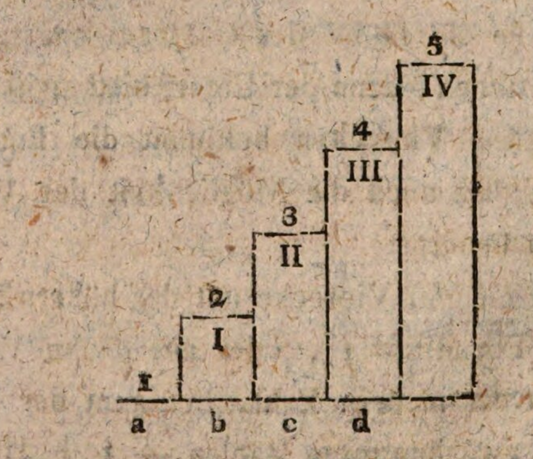
Accordingly, fusiliers, grenadiers, and light infantry can fire from a to 2, but not from a or b to 3; sharpshooters can fire from b, but not from a, to 3. Fusiliers, grenadiers, and light infantry can even fire from 5 to d, and sharpshooters also from 5 to c, in those cases where no other height is situated at d, etc.
Sections 62, 63, and 64 will give more specific guidance on this matter, especially regarding artillery fire.
26.
Further Notes on the Movement of Pieces.
Cavalry may cross the squares on waterways marked 1 (as shallows and fords, §9). Generals may do likewise.
This does not apply, however, with respect to marshes and swamps *), *§9*.
[Note: These are all those waterways which, throughout their entire extent, bear no arrow at all and are instead marked with 1.]* Editor’s note.
All pieces that move more than 1 square may also pass over squares already occupied by pieces — provided they are not enemy pieces.
Movement upward cannot, as a rule, ever proceed from the plain (= 1) to 3, from 2 to 4, or from 3 to 5, nor in reverse downward — unless infantry manages to climb up or clamber down, as shall be covered further on (in §44).
With respect to movement in the mountains as well, heights and squares must be counted according to the rule of §25.
Of the Game Itself.
27.
The Initial Placement of Pieces.
The player who has the lead, or who begins the game (§7), whom I call A, places all his pieces first in whatever arrangement he pleases, subject however to the following restrictions:
First, First, that no piece may be placed closer than the 8th square (without regard to the squares’ numbers) to the dividing line (§6).
Second, that magazines may not be placed more than 20 squares from that same dividing line. How the absence of magazines can lead to desertion among the troops will be covered further on (in §38).
Once A has placed all his pieces, the second player, whom I call B, likewise places all his pieces as he pleases, subject to the same restrictions as A.
Not included among these pieces, however, are palisades and field redoubts, for with respect to these immovable pieces (§19), it is left to the players’ discretion whether to use them immediately or only during the course of play, according to special rules (which are to follow in §78).
28.
The First Movement of the Army.
Once the initial placement of pieces by both sides has been carried out according to regulations (§27), A begins, moving his army as he pleases in accordance with the rules I set out in Sections 16, 17, 18, and 26.
This movement is carried out with as many pieces as the player wishes. Indeed, he also has the freedom to leave his position entirely unchanged. Both players share this twofold freedom throughout the entire game.
29.
The First Strike and Counter-Strike.
If A has, through his movement, given the opponent somewhere an opportunity to strike, then B strikes, observing the rules given in Sections 20 through 25.
Has If B has nothing more to strike, then it is A‘s turn to strike in return according to those same rules.
The loss inflicted on the opponent by striking — from either side — is shown by the dice roll, specifically with regard to each piece of the opponent individually. More on this will be said in §33.
30.
The First Movement of the Opposing Side.
Once A has completed the counter-strike (§29), then B likewise sets his pieces in motion for the first time, as he pleases and with the same freedom that A also had per §28.
31.
How Move, Strike, and Counter-Strike Follow One Another.
If B has, through his move, somewhere given the opposing side A an opportunity to strike, then then A strikes — after B‘s move is fully completed, whereupon B in turn has the counter-strike — in exactly the same manner as prescribed for A in §29.
This order with respect to moving, striking, and counter-striking is observed throughout the entire course of the game. Here is the formula indicating this sequence:
A moves. B strikes. A strikes.
B moves. A strikes. B strikes.
A moves. B strikes. A strikes.
etc.
32.
Tables from Which the Current Strength of the Troops Can Be Seen *.
*[Note: For greater clarity, the schema of such a table appended at the end of this essay may serve as a guide. The table itself could, for convenience, consist of a black slate board, on which the schema, as below, would be permanently pre-marked in white.]* Editor’s note.
In addition to the pieces, each player needs a table in which thecurrent troop losses in wounded, killed, prisoners, and deserters (which, as already mentioned in §29, only dice rolls can determine) is noted for each individual troop piece it affects — so that from the tables one can at any moment see the current actual strength, condition, and other characteristics of each individual troop piece.
This purpose is achieved when the loss determined by the dice roll for each individual blow landed against a striking force, or in the event of some other misfortune, is immediately recorded according to the loss figure and subtracted from the number indicating the previous strength. For this, a single column in the tables is sufficient for each individual troop piece. In general, the dice number is taken 4 times for each single strike.
33.
On Troop Losses and Dice Rolls.
It is by no means necessary, when recording the troop losses determined by the dice, to separate the wounded from the killed, or the latter from the former, in the notation in the tables. One may generally assume that with every blow that strikes a troop piece, always only one quarter is killed, the remaining portion being wounded.
The sum of the loss for each individual troop piece is determined (as already indicated in §29 and §32) by the dice roll, whereby the resulting dice number (2 to 12) is either taken simply or multiplied by 2, 3, 4, etc., depending on circumstances.
34.
The Taking of Prisoners.
The taking of prisoners occurs partly individually by head count, and partly by whole battalions of infantry or divisions of cavalry. The former takes place during the retreat of the army or a corps thereof, when the pursuing force presses very close to the pursued and the latter is at least 3 squares away from the troops of its own side. — The latter occurs when an infantry battalion or cavalry division is taken in the flanks on at least 2 opposing sides by closely stationed enemy striking pieces.
Whether the taking of prisoners actually succeeds is determined in both cases above by the dice roll, whose even numbers 2, 4, 6, 8, 10, and 12 mean Yes; the odd numbers 3, 5, 7, 9, and 11 mean No.
If opposing striking pieces were to come into such a position that friend and foe, A and B, found themselves mutually flanked by one another, for example thus:
A. B. A. B.
then no taking of prisoners can take place on either side.
35.
The Yes and No of the Dice.
That same Yes and No of which I spoke in the preceding section applies in all cases where a question is decided by the dice roll.
36.
How to Determine the Number of Individually Taken Prisoners.
If, in the case of the individual taking of prisoners (which, per §34, takes place during a retreat), the dice roll says Yes, then a further roll is made, the resulting number is taken 4 times, and it is recorded and subtracted in the table (§32) for the piece in question, accompanied by the notation of the 3 letters pris.
37.
If the Troops Do Not Wish to Surrender — What Then Happens.
If the taking of prisoners does not occur because the dice roll says No;
then then, as usual, both sides strike; namely, the challenged party strikes first, and the challenger after him.
This mutual striking applies both to the individual and to the total taking of prisoners.
38.
Desertion Due to Distance from Magazines.
Desertion applies to all troop pieces that are more than 16 squares away from a magazine. However, the dice roll also decides this first with Yes or No for each individual battalion, as well as for each individual cavalry division: whether desertion actually occurs, or not. The second dice roll, with the number taken 4 times, shows how severe the desertion is.
39.
When Desertion Also Occurs.
Desertion also occurs in the case of a disorderly retreat. Whether the retreat is in fact truly disorderly is likewise decided by the dice, but only in the following two cases:
a) When the retreating side has no general remaining; in this case the desertion is general, i.e., it affects all retreating troops.
b) When the retreating troop piece is genuinely exposed to enemy fire from two or more sides.
40.
When Artillery or Infantry Fire Reaches a General.
Whether artillery kills a general is decided solely by the dice roll 12. A dice roll of 2 indicates that he is wounded. If any other number falls (3 to 11), then the artillery fire has not hit him.
If infantry can reach him with its fire, then the dice roll likewise decides: whether he is killed or wounded.
Der The even dice roll 2, 4, 6, 8, 10 and 12 means dead; the odd 3, 5, 7, 9 and 11 means wounded.
In both of the above cases he must be removed from the game board, with only one difference: the wounded man may be placed back on the board as he pleases after 6 moves (namely 3 moves per side). The dead man is only brought back to the board after 10 moves (namely 5 moves per side), and in that case likewise placed as desired.
41.
When Generals Are Taken Prisoner.
The taking of a general prisoner is only possible:
a) When he falls between two striking enemy pieces standing very close to him in an opposing position. If the dice roll says Yes, he is captured; if it says No, a new dice roll determines whether he is killed or wounded.
[Translator’s note: Scan-S. 92 continues §41a: “…whether he is killed or wounded. Yes means dead, No means wounded.”]
Yes means dead. No means wounded. In the latter case he is nonetheless taken prisoner.
b) Also when only one striking enemy piece comes close to him, he is captured according to the dice roll Yes, or killed according to the dice roll No.
In both of the above cases the captured general is removed from the game board and noted for ransom; however (notwithstanding that he remains noted for ransom), he is brought back to the board after 10 moves of play and placed as desired, just like the dead (§40).
42.
Firing on Forests, Villages, and Open Towns.
The fire of artillery and infantry is only effective against forests or thickets, villages, and open towns when the dice roll falls affirmatively. On the other hand, infantry or artillery standing in a forest or thicket, in a village, or in an open town (as already stated in §23) always has double shots.
43.
When Cavalry Can Strike in Forests, Villages, Towns, and in Water.
Cavalry standing both in front of and inside a forest, both in front of and inside a village, both in front of and inside a town, etc., can indeed, per §22, strike neither inward nor outward. But if it encounters enemy cavalry or infantry in a forest or thicket, or in a village consisting of more than one square, or in a town, then both sides strike — however, so that infantry strikes more effectively than cavalry. This is achieved by multiplying the dice roll number by only 2 for cavalry blows against infantry, but by 4 for infantry fire against cavalry.
Cavalry against cavalry in water outside of pontoon bridges (consequently on the squares marked 1), or in forests, thickets, and in villages and towns consisting of more than one square, strikes one another just as on the open plain.
44.
Climbing Steep Mountains.
Whether infantry can climb steep mountains — that is, from the plain == 1 to 3, or down from 3 to the plain == 1; from 2 to 4, or down from 4 to 2; from 3 to 5, or down from 5 to 3 — is decided by the dice roll when it falls affirmatively.
To climb from the plain == 1 to 4, or from 2 to 5, and in reverse downward, the dice roll Yes must occur twice in succession.
For the climb from 1 to 5, or in reverse from 5 to 1, a Yes of the dice roll falling three times in succession is required.
45.
Reinforcing Weakened Armies.
Weakened battalions and cavalry divisions are reinforced by recovered men (convalescents), by recruits, and by ransomed prisoners.
This can, however, never occur during the course of the same game, but only before the opening of a new game. The dice rolls are likewise used for this purpose, specifically with respect to each individual infantry battalion and each individual cavalry division separately. The rules to be observed in this regard shall now follow.
46.
Convalescents.
First, with respect to the recovered men or convalescents, the dice roll shows what fraction of the wounded have died. For example, if the number of wounded of a troop piece were 365, and the dice roll were 7, then the 7th part of 365 must be assumed to have died, namely 52. Fractions are disregarded. Accordingly, the number of recovered men would be 313, which number is credited to the remaining strength of the battalion or division (§32).
How the number of wounded is to be found is easy to grasp from what was already taught in §33.
47.
Recruits.
Second, with respect to recruits, two dice rolls must be made depending on circumstances — of which the first decides: whether the entire loss of troops of this or that battalion, or this or that division, killed in the field and died in hospital, is to be replaced by fresh troops, or whether this replacement is only to be partial.
In the first case no second roll is needed; the entire loss of dead of the relevant troop piece is replaced by recruits.
In the second case, the second dice roll must show what fraction of the dead are to be replaced by recruits. For example, if the loss of fusiliers of Battalion No. 1 killed in the field were 1,095 men, and 52 men had died in hospital, then the total of dead would be 1,147 men. If the second dice roll now showed 8, then the eighth part of 1,147 men must be credited to the battalion as reinforcement in recruits, namely 143 men — for here too fractions are disregarded.
How the number of those killed in the field is to be found was taught in §33. Deserters are likewise counted as dead.
48.
The Ransoming of Prisoners.
Third. With respect to the ransoming of prisoners, it depends solely on the voluntary agreement of the players whether it shall take place stattThe following guideline must, however, be observed:
a) Infantryman against infantryman, man for man. —
b) Cavalryman against cavalryman, or 2 infantrymen. —
c) General against general, or 1,200 infantrymen, or 600 cavalrymen. —
d) General-in-chief against general-in-chief, or 2 sub-generals, or also against 2,400 infantrymen, or 1,200 cavalrymen. —
For example, the total sum of prisoners of player A who have fallen into the hands of player B would be:
General . . 1.
Cavalrymen . . 959.
Infantrymen . . 1,328.
Those of player B who have fallen into the hands of A would be:
Cavalrymen . . 1,007.
Infantrymen . . 927.
In this case B returns to A the general. In return B receives from A 600 cavalrymen.
[Translator’s note: Scan-S. 99 continues the ransoming example from §48.]
Accordingly A retains 407 more cavalrymen of B; for 1,007 − 600 = 407. Deducting these 407 cavalrymen of B from the 959 cavalrymen of A that B holds, B retains 552 cavalrymen of A; for 959 − 407 = 552. To return these 552 cavalrymen of B to A, B must receive back from A the remaining 407 cavalrymen, and then 290 infantrymen. Accordingly A retains only 637 infantrymen of B; for 927 − 290 = 637. These 637 infantrymen of B exchanged against an equal number of infantrymen of A, B retains 691 infantrymen of A; for 1,328 − 637 = 691.
A can credit those 637 infantrymen and 959 cavalrymen to his battalions and divisions as he pleases. B can do likewise with his 927 infantrymen and 1,007 cavalrymen.
49.
The Capture of Artillery.
With respect to artillery, the capture thereof takes place in the following cases:
a) Kömmt a) If the artillery comes into such a position that it can no longer save itself — that is, has no free move remaining — it falls into the hands of the opponent and is used by him.
b) If it is surrounded on two opposing sides by enemy troops, or enclosed on three sides by artillery and troops, then the dice decide whether it is taken or not. In the latter case it fires.
In a new game, the cannon pieces that have fallen into the hands of the opponent, like every artillery piece, are fully restored and placed as desired *).
*) *[Note: Everything stated in §§45 to 48 regarding the reinforcement of armies, convalescents, recruits, ransoming of prisoners, and likewise in §49 at the end regarding the exchange of artillery, can by agreement of the players also quite reasonably be carried out during the course of the game itself — it is not required to be done only at the conclusion of each game.]*
50.
The Capture or Destruction of Magazines.
Magazines are either captured or destroyed. The former (the capture) occurs: when a magazine is either surrounded on two opposing sides by enemy troops while away from the player’s own striking forces, or when enemy troops approach it on even one side while it is at a distance from the player’s own striking forces. It must be noted in this regard, however, that in the former case (namely the first) the dice roll must also decide: whether the capture is actually feasible. — If the dice roll falls affirmatively, then the enemy forces retain the magazine. If it falls negatively, then, when the magazine is situated near one’s own forces, a further roll must be made: whether it is destroyed or not. — If the maga[Note: To want to restrict this would mean wanting to prolong the game itself to infinity.] Editor’s note.
zine is situated far from its own forces, then it is destroyed following the negative dice roll. —
A magazine can be burned when it is reached by artillery fire. Whether it is actually burned is decided by the dice roll 12 or 2.
Both the destroyed magazine and the one burned by artillery fire are (as goes without saying) removed from the game board. In a new game each side receives its 3 magazines back.
51.
The Capture of Pontons.
Whoever occupies enemy pontons, pontoon bridges, or boats with a troop piece retains them for their own use. In a new game they return to the hands of the one who lost them. The same applies, as was already stated in §49, to artillery, and per §50 to magazines.
Da Since several pontoon bridges or pontons stacked on top of one another on a land square (on water this may not happen) can have other pieces placed on them as well, it is also possible for several stacked pontons to be occupied at once by a single enemy troop piece, and thus to fall into enemy hands through this act of occupation. And since pontons (as just stated) can also be occupied by other pieces, they also fall into enemy hands when the piece situated upon them falls into those hands.
52.
Rule for Moving and Striking.
When a player, following the counter-strike of his opponent, gives his pieces a new position (§31), each piece may make only one move.
To prevent violation of this rule amid the large number of pieces without any dispute, this move must not be made arbitrarily now in one area then in another, but must proceed such that — beginning either from the right or from the left hand — it is carried out according to the rows of squares running straight toward the opposing side (consequently neither according to horizontal nor according to diagonal rows). This same rule is also to be observed when striking.
Each side is free to set in motion as many pieces as it pleases.
53.
How a Game Is Suspended or Concluded.
A game is only suspended when one is either forced by some circumstance to break off the game — or when this breaking off happens by mutual free agreement; — in both these cases everything remains unchanged until the next game. —
Das The game is also suspended when both players agree on a retreat. In this case each side makes two moves with its pieces that are in a striking or strikable position, backward or also sideways in such a manner that it can neither be struck nor can strike. It goes without saying that if some pieces stand in the way of this retreat, these too must change their position as much as necessary.
If only one side wishes to withdraw, then this may not happen before it is that side’s turn (per §31) and when the dice roll falls affirmatively. This withdrawal happens as in the previous case, but by no means with two, but rather with four moves.
A game is fully concluded only:
a) when both sides are satisfied, or
b) when one side is almost entirely annihilated. That each game can usually last several weeks before the latter case occurs is easy to grasp in itself.
54.
On the Edge of the Game Board.
If a piece finds itself at the edge of the game board, it is to be regarded as though it stood before a completely insurmountable mountain.
On Fortresses and Citadels.
55.
Essential Characteristics Thereof.
With respect to fortresses and those citadels situated outside of fortresses, it is to be noted that they have their own artillery, their own ammunition and provisions, as well as their own garrison troops.
The presence of ammunition and provisions in fortresses is indicated by designating the squares devoted to them with M and P.
Für For the artillery in fortresses and citadels (which are already immutably fixed on the game board, per §§4 and 5), the batteries are indicated by notches in the black borders as follows:
[Figure: Two L-shaped battery symbols showing notches/embrasures in fortress walls]
From as many sides as there are notches on a battery, one may fire with cannon — always twice — at a range of 7 squares.
56.
The Destruction of Ammunition and Provisions in Fortresses.
Concerning the ammunition and provisions in fortresses (for citadels the instructions follow in §59), these are destroyed only by bomb fire (from mortars). When this destruction is to occur, however, the dice roll 12 must fall for ammunition, and the dice roll 2 for provisions.
If the ammunition is destroyed, then the batteries of the fortress fall silent; the fortress is summoned, and the dice roll Yes decides its surrender.
If the food stores (provisions) are destroyed, then the desertion and mortality rules come into effect, which are to be given in §§81, 82, and 83. The summons also now takes place (but only on the besieger’s next move). Only when the dice roll falls affirmatively twice does the fortress surrender.
57.
On Storming.
Fortresses and citadels or castles are also stormed. In this case the storming infantry makes a move of 4 squares.
draten. Ob Whether the storm succeeds is decided by the dice roll 12.
How great the losses are on both the storming side and the besieged side is decided by dice rolls according to the known rules. It must be remembered only that on the besieged side the dice number is taken simply, indicating their losses; whereas for the losses of the storming side, the dice number is multiplied by 4 per the general rule (§32). —
If the storm succeeds, then the fortress falls into the hands of the besiegers. If it does not succeed, then the stormers have, just as in an attack, the advantage of being able to withdraw to the fourth square.
Even when the storm succeeds, the mutual losses are determined by dice rolls as already stated above — namely, on the side of the stormers the dice roll number is multiplied by 4, but on the side of the defeated it is taken only once.
58.
On Sorties.
That sorties from fortresses and citadels simultaneously occupied by field troops can also be made by these troops goes without saying. The general game rules are observed both with respect to movement and to striking.
59.
The Destruction of Ammunition and Provisions in Citadels.
With respect to castles or citadels (since these too must be furnished with ammunition and provisions or food stores), both with bomb and cannon fire (horse artillery is applicable neither here nor against fortresses), the dice roll 12 decides the destruction of the ammunition store; the dice roll 2 decides that of the provision store.
After the destruction of one or the other, if the castle is occupied by no field troops, the dice roll Yes decides whether the castle or citadel passes to the besiegers. If the castle is occupied by field troops, then after the destruction of the food stores those same rules are observed that apply to larger fortresses (§56), specifically those regarding mortality and desertion, which will follow further below (in §§81, 82, and 83).
Here is the image of a castle equipped with batteries on all four sides.
[Figure: Square castle with notches on all four sides; labelled “Red.” on the interior]
Further Highly Essential Rules of Various Kinds.
60.
On Mobile Artillery.
With respect to mobile artillery — that is, the kind that is not integral to the batteries of fortresses and citadels — the following additional rules are to be observed:
a) This artillery only takes effect in the vicinity of one’s own troops.
b) When artillery plays against artillery — either from fortresses and citadels or outside them — the possibility of dismounting arises. This is effected by the dice roll 12, but only on one cannon or one mortar at a time. Since there are now batteries of 4 and 2 cannon, and also of 2 mortars (§1), it is advisable to also have batteries of 3, 2, and 1 cannon, plus individual mortars in reserve for exchange.
c) Die c) Mobile artillery cannot be used from any square of a fortress or citadel that is already occupied by one’s own immovable artillery.
The dismounting of the artillery integral to fortresses (§55) has no effect, since it is assumed that this artillery can easily be replaced.
61.
When One Side Has No General Left.
If one side has no general left, then the opposing party strikes doubly throughout, and in the vicinity of its own general even three times. — Then too (as was already stated in §39) the possibility of disorderly retreat arises. Whether it actually occurs is decided by the dice roll Yes.
During this disorderly retreat, both a) the individual and the total — that is, battalion- or division-wise — taking of prisoners at infantry and cavalry lerie, and then b) the capture of artillery are also possible.
Individual taking of prisoners is in that case also possible when only one striking piece approaches the striking retreating forces and the latter is 3 squares away from the troops of its own side (§34). Whereas total taking of prisoners is, per the rule (§34), only possible when the troop piece falls between two striking pieces of the opposing party.
The same applies also during a disorderly retreat with regard to the capture of artillery. —
In these cases too the dice roll Yes is required.
62.
Artillery Fire toward Steep Mountains.
Further rules to be observed with respect to the effect of artillery toward steep mountains (§25) are as follows.
a) Ein a) A mortar at the foot of a height == 4 or 5 cannot fire on it. It cannot reach any height == 3 even at a range of 3 squares. On a height == 2 it acts just as on the plain — that is, even at a range of 5 squares (§20). On the other hand it fires down from any height, even to a range of 5 squares.
b) Other artillery, when it stands directly beneath a steep mountain == 3, or == 4, or even == 5, can neither fire upon it nor, even less, over it. If it stands directly before a height == 2, its fire can only reach that height — by no means the equally high squares behind it, and even less the lower squares.
c) If the cannon stand 2 squares in front of a height == 2, or == 3, or == 4, or == 5, their fire can only reach heights 4, 3, 2 — but by no means the height == 5.
d) Sted) If the cannon stand 3 squares in front of a height == 2, or == 3, or == 4, or == 5, their fire likewise only reaches up to height == 4.
e) At a range of 4 squares, the fire of cannon reaches heights 2, 3, 4.
f) At a range of 5 squares, the fire of cannon reaches only heights 2, 3.
g) At a range of 6 squares, the fire of cannon reaches only height 2.
h) At a range of 7 squares, the fire of cannon cannot reach any height at all.
i) Regarding horse artillery, whose fire only acts at a range of at most 6 squares in a straight non-diagonal line (§20): its fire reaches no height at a range of 6 squares; at a range of 5 squares only die
[WargamingScribe: The scan did not capture the figure [a page is folded in front of it, BUT the backpage shows it reversed by transparency]
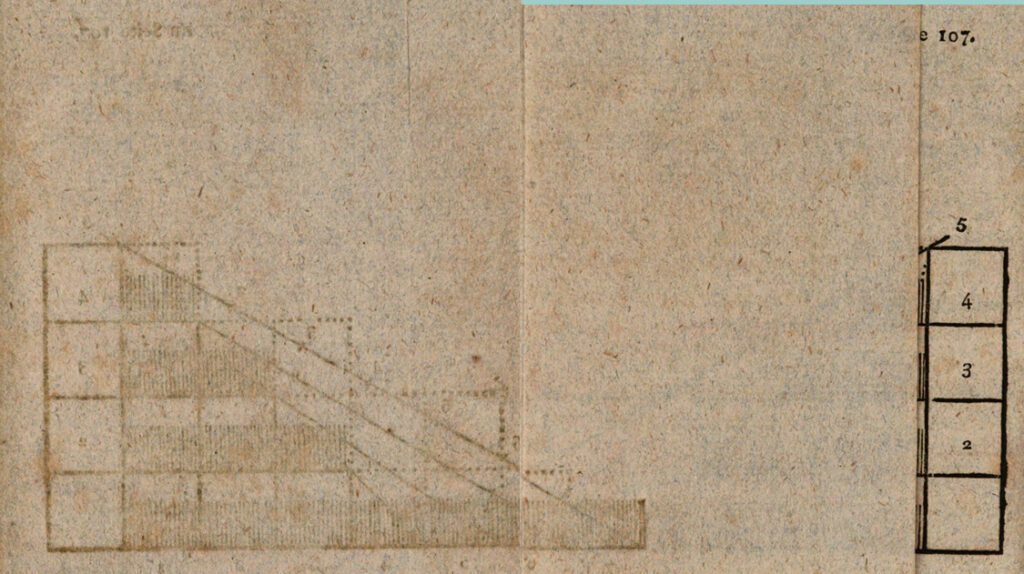
height 2; — at a range of 4 squares, heights 2 and 3; — at a range of 3 squares, heights 2, 3 and 4; — at a range of 2 squares, only heights 2 and 3; — directly before a height, only height 2.
63.
Artillery Fire Down from Heights.
With respect to artillery fire from heights downward, the following rules, based on the reference figure shown here (see adjacent illustration), are to be observed.
a) Mortars fire from heights just as on the plain.
b) Other artillery can fire down from heights 5 and 4 onto the plain only to ranges of 6 and 5; — from heights 3 and 2, to 7 and 6 — in a straight non-diagonal line. In both cases the lesser number applies to horse artillery.
c) In c) In the diagonal direction, artillery fire (per §20) reaches one square less far. —
d) If, in front of the heights on which the artillery stands, an equal height (which I have indicated here by dots) is situated, then fire is impossible (except from mortars) — consequently not from 5 over 5, not from 4 over 4, etc. Also not when the third square before 5 == 4; also not when the fifth square before 5 == 3; etc.
64.
Mountain Norm.
So as not to multiply further the already very numerous game rules — which would have to happen if I wished to give special rules here for every possible mountain configuration — I believe I need only advise the players of the following.
a) If the mountains of their game board are represented by precisely regular (solid) cubes represented in this way, then the possible effect of cannon fire in the mountains can very easily be researched simply by applying a measuring stick on which the distances are marked according to the width of the squares.
b) But if the mountains of the game board are not represented by precisely cubic elevations, then such a measuring stick is not applicable; instead one makes use of a special moveable Mountain Norm.
This Mountain Norm can be made as follows from card stock or thin sheet metal:
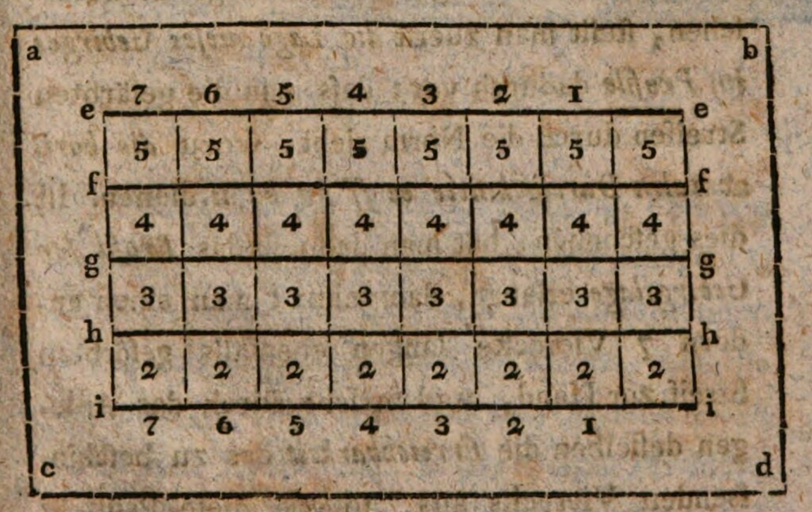
a b c d is the overall size of the Mountain Norm.
ee ff gg hh ii are horizontal cross-sections through it.
1 to 7 are the distances from the height from which fire is directed.
5 4 3 2 are the height numbers.
Belonging to this norm are also 8 long strips of colored, similarly heavy paper or sheet metal. These strips need only be as wide as each of the squares in the norm, and 6 such squares long.
To investigate the possible effect of cannon fire in a given mountain range, one first represents the position of this mountain range in profile by drawing the colored strips through the norm, using the horizontal cross-sections ee ff gg hh ii for this purpose. Once this is done, having thus obtained the profile of the mountain configuration, one takes a further colored strip 7 squares long and, by applying it, investigates the reachability of the square to be fired upon — just as this test can also already be understood from the reference figure established in the previous (§63) section. The following profile illustration may serve as an example.
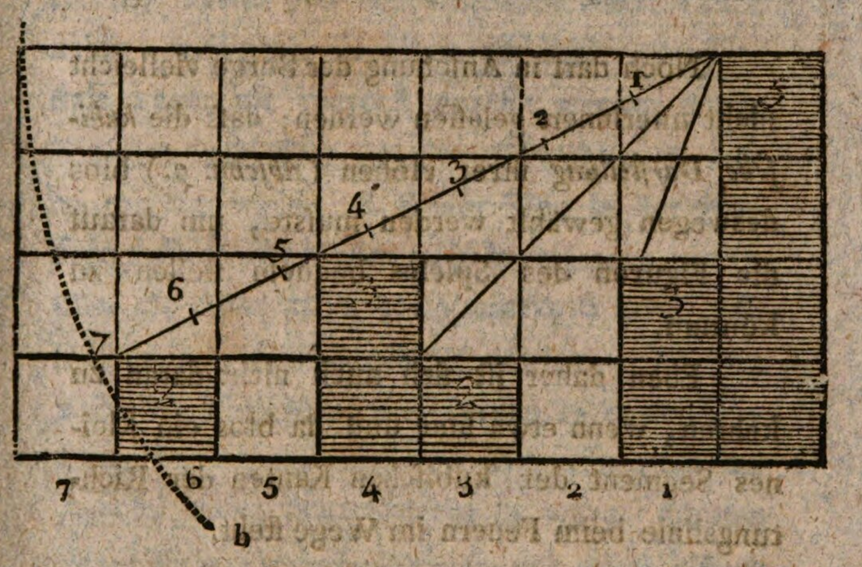
One sees from this illustration that from height == 5 one can fire only at distances 1, 3, 4, 6 — but not also at distances 2, 5 and 7. Not at the latter (7) for the additional reason that this distance, measured in the diagonal direction, amounts to more than 7 squares, which ches is demonstrated in the preceding figure by the dotted arc a b.
65.
The Cubic Representation of Mountains.
One further thing perhaps ought not to be left unmentioned with regard to mountains: that the cubic representation of their heights (§9) had to be chosen simply in order to conveniently place the game pieces on them.
For this same reason one should also not be troubled if here and there only a small segment of the cubic edges stands in the line of fire.
66.
Movement in the Mountains.
Up the mountains and down from the mountains, not only cannon but all pieces in general move at a slower pace (§26) — solely mortars excepted, nommen, which cannot move slower than 1; therefore for mortars the side squares of the mountain cubes are not counted.
The slower movement of pieces up the mountains and down from them arises because the height of the cubic form must also be counted as a square — as was already mentioned in §§25 and 26. For example, the path in the profile illustration of §64 from 5 over the height == 2 of square 6 to 7 would require 4 squares to be counted, since here 2 heights (for up and down) are to be counted. Likewise, if there the path from 2 to the height == 3 of square 4 were to be taken, 4 squares would likewise have to be counted (on account of the two heights going up).
Since no piece can stand on the side or the perpendicular face of a cube or block, if the movement number (§16) reaches only as far as this side face (the height square), the full move may not be made. For example, sharpshooters, light infantry, cuirassiers, etc. move up to 3.
In In the two cases assumed above, they could therefore reach from 5 and 2 only the heights == 2 of the 6th and 3rd squares.
67.
Garrison Troops.
With respect to castles and fortresses, it is assumed that each castle with batteries on four sides has its own garrison of 600 men — that is, 150 men per such side. The same applies to fortresses. Accordingly, a fortress with 12 square sides equipped with batteries has a garrison of 1,800 men; one with 24 such square sides, 3,600 men as garrison; etc.
68.
Generals Do Not Strike.
Since generals do not themselves strike, this also holds even if they should come into contact with one another — especially since each square of the game board represents a space of several thousand square fathoms. Assuming that each side of such a square is only 90 fathoms long, its surface area already equals 8,100 square fathoms.
69.
Use of Artillery in Sieges.
During sieges the besieger may employ not only mortars but also the remaining field artillery (horse artillery only excepted, §59) for bombarding fortresses and castles or citadels — but only at a range of 5 squares, regardless of whether it occurs in a straight or diagonal direction.
Likewise, from every work of a fortress, as well as from every citadel, from the side equipped with batteries, mortar rounds (instead of cannon shots) may be fired — but in this case only to a range of 5 squares, ecken, I likewise without distinction between diagonal or straight direction.
70.
The Shooting Down of Boats.
The pontons, pontoon bridges, or boats situated on the water can be shot down — either from mortars by mortar rounds, or, insofar as they can be reached, also by any other artillery, when the latter is situated either on the shore or on a height.
In each of these cases, however, the dice roll Yes must decide: whether the shooting down has actually succeeded.
The shot-down pontons are removed from the game board.
If troops were on board, the dice roll decides what fraction of them saved themselves by swimming. For example, if the strength of the troops were still 786 men and the dice number were 7, then only 112 men would have saved themselves by swimming.
Wäre If there had been artillery or a magazine on the ponton, then both go lost along with it. On the other hand, with respect to a general a new dice roll Yes decides whether he saved himself by swimming. Those saved by swimming are placed on the nearest occupiable square.
If the shooting down does not succeed, then with respect to the troops on the pontons the dice number is calculated for their losses according to the general rules — or, if a general is on board, one proceeds according to the rule of §40.
71.
When Troop Pieces Can No Longer Strike Due to Weakness.
When of a battalion or cavalry division only the 20th part of the troops remains, then this small remnant is no longer capable of holding out on the battlefield. The piece schlägt strikes no more, and can be removed from the game board by the player to whom it belongs, when it is that player’s turn.
This 20th part amounts to:
for Fusiliers (at 1,200 men) . 60 men.
for Grenadiers (at 1,000 men) . 50 –
for cavalry divisions (at 900 men) . 45 –
for battalions of sharpshooters
and light infantry (at 800 men) . 40 –
72.
What Happens to Captured Troop Pieces and Captured Artillery.
With respect to the taking of entire battalions and cavalry divisions prisoner (§§34 and 61), as well as the capture of artillery (§§49 and 61), it must further be noted that the troop piece that has fallen into captivity is not only removed from the game board, but its troops are also recorded as prisoners in the table (§32) according to their actual strength, and noted merkt as such. The captured artillery, on the other hand, remains with the opponent, to be used as their own ordnance — however not already on the same move, but only on future moves.
73.
What Happens to Surrounded Pieces?
If troops, artillery, a general, or a magazine come into such a position that no move remains free to them and they can consequently no longer save themselves, then two striking pieces (troops or artillery) — regardless of what position they are in — or even a single such piece can carry out the capture or seizure. Several pieces can also fall into enemy hands simultaneously if they are surrounded such that no free move remains to them — that is, they can no longer save themselves from that situation by any move. However, even in this situation the dice roll felwurf Yes decides whether they surrender. If it falls negatively, they strike.
74.
Artillery Too Far from Its Own Troops.
Artillery that is 3 squares away from one’s own striking forces can also be taken by an approaching enemy troop piece.
75.
On Mortar Rounds toward Forests, Villages, or Open Places.
Against pieces in forests, villages, or open places (§42), mortar rounds (from mortars) require no dice decision as to whether the fire takes effect.
76.
Effect of Fire against Troops in Forests, Villages, and Open Places.
Against troops in forests, villages, or other open places, fire from the outside is minder less effective. Therefore the dice roll number is not multiplied (as per the general rule) by 4, but only by 2 to determine the loss.
77.
Effect of Fire against Troops behind Field Redoubts.
Against troops behind field redoubts, the dice roll number is multiplied by 3 to determine the loss — except from mortars and from a height, where per the general rule this loss number is multiplied by 4.
78.
On the Use of Palisades and Field Redoubts.
With respect to palisades and field redoubts, these can be placed either immediately with the initial placement as desired — but no closer than troops, artillery, etc. to the dividing line (§27) — or also occupied during the course of play.
In the latter case, however, no more than 2 field redoubts or palisades may be placed at once, and only on those squares that have already been occupied by troops or artillery since the previous move and remain occupied on the new move, and are at least 4 squares away from enemy striking pieces or their castles and fortress works. This would be different if one’s own striking piece were standing in front — in that case this distance of 4 squares is not required.
Likewise, field redoubts and palisades can also be razed again during the course of play — but likewise no more than two pieces per move, and only those that were actually still occupied by troops or artillery from the previous move.
79.
Losses of Garrison Troops Caused by Artillery Fire.
With respect to garrisons or garrison troops in castles and fortresses (§67), when these are not occupied by field troops, the artillery shots reaching them are likewise wounding and killing. For this loss, the dice roll number is taken simply.
It will perhaps not be superfluous to note that columns must also be designated in the tables (§32) for garrison troops as well, in which their various losses (as is done for field troops) are to be recorded and deducted.
80.
When Castles and Fortress Works Are Occupied by Field Troops.
If the castles or the bombarded works of a fortress are occupied by field troops, dann then each artillery shot (apart from the significance of dice rolls 12 and 2 for castles, §59) affects not the garrison but the field troops.
For the loss here too the dice roll number is taken simply.
What was stated in this and the preceding section applies also to stormings, which I dealt with in §57.
81.
Mortality in Castles and Fortresses.
With respect to mortality in castles and fortresses when the food stores or provisions are destroyed: at every subsequent move (as long as the castle or fortress has not passed into enemy hands), the severity of mortality among the garrison troops is determined by a dice roll for each entrenched square — specifically so that each dice number is multiplied by the number of sides equipped with batteries.
wird. Hat Has the mortality in a castle or fortress raged so severely — or has it also come about through some other loss — that only the 10th part of the garrison troops (i.e., 15 men per battery-equipped side) remains, then the fortress or castle surrenders — except when the dice roll falls negatively three times in succession.
Castles and fortresses that have passed into enemy hands are regarded as fully re-garrisoned with garrison troops and re-stocked with provisions and ammunition only from the next move onward.
82.
Desertion of Garrison Troops from Castles and Fortresses.
Since after the destruction of food stores in castles and fortresses desertion from them is also possible (§56), the first dice roll Yes decides whether it takes place; — and the second: how severe sie it is. — For the garrison troops the dice are rolled as many times as there are battery-equipped squares. The dice number is taken only once for desertion.
83.
Desertion and Mortality of Field Troops in Castles and Fortresses.
If field troops are also present in a castle or fortress, then after the destruction of the food stores (as long as the castle or fortress does not surrender), not only with respect to garrison troops but also with respect to field troops, dice are rolled for both desertion and mortality — separately for each battalion and each cavalry division; first, whether desertion occurs, and second, whether mortality occurs; finally, after affirmative rolls, how severe each one is. The dice number is taken once for desertion, but twice for mortality.
84.
From What Height Mortars Can Fire.
Mortars can fire only over a height == 3, never over a higher one.
This rule applies to mortar rounds from the plain == 1. It therefore also goes without saying that if a mortar stands on a height == 2, it can fire over a height == 4; and if it stands on a height == 3, it can also fire over a height == 5.
It must also be noted here that one cannot fire over more than one square == 3, etc.
85.
Sunken Roads, Defiles, Ravines, and the Like.
Sunken roads, defiles, ravines, or other hollows and depressions of the terrains, rain, which per §5 are indicated by a brown colour on the game board, afford the troops and other pieces protection in so far as they can only be fired upon from the edge of the depression, or from mountains, or from mortars. Likewise, however, fire from these depressions can only be directed toward the edge, or toward the mountains, or from mortars.
86.
Firing To and From Water.
Pieces standing on or in water can likewise only be fired upon from the shore, from mountains, and from mortars. They likewise fire in return.
87.
When Generals Have No Effect on Their Troops.
Generals who are separated from their troops either by a river or by a row between lying forests or steep mountains do not produce the stronger doubled striking and firing of their troops and batteries (§21.).
Should, however, the striking pieces stand on one side, but their general on the other bank of a river no more than 2 squares wide, — or those pieces directly in front of a forest no more than one square wide, and the general directly behind this forest (on whatever square), — then his presence takes effect as usual, but reduced by 2 squares in range; the general-in-chief thus only up to a range of 5, a sub-general only up to a range of 3 squares.
[Abb.: small vignette illustration]
88.
Weakened Troop Pieces Strike Less.
Troop pieces that have already lost half their strength are less effective.
For this very same reason, the shots of the infantry have only half the effect even at close range compared to their full strength. The same applies to cavalry.
In order to make troop pieces already weakened by half easily recognizable, one uses a so-called Kragen (collar), which is slipped over the flag or standard of the relevant piece. This collar consists of an oblong rectangular piece of stiff paper, on one side e.g. red, on the other white, slit in the middle, as in the following pattern:
[Abb.: oblong rectangular paper band with slit in the middle]
The red side serves to mark the troop pieces of the white party, just as the white side belongs to the red party.
89.
Further Remarks on Infantry Fire.
Infantry affects troops standing at a distance greater than one square only such that the dice number is taken 3 times for the loss.
Against troops or generals in forests, villages or towns, or in field entrenchments, infantry fire takes effect only when it is standing very close; also with regard to forests, villages, or other open places, the dice roll decides the effectiveness of the firing (§42.) — In this case, the dice number for forests, villages and other open places is multiplied only by 2 (§76.). — For field redoubts, on the other hand, as is already known from §77, the dice number is multiplied by 3. —
90.
Further Remarks on Artillery Fire.
Artillery fire is only at a range of exactly 4 squares so strong that the dice number (according to the general rule) is taken 4 times. Otherwise, this, or as the case may be, any other dice number to be multiplied by a lesser factor, is taken only at half.
Postscript.
Czaslau, July 1803.
I flatter myself that in the foregoing 90 sections I have sufficiently defined and explained everything that it is necessary to know with regard to my tactical board game. During play itself, the person who grasps the essential nature of this game, and possesses a spirit even slightly inventive, will be able to supply, quite easily, by analogy, whatever may still be lacking therein and would be worth establishing, so as to serve as a new rule for future games. — A practical tactician will be especially able to do this in such a case; he will provide this game — undoubtedly worthy of protection from tacticians — with all the appropriate arrangements of which it is capable. —
Based on the entirely original idea carried out in this tactical board game described here, a plan together with rules for a naval war game could also well be devised. — For this purpose, the sea would need to be represented on the game board with islands, shallows, sandbars, cliffs, surf, currents, coasts, straits, seaports, bays, etc. Here too, dice rolls would need to be employed in various ways, in particular with regard to winds, storms, the effect of artillery, etc.
Inventis facile est addere. — [It is easy to add to what has already been invented.]
Index
of the most important subjects of the Description of the Game, with references to its sections.
A.
Army [Armee]: when and how the reinforcement of a weakened army can take place. §45. See also Pieces [Figuren].
Artillery, mobile [Artillerie, bewegliche] (not that belonging to fortresses and citadels): acts only in the vicinity of one’s own troops. §60. — Its fire acts more strongly at close range than at distance. §90. — How and at what distances it acts toward steep mountains. §62. §64. — Which type and at what distance it may be used against fortresses and citadels. §69. — How it acts firing down from mountains. §63. §64. — How it is dismounted. §60. — Cannot be used in any fortress or citadel from a square already equipped with its own artillery. §60. — When it can be captured, and what happens to the captured piece. §49. §61. — Artillery too far removed from one’s own troops can also be captured by a single troop piece. §74. — That which has fallen into enemy hands can only be used by him for striking at the following move. §72. — A supply of various types for replacement should be kept on hand. §60.
Artillery, horse [Artillerie, reitende]: cannot be used in sieges. §59. §69. — At what distances it acts toward steep mountains. §63.
Artillery, fixed [Artillerie, unbeweglische], namely that proper to fortresses and citadels: how it is to be used. §55. §69.
Sorties [Ausfälle]: how they are made from fortresses and citadels. §58.
B.
Siege [Belagerung]: how the besieger may employ artillery therein. §69.
Mountains [Berge]: how they are to be represented on the game board, and why in cubic forms. §9. §65. — Firing from, toward, and on them. §25. §62. §63. §64. — Movement to, on, and from them. §26. §66. — When infantry may climb steep mountains. §44.
Mountain norm [Bergnorm]. §64. §65.
Garrison troops [Besatzungstruppen]: how many and according to what norm they are to be assumed in fortresses and citadels. §67. — How their losses are to be calculated. §79. §81. §82. §83.
Wounded and dead [Blessirte und Todte]: in what ratio against each other they are to be calculated upon the loss of troops. §33.
D.
Dismounting of artillery [Demontirung der Artillerie]: how it takes place. §60.
Deserters [Deserteurs]: to be counted as dead. §47.
Desertion [Desertion]: due to distance from magazines. §38. — Upon disorderly retreat. §39. — From fortresses and citadels. §56. §82. §83.
Villages [Dörfer]: whether firing toward them takes effect is decided by the dice. §42. — Mortar fire toward them always takes effect. §75. — Against troops in them, firing from outside is less effective than usual. §76. — When and how strongly infantry fire takes effect against them. §89. — Firing from them always happens with doubled effect. §23. §42. — How striking takes place in them. §43. — Cavalry does not strike to or from them. §22. §43.
E.
Invention of this game [Erfindung dieses Spieles]: when, where, and by whom it took place. §1.
F.
Field redoubts [Feldschanzen]: are immovable. §19. — Placing them. §27. §78. — How strongly the fire of artillery and infantry acts against them. §77. — When infantry may fire from them. §89. — Cavalry cannot strike over them. §22. — Fire from them is always doubled. §23.
Fortresses [Festungen]. §55. — How artillery may be used from them. §69. — Which artillery, and at what distance, may be used against them. §69. — How sorties from them take place. §58. — How they are stormed. §57. — How munitions and provisions are destroyed within them, and what follows after the destruction of one or the other. §56. — Desertion from them. §56. §81. §83. — When mortality occurs therein, and how it is calculated. §56. §81. §83. — How losses are to be calculated when field troops are within. §80. §81. — How the losses of garrison troops are to be calculated when no field troops are within. §79. — When they capitulate on account of a weakened garrison. §81.
Game pieces [Figuren des Spieles]: their number. §15. — General description of their form. §10. — Their colour. §11. — Of what material they may be made. §14. — The actual form of the troop pieces or striking troops. §12. — The actual form of the artillery. §13. — of the field redoubts. §13. — of the generals. §13. — of the magazines. §13. — of the palisades. §13. — of the pontoon bridges. §13. — Their initial placement. §27. — When the first move with them takes place. §28. — When they strike for the first time. §29. — When the second move with them takes place. §30. — In what order each move, as well as each strike, takes place. §52. — Movement in straight direction to and from the 4 sides of the squares. §16. — Movement in diagonal direction to and from the 4 corners of the squares. §17. — Movement in mountains. §26. §66. — At what distances they they strike. §20. — When they no longer have a free move, they may even be captured by a single striking piece. §73.
G.
Movement of pieces [Gang der Figuren]. §16. §17. §26. — In mountains. §26. §66.
Movement of mortars [Gang der Mörser]. §17.
Movement of pontoon bridges [Gang der Schiffbrücken], pontons or ships on water. §18.
Garrison troops [Garnisontruppen]: see Besatzungstruppen.
Prisoners [Gefangene]: how they are ransomed or exchanged. §48.
Capture of a general [Gefangennehmung eines Generals]: when it takes place. §41.
Capture of troops [Gefangennehmung der Truppen]: individual, not of whole battalions and divisions. §14. §36. §61. — Of whole battalions and cavalry divisions. §34. §61. §72. §73. — How it is recorded. §36. §72. — When troops are not willing to surrender, both sides strike. §37.
Generals [Generale]: do not strike. §68. — How and when their presence takes effect. §21. — When separated from their troops by a river, forests, or steep mountains, they have no effect. §87. — Where they can cross water. §26. — Cannot cross marshes or swamps. §26. — When they are captured. §41. — When they can be wounded or killed. §40. §41. — When one side has no general left, what advantage the opposing side thereby gains. §39. §61.
H.
Heights [Höhen]: over them fire may only be directed from mortars. §24. — Heights over which fire from mortars cannot reach. §84.
I.
Yes of the dice roll [Ja der Würfelwürfe]: which dice numbers indicate it. §34.
Infantry [Infanterie]: its fire acts less strongly at distance than at close range. §89. — Its fire against forests, villages, towns and field redoubts only at very close range. §89.
K.
Castles [Kastelle]: see Zitadellen.
Cavalry [Kavallerie]: where it does not strike. §22. — When and how it can strike in forests, villages, open places, and in water. §43. — Where it can cross water. §26. — Cannot cross marshes and swamps. §26.
Climbing of infantry over steep mountains [Klettern der Infanterie über steile Berge]: when this is possible. §44.
M.
Magazines [Magazine]: their being too far away can cause desertions. §38. — When they are captured or burned. §50.
Mörser, Mortars [Mörser]: movement thereof. §17. §69. — From them fire may also be directed over other pieces. §20. — Heights over which they cannot fire. §84. — How fire from them toward elevated ground is conducted. §62. — How fire from elevated ground with them is conducted. §63. — Can also be used from fortresses and citadels as battery artillery. §69. — Always act toward forests, villages and open places. §75. — Their effect against troops behind field redoubts. §77. — From them fire can always be directed toward and from fortresses, ravines, defiles, etc. §85.
Marshes [Moräste]: see Sümpfe.
Food supplies [Mundvorräthe]: see Proviantvorräthe.
Munitions stores [Munitionsvorräthe]: how they are destroyed in fortresses. §56. — How they are destroyed in citadels. §59.
N.
No of the dice roll [Nein des Würfelwurfs]: which dice numbers indicate it. §34.
Usefulness of this tactical game [Nützlichkeit]. §2.
P.
Palisades [Pallisaden]: are immovable. §19. — Their placement and use. §27. §78. — Cavalry cannot strike over them. §22.
Pontons [Pontons]: see Schiffbrücken.
Provisions [Proviantvorräthe]: how they are destroyed in fortresses. §56. — How they are destroyed in citadels. §59. — When they have been destroyed in fortresses and citadels, how the mortality of the troops stationed therein is to be calculated. §81. §83. — How, after their destruction, the desertion from fortresses and citadels is to be calculated. §82. §83.
R.
Ransoming of prisoners [Ranzionirung der Gefangenen]: when and how it takes place. §45. §48.
Ravines [Ravins]: what advantage they afford the pieces. §85.
Convalescents [Rekonvalescenten]: how they reinforce weakened troops. §46.
Recruits [Rekruten]: how they reinforce weakened troops. §47.
Retreat [Retirade]: see Rückzug.
General retreat [Rückzug, allgemeiner]: when and how it takes place on one or both sides. §53.
Disorderly retreat [Rückzug, unordentlicher]: when it takes place, and what happens in consequence. §39. §61.
S.
Chess [Schachspiel]: how this war game differs from it. §3.
Pontoon bridges or ships [Schiffbrücken oder Schiffe]: cavalry cannot move on them in any case. §22. — How they fall into enemy hands. §51. — Several may be laid over one another (out of water) and occupied with any piece. §51. — Can be shot to pieces on the water, and what is to be observed regarding the troops on board. §70.
Striking [Schlagen]: at what ranges it takes place. §20. — When the first strike occurs. §29. — In what order it customarily takes place. §52. — How strike, counter-strike, and move follow one another. §31.
Swimming [Schwimmen]: how to determine whether, after ships have been shot to pieces, some of the troops on board have saved themselves by swimming. §70.
Game [Spiel]: its invention. §1. — Its usefulness. §2. — How it is begun. §27. — How it is ended. §53. — Its interruption. §33. — When and how a general retreat on one or both sides takes place therein. §53.
Game board [Spielbret]: its nature. §4. §5. §6. §8. — Its size. §8. — Its border. §54. — Placement. §7.
Towns [Städte]: what applies to villages applies also to towns. See therefore Dörfer.
Placement of the game board [Stellung des Spielbretes]. §7. — First placement of pieces. §27. — Second and each subsequent placement of pieces. §51.
Storms against fortresses and citadels [Stürme]. §57. §80.
Swamps [Sümpfe]. §9. §26.
T.
Tables for recording each individual troop loss [Tabellen]. §32. §79.
Terrain [Terrain]: see Spielbret.
Dead [Todte]: how the loss thereof is to be recorded. §33. — How the loss thereof is to be replaced. §47.
Troop pieces [Truppenfiguren]: when they have lost half their strength, they strike less. §88. — When they can no longer act owing to weakness. §71.
Troop losses [Truppenverlust]: determined by dice rolls. §29. §32. — How the wounded and dead therein are to be calculated. §33. — How the loss in storming fortresses and citadels is to be calculated. §57. — How it is to be recorded. §32. — How and when it is to be replaced. §45. §49.
U V.
Difference of this game from chess [Unterschied]. §3.
Losses of troops [Verlust der Truppen]: see Truppenverlust.
W.
Forests [Wälder]: when firing toward them takes effect. §42. — Against troops therein, firing from outside is less effective. §76. — Mortars always act toward them. §75. — When and how strongly infantry fire acts against them. §89. — Cavalry does not strike to or from them. §22. — Fire from them is always doubled. §23. §42. — How striking takes place in them. §43.
Water [Wasser]: how its course is indicated. §18. — Depths and shallows therein. §9. — Cavalry does not strike to or from it. §22. — When infantry and artillery may fire to and from it. §86.
Hollow roads [Wege, hohle]: see Ravins.
Dice rolls [Würfelwürfe]: indicate troop losses. §29. §32. — Yes and No of the dice roll. §34. §35.
Z.
Citadels [Zitadellen]. §55. — Their representation. §69. — How artillery may be used from them. §69. — How they are stormed. §57. — How sorties from them take place. §58. — How munitions and provisions therein are destroyed. §59. — When they are garrisoned by field troops, how the losses thereof are to be calculated. §80. — How the garrison capitulates due to weakness. §81.
Move with pieces [Zug mit Figuren]: when the first takes place. §28. — When the second takes place. §30.
Move and strike [Zug und Schlagen]: how they follow one another. §31.
Errata [WargamingScribe: Removed because it does not apply to the translated version]