Hellwig 1780 – Venturini 1797 – Giacometti 1801 – Hellwig 1803 – Opiz 1806 – Firmas-Périès 1809 – Reiswitz Sr. 1812
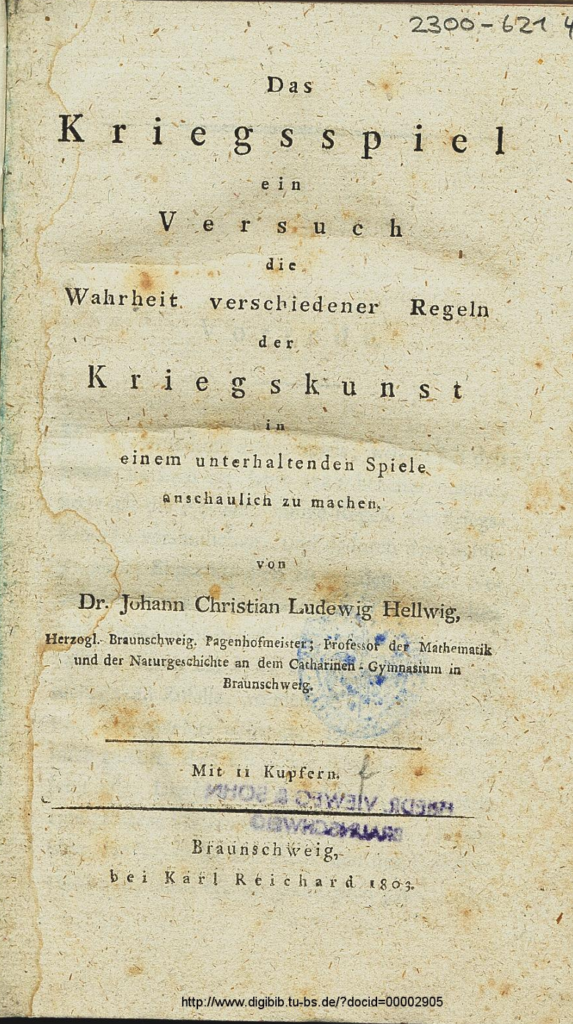
This is the second edition of Hellwig’s wargame, in which he removes the trappings of Chess.
This version comes from the library of the University of Braunschweig.
As usual, I uploaded a copy on the archives.
The quality of the pages is mediocre, and the OCR struggled. Translation errors and missing lines are extremely likely.
Johann Christian Ludewig Hellwig — The War-Game (Brunswick, 1803)
an Attempt to make the truth of various rules of the Art of War
evident by means of an entertaining game.
by Dr. Johann Christian Ludewig Hellwig, Ducal Brunswick Pageschoolmaster, Professor of Mathematics and of Natural History at the Catharineum Gymnasium in Brunswick.
—
With 11 copper plates.
Brunswick, at Karl Reichard’s, 1803.
[Pencil note at upper right: “2300-621 4”. Stamp (faded, blue): Vieweg & Sohn, Braunschweig]
[Back of title page, blank. Show-through of stamps from the reverse side visible: “FRIEDR. VIEWEG & SOHN BRAUNSCHWEIG”, and a round library seal]
Preface.
In inventing this game, of which I first made an attempt known in the year 1780, my intention was to give vivid illustration to some rules of the art of war, and thereby to be of use to the student of that art. A secondary intention was to provide an agreeable entertainment, by means of a game in which nothing depends on chance but everything on the player’s own direction, for anyone who has no need of such instruction. Experience has taught me that I have not failed in my intention. This encouraged me to bring the game to a greater degree of perfection. To what extent the attempt corresponds to its inventor’s intentions, he — who cannot possibly be entirely impartial — must leave to others to judge.
Even should it be found that this game stands at a lower degree of perfection than I flatter myself it does, experience has nevertheless taught me that it gives vivid illustration to many rules of the art of war, and that it has been of great help to beginners in this science in gaining insight into important truths of that doctrine. I did not have this pleasant experience alone. A scholar famous in that field, the Ducal Brunswick Lieutenant-Colonel Mauvillon, convinced himself of this through some of his own pupils. This induced him — who at first had been prejudiced against the game as a means of contributing to the education of a young soldier — to become thoroughly acquainted with it. He became a zealous defender of it. Only death prevented him from translating it into French, so as to make foreign countries acquainted with an invention that seemed to him anything but unimportant.
Allow me to cite a few of the propositions whose truth the game confirms.
- One must above all seek to cover the flanks of the armies, and to maintain the connection between their various corps.
- After gaining advantages, one must advance cautiously, so as not to lose them again. To this end, the disorders unavoidable in a victorious army even after a successful battle must first be cleared away before one can think of further important undertakings.
- A battle, here as in nature, is subject to many incalculable chances, and may turn out unfortunately even with the best arrangements made for it. One must therefore think beforehand about where and how one could retreat, so that the retreat does not degenerate into a disgraceful flight.
- One must seek to draw the enemy out of his advantageous position more by diversions and by threatening his communications than by going straight at him.
- One must lure him into detaching troops, and then attack him wherever he has thereby weakened himself.
- One must not enter into a battle without cause, until one has first made such arrangements as are needed to make proper use of victory.
- One must not count on the enemy’s failing to do something merely because the undertaking seems to border on the impossible.
- A clever commander often chooses just such a point of attack, and surprises the enemy. One must seek to divert the enemy’s attention from the true point of attack.
- In the case of defense, one must not place oneself directly opposite the enemy, but take up a position to his side.
- In the case of an attack, one must operate against the enemy’s flanks and rear, but not attack the front — unless one wishes to deceive him, to prevent him from thinking of flank and rear, and to hold him fast at his post.
- A defeated army must seek to carry out its retreat eccentrically, in order to hinder the victor’s pursuit.
- Without compelling reasons, one must not attack the enemy’s center. For even if one is fortunate enough to split him, one thereby forces the defeated enemy into an eccentric retreat, and thereby hinders one’s own progress.
- One must attack the enemy’s flanks for this reason too, namely, in order to prevent him from making an eccentric retreat that would be useful to him.
- The retreat of a corps that serves merely to occupy the enemy’s front must not be eccentric, but parallel to the front, because by this occupation one wishes to divert the enemy’s attention from his flanks. But if this purpose no longer applies, then the rule of eccentric retreat again takes effect. —
- The cordon system is faulty, for he who wants to hold everything loses everything.
- In war, the smallest events deserve the commander’s attention; to him nothing is a trifle.
- Even in the most desperate circumstances, the commander must lose neither his courage nor his head. By this he will be able to take advantage of the carelessness into which the opponent all too easily falls as a result of the advantages he has gained.
I have not yet played a single game in which the importance of these, and of a great many other rules, was not made so vivid that they impress themselves indelibly on the memory. The teacher thereby had occasion to bring in interesting parallel events from the history of war, and to provide the pupil with an instructive entertainment.
Let this be enough to encourage an attempt to convince oneself, through one’s own experience, of the truth of what I say. This attempt might be hindered by the notion that learning the game involves too many difficulties. One might easily wish to draw proof of this from the large number of rules of the game; but experience shows the opposite. The Ducal pages at Brunswick, between 13 and 15 years of age, have learned the game for the most part by mere observation, all of them play it with a fair degree of perfection, and find in it an extraordinarily engaging entertainment. It is, of course, not everyone’s affair to learn an art from a book without verbal instruction. I cannot, therefore, expect of this game either that everyone will learn it from my description, however clearly I have tried to make everything. But in most places there will nevertheless be someone with ability and patience enough to think through these rules, and to explain enough of them verbally to another person that he can then help himself further by means of this description.
Since I believe myself to be sufficiently acquainted with the imperfections of this game, my paternal fondness for it notwithstanding, and have indicated as much in the description through various hints, a request that they be pointed out to me would only cause needless trouble. But I shall acknowledge it with unfeigned gratitude if anyone should indicate to me the means of removing the imperfections, without thereby giving rise to even more important ones, and without causing inconveniences in play. Thus, for example, the ratio of the firing ranges to the day’s march is not the one that corresponds to the ratio in the original [i.e., in reality]. I have, however, been unable to find any means of making the former equal to the latter, without either enlarging the game board excessively, or causing various inconveniences in play through some alteration.
Complete war-games with a fixed terrain of 1617 squares cost, ordered through me, five and a half pistoles; with a terrain that can be altered in 63 different ways, 7 pistoles; and with a terrain made up of cubes amounting to 2000 squares, so arranged that it can be altered in every possible way, according to plans designed either arbitrarily or after nature, 10 pistoles. They can, however, also be had smaller or larger.
Brunswick, 9 October 1802.
The Author.
Contents.
General considerations, §§ 1–7.
Difficulties encountered in any attempt to imitate the operations of war by means of a game, § 1.
Division of war, with regard to its theater, § 2.
The most important subjects of the art of war, § 3.
The various types of troops, § 4.
On the theater of war, § 5.
On the equipment required for war, § 6.
Needs of an army that differ from these, § 7.
The purpose of war, and by what it is naturally brought to an end, §§ 8–10.
The First Chapter. On the nature of the board on which the theater of war is depicted in the war-game, §§ 11–25.
Size of the surface on which the game is played. How the various kinds of terrain are distinguished upon it, § 11.
Terrain passable without hindrance, § 12.
High, impassable mountains, § 14.
Swamp and marsh, §§ 15, 16.
Defiles (narrow roads), § 17.
Bodies of water, § 18.
Buildings, towns, and villages, § 19.
Provinces, § 20.
Fortresses, §§ 21, 22, 23.
Lines of communication, § 24.
Means of designating every smallest part of the terrain, § 25.
The Second Chapter. On the nature, in general, of the pieces by which the movement of the troops is imitated, §§ 26–32.
The material from which they are made, § 26.
Infantry, § 27.
Cavalry, § 28.
Each piece represents not individual soldiers but a body of troops, § 29.
Artillery, § 30.
Why no cuirassiers have been introduced, § 31.
Designation of the troops on the board, § 32.
The Third Chapter. On the changes which the troops can make in their position, §§ 33–61.
Who has the move. One must not rush one’s opponent in making it, and, when it is finished, this must be indicated by a sign, § 33.
What is meant by the changes of the game belonging to the first and second classes, § 33.a.
Change of front, actual movement, and the capturing of a piece, § 33.b.
Adjoining-side corner squares, § 34.
Side rectangle, § 35.
Front rectangle. Line of direction of the front, § 36.
Rectangle of the reversed front, of the right wing, of the left wing, § 37.
A piece’s change of front by facing right or left belongs to the changes of the first class, §§ 38, 39, 39.a.
On the movement of a single piece, without thereby capturing an enemy piece. — On the movement of the infantry, §§ 40, 41.
On the movement of the dragoons, §§ 43, 44.
When they have dismounted, § 44.a.
On the movement of the light cavalry, §§ 45, 46, 47.
On the movement of pieces over broken terrain, §§ 48, 49.
Direction of a piece’s front, § 50.
Movement and change of front of the same piece can take place in one move, § 51.
The former belongs to the changes of the second class, § 51.a.
The capturing of a piece, § 52.
How the infantry captures, § 53.
How the cavalry [captures], §§ 54, 55.
Capturing belongs to the changes of the first class, § 56.
How many enemy pieces a piece can capture in one move, § 57.
How the cavalry attacks an enemy piece in the rear and on the flanks, § 58.
A remark on the cavalry’s attack on the infantry, § 59.
It is not permitted to change front and, in the same move, capture or take up a position in accordance with this changed front, §§ 60, 66.
Pieces that have captured may keep their front or change it, § 61.
The Fourth Chapter. On small-arms fire, §§ 62–70.a.
In general, §§ 62, 63.
In which cases the equal advantage that the infantry of both armies has in firing, when facing each other, ceases to apply, §§ 64, 65.
A position cleared by fire may, in the same move, be occupied, passed through, and entrenched, § 65.a.
The infantry does not fire and capture in the same move, § 67.
On the firing of the dismounted dragoon, § 68.
Why the cavalry, as such, does not fire in the war-game, § 69.
On the firing of the infantry assigned to serve the artillery, § 70.
Firing belongs to the changes of the first class, § 70.a.
The Fifth Chapter. On bridges and pontoon-wagons, and their movement, §§ 71–81.
Bridges and pontoon-wagons, §§ 71, 72, 73.
The pontoon-wagon does not make its square impassable, § 74.
When it can be moved, § 75.
The manner of its movement, §§ 76, 79, 81.
When its movement belongs to the changes of the first or of the second class, § 80.
The Sixth Chapter. On the artillery, §§ 82–177.d.
Description of the piece (gun-carriage), §§ 82, 87.
Types of ordnance, and how they differ from one another in appearance, §§ 83–86.
Gunners, the gunners’ square, the artillery’s square, § 87.
How to render the artillery ineffective without ruining it, § 87.a.
Designation of the artillery on the board, § 88.
The artillery introduces obstructions into the terrain, § 89.
Three changes in the position of the artillery, § 90.
Wheeling of the artillery, §§ 91–94.
Turning the artillery about, §§ 95, 96.
Movement of the artillery, §§ 97, 98.
Where the artillery’s effect reaches, §§ 99–101.
In what the effect of the artillery consists, § 102.
What the gunners can do, both as such and as infantrymen, in the same move. The firing of the artillery belongs to the changes of the first class, § 103.
In what positions the artillery of the two armies can come relative to one another, and how artillery can be ruined by artillery, §§ 104–110 and § 177.d.
When a piece of ordnance just occupied becomes effective, § 111.
Ratio of the firing ranges of the various types of ordnance to one another, to small-arms fire, and to the infantry’s day’s march, §§ 112–115.
What can happen to a piece of ordnance when the cavalry has occupied the gunners’ square, §§ 116, 117.
Combination of different batteries, § 117.a.
Spiking of the ordnance, § 117.b, c.
The Seventh Chapter. On the bridges carried with the artillery, §§ 118–124.
By means of special pontoon-wagons, §§ 118–121.
By placing bridges on the gunners’ square, §§ 122–124.
The Eighth Chapter. On the simultaneous movement of several pieces, in order to imitate the movement of entire corps, §§ 125–139.
Pieces and machines that form a rectangle can be moved simultaneously in one move, §§ 125, 126.
Closer determination of the conditions under which such a rectangle is movable, § 127.
By an actual movement, or by a wheel, §§ 128, 129.
Closer determination of wheeling movements and their various kinds, §§ 130, 131.
Examination of whether a rectangle, in wheeling, would pass over passable or impassable terrain, §§ 135–137.
What can and cannot be done, in the same move, with the pieces and machines contained in a movable rectangle, § 138.
Whether parts of a rectangle — and which ones — can be moved in place of the whole rectangle, § 139.
The Ninth Chapter. On entrenching, §§ 140–183.
Definition of this concept for the war-game, § 140.
On the signs by which entrenchment is indicated, §§ 141–143.
How entrenching takes place in the war-game, and how an entrenchment is strengthened, § 144.
Conditions under which a position can be entrenched, §§ 145, 146.
Which type of troops can entrench, § 147.
Obstacles created by an entrenchment, § 148.
Several squares can be entrenched in one move, but only one square by each piece, and the squares need not be contiguous, §§ 149–151.
Which squares can and cannot be entrenched, §§ 152–154.
What obstacles an entrenchment poses to small-arms fire and to ordnance, §§ 155–160.
On occupied and defended entrenchments, §§ 161–165.
On entrenchments under attack, §§ 166–169.
When an entrenchment is abandoned, § 170.
When one occupies an abandoned entrenchment, § 171.
By what means we remove an obstacle placed in our way by an entrenchment, § 172.
Demolition of an entrenchment, § 173.
Destruction of the same by gunfire, § 174.
What advantage firing on an entrenchment with small-arms fire brings, § 175.
Comparison of the advantages had in demolishing or shooting down entrenchments, § 176.
This destruction of entrenchments belongs to the changes of the first class, § 177.
When a position cleared of its entrenchment becomes passable, § 178.
How to handle the markers of a ruined entrenchment, § 179.
Which entrenchment cannot be demolished, §§ 180, 181.
On storming entrenchments, §§ 182, 183.
The Tenth Chapter. On building, dismantling, and ruining bridges, as well as loading and unloading them, §§ 184–208.
What is to be noted in building a bridge, §§ 184–194.
What [is to be noted] in dismantling a bridge, §§ 195–203.
What [is to be noted] in ruining a bridge, § 204.
What [is to be noted] in setting fire to a bridge, §§ 205, 206.
What [is to be noted] in loading and unloading bridges, §§ 207, 208.
The Eleventh Chapter. On obstacles to building, dismantling, and ruining bridges, §§ 211–215.
The Twelfth Chapter. On towns and villages, §§ 216–229.a.
How to proceed in passing through and occupying them, § 216.
Obstacles they pose to the effect of firing, § 217.
What advantages they afford the troops, §§ 218, 219.
How, in case of necessity, they are set on fire, §§ 221, 222.
Consequences of setting fire, §§ 223–229.
The marker given to the machines and pieces that have occupied towns or villages, § 229.a.
The Thirteenth Chapter. On those objects that pose obstacles to the free movement of the pieces and to the effect of the artillery and of small-arms fire, §§ 230–241.
The Fourteenth Chapter. On the interruption of a corps’s communication with the place from which it receives its supplies, and the consequences thereof, §§ 242–250.
Designation of the lines of communication on the board, § 242.
They run from one player’s fortress to his opponent’s fortress, § 243.
By what means communication is interrupted. The first point of interruption; the line of interruption; this side and that side of it, §§ 244, 245.
Consequences of interrupted communication, § 246.
Under what conditions these consequences take effect, § 247.
What must be done to render these harmful consequences as harmless as possible, § 248.
Given this theory of the line of communication, a theory of establishing magazines in the war-game can be dispensed with, § 249.
Illustration of the theory of the lines of communication by examples, § 250.
The Fifteenth Chapter. On setting up the game, §§ 252–254.
The Sixteenth Chapter. Something on the manner of playing the game, §§ 255–257.
The Seventeenth Chapter. On the fortress, its capture, and the game thereby ended, §§ 258–261.
The capture of the fortress ends the game, § 258.
When the fortress is captured by force, §§ 259, 260.
When [it is captured] through lack of provisions, § 261.
The Eighteenth Chapter. Some practical cases, §§ 262–275.
Relative value of a loss, §§ 262–266.
Practical cases in which batteries are ruined, §§ 267–274.
[Cases] in which they are captured, § 275.
The Nineteenth Chapter. On the means of expressing the position of a game by notation, and of describing the moves of a game as clearly and briefly as possible, §§ 276–295.
The Twentieth Chapter. On an arrangement of the terrain by which every possible alteration can be made with it, §§ 296–300.
The Twenty-First Chapter. General remarks, §§ 301–308.
The game is still capable of various improvements, § 301.
An appeal to enthusiasts and connoisseurs of the game to devise a theory of heights for it, § 302.
A theory of forests would be subject to fewer difficulties, § 303.
A proposal to attach still more interest to the retention of a province, § 304.
Some thoughts toward a theory of establishing magazines in the war-game, § 305.
On the introduction of practicable mountains, § 306.
On the introduction of a movement imitating deployment, §§ 307, 308.
The Twenty-Second Chapter. How the game could be played by four persons, §§ 309–323.
Each pair of them plays with combined forces against the other. With each pair there is a commanding general and a general subordinate to him, § 309.
Council of war, § 310.
The duties of the commanding general, § 311.
Precise determination of which part of the army stands under the particular command of each general, §§ 312–316.
In what order the moves are carried out by the four players, §§ 317–323.
[End of the table of contents. The main text follows.]
General Considerations.
§ 1.
The subjects of war are of such great variety and of so peculiar a nature that a complete and vivid representation of them by means of a game is impossible. Even where, in attempting this representation, one does not have to struggle against outright impossibilities, there are still difficulties that are exceedingly obstructive to a successful execution of this idea. These difficulties lie not so much in inventing the rules by which such a game would have to be played, as rather in certain other circumstances. For one thing, it is not within our power to make the board on which the game is to be played as large as it would really need to be if the day’s marches of the various types of troops, the firing ranges, and the like were to stand in their proper proportion; one must, in this respect, have regard to the place where the game is to be set up, and to a price that is not too high. Both considerations make a limitation in size necessary. But this very limitation is also an obstacle to the perfection of which such a game would otherwise still be capable. Furthermore, if this game is to serve as an agreeable entertainment and as some instruction for young people, and if it is to be generally useful and not merely for the rarest of minds, then the subjects of the game must surely not be as numerous as the subjects of the original. A war-game will therefore approach perfection if it vividly represents only the most important occurrences of war, and employs the simplest possible means to do so. Even with this arrangement, it will still remain, for a game, fairly intricate, and will be an entertainment only for thinking minds. To judge how near I have come to the goal I set myself, I will preface a few propositions on which I base this imitation.
§ 2.
With regard to the theater in which wars are conducted, one is accustomed to divide them into naval wars and land wars. Only the imitation of the latter is the subject of this game.
§ 3.
The nature of the troops (§ 4), the region in which the war is conducted, or the theater of war (§ 5), the equipment required for war (§ 6), and the remaining needs of an army (§ 7), the means of ending the war (§§ 8, 9, 10) — these are general headings under which the greatest and most important part of all the subjects of the art of war can be brought, and concerning which I will therefore preface some general considerations.
§ 4.
There is infantry, cavalry, and artillery. These various types of troops form the three principal classes, the distinction between which is contained in the following propositions.
- The infantry cannot move as quickly as the cavalry.
- The infantry causes harm, first, on the spot it has taken — that is, it presses into the enemy with the help of the bayonet, and thereby also keeps him away from itself; and second, it causes harm by firearm at some distance from the place where it stands.
- The greater mass of the cavalryman, arising from his union with his horse, and his superior speed from this same cause, make the charge of the cavalry more effective than the attack of the infantry, all other circumstances being equal.
- The cavalry causes harm chiefly on the spot it occupies through its movement, or by the saber.
- The artillerymen cause harm, by means of machines specially made for the purpose, at a considerable distance.
If a war-game is to have any value, it must imitate this distinction between the types of troops and make it vivid.
§ 5.
In considering the theater of war (§ 3), we find that some parts of it pose no obstacle to the movements of the troops and to the effects of their machines acting at a distance, while others have the opposite effect. Often these obstacles can indeed be cleared out of the way, but sometimes not — at least the shortness of time often does not permit it. It is established that this difference in terrain can, according to the circumstances, bring now an advantage, now a disadvantage. In a war-game, therefore, when designing a board on which the theater of war is depicted, regard must also be had to this, and this distinction must be made vivid.
§ 6.
Of the equipment required for war (§ 3), little can be said in general, since the purposes to be achieved by it differ too greatly from one another. They can, however, be reduced to a very small number, without the war-game losing anything of its perfection thereby. But all of them agree in this:
1) that they have no movement of their own, but that both this and all changes to be made with them depend on creatures acting by their own will.
2) that their movement is for the most part slower than the movement of the troops, and that they therefore pose various obstacles to the free movement of the army.
These truths, too, must not be lost sight of in the war-game.
§ 7.
The needs of an army (§ 3), which are distinguished from its necessary equipment, are very varied. The men and animals belonging to it require many things for their sustenance. But it would be superfluous, in the war-game, to attend to the variety of objects serving this purpose, and to all the equipment belonging to it. It is enough to combine them all under the general name of supplies, to arrange both their acquisition and their distribution according to the nature of this subject, and yet, in the imitation, to keep the law of greatest possible brevity in view.
§ 8.
In war, one seeks to obtain one’s right by force of arms. The intention attained ought therefore to end the war. But this is not so. The stronger party — whether he is in the right or in the wrong — keeps the field, or is the victor, which, however, cannot always be correctly judged from the smaller loss of troops or matériel. The natural way of ending the war, even against the enemy’s will, is rather this: when one deprives him of those means without which he cannot continue the war. But each of the belligerent parties draws these chiefly from his own country. The conquest of the enemy’s country must therefore bring the war to a natural end. Wars that end otherwise — even if their number should be the greater — are not really suited to being represented by a game.
§ 9.
One has not yet conquered a country merely by having invaded it; one must also be able to maintain possession of it with ease. The enemy’s country will therefore be called conquered only once we have taken possession of the strongholds within it, in which the necessities of war that an army must have nearby can be securely kept. The natural outcome of the war thus depends on the conquest of a country’s fortresses; hence the enemy is not yet wholly overcome so long as he can still maintain himself in possession of a fortress of importance.
§ 10.
If, then, we wish to approach nature as closely as possible in the war-game, we must base the means of ending the war within it on the principles laid down in §§ 8 and 9. The war-game must consequently end with the conquest of the enemy’s country and of the fortresses lying within it.
The First Chapter.
On the nature of the board on which the theater of war is depicted in the war-game.
§ 11.
The surface belonging to the war-game, on which the game is played, or the theater of war, is arbitrary. I usually make use of a rectangle a little over 44 Paris inches long and nearly 30 inches wide. Its length is divided into 49, and its width into 33, equal parts. If one draws, through these division points, lines parallel to the sides of the rectangle, the board is thereby divided into 1617 equal squares. The kinds of terrain have been distinguished from one another by different colorings. If these are not sufficient for clarity, other markings must be combined with them.
§ 12.
Some squares of the war-game board, which the first plate depicts on a reduced scale, are black, others white. I call these the principal colors. On these the troops, with their machines and equipment, move as freely as the nature of their movement at all permits. They are parts of the terrain that nature has provided with no obstacles, or only quite insignificant ones.
[Scribe’s note: There is is no paragraph #13 in Hellwig’s book. ]
§ 14.
Other squares are colored entirely red, and denote terrain that, because of the natural obstacles found on it, cannot be occupied, nor passed over. Neither small-arms fire nor artillery has any effect on such terrain, nor beyond it. Under this designation one may therefore picture high, impassable mountains.
§ 15.
Deep swampy and marshy places likewise prevent passage, but one can nevertheless fire across them. It was therefore necessary to distinguish places of this kind from those referred to in the preceding section, and I have accordingly colored places of this kind green.
§ 16.
For both kinds of impassable terrain in §§ 14 and 15, it is assumed in my war-game that there is not enough time to remove the obstacles and render it practicable (§ 5). Anyone, however, who wishes these obstructions of the terrain in the war-game to be of such a nature that they can be overcome with some loss of time, will find it not difficult to devise the necessary rules for this himself.
§ 17.
[Squares] not far apart from one another, separated by black and white squares, colored red or green, thus form defiles (narrow passages).
§ 18.
Bodies of water found within a terrain deserve the greatest attention in war. I have colored these blue on the board, and have assumed that they are deep enough that they cannot be crossed either on foot or on horseback.
§ 19.
Squares divided by diagonal lines into triangles, one half of which is red and the other white, signify buildings. Hence several such squares lying next to one another form, according to the other circumstances, either towns or villages. These buildings do not render the terrain on which they are drawn impassable, since it is assumed that passage runs through between them. In this respect, therefore, they are of the same nature as the terrain colored with the principal colors (§ 12). In what respects they differ from it, more will be said in § 216 and following.
§ 20.
Several squares lying next to one another are bordered by dotted lines. These denote the boundaries of the provinces, which take their names from the Latin letter inscribed in them. These divisions have the advantage that one can express oneself more briefly when describing the position of the armies. They also provide a means of determining precisely, in the event of interrupted communication, which troops are to be regarded as cut off. More on this in § 242 and following.
§ 21.
Among these divisions, A and P are particularly to be noted, being the fortresses of the two players, who shall henceforth be named after them. The loss of the whole game depends on their loss (§ 10). The provinces lying around fortress A — B, C, D, E, F, Ff, G, H, Hh, J, and K — belong to player A, whose country is separated from player P‘s country by a doubly dotted line; to player P, accordingly, in addition to fortress P, belong the provinces O, Q, R, S, T, V, L, W, U, M, and N.
§ 22.
The squares marked with crosses and 4 dots are the parapets of the fortress rampart, which during the game are covered with the markers appropriate to them. The corner square of the fortress, colored with various colors, is the place on whose loss the loss of the fortress, and thereby the loss of the game, depends (§ 21). One may picture, under this place, a citadel dominating the whole town. How the loss of this corner square is brought about will be explained in detail in a separate chapter.
§ 23.
That the two countries are equal and similar, and that the fortresses are larger than some of the provinces, are departures from nature; but these have no detrimental influence on the perfection of the game. The former is, indeed, not required by the nature of the game itself, but was done only to give the players the same advantages at the start of the game. The latter, however, was so that the fortress could nevertheless be defended to some degree, which would not have been well possible with a small extent.
§ 24.
The red lines running from one fortress, through the middle of the squares, to the other fortress are the lines of communication, along which the armies’ supplies are brought up to them from the fortress, and whose interruption by enemy troops can have important consequences. This will be treated in more detail below, in § 242 and following. On the game board, one may have these squares, through which the line of communication passes, colored yellow.
§ 25.
In order to designate every smallest part of the board with the utmost precision, each square is provided with a number. They begin at the corner square of the board lying in province E, and run along the longer side of the board through the provinces Ff, Hh, O, to another corner square of the board, numbered 49, in fortress P. The square adjoining square No. 49 — the outermost square of the second row, running parallel to the longer side — is No. 50. Adjoining this, in the same row, is No. 51. And so the numbers in this second row run back again, through the provinces O, Hh, and Ff, to the outermost square of this row in province E, which becomes No. 98. From this one proceeds to the outermost square of the third row in province E, which becomes No. 99. From which the rule for the further progression can now easily be inferred. The last square is No. 1617. It is the corner square of the board in province S.
—
The Second Chapter.
On the nature, in general, of the pieces by which the movement of the troops is imitated in the war-game.
§ 26.
The pieces by which the troops are imitated in the war-game are made of light wood, but their feet, so that they do not topple over so easily, are of lead. Their base is a circle, the diameter of which is nearly as large as the side of one of those squares (§ 11) into which the war-game board is divided. They are painted with oil paint, differently for each army, by which they are thus distinguished from one another. According to a quite new arrangement, the pieces are made entirely of lead.
§ 27.
The infantry is represented in the war-game by pieces resembling grenadiers. The first figure of the second plate shows one of these in its actual size. The direction in which the grenadier’s cap is tilted indicates its front.
§ 28.
Of the cavalry I have introduced two kinds into the war-game: dragoons and light cavalry. The former are also intended to serve on foot when required, while the latter serve only mounted. The pieces representing the cavalry are larger than the infantry pieces, and are furthermore provided with a horse’s head. The dragoons are distinguished from the light cavalry by tricorn hats, whereas the light cavalry, by contrast, are provided with cylindrical caps, like the hussars. The second figure of the second plate shows a piece for the dragoons, and the third a piece for the light cavalry, in their actual size. The horse’s head likewise indicates their front.
§ 29.
A piece represents not a single man but an entire body of troops. One should therefore think of an infantry piece as a battalion, and of a cavalry piece as a body of troops which, when drawn up in order, occupies the length of a battalion. A single squadron is too few. Two squadrons — which in the Austrian military service are called a division — come closer to the truth. The name, however, makes no difference to the matter here either.
§ 30.
For gunners I have introduced no separate piece, since in the war-game the infantry also serves the ordnance. I hope this will not be found unnatural. For since every infantry piece represents a battalion (§ 29), one may think of an infantry piece assigned to serve the artillery as representing, in part, the number of gunners needed to serve the ordnance, and in part the infantry that helps provide the cover for the artillery, to which the gunners belonging to it are attached. A military arrangement of this kind, even if it could not be recommended, would not be absurd, and — since it greatly simplifies the game — deserves to be introduced at least in the war-game.
§ 31.
I have not introduced cuirassiers, for the following reasons:
- I know of no means of imitating, in the war-game, the advantage that this kind of cavalry has by being somewhat protected against small-arms fire.
- Their usefulness in general does not yet seem to me so evident that one would need to make use of them in a war-game. [WargamingScribe’s note: I chuckled here. ]
§ 32.
The designation of a battalion of player A‘s infantry on a board is done by m, of a division of dragoons by d, and of a division of light cavalry by n. The designation of player P‘s infantry, however, is by b, of the dragoons by o, and of the light cavalry by u.
The upper part of these letters indicates, on the board, the direction in which they have their front.
—
The Third Chapter.
On the changes which the troops of the war-game can make in their position.
§ 33.
Whichever of the players currently has the right to alter the position of his pieces, and to act upon his opponent’s pieces in accordance with the rules of the game, is said to have the move, or to be at the move. During this time, the opponent of the one at the move remains passive, watching to see whether his opponent proceeds according to the rules of the game;
he indicates to him at once, for correction, should the opposite occur; meanwhile he considers in advance the cases that may arise; and he also surveys his own position, to see whether something might need to be altered on the next move, perhaps in some other place than the one where the operations are presently taking place.
Since, as will be seen in what follows, so many different changes can be made to the position of the game during one move, the player who does not have the move must give his opponent time, and not hurry him, since a victory obtained in that way would not be an honorable one.
So that this proceeds the more orderly, he must not undertake his counter-move until an agreed-upon signal is given. But should it be supposed that the player having the move has forgotten to give this signal, he may ask him about it. Once this signal has been given, however, and the move has passed to the other player, the player who had the move before may make no further changes — not even in the case where a move contrary to the rules of the game was made and the opponent is satisfied with it. If the opponent is not satisfied, however, he may certainly demand the correction, provided only that he points it out before he himself has made any change in his own position. But once he has done so, everything remains as it was at the moment the move was taken over, even if it could be proven that a move contrary to the rules of the game had been made — unless the player now having the move voluntarily agrees to allow it. This rule will prevent many disputes. On the other hand, every player will take the utmost pains to carry out his moves with the greatest scrupulousness, since it would be dishonorable to abuse one’s opponent’s trust and to deliberately leave it to chance whether the opponent notices moves made contrary to the rules of the game. With very important moves, especially when pieces are captured, it will therefore be wise to draw one’s opponent’s attention to one’s current position and to the undertaking that follows from it, so as to remove all suspicion of irregular moves — provided this can be done without betraying one’s intentions for the next move.
§ 33.a.
While one is at the move, one may make various changes to one’s position (§ 33), which must nevertheless have their limits, so that the game remains comprehensible. I will divide these changes into two classes. By the changes belonging to the first class, I mean such ones of which a player at the move can make several in the same move. So when I say in what follows that a piece’s change of front, the building of a bridge, the dismantling of a bridge, the ruining of a bridge, the throwing up of parapets, the capturing and the shooting-down of pieces, and the like, belong to the changes of the first class, this means that in the same move one may change the front of several pieces, build, dismantle, or ruin bridges at various places, and so on.
By the changes belonging to the other class, I mean such ones of which a player at the move cannot make several in the same move. To this belong: the movement of a piece from its square, without an enemy piece being captured at the same time thereby; further, the wheeling of pontoon-wagons and of ordnance, by which the pieces standing on them change their place; and finally, the wheeling or movement of several pieces and machines joined together in a rectangle. So when it is said in what follows that the wheeling or movement of a rectangle belongs to the changes of the second class, this means that in the same move neither a wheel or movement of another rectangle, nor such a wheeling of a pontoon-wagon by which our piece standing on it changes its place, and the like, can be undertaken.
§ 33.b.
The change in a piece’s position takes place either through a movement from its square, or without its moving from its place. The latter may be called a change of front, and the former a movement of the piece. This movement may or may not be combined with the capture of an enemy piece. In the former case one captures, and in the latter the piece makes a mere movement. Hence in this chapter we shall treat 1. of the change of front, 2. of mere movement, and 3. of the capturing of pieces.
§ 34.
Every square — for example, square 185, Plate III — that does not lie on the outermost row of squares of the board is immediately surrounded by eight squares, which I will call its adjacent squares. Thus, for example, squares 162, 163, 164, 184, 186, 206, 207, 208 are the squares adjacent to square 185. Of these adjacent squares, some are so situated that two of their corners form adjacent angles with two corners of the square (185) that they surround; these we shall call the side squares of the given square (185). Others are so situated that one of their corners forms a vertical angle with one of the given square’s (185) corners. These may be called its corner squares. Thus, for example, 163, 184, 186, 207 are side squares, and 162, 164, 206, 208 are corner squares, of square 185.
§ 35.
A side square always lies between two corner squares, in such a way that these form a rectangle. I will call this the side rectangle of a given square, or of the piece standing on it. Every square that does not lie on the outermost line of squares of the board therefore has four side rectangles. Thus, for example, square 185 has the following four side rectangles, namely 1. the side rectangle 162, 163, 164.
- — — 162, 184, 206.
- — — 206, 207, 208.
- — — 164, 186, 208.
§ 36.
The side rectangle that lies parallel to a piece’s front determines the extent of its front. I will therefore call it the front rectangle. Thus, for example, 162, 163, 164 is the front rectangle of piece m in the position drawn on 185 (§ 32).
The line 162, 139, etc., the line 164, 143, etc., and the line 163, 141, etc., may be called the lines of direction of the front.
§ 37.
The side rectangle 206, 207, 208, which lies parallel to the front rectangle 162, 163, 164 of piece m on 185, shall be called the rectangle of the reversed front; the side rectangle 164, 186, 208, adjoining the right wing of piece m on 185, the rectangle of the right [wing]; and the side rectangle 162, 184, 206, adjoining its left wing, the rectangle of the left wing.
§ 38.
A piece changes its front when it exchanges its front rectangle for another side rectangle, without moving from its square. It therefore faces right, or wheels right, when its previous rectangle of the right wing becomes its front rectangle. It faces left, or wheels left, when its previous rectangle of the left wing becomes its front rectangle. Finally, it makes an about-face when its previous rectangle of the reversed front becomes its front rectangle.
These changes of front of a piece have been adopted in the war-game for the infantry, artillery, and cavalry.
§ 39.
A piece m in No. 1, Plate IV, has therefore faced right, or wheeled right, if, without moving from its place, it has taken the position shown in No. 2. It has faced left, or wheeled left, if, relative to its first position, it has placed itself as in No. 3. In No. 4, it has made an about-face relative to its first position. The position shown in No. 5, however — by which the piece presents the center of its front to a corner of the square — has not been introduced into the war-game, because this position could very easily give rise to disputes among the players.
§ 39.a.
The change of front belongs to the changes of the first class; hence the player at the move may make as many changes of front of individual pieces as he finds necessary (§ 33.a).
§ 40.
In the case of a movement of a single piece from the square on which it stands to another, without an enemy piece thereby being captured — that is, in the case of a mere movement (§ 33) — one must distinguish whether this movement is made 1. by the infantry, 2. by dragoons, or 3. by the light cavalry.
§ 41.
The mere movement of the infantry (§ 40) takes place, as with the queen in chess, up to at most the 8th square in any of the eight directions lying around a square, whether or not it has its front turned that way, provided no obstacles are found there. In Plate III, an infantry piece is found on 185. The dotted lines proceeding from it show all the directions and places to which it can move, and at the same time the greatest distance it can cover in one march from its previous place. These lines may be called march-lines. This piece can therefore reach, at most, either 1, 9, 17, 193, 369, 361, 353, or 177.
§ 42.
Hence, unless prevented by obstructions of the terrain or by other circumstances, which will be indicated more precisely in § 48, the infantry can take 64 other positions from one place; for so many different places are contained in its march-lines (§ 41).
What has been said here about the infantry, and what will be said about it in the future, also applies to it when it is assigned to serve the artillery (§ 30).
§ 43.
The dragoon moves, as the queen in chess, up to the 12th square in any of the eight directions lying around his square, whether or not he has his front turned that way. If, then, a division of dragoons stands on 185, Plate III, the dotted lines indicate its march-lines, or all the directions in which it can move. If one further extends each of these lines to 4 squares, one has at the same time the greatest distance it can cover in one march from its previous place. I will call these eight lines the cavalry’s lines of effect. All of these lines deserve this name with respect to what the cavalry can undertake against the infantry on them; the three lines of direction of the front (§ 36), however, deserve it also with respect to attacks on the enemy’s cavalry. More on this in § 54.
§ 44.
Hence, unless prevented by obstructions of the terrain or other circumstances, the dragoon can take 96 other positions from one place, since each of his eight march-lines contains twelve places he can reach from his square.
§ 44.a.
Dragoons are a kind of troops that, according to circumstances, are also meant to serve on foot. In order to imitate this in the war-game as well, a war-game includes some pieces that differ from the rest of the infantry, in outward appearance, only in that they have hats instead of grenadier caps. These pieces serving this purpose, however, are not set up at the same time as the other pieces of the game, but are kept in readiness only until needed. If, then, one wishes to use a dragoon as an infantryman, one simply exchanges the dragoon for this piece, and sets the dragoon aside out of the game for the time being. The following is to be noted in this connection:
- The dragoon may dismount in the move during which he still moves as a dragoon.
- In the move during which the dismounted dragoon moves as an infantryman, he may also remount.
- Dismounted dragoons are in no way different from the rest of the infantry with respect to their effect, and may also serve as gunners.
- If the dismounted dragoon is lost, then the dragoon set aside out of the game for that time must be surrendered, while the piece representing the dismounted dragoon is returned and set aside out of the game until some possible similar use in the future.
- The designation of a division of dismounted dragoons of player A on a board is dm, and for player P: bb. The reason for this designation is clear from § 32.
§ 45.
The light cavalryman moves, likewise as the queen in chess, up to the 16th square in any of the eight directions lying around his square, whether or not he has his front turned that way. If, then, light cavalry stands on 185, Plate III, the dotted lines also indicate, in this case, all the directions in which it can move. If one further extends each of these lines to 8 squares, one has at the same time the greatest distance it can cover in one march from its previous place.
§ 46.
Furthermore, the light cavalry also has the move of the knight in chess. Hence, if it stands, for example, on 185, Plate III, it can from there also reach squares 161, 140, 142, 165, 209, 230, 228, and 205, provided the intervening squares 162, 163, 164, 186, 208, 207, 206, 184 are occupied neither by our own nor by enemy troops. It may not, however, make both kinds of march in the same move. For if it has begun its march in a straight line, as the queen in chess, it cannot in the same move continue it further as a knight. If, for example, it has come from 185 to 80, it cannot in the same move further reach 56 from there as a knight.
§ 47.
Hence, unless prevented by obstructions of the terrain, the light cavalry can take, from one place, 128 [other positions] as the queen in chess and 8 as the knight, and thus 136 other positions in all.
§ 48.
That high impassable mountains, deep swampy and marshy places, and bodies of water — which on our theater of war are designated by red, green, and blue coloring — shorten the march-lines when their direction passes over them, is already clear from §§ 14, 15, 18, and I do not believe it necessary to add anything further by way of explanation. This same shortening of the march-lines occurs because of one’s own or enemy pieces. If, for example, a piece stands on 75, Plate III, then m from 185 cannot, on this line, reach further than 97.
I further note that impassable places in the positions 58 and 81 of Plate III do not interrupt the line of direction of the march; rather, the line via 80 and 59 is passable for all kinds of troops, whether 58 and 81 are colored red, green, or blue, or — if they are practicable — occupied by one’s own or enemy troops.
§ 49.
The march of the light cavalry by a knight’s move, on the other hand, requires some explanation in broken terrain, which is sufficiently given by the following rule.
The light cavalry can, by a knight’s move, occupy a place that is directly connected with the one on which it stands by means of a practicable square; but it cannot occupy a place for which this condition does not hold.
Thus, for example, the light cavalry standing on 136, Plate III, can indeed reach 91 by a knight’s move, because 136 is directly connected with 91 by means of the practicable square 113. But from 136 it cannot reach 93, because 136 is connected with 93 not by means of one practicable square, but only by means of two, namely through squares 113 and 92.
§ 50.
The direction of the front is the same for all kinds of pieces. Only for the light cavalry must it still be determined which of the places lying in the front it can reach by a knight’s move. An example will sufficiently establish this. Suppose light cavalry is placed on 86 in A of Plate III, such that 63, 64, 65 is its front rectangle; then, of the places it can occupy by a knight’s move, 62, 41, 43, 66 lie in the front, but 106, 129, 131, 110 do not.
§ 51.
Pieces that have moved may, after the movement, keep their previous front or change it as they wish. This is a rule that prevents many disputes, which I have likewise made it a duty of mine to observe wherever it was at all possible.
§ 51.a.
The mere movement of a piece, which has been discussed from § 40 up to here, belongs to the changes of the second class. See § 33.a in this regard.
§ 52.
A piece captures, or takes, an enemy piece when it moves from its square and places itself on the square of the enemy piece it has captured or taken, as is customary in chess. Under this manner of weakening the enemy and gaining ground, adopted in the war-game, one may imagine that one presses upon the enemy, partly cutting him down, partly knocking him over, and taking him prisoner. It belongs to those trifles which, in the war-game, need not be attended to (§ 1) to note the distinction as to when the enemy in this case is to be regarded as killed or as taken prisoner. It is enough that he is put out of a position to do us further harm.
§ 53.
The infantry captures only onto one of the squares of its front rectangle (§ 36). Thus, for example, the infantry standing on 185, Plate III, can capture only onto 162, 163, or 164.
§ 54.
With regard to the cavalry’s capturing, note the following cases:
- Wherever the cavalry can go according to §§ 43, 44, 45, 46, 47, 48, 49, there it can also capture enemy infantry, regardless of whether it has its front turned toward that infantry or not. Hence a. the dragoons can do harm to enemy infantry, by capturing, on 96 squares (§ 44), and b. the light cavalry can do harm to enemy infantry on 136 squares from one position, unless this number of possible cases is reduced by obstructions of the terrain or by intervening pieces, as in § 48.
What was said about the light cavalry in § 46 regarding the knight’s move available to it also applies to capturing enemy infantry. - The cavalry captures enemy cavalry only if it finds it on places lying in its front, regardless of whether the enemy cavalry has its front turned toward ours or not.
§ 55.
If, for example, a division of dragoons stands on 185, Plate III, such that 162, 163, 164 becomes its front rectangle, then it can capture whatever enemy cavalry is found on a square of the lines of direction of the front (§ 36). In this case there are three lines of direction: 162, 139, etc.; 163, 141, etc.; 164, 143, etc. Now since the dragoon can move along each march-line, and consequently also along the lines of direction of the front, up to the 12th square (§ 43), there are 36 places on which it can capture enemy cavalry, unless this number of possible cases is here too reduced by obstructions of the terrain or by intervening pieces.
The same holds for the light cavalry. But since it can move up to the 16th square (§ 45), the three lines of direction of its front contain 48 squares on which it can capture enemy cavalry, unless here too this number of possible cases is reduced by obstructions of the terrain or by intervening pieces. To this must be added the 4 places lying in the front that it can occupy by a knight’s move (§ 50), so that the total number of squares on which enemy cavalry can be taken by the opponent’s light cavalry amounts to 52.
§ 56.
The capturing of a piece belongs to the changes of the first class (§ 33.a). Hence every piece of the player at the move can capture, if it finds the opportunity to do so. Consequently, several pieces can be removed from the board by this means in one move.
§ 57.
According to the rule, indeed, in each move only one enemy piece can be captured by each piece that finds the opportunity to do so. There is, however, an exception to this in the case of the cavalry. For, 1. a division of cavalry can capture, in one move, several uncovered pieces standing on its line of effect, provided they all lie in the same first direction that the cavalry took in capturing the first of them. For if the light cavalry has taken an uncovered piece by a straight-line movement, it cannot then also take another uncovered piece by the knight’s move, and vice versa (§ 46).
If a division of cavalry has taken an uncovered piece, it can also take a second one, lying in the same direction on its line of effect, even if this second one is covered. Likewise, it can also take a third one, even though it is covered, provided only the first two are uncovered, and so on. That the attacking cavalry then occupies the square of the last piece taken presumably requires no special reminder.
Thus, for example, the light cavalry of player A standing on 136, Plate III, can capture the battalions of player P‘s infantry standing on 202, 268, 334 — even though the third, on 334, is covered by the light cavalry on 358 — because the first two, on 202 and 268, are uncovered. On the other hand, the light cavalry of player A standing on 136, having captured the uncovered battalions of player P on 202 and 268, cannot then also capture, by a knight’s move, the battalion on 288.
§ 58.
Given this arrangement of the cavalry with respect to attacks on enemy cavalry, the cavalry has weak sides, and consequently there are attacks on the flanks and in the rear.
Thus, for example, 1. player A‘s division of dragoons on 72, Plate III, is attacked by player P‘s division of dragoons on 67 in its left flank, by the light cavalry on 77 in its right flank, and by the light cavalry on 358 in its rear. Further, 2. player P‘s light cavalry on 6 is attacked by player A‘s division of dragoons on 72 in its left flank. Finally, 3. player P‘s division of dragoons on 67 and player A‘s light cavalry on 136 present their fronts to each other reciprocally, so that whichever of them has the move may make the attack on his opponent as he chooses.
§ 59.
If the cavalry could act upon enemy infantry only in the direction lying in its front, its effect upon the infantry would become too insignificant. One will be even more convinced of this once one fully knows the means by which the infantry can protect itself against the cavalry. This is the reason why I have framed the rule in § 54, No. 1, such that the cavalry attacks the infantry even when it does not have its front turned toward it. This can, moreover, be justified by the comparatively faster movement of the cavalry as against the infantry.
§ 60.
The player at the move may, during this time, make as many changes of front of individual pieces as he finds necessary (§ 39.a); but to change front and, in the same move, to capture in accordance with this changed front, is not permitted. Hence, if a piece is to capture in accordance with its front — which is the case with the infantry (§ 53) and with cavalry against cavalry (§ 54, No. 2) — it must already have had this front in the previous move.
§ 61.
Pieces that have captured other pieces may keep the front they previously had, or change it. Should anyone wish to object to this provision — though I cannot see the reason for doing so — let him consider that it prevents disputes that would be unavoidable under a different provision.
—
The Fourth Chapter.
On the infantry’s small-arms fire.
§ 62.
If one considers that the essence of firing consists in doing harm at some distance by means of a projectile, without leaving one’s place, then the effect of the infantry’s small-arms fire can be imitated in the war-game by the following arrangement. One imagines, namely, the front rectangle of a division of infantry, together with the middle square of the front rectangle extended by one more square, as being fired upon. The 6th figure of Plate IV shows this more clearly. For m is the firing battalion of infantry, and x, y, z, v are the places fired upon by it. Whatever enemy cavalry is found there, regardless of whether the cavalry has its front turned toward the infantry or not, is all removed from the game in the same move. It goes without saying that it is also up to the firing infantry whether it wishes to remove only some of it, or perhaps none at all. But in order to act upon enemy infantry that happens to be on these squares within the field of effect of its fire, the enemy infantry must present its flank or rear to the firing infantry. Infantry presenting their fronts to each other, on the other hand, do no harm by firing, because — in order to reduce the rules of the game — we assume that the losses of infantry firing upon each other from the front, on both sides, cancel each other out, and that it is therefore unnecessary to calculate them. This provision has no detrimental influence on the perfection of the game.
§ 63.
Nos. 7, 8, 9, and 10, Plate IV, show all the cases in which the infantry of both sides do not harm each other by firing, even though their distance from one another would otherwise permit it.
Nos. 11, 12, 13, 14, 15, 16, 17, 18, 19, 20, Plate IV, show those cases in which player P‘s infantry b is invariably fired upon by player A‘s infantry m, because the former presents either its flank or its rear to the latter.
§ 64.
Meanwhile, the equality of advantage that the infantry of both armies has in firing when presenting fronts to each other, discussed in § 62, ceases to apply in the following cases:
- When the infantry of one player is fired upon, in front, by several of the opponent’s. Thus, for example, in Nos. 21 and 22, Plate IV, two of player A‘s infantry battalions m fire upon only one, b, of player P‘s, in which case the latter, b, is fired upon by the former, even though they present fronts to each other.
- When, of the infantry presenting fronts to each other, one is covered by a parapet, in which case the one not so covered is fired upon by the other.
§ 65.
In figure 21, Plate IV, b is fired upon only by the two m if b remains in its first place. But should b take the m nearest to it, then the second m can no longer fire upon the b that has advanced into the place of the first m and still has the same front; it retains only the freedom to take b again.
§ 65.a.
A place on which an enemy piece has been shot down may, in the same move, be occupied, passed through, and entrenched.
§ 66.
To change front, or to move, and then to fire in accordance with this changed position in the same move, is not permitted. Hence, if the infantry is to fire in accordance with its position, it must already have had this position in the previous move. And conversely, if the infantry has fired, it can neither move nor change its front in the same move.
§ 67.
The infantry is not permitted to fire and to capture in the same move.
§ 68.
What holds with regard to the infantry’s firing also holds for dismounted dragoons. In this connection, the following is also to be noted.
- The dragoon may dismount at any time, whether he has moved or not.
- In the move during which the dragoon dismounts, he cannot fire immediately.
- In the move during which the dismounted dragoon has fired, he cannot immediately remount.
- In the move during which the dismounted dragoon has captured an enemy piece, he cannot remount.
- The mounting and dismounting of dragoons belongs to the changes of the first class, § 33.a.
§ 69.
The harm that the cavalry, as cavalry as a whole, can do with firearms is not only insignificant, but in certain cases — especially when the commander of a troop does not have his heart in the right place — can become a plausible pretext for keeping away from the enemy, by giving his inaction the appearance of having had the enemy fired upon, when in fact he should have attacked the enemy sword in hand, had he wished to do his duty. This determines me not to let the cavalry of my war-game fire at all — by which, however, I do not wish to deny individual cavalrymen the use of their pistols, nor, in certain cases, the use of their carbines.
§ 70.
The infantry assigned to the artillery is, with respect to the firing it carries out as infantry, subject to the same rules as the infantry in general, as is already clear from § 42.
§ 70.a.
Firing belongs to the changes of the first class (§ 33.a). Hence every infantry battalion of the player at the move can fire, if it finds the opportunity to do so.
—
The Fifth Chapter.
On bridges and pontoon-wagons, and their movement.
§ 71.
The bodies of water assumed on the war-game board (§ 18) are imagined to be so deep that they cannot be crossed without artificial means. Of such means there are, in general, various kinds, among which, however, bridges are the foremost in a land war. I will therefore, in the war-game too, call the means by which we cross rivers, under the general name, bridges, and the machines on which they are transported from one place to another, pontoon-wagons. There is no difficulty at all in providing the terrain with water that could not be crossed by infantry, but could be crossed by cavalry, even without bridges. Such bodies of water could be colored with alternating blue and white stripes.
§ 72.
The 4th figure of Plate II gives a depiction of a pontoon-wagon. It consists of a thin rectangular board (parallelepiped), as wide, and twice as long, as the side of a square into which the war-game board is divided. At x, the middle of the line af, which divides the surface bceg into two equal parts, a pin, somewhat longer than the piece for the light cavalry, is fixed upright. It serves for convenience in moving the pontoon-wagon forward. The two squares abgf and acef are each covered, at the start of the game, with two bridges. These bridges are pieces of fine cardboard, of the size and shape of half the surface abgf of the pontoon-wagon. They are covered on one side with yellow paper, marked for one player with two parallel lines, and for the other with two pairs of parallel lines crossing each other at right angles. The other side of these bridges is covered with red paper. The 5th and 6th figures of Plate II show the shape, size, and markings of these bridges for both players. The pontoon-wagons are painted with yellow oil paint, and so that one player’s can be distinguished from the other’s, the line af, which divides the surface into two equal parts, is of a different color for player A than for player P. Since it often happens in the game that pontoon-wagons, or the machines for the ordnance, come to stand on top of other pontoon-wagons, and the pin at x is then a hindrance, because it cannot easily be laid down or pulled out, one must have other pontoon-wagons in reserve, on which such a pin is fixed in the middle of the line fi instead, which one substitutes for the former for as long as needed, and which do not cause that obstacle. One could, of course, have made all the pontoon-wagons this way, but their use, on the whole, is not as convenient as that of the others.
§ 73.
The designation of a pontoon-wagon on a board is done by a straight line connecting the centers of two adjacent squares forming a rectangle, at one end of which is found an O for player A‘s pontoon-wagon, and a ● for player P‘s. Plate IV contains some necessary drawings relating to bridges. Namely, it shows:
No. 23, a pontoon-wagon of player A on which all 4 bridges are still present.
No. 24, the same for player P.
No. 25, the same for player A, but on which only 3 bridges remain.
No. 26, the same, on which one is missing from each surface.
No. 27, the same, on which only one bridge remains.
No. 28, the same, completely empty of bridges.
One may also place the dots indicating the number of bridges still present on the pontoon-wagon directly on the line designating the pontoon-wagon, as in No. 31; this saves some space, and the marking cannot become ambiguous, especially in the case where three pontoon-wagons stand on top of one another.
§ 74.
The pontoon-wagon, whether laden with bridges or not, does not render the terrain on which it stands impassable; rather, pieces of any kind may be placed upon it, and it is up to each player whether he wishes to occupy only one or both of its surfaces, regardless of whether the pontoon-wagon belongs to him or to the enemy. In short, a place on which a pontoon-wagon stands is treated, with respect to its occupation, exactly as an empty place passable without obstacles. I hope it will not be imagined here that the pieces place themselves upon the wagons; rather, they merely approach the wagons closely enough that they can now bring about its transport, its cover, and the building, dismantling, and ruining of the bridges found upon it, according to their particular position and circumstances. By this arrangement, the board gains a great deal of ideal space in a non-forced manner, since one is so very limited in the extent of real space (§ 1), and thus this contributes something, from this side, to the perfection of the game. This is also the reason why one or several pontoon-wagons can be placed half or wholly on top of one another, some cases of which are drawn in Nos. 32, 33, 34 of Plate IV.
§ 75.
If the pontoon-wagon is not occupied by at least one piece, then it is not only immovable, but no bridges can be built from it either. If, however, it is occupied by one or by two pieces, then both can be done. In its movement, two cases are to be distinguished:
- The movement can take place such that no part of it remains in its previous place. I will call this the actual movement of the pontoon-wagon.
- It can take place such that only one surface changes its previous place, the other not. This shall be called the wheeling of the pontoon-wagon.
§ 76.
The movement of the pontoon-wagon takes place over the sides of the rectangle on which it stands, like the movement of the rook in chess, hence not along the diagonals of that rectangle, and at most up to the 8th square, whether or not bridges are still present on it. Hence a pontoon-wagon placed on 185, 186, Plate V, can reach at most 177, 178; 9, 10; 193, 194; and 361, 362. Consequently, all the possible positions, starting from the assumed initial place 185, 186 of the pontoon-wagon, will be as follows:
I. Forward
- on 163, 164.
- — 141, 142.
- — 119, 120.
- — 97, 98.
- — 75, 76.
- — 53, 54.
- — 31, 32.
- — 9, 10.
II. To the left side 1. on 184, 185. - — 183, 184.
- — 182, 183.
- — 181, 182.
- — 180, 181.
- — 179, 180.
- — 178, 179.
- — 177, 178.
III. To the right side. - on 186, 187.
- — 187, 188.
- — 188, 189.
- — 189, 190.
- — 190, 191.
- — 191, 192.
- — 192, 193.
- — 193, 194.
IV. Backward - on 207, 208.
- — 229, 230.
- — 251, 252.
- — 273, 274.
- — 295, 296.
- — 317, 318.
- — 339, 340.
- — 361, 362.
provided these squares are not occupied by troops, and no other obstacles are found upon them.
§ 77.
In the wheeling of the pontoon-wagon, one need only note that one of its surfaces remains in its previous place. By a wheel, then, a pontoon-wagon placed on 6, 7 in E, Plate V, can obtain the following positions:
I. If the surface over 7 remains in its previous place 1. on 3, 7, as in A
- — 7, 11, as in B
- — 7, 8, as in C II. If the surface over 6 remains in its previous place 1. on 2, 6, as in D
- — 5, 6, as in E
- — 6, 10, as in F
§ 77.a.
In the wheel of the pontoon-wagon in A, Plate V, the moving surface over 6 passes from 6 to 3, either via 2, or via 10, 11, 12, 8, 4. In the first case it describes a quarter of a circle, and in the latter case three-quarters of a circle. The pontoon-wagon can therefore reach this changed position from its original position by either a quarter-wheel or a three-quarter-wheel. This is also the case in B, D, and F.
In the wheel of the pontoon-wagon in C, the moving surface over 6 passes from 6 to 8, either via 2, 3, 4, or via 10, 11, 12. In both cases it therefore describes a half-circle, hence this wheel is called a half-wheel. This is also the case in E.
§ 77.b.
For a wheel to be possible, the squares over which the wheel passes, and which mark out the arcs of the circle, must be passable and occupied by neither pieces nor ordnance. But since we can reach the changed position by two routes (§ 77.a), and it is up to us which one we choose to take, objects occurring on one route do not prevent us from achieving our aim, provided no obstacles also arise on the other. So what one cannot achieve by a quarter-wheel, one may perhaps achieve by a three-quarter-wheel, and what one cannot achieve by one kind of half-wheel, one may perhaps achieve by the other.
§ 78.
- Two or more pontoon-wagons standing fully on top of one another — such as, for example, those found in G, Plate V — can, if occupied by one or by two pieces, be moved together in one move entirely according to the rules given above, provided that, taken all together, they are not laden with more than 4 bridges.
- One may also make this movement with one of them as desired, and leave the others standing. It makes no difference whether this is done with the lower or the upper one. One may also, in the same move, take along with the one being moved, from the other pontoon-wagons standing beneath it, as many bridges as needed to fill it up to the maximum of four (§ 72).
- If two pontoon-wagons stand only partly on top of one another, forming a rectangle in this position, and both are jointly occupied by one piece — as is the case in H, Plate V — then an actual movement (§ 75, No. 1) can be made with both, provided that, taken together, they are not laden with more than four bridges. Wheels (§ 75, No. 2), however, can be made with only one of the two, and again it is arbitrary with which of them this is done.
- If two pontoon-wagons stand on top of one another with only one surface, but do not form a rectangle, and the part on which they stand on each other is occupied by a piece — as is the case in I, Plate V — then both pontoon-wagons cannot be moved or wheeled at the same time, but each can certainly be moved or wheeled individually, according to the given rules.
- If two pontoon-wagons stand on top of one another with only one surface, but do not form a rectangle, and the part on which they stand on each other is not occupied by a piece, but another part is — as, for example, in K, Plate V — then the pontoon-wagon over 13, 14, on which piece m does not stand, can neither be wheeled nor moved, which, however, is certainly possible with the one standing over 14, 15. Yet this position has the advantage that one can take the bridges off the immovable pontoon-wagon over 13, 14, place them on the one over 14, 15, and then move or wheel with the latter in the same move.
§ 79. - One can wheel a pontoon-wagon underneath a piece belonging to us, and likewise wheel it out from underneath the same again. Thus, for example, the pontoon-wagon standing in L, Plate V, over 16, 17, can be wheeled under d onto 18; and, if it already had the position 16, 18, it can be wheeled out from under d onto 17.
- The pontoon-wagon standing in M, Plate V, can be wheeled out from under our own piece m standing on 20, and wheeled in under our piece h on 21. Only, in both cases, the surface of the pontoon-wagon that remains in place must be occupied by a piece.
- If a pontoon-wagon is occupied by two pieces, one may leave one of them in its previous place, and have an actual movement of the pontoon-wagon take place with the other. Thus, for example, the pontoon-wagon standing in N, Plate V, over 22, 23, can move with one m onto 24, 25, leaving the other behind over 22.
- A pontoon-wagon cannot be brought under another piece by an actual movement. Thus, for example, the pontoon-wagon over 26, 27 in O, Plate V, cannot be moved onto 28, 29, because it must not be brought under the h standing on 29.
- One may not wheel a pontoon-wagon under an enemy piece.
- A pontoon-wagon on whose two surfaces are found pieces of both players can neither be wheeled nor moved.
§ 80.
The actual movement of a pontoon-wagon, and that wheel of it by which a piece standing on it leaves its place, belong to the changes of the second class; but that wheel by which the piece standing on it does not leave its place belongs to the changes of the first class (§ 33.a) — the latter therefore being capable of being carried out at as many places in one move as one finds necessary.
§ 81.
A pontoon-wagon that has been moved cannot, in the same move, also be wheeled, and one that has been wheeled cannot, in the same move, also be moved.
—
The Sixth Chapter.
On the artillery.
§ 82.
The machine for the ordnance occupies, in the war-game, two adjacent squares forming a rectangle, like the pontoon-wagon, to which the base on which the ordnance stands is in fact entirely identical. One need only picture, on the surface abgf of the pontoon-wagon, figure 4, Plate II, a movable gun resting on 2 wheels, whose muzzle can be turned toward ab, bg, gf, and one has the machines I use to represent the ordnance in the war-game.
§ 83.
In the war-game, three kinds of ordnance have been introduced.
- Regimental guns.
- Battery guns.
- Howitzer/mortar ordnance (“Wurfgeschütz”).
The latter two kinds are also called heavy ordnance. Under “Wurfgeschütz” one may, according to circumstances, picture mortars and howitzers; hence we also assume that the Wurfgeschütz can fire both direct (cannonball) and arcing (mortar-type) shots.
§ 84.
The regimental and battery guns differ in outward appearance in that the latter are somewhat taller than the former. The wheels of the battery guns are also, in addition, fitted with red bands. See the 7th figure, Plate II.
§ 85.
The Wurfgeschütz is of the height of the battery guns, only its barrel is somewhat shorter and more elevated. Its wheels’ red bands are, moreover, also studded with black nails. The 8th figure, Plate II, provides a depiction of it.
§ 86.
Such a machine, however, represents not a single piece, but several of them, or a battery.
§ 87.
The part of this machine, abgf, which actually contains the ordnance, renders the square of the board on which it stands, for as long as it is found there, just as impassable as if this square were colored green (§ 15). On the other hand, it becomes passable again the very instant this part of the gun leaves this square. One may therefore, in the same move, leave the square with this part of the gun, and immediately pass through it with other pieces as well.
The other surface, acef, on which, in the middle of ce, there is a pin, as on the pontoon-wagon, for convenience in moving the machine forward, is fundamentally nothing other than terrain passable without any obstacle, which one may occupy in the same way one is permitted to occupy practicable terrain. It is, however, a subject worthy of our particular attention. For if the surface acef is occupied by no piece, then the whole machine is immovable, and has no effect (§ 6, No. 1) other than, as I have just said, rendering impassable the square on which the ordnance actually stands. If, however, the surface acef is occupied by a piece, of whatever kind, then the position of the machine can be changed. It can also, if occupied by an infantry piece performing artillery service (§ 30), take effect on the spot. I will therefore, for brevity, call the surface acef found on this machine the gunners’ square; the surface abgf the artillery’s square; and the infantry pieces that occupy this square, for as long as they are found there, gunners. That the gunners’ square is mere terrain has already been said above.
It is therefore no real part of the machine that represents the ordnance; consequently the gunners’ square is also not subject to any ruin. But whichever player has occupied the gunners’ square may make use of the battery just as its nature permits, even if it is an enemy battery.
§ 87.a.
From this it follows:
- Whoever wishes to render an enemy battery ineffective must clear the gunners’ square of [the enemy’s] gunners.
- A battery’s effectiveness ceases the moment its gunners’ square becomes empty of them. Hence one can 3. in the very same move in which one has rendered an enemy battery ineffective, also do that which one would otherwise have to refrain from doing because of the battery’s effectiveness — for example, entrench a place that would otherwise lie within the battery’s field of effect, or build a bridge over a part of a river that would otherwise be swept by it, and the like.
§ 88.
The designation of the artillery on a board is found in B, Plate III, for player A, namely:
for a regimental gun, on 141, 217.
— a battery gun, on 142, 218.
— Wurfgeschütz, on 143, 219.
the o provided with a line denotes the place of the gunners, and the fork denotes the ordnance. The opening of the fork indicates the direction of fire, whose more precise effect is given below.
For player P‘s artillery, the drawings are found in C, Plate III, on 327, 349; on 328, 350; and on 329, 351.
§ 89.
Since the part of the machine for the ordnance that stands on the artillery’s square renders this square just as impassable as if it were colored green, or as if it were a marsh (§ 87), the gunners thereby lose one line of direction of their march. Hence, for example, the gunners standing on 170, Plate III, cannot, because of the part of the machine for the ordnance standing on 148, reach 148, 126, 104, 82, 60, 38, 16; conversely, for the same reason, an enemy piece standing on 126, 104, 82, 60, 38, or 16 cannot capture the gunners on 170.
§ 90.
The change in the position of the artillery, when the gunners’ square is occupied by a piece, can take place in three ways.
- By a wheel.
- By turning about.
- By a movement.
§ 91.
The wheeling of the artillery takes place according to the same rules as the wheeling of the pontoon-wagon, discussed in § 77. For here too one of the surfaces of the machine for the ordnance remains in its previous place. By a wheel, then, the artillery standing on 6, 7 in A, Plate VI, occupied by m, can obtain the following positions:
I. If the gunners’ square remains in place with the gunner:
- On 7, 3, by a quarter- or three-quarter-wheel, as in B.
- On 7, 11, by such a wheel, as in C.
- On 7, 8, by a half-wheel, as in D.
II. If the artillery’s square remains in its previous place, and the gunners’ square, with the gunner, changes place. - On 6, 2, by a quarter- or three-quarter-wheel, as in E.
- On 6, 10, by such a wheel, as in F.
- On 6, 5, by a half-wheel, as in G.
The remark made in § 77.b applies here too.
§ 92.
The wheel of the artillery in which the gunners’ square remains in place (§ 91, I) belongs to the changes of the first class; but that wheel of the artillery in which the gunners’ square is changed (§ 91, II) belongs to the changes of the second class (§ 33.a). The reason for this difference lies in the fact that, in the latter case, the gunner too changes his place; but the movement of a piece from its square, without an enemy piece being thereby captured, belongs to the changes of the second class (§ 51.a).
§ 93.
After the wheel of the artillery in which the gunners’ square remains in place, all the changes of the first class, and one change of the second class, can therefore still be made in the same move. After the wheel of the artillery in which the gunners’ square changes place, on the other hand, only changes of the first class can still be carried out. This remark can be applied wherever changes of the first and second class are discussed. From this it is clear that, if circumstances require a wheel of the ordnance but not a specific one, it is better to wheel the ordnance such that the gunner remains in place, rather than making a wheel by which the gunner changes his place; because in the former case we still have left a change of the second class (§ 33.a), which can be very advantageous to us.
§ 94.
Someone might raise the question here, why I have not counted both kinds of wheels among the changes of the first class. For this would then permit yet another change of the first class in the same move, by which more activity would come into the game. I answer to this:
- It is indeed true that more activity would thereby come into the game; but this would also mean that there would be more combinations, by which the game becomes harder.
- If the wheel by which the gunner leaves his place were also made a change of the first class (§ 33.a), this would create an exception to the rule laid down in § 51.a, according to which a change of a piece’s place, without its capturing an enemy one, belongs to the changes of the second class. Without the most compelling reasons, however, I have been reluctant to make exceptions in a work that already has so many rules.
- If the wheel by which the gunner leaves his place were also made a change of the first class, one would often be able to rescue oneself with one’s artillery from a predicament into which one had plunged through mere carelessness. But I should not like the number of instructive lessons to be diminished.
I have now presented my reasons why I have settled these cases in this way and not otherwise. I shall not, moreover, dispute the matter if someone should believe he has overriding reasons for settling these cases differently.
§ 95.
The other kind of change in the position of the artillery, which can take place when the gunners’ square is occupied by a piece, takes place by turning about (§ 90). In this change, the board bceg remains immovable in its previous place, and the gunner does not change his place either, but the position of the barrel of the ordnance found over abgf is changed. To make this possible, the ordnance is, indeed, fixed to the board so that it cannot be taken off, but is nevertheless movable about its axis. By this means, for example, the ordnance found over 6, 7 in H, Plate VI, can, without the whole machine leaving squares 6, 7, take on, over 6, the position it has in I and K; but it does not take on the position in L, because then the direction of fire would point directly at its own gunners (§ 88).
§ 96.
- The turning about of the ordnance belongs to the changes of the first class (§ 33.a). If, then, we can achieve a certain aim either by turning the ordnance about, or by such a wheel of it as causes the gunners’ square to change its previous place, then turning it about is to be preferred, because in this case we still have left a change of the second class (§ 33.a), from which we may perhaps still derive an important advantage.
- If, by the wheeling of the ordnance (§ 90), the gunner does not leave his place, then the wheeled ordnance can still be turned about in the same move. But if, by the wheeling of the ordnance, the gunner does leave his place, then this turning about may not take place in the same move.
§ 97.
The third kind of change in the position of the artillery, which can take place when the gunners’ square is occupied by a piece, takes place by movement (§ 90). This consists of such a change of its previous place by which no part of it remains in its previous position, and consequently both the artillery’s square and the gunners’ square leave their previously held place. This movement corresponds entirely to the movement of the pontoon-wagon described in § 76, except that the heavy ordnance (§ 83) goes no further than the sixth square, while the regimental guns can also go up to the eighth square. If, then, one imagines a regimental gun in place of the pontoon-wagon placed on 185, 186 in Plate V, it can, from there, by a movement, take all the positions indicated for the pontoon-wagon in § 76; but for the heavy ordnance, the positions under 7 and 8 of § 76 fall away in all four cases, since it can move at most only to the 6th square.
§ 98.
- The actual movement of the artillery belongs to the changes of the second class, because the gunner thereby changes his place without an enemy piece being captured (§ 51.a).
- Artillery that has been moved can, in the same move, neither be turned about nor wheeled.
- Artillery that has been turned about can neither be moved, nor wheeled in such a way that the gunner leaves his place.
- Artillery that has been wheeled in such a way that the gunner thereby leaves his place can neither be turned about nor moved.
- After the change made to the artillery’s position — whether by wheeling, turning about, or an actual movement — the gunner may, in the same move, change his previous front, or keep it, but may not leave his place.
§ 99. - A battery of regimental guns over 11, 14 in P, Plate V, in the position drawn there, acts at the same time upon the four squares 5, 7, 8, 9.
- A battery of heavy ordnance over 18, 23 in Q of the same plate acts, in the position drawn there — whether it consists of battery guns or of Wurfgeschütz — at the same time upon the seven squares 3, 7, 8, 9, 12, 13, 14.
- The Wurfgeschütz is, moreover, also used to set certain objects, such as houses and bridges, on fire. Below, in § 239, a further distinction between these two kinds of heavy ordnance will also be shown, in a certain case.
- From this one sees that the heavy ordnance (§ 83) has a greater effect than regimental guns, and that the latter can already be reached by the former before the former can reach the latter. Thus, for example, player A‘s battery of heavy ordnance standing on 1, 2 in R of the same plate already reaches player P‘s battery of regimental guns standing on 3, 4, without the latter in turn reaching the former.
- The effect of the heavy ordnance is to the effect of the regimental guns as 7 is to 4, if one looks only at the space swept by them. This gives us grounds, in future calculations of the effect of these guns, to set the effect of the heavy ordnance at 7, and the effect of the regimental guns at 4.
§ 100.
The places that are swept simultaneously by the ordnance in a given position may be called its fields of effect. They can be divided into the central and the outer fields of effect. If it is necessary to make a distinction among these, one can further divide them into the right and left field of effect. The ordnance standing over 18, 23 in Q of Plate V therefore has its central field of effect over 3, 8, 13; its right field over 9, 14; and its left field over 7, 12. If a designation of the parts of these fields of effect is needed, one may call 12 the first, and 7 the second place of the left field of effect; 13 the first, 8 the second, and 3 the third place of the central field of effect; and 14 the first, and 9 the second place of the right field of effect — by which the smallest parts of these fields of effect are now also determined with the greatest precision.
§ 101.
By a change in the position of the artillery, the fields of effect are altered either wholly or only in part, from which one can see the usefulness of these changes of position.
§ 102.
The effect of the ordnance consists in this: everything belonging to enemy troops, and to some other objects to be more precisely determined below, that is found within the fields of effect of the ordnance, is removed from the game in that same move, when it is the move of the owner of this ordnance, without it being necessary for this purpose to move the machine and the gunners standing on it. What cannot all be removed at the same time will be indicated in what follows.
§ 103.
- If the artillery has fired, then not the slightest change in its position (§ 90) may be made with it in that same move.
- In the move in which one makes a change in the position of the artillery, one may not fire with it.
- The gunners can, in the same move, fire both as gunners and as infantrymen (§ 30).
- If the gunners have fired as gunners, they can, in the same move, change their front. But if they fire at the same time as infantrymen as well, then the rule established in § 66 stands — that no change of front takes place.
- The gunner can also strike as an infantryman. But to fire first as a gunner and then strike in the same move is not permitted.
- The firing of the artillery belongs to the changes of the first class.
- It is up to us whether the artillery shall take effect as soon as the opportunity for this presents itself, whether we postpone its effect to another time, or whether, in this position, we do not wish to let the ordnance take effect at all. There are, however, cases in which a disadvantage in the game can also arise from the omitted effect of the ordnance (§ 105, second case, 𝔄).
§ 104.
From what has been said so far about the ordnance, it follows that two opposing batteries — which, for brevity, we will call B and 𝔅 — can have the following relative positions toward one another.
- If B is in such a position relative to 𝔅 that B can be damaged by 𝔅, but conversely 𝔅 cannot be damaged by B, then the determination of on whose side the loss lies is not subject to any doubt. But if 2. B can be damaged by 𝔅, and 𝔅 in turn by B, and 𝔅 and B are batteries of the same value — that is, both either regimental guns or both heavy ordnance — then the one already in position has the advantage over the one advancing; and if the former has not made use of its advantage, then the advantage belongs to whichever side has the move. But if 3. the case is as before, and the advancing one is of greater value than the one already in position — i.e., the one in position is a battery of regimental guns and the advancing one a battery of heavy ordnance — then the one in position, being of lesser value, must yield, provided only that the advancing one does not advance in such a way that its gunners could be shot down.
- If a battery of regimental guns advances upon a battery of heavy ordnance, then the advantage lies all the more on the side of the already-positioned battery of heavy ordnance, since this is already the case for batteries of equal value. See No. 2. If 5. several batteries advance upon one or upon several, or one battery advances upon several, then one compares the sum of the effects of the advancing batteries with the sum of the effect of those upon whom the advance is made, according to § 99, No. 5. If the sums of both are equal, or if the sum of the effect of those upon whom the advance is made is greater than the sum of the effect of the advancing batteries, then the advantage lies on the side of those upon whom the advance was made. In the opposite case, however, the advantage lies on the side of the advancing batteries. We shall set this out more fully in what follows.
§ 105.
If a battery of player A comes within the field of effect of a battery of player P, and it is P‘s move, the following cases arise.
First case. If, by this, player P‘s battery does not at the same time come within the field of effect of player A‘s battery, then either 𝔄. Player A‘s battery is wholly within the field of effect of player P‘s battery. Here it is up to player P either 1. only to shoot down the gunners. P might be induced to do this if he had hope of capturing this battery of player A‘s (§ 104) and using it against the enemy. In which case it would be against his own advantage to ruin the battery; or 2. to ruin the battery and shoot down its gunners at the same time. P has reason to do this if he has no hope of capturing the battery, and if shooting down the gunners would not, say, clear the way for some other enemy troop to attack him to advantage; or finally 3. only to ruin the battery, but spare the gunners. P will do this if he has no hope of capturing the battery, but shooting down the gunners would clear the way for some other enemy troop to attack him to advantage. In S, Plate V, a battery of player A stands over 1, 2, wholly within the field of effect of player P‘s battery over 3, 4. If, in this position, it is player P‘s move, then he can proceed as has just been shown.
Or else 𝔅. Player A‘s battery is not wholly within the field of effect of player P‘s battery. Consequently, either only a) the gunners’ square of player A‘s battery is within the field of effect of player P‘s battery.
In this case, the gunners of player A‘s battery can be shot down by P. By this he will pave the way toward capturing player A‘s battery, because, after the loss of its gunners, player A‘s artillery cannot move, and consequently cannot escape the danger by a retreat; the artillery itself, however, he cannot, in this position, ruin, for the reasons indicated in § 87.
In this position, player A‘s battery is at T, Plate V, on 1, 2, and player P‘s battery over 3, 4 — where only the gunners over 2 can be shot down by the artillery over 3.
Or else b) only the artillery’s square (§ 87) of player A‘s battery is within the field of effect of player P‘s. In this case only the ordnance can be ruined, while the gunners remain in their place.
Player A‘s battery over 1, 2 and player P‘s battery over 3, 4 in M, Plate VI, are in this position, in which the former can be ruined by the latter.
Note. Whether A or P brought about this position makes no difference, provided everything remains as it is until the move comes to P. The only difference is that, if P brings about this position, player A still has time left to take countermeasures to avert his loss. But if A himself brings about this position, then the move comes to P, who will, according to circumstances, immediately make use of this position favorable to him.
Second case. If, by this, player P‘s battery at the same time comes within the field of effect of player A‘s battery, then 𝔄. Both batteries are of the same value (§ 103).
In this case, the battery of whichever player took the place first — which in this case is player P‘s battery — has the preference. Hence player P‘s battery can, according to circumstances, treat player A‘s battery as has been shown in the first case. But should P not make use of the opportunity to do so, and the move comes to player A, then he can draw from the position whatever benefit the particular circumstances of this position afford him.
- In N, Plate VI, for example, player P‘s battery stands on 3, 4. Player A advances his battery in the following move onto 1, 2. Here player P‘s battery has the preference, because it took its place earlier. If the move now comes back to player P, he can make use of this position and ruin the ordnance, or only shoot down the gunners, or do both at once. But if player P has not done this, and everything remains as before until the move comes again to player A, then player P‘s battery suffers the fate that would have befallen player A‘s battery at the previous move, had player P made use of the opportunity. But should A in turn let this favorable opportunity slip from his hands, these advantages return again to P when the move comes to him, and so on.
- Further, in the same plate, in O, player P‘s battery stands on 3, 4. Player A advances his battery in the following move onto 1, 2. Here player P‘s battery has the preference, because, etc., as in the previous example.
- If, in the same plate, in P, player P‘s battery stood on 3, 4, and player A advanced his battery in the following move onto 1, 2, then again player P‘s battery has the preference, because it took its place earlier. If the move now comes to player P, he can make use of this position and ruin player A‘s battery; but because the gunners belonging to this battery, over 1, are not within the field of effect of player P‘s battery (§ 99, No. 1), they cannot, in this relative position of the artillery, be shot down as in the two previous cases. But if player P did not ruin this battery in the move that came to him, and everything remains as before until the move comes to player A, then player P suffers with his battery the fate that player A would have suffered with his at the previous move, had player P made use of the opportunity. But should A in turn let this favorable opportunity slip from his hands, then here too it proceeds as under No. 1, which one should note once and for all. Since, in this case too, player P‘s gunners b do not stand within the field of effect of player A‘s battery, these likewise cannot be damaged.
- If, in the same plate, in Q, player P‘s battery stood on 3, 4, and player A advanced with his battery onto 1, 2, then player P‘s battery has the preference, because, etc., as in the previous example.
- If, in the same plate, in R, player P‘s battery stood on 3, 4, and player A advanced with his battery onto 1, 2, then player P‘s battery has the preference, because, etc., as in the example under No. 3.
- If, in the same plate, in S, player P‘s battery stood on 3, 4, and player A‘s battery advanced onto 1, 2, then player P‘s battery has the preference, because it took its place earlier. If the move now comes to player P, he can make use of this position, and either ruin the ordnance, or only shoot down the gunners, or do both at once. But if player P has not done this, and everything remains as before until the move comes again to player A, then A can indeed destroy player P‘s battery, but cannot shoot down its gunners, because they are not within the field of effect of his battery, etc. Or 𝔅. Both batteries are not of the same value. In this case let everything be as before, except that a. player P took his place with a battery of heavy ordnance, and player A advances upon it with a battery of regimental guns. Here the outcome is as before under 𝔄. Also, here P derives from his battery of heavy ordnance no other advantage than the one that already arises from its nature, namely, being able to hit a battery of regimental guns at a greater distance than it can be hit by it (§ 99).
Or else b. player P took his place with a battery of regimental guns, and player A advances upon it with a battery of heavy ordnance. In this case, either α. player A has advanced so far with his battery of heavy ordnance that the gunners’ square of his battery has at the same time come within the field of effect of player P‘s battery.
Here again the advantage lies on the side of the already-positioned, albeit lesser, battery, which can either ruin the whole of player P‘s battery, or shoot down its gunners, or do both at once. If, for example, a battery of regimental guns of player P stood in T, Plate VI, on 1, 2, and a battery of heavy ordnance of player A advanced onto 3, 4, then the gunners’ square of this latter battery is within the field of effect of the former, and what has just been said can occur. But should player P make no use of this position favorable to him, then player A gains the advantage when the move comes to him, as has already been set out more fully in similar cases.
Or else β. player A has not advanced so far with his battery of heavy ordnance that the gunners’ square of his battery has come within the field of effect of player P‘s battery.
In this case, player P‘s battery must vacate its place, if it is not to be ruined by player A‘s battery. E.g., 1. Let a battery of regimental guns of player P stand in U of the same plate on 3, 4, and let a battery of heavy ordnance of player A advance onto 1, 2; then the battery of regimental guns must yield, if it is not to be ruined in the following move by player A‘s battery of heavy ordnance. In this position, player A would again have the choice of whether to ruin the ordnance, or shoot down the gunners, or do both at once. But should player A make no use of this position favorable to him, then player P gains the advantage when the move comes to him, etc., as in the cases already cited. - The batteries in V of the same plate, over 1, 2 and over 3, 4, are in a similar position, where the latter must yield to the advanced former, if it is not to be ruined. This case differs from the previous one, however, in that here player P‘s gunners have nothing to fear at the same time, unlike in the previous case.
There are several more such positions. I hope, however, that what has been said will suffice for judging the remaining cases as well.
§ 106.
We have seen above what the outcome is when individual opposing batteries reach each other. Here we shall now also examine what results when the number of mutually reaching opposing batteries is unequal. In § 104, No. 5, the general law for this case has already been indicated. Here it should be noted — which is also self-evident — that whatever effect one battery has in a given position is produced all the more by several. Thus, for example, an advancing regimental gun would be ruined by an enemy one that had already taken its place. If, then, one of these should advance upon two enemy ones firing upon it, this is all the more the case. We therefore need only examine the remaining cases.
§ 107.
If two batteries of regimental guns advance upon a battery of heavy ordnance, or of regimental guns, already in position, in such a way that the advancing ones fire upon the one in position, then the one in position — even if it also fires upon the advancing ones — must yield, and cannot damage the advancing ones; for the effect of two regimental guns is = 8, and the effect of a battery gun = 7 (§ 99, No. 5). But if one or both of the advancing ones had advanced in such a way that the one in position could fire upon the gunners’ square of one of the two advancing ones, then the one in position ruins both of the advancing ones. Explanations by examples follow in § 109.
§ 108.
Since two advancing regimental guns, as shown in § 107, already have advantages over one battery gun in position, this advantage applies all the more to one advancing and one positioned, or two positioned, regimental guns against one advancing heavy ordnance.
§ 109.
To illustrate some cases relevant here, I will cite a few examples.
First example. If both the ordnance and the pontoon-wagon of player P in W, Plate VI, which are found on 1, 2, 3, 4, 5, 6, have advanced in one move against the ordnance of player A standing on 7, 8 — which, as we shall see below in § 125, can happen — then player A‘s ordnance cannot ruin either of player P‘s advanced batteries; rather, it must yield, if it is not to be ruined in the following move by player P‘s two batteries. Should it nevertheless wish to remain in place, it could indeed ruin the pontoon-wagon over 3 and 4, and shoot down the infantry over 4. Also, if it wished to remain in place, its destruction is not averted by the fact that player A‘s ordnance standing on 9, 10 advances to 11, in order again to attack player P‘s ordnance standing on 1, 2 from two sides; for player A‘s ordnance standing over 7, 8 will, according to the rule just given, be ruined, and the one only just advanced to 11 will be ruined according to the rule by which one already occupying the place has the advantage over one only just advancing.
Whether this and a similar position of player P‘s two batteries was brought about by an actual movement, by wheeling, or by turning them about, makes no difference, provided this happened in one and the same move.
Second example. If, in X, Plate VI, both the ordnance, the pontoon-wagon, and the infantry of player P, found on 1, 2, 3, 4, 5, 6, 7, 8, 9, 10, have advanced in one move against the battery of heavy ordnance of player A standing on 11, 12 — which, as we shall see below in § 125 and following, can happen — then player A‘s ordnance cannot ruin either of player P‘s advanced batteries; rather, it must yield, if it is not to be ruined in the following move by player P‘s two batteries. Should it nevertheless wish to remain in place regardless, it can do so, ruin the pontoon-wagon over 3, 8, and shoot down the infantry over 7, 8, 9.
Third example. Player A‘s heavy ordnance stands in Y, Plate VI, on 1, 2, and player P‘s two regimental guns on 3, 4 and 5, 6. Let it be player P‘s move; he can then, by a wheel, bring his regimental gun over 5, 6 into the position 6, 7, and the one over 3, 4, by a wheel and a turning-about in one move, into the position 3, 8, whereby player A‘s heavy ordnance is so attacked that it must either yield, or expose itself to its destruction in the following move.
§ 110.
If the batteries, pontoon-wagon, and troops of player P standing in A, Plate VII, on 1, 2, 3, 4, 5, 6, 7, 8, 9, 10, have advanced in one move against the batteries of player A standing on 11, 12 and on 13, 14 — which, as we shall see below in § 125 and following, can happen — then player A‘s batteries must yield, if they are not to be ruined by player P‘s batteries in the following move. For the effect of the batteries in position is = 8, and the effect of the advancing ones = 12 (§ 104, No. 5).
§ 111.
Ordnance that has, even for the briefest period of time, stood unoccupied by any gunners does not become effective in the move in which it is again provided with gunners.
For example, let an unoccupied battery of heavy ordnance of player P stand in B, Plate VII, on 1, 2, against which a battery of regimental guns of player A advances onto 3, 4, in order to ruin it, since it is not effective. But since this cannot happen in the move in which it has advanced (§ 103, No. 2), the move comes meanwhile back to player P. He must not believe that, by advancing his infantry from 5 onto 1, the gunners’ square, he thereby makes his battery of heavy ordnance so effective, in that same move, that player A‘s battery on 3, 4 must yield. Rather, player P‘s battery can still be ruined by player A‘s battery, since player P‘s battery does not become effective in this move merely by occupying the gunners’ square.
This rule makes a cautious advance of the artillery necessary. For if player P had advanced onto 1, 2 with his battery of heavy ordnance already provided with gunners, and player A had cut down these gunners, and had in the same move advanced onto 3, 4 with his battery of regimental guns, then this battery of player P‘s would not, by re-occupying the gunners’ square in the following move, become so effective that player A‘s battery would have to yield. Rather, player A‘s battery of regimental guns could still ruin player P‘s battery of heavy ordnance in the following move. But had player A‘s battery already had the place on 3, 4 when player P‘s battery of heavy ordnance advanced onto 1, 2, then player A, if he cut down the gunners of this battery of player P‘s, could also ruin player P‘s battery in that same move.
§ 112.
If one counts the firing ranges from the place nearest to the piece from which the shots are fired, then the greatest firing ranges of the heavy ordnance, the regimental guns, and the infantry are to one another as 4, 3, 2 (§ 62, § 99, Nos. 1, 2). See in C, Plate VII, the firing ranges of the gunners and the infantry.
§ 113.
- The firing range of the infantry is to its day’s march as 2 : 8 = 1 : 4 (§ 62, § 41).
- The firing range of the regimental guns is to the infantry’s day’s march as 3 : 8 (§ 99, No. 1, § 41).
- The firing range of the heavy ordnance is to the infantry’s day’s march as 4 : 8 = 1 : 2 (§ 99, No. 2, § 41).
- The firing range of the heavy ordnance is to a day’s march to be undertaken with this ordnance as 4 : 6 = 2 : 3 (§ 99, No. 2, § 97).
- The firing range of the regimental guns is to a day’s march to be undertaken with them as 3 : 8 (§ 99, No. 1, § 97).
§ 114.
The ratios given in the previous section certainly depart from nature. The reason for this shortcoming, which I have not corrected, lies in the fact that one may neither enlarge the board on which the terrain is depicted, nor make the individual squares of the terrain, pieces, and machines smaller than has already been done, if the game is not to become unusable for the greater part of its enthusiasts.
§ 115.
Given the departure of the ratios stated in § 113 from nature, the effects of the artillery and of small-arms are too great; I have therefore sought to weaken their effect again by other means. One of these means consists, for example, in this: that one can pass through the fields of effect of the artillery and of small-arms without loss; the excuse for this being that, because of the speed with which the enemy passes through, the loss is not so great that it could be taken into account. Should one nevertheless wish to take into account the loss suffered by passing through enemy fire, one could proceed as follows. One introduces tokens, and pays the opponent 1, 2, or 3 tokens for each infantry battalion, depending on whether it passes through the fire of an enemy infantry battalion, a battery of regimental guns, or a battery of heavy ordnance. When 24 tokens have been paid, whoever has paid them is obliged to remove one infantry battalion from the game. However, the decision as to which battalion shall meet this fate rests with the one who suffers the loss. In the same way, a similar loss of a division of dragoons is indicated by 32, and the loss of a division of hussars by 40 tokens, and one proceeds with these as above with the loss of an infantry battalion.
In the meantime, one may also exchange the tokens received in this way by each side against one another.
§ 116.
It has already been said in § 87 that the movement of the artillery can be effected by any piece; hence ordnance can also be turned about, wheeled, and moved, when the gunners’ square is occupied by a cavalry piece. But the firing of the artillery cannot be effected by cavalry pieces, unless the gunners’ square is occupied by dismounted dragoons, who can serve the ordnance like gunners. Note only the following:
- In the move in which the dragoon places himself on the gunners’ square, he can dismount — only not if he has cut down enemy gunners that may have been found there; in that case he can only do so in the following move.
- In the move in which the dragoon places himself on the gunners’ square and dismounts, he cannot fire as a gunner. In § 68, No. 2, this is also forbidden to him as an infantryman.
- In the move in which the dismounted dragoon has fired, he cannot immediately remount.
§ 117.
If cavalry occupies the gunners’ square in one move, then infantry can relieve them in the following one, provided the artillery does not move in that same move, and the infantry is not more than 3 squares away from the gunners’ square. The cavalry, in turn, takes the place that the relieving infantry had previously occupied. But the artillery gains its effectiveness from this only in the following move thereafter. This relief of the cavalry belongs to the changes of the first class (§ 33.a).
§ 117.a.
It has been shown in § 87 that the gunners’ square is nothing other than practicable terrain, on which one may place and do everything one is permitted to place and do on practicable terrain. If, then, the gunners’ square of one battery’s gunners is empty, one will be able to place another battery upon it.
In this connection the following cases arise:
- The gunners’ square of one battery comes to lie over the gunners’ square of the other, and the two batteries do not form a rectangle. In this case both batteries are effective; each can, in one move, be wheeled, each turned about, and each moved individually. A joint movement, however, cannot be made with both in one move.
This case is drawn in D, Plate VII.
But if 2. everything is as in the first case, only with the difference that the two batteries form a rectangle, as in E, Plate VII, then a joint actual movement can additionally be undertaken with both. That, in such a joint movement, its extent is governed by the slower one — in this case by the heavy ordnance found among them — follows already from the nature of the matter. The eighth chapter, however, will give the necessary rules concerning the joint movements of various pieces and machines. But if 3. the artillery’s square of one battery comes to lie over the gunners’ square of the other, and the two batteries do not form a rectangle, as in F, Plate VII, then the battery whose gunners’ square is not occupied by a piece — here the one over 1, 2 — is not effective, and can neither be wheeled, turned about, nor moved.
But if 4. everything is as in the third case, only with the difference that the two batteries form a rectangle, as in G, Plate VII, then both batteries can be moved and wheeled as one. The one, however, whose gunners’ square is not occupied by a piece — here the one over 1, 2 — cannot alone be wheeled or turned about, and is also not effective.
Finally, 5. three or more batteries can also stand in such a connection with one another, of which the same applies as has been said of the connection of two. In H, Plate VII, such a case is drawn, where all three batteries are made effective by the single piece m over 2.
§ 117.b.
So far we have seen how batteries are ruined by other batteries. By this means we can destroy either our own or enemy artillery. But there is yet another means of ruining batteries in our own possession, which especially deserves our attention, because, if the former means were not applicable, a battery would often fall into the enemy’s hands, of which he would make the best use to our disadvantage. It consists in this:
Whoever holds the gunners’ square of a battery occupied can ruin this battery. The machine for the ordnance is removed from the game.
This means imitates the spiking of the ordnance, and indeed in such a way that, for as long as the game lasts, there is no time at which it could be made usable again.
§ 117.c.
In this manner of ruining the ordnance, the following rules are to be noted:
- Whoever wishes to ruin a piece of ordnance in this manner must already have held it occupied in the previous move. Hence one cannot ruin a piece of ordnance in the same move in which one occupies it.
- With a piece of ordnance that is to be ruined in this manner, no change in its position may be made in the same move, nor may one fire with it.
- The pontoon-wagon, which, according to § 122, is always thought of as connected with the ordnance, is thereby considered ruined as well.
- The pieces that hold the gunners’ square occupied are, properly speaking, what ruin this artillery. It is up to them whether, after the artillery has been ruined, they vacate this square or keep it occupied still.
- The ruining of the artillery belongs to the changes of the first class (§ 33.a).
§ 117.d.
Whoever ruins a battery that is in the enemy’s possession — which can happen only by shooting it down — can, in the same move, not only occupy the artillery’s square thereby vacated, but also pass over it. Whereas one may, in the same move, neither occupy nor pass over the square of one’s own artillery that one has ruined oneself.
—
The Seventh Chapter.
On the bridges found with the artillery.
§ 118.
We have seen in § 74 that a pontoon-wagon, whether or not it is laden with the bridges belonging to it, is to be treated, with respect to its occupation, as an empty place passable without obstacles. One may therefore, this being presupposed, also place a battery upon it, and, under certain circumstances, move both of them by means of the gunners belonging to the battery. We shall examine these circumstances more closely.
§ 119.
If a battery stands on a pontoon-wagon, two cases arise:
First case. When both surfaces of the battery occupy both surfaces of the pontoon-wagon; of this, § 120.
Second case. When only one surface of the battery occupies only one surface of the pontoon-wagon; of this, § 121.
§ 120.
If a battery stands on a pontoon-wagon, and both surfaces of the battery occupy both surfaces of the pontoon-wagon (§ 119, first case), then the gunners can effect the movement of the pontoon-wagon and of the battery at the same time, or of the pontoon-wagon alone, or of the battery alone.
- If, in this case, the gunners effect the movement of the pontoon-wagon and of the battery at the same time, then the movement of the pontoon-wagon follows the movement of the artillery, just as if no pontoon-wagon were being moved along with it at all. With both, therefore, the same wheel, and the same actual movement (§ 90), can be carried out as the nature of the battery standing over it permits. In this case, a change in the position of the battery also brings about a corresponding change in the position of the pontoon-wagon underneath it. But by the turning-about of the battery (§ 90), no change occurs in this case in the position of the pontoon-wagon.
- If, in this case, the gunners effect the movement of the battery alone, there is nothing further to note; for in this case the pontoon-wagon standing under the battery remains immovable in its place.
- If, in this case, the gunners effect the movement of the pontoon-wagon alone, there is likewise nothing further to note; for in this case the battery standing over the pontoon-wagon remains immovable in its place, and only the pontoon-wagon undergoes the movements — except that the pontoon-wagon cannot move in the direction in which, in this case, the gunners cannot move (§ 88.a). For if, under the battery standing over 148, 170 in Plate III, on these very squares a pontoon-wagon were found, it could not, without the battery, get onto 126, 104; not onto 104, 82; not onto 82, 60; not onto 60, 38; not onto 38, 16 — to which it could otherwise get, had no battery been found upon it.
§ 121.
If a battery stands on a pontoon-wagon, and one surface of the battery occupies only one surface of the pontoon-wagon (§ 119, second case), then either I. Only the artillery’s square is on one surface of the pontoon-wagon. In this case the pontoon-wagon is not movable together with the gunners, because they do not at the same time occupy the pontoon-wagon. This case is drawn in I and K, Plate VII.
Or else II. Only the gunners’ square is on one surface of the pontoon-wagon.
In this case, either a. the battery forms a rectangle with the pontoon-wagon, as in L, Plate VII.
Here 1. the gunners can move the battery, in connection with the pontoon-wagon, forward, backward, right, and left, as far as the battery is able to do so by its nature.
- the gunners can move the battery alone, leaving the pontoon-wagon in its place — in which case, however, the pontoon-wagon cannot be moved onto 4, 5, etc., because the ordnance on 3 renders the place impassable and thus prevents a movement over it.
- wheels can be made with these machines individually, without regard to their connection with the other. Finally, 4. joint wheels can also be made with these connected machines, in which case, in this particular instance, either surface 1 of the pontoon-wagon, or the artillery’s square, remains in place.
Or else b. the battery does not form a rectangle with the pontoon-wagon, as in M, Plate VII. In this case, what is indicated under 2 and 3 of a. can happen, but not what has been noted under 1 and 4 of a.
§ 122.
Because the presence of the artillery is useful everywhere, one must also see to it that it can be brought across the rivers as quickly as possible, wherever this is necessary. It is therefore necessary that artillery and bridges be kept constantly together. This can best be achieved by placing the artillery over the pontoon-wagon, as shown in § 120, so that both stand entirely on top of one another. But because this placing of these two machines on top of one another easily causes them to fall over, I have considered means of actually achieving the purpose one sets out to achieve thereby, without having to resort often to that expedient. What I have found most convenient for this purpose consists in this: that one always presupposes, under the battery, a pontoon-wagon both of whose surfaces are occupied by both surfaces of the battery, without actually placing it underneath. To this end, at the start of the game, four bridges are always laid under the gunners, on their square. This must be especially noted when setting up the game. By this, indeed, four bridges come to lie on top of one another, which never happens with an actual pontoon-wagon. But since there is no room for this on the other surface, one must depart from the rule here. This arrangement, however, does not abolish the one according to which one actually places a pontoon-wagon under the battery. One need only note that the bridges found on the gunners’ square, together with the bridges on the pontoon-wagon under the battery, may not exceed the number of four (§ 8, No. 3), if both are to be moved at the same time.
§ 123.
If the battery is ruined, then the pontoon-wagon that one imagines underneath it is likewise ruined, together with all the bridges found upon it; but a pontoon-wagon that may actually be found underneath can either be ruined together with the ordnance at the same time, or one may ruin the ordnance alone, as one finds advantageous for oneself.
§ 124.
The arrangement according to which one imagines a pontoon-wagon under each battery, without actually placing it underneath, makes the introduction of some symbols necessary. They are found in Plate IV, and signify:
- The symbol in 35: ordnance — here, in this case, a regimental gun — whose gunners’ square is laden with four bridges, without there actually being a pontoon-wagon underneath.
- The symbol in 36: ordnance whose gunners’ square is laden with three bridges, etc.
- The symbol in 37: ordnance whose gunners’ square is laden with two bridges, etc.
- The symbol in 38: a battery gun whose gunners’ square is laden with only one bridge, etc.
- The symbol in 39: ordnance whose gunners’ square has no bridge.
- The symbol in 40: a Wurfgeschütz whose gunners’ square is laden with two bridges. Beneath this ordnance there is, moreover, also a pontoon-wagon, on both of whose surfaces a further bridge is found.
—
The Eighth Chapter.
On the movement of several pieces at the same time, in order to imitate the movement of whole corps.
§ 125.
Those pieces, ordnance, and pontoon-wagons can be moved at the same time in one move whose base-surfaces, taken together, form and fill out an equilateral or non-equilateral rectangle. It makes no difference whether all the objects filling out a rectangle are of the same kind, whether they are pieces only, or pieces and ordnance, pieces and pontoon-wagons, and so on. Nor does the size of this rectangle have any bearing on the matter. The smallest rectangle occupies at least two squares; the others are larger, and as large as one wishes and is able to make them according to the available number of pieces and machines, in accordance with one’s purpose and the nature of the terrain.
§ 126.
Since these rectangles occur often, they shall be designated — if they consist of a single row of squares — by the two outermost squares of that row; but if they consist of several adjoining rows of squares, by the outermost squares lying on a diagonal line.
§ 127.
For such a rectangle to be movable, there must be no entirely empty square on its surface, no battery empty of gunners, and on every pontoon-wagon at least one piece.
Thus, for example, in Plate VII:
- The rectangle 1, 9 in N is, as a rectangle, immovable, because square 5 is entirely empty.
- The rectangle 1, 6 in O, Plate VII, is likewise, as a rectangle, immovable, because the gunners’ square over 4 is empty. Finally, 3. the rectangle 1, 6 in P, Plate VII, is likewise, as a rectangle, immovable, because the pontoon-wagon on 4, 6 is not occupied by any piece at all.
I say here: immovable as a rectangle, because individual pieces and machines of it can certainly be moved, but under the circumstances given, not the whole rectangle.
§ 128.
The movement of a rectangle is, like the movement of a pontoon-wagon (§ 75), of a twofold kind; for it occurs either such that no square of it remains in its previous place, or such that one square of it retains its previous place while the other squares change it; the former shall be called an actual movement, and the latter a wheel, of the rectangle.
§ 129.
Both kinds of movements of the rectangle belong to the changes of the second class (§ 33.a).
§ 130.
In the wheeling of rectangles, a corner square must always remain in its previous place. With respect to the square that remains in place, there are, for rectangles consisting of a single row of squares, only two kinds, and for those consisting of several rows of squares, four kinds, of wheels. Thus, for example, the rectangle 1, 3 in L, Plate VII, can wheel such that either 1 or 3 remains in place; the rectangle 1, 6 in Q of the same plate, however, such that 1, or 2, or 5, or 6 remains in place.
§ 131.
With respect to the size of the wheels of rectangles, they are divided into quarter, half, and three-quarter wheels, like the wheels of the pontoon-wagons (§ 77), whereby in general what was said in § 77 about the wheeling of pontoon-wagons is also to be noted for the wheeling of rectangles.
We will here give a few more positions into which the rectangle 1, 6 in Q, Plate VII, can come, if one thinks of 1 as the pivot point, from which the remaining wheels can then easily be deduced by analogy. Namely, the rectangle 1, 6 comes:
I. By a quarter-wheel, onto 1, 8. In this position there come 1) the ordnance onto 1, 3 — namely, the artillery’s square onto 1, the gunners’ square with m onto 3.
2) the pontoon-wagon over 7, 9 — namely, the surface with m onto 7.
3) d onto 10, and 4) h onto 8.
II. By a quarter-wheel, onto 1, 13. In this position there come 1) the ordnance onto 1, 11 — namely, the artillery’s square onto 1, the gunners’ square with m onto 11.
2) the pontoon-wagon onto 2, 14 — namely, the surface with m onto 14.
3) d onto 12, and 4) h onto 13.
III. By a half-wheel, onto 1, 15. In this position there come 1) the ordnance onto 1, 9 — namely, the artillery’s square onto 1, and the gunners’ square with m onto 9.
2) the pontoon-wagon over 11, 17 — namely, the surface with m onto 17.
3) d onto 16, and 4) h onto 15.
§ 132.
If one compares the position of a non-equilateral rectangle with the one it has taken on by a quarter-wheel, then both places form a rectangle, if yet another rectangle is added in thought. Thus, for example, the place occupied by the rectangle 1, 6 in Q, Plate VII, together with the place 1, 8 it obtained by a quarter-wheel, forms a rectangle, if one further imagines the rectangle 18, 19. This latter rectangle I will call the complement rectangle. If the rectangle 1, 6 wheels by a quarter-wheel onto 1, 13, then 20, 21 is the complement rectangle.
§ 133.
If, on the complement rectangle, there are mountains, marshes, breastworks, and bodies of water that have not been made passable by bridges; if there are pieces upon it, whether our own or the enemy’s, then the wheel cannot take place over it. If, for example, there were marsh on 19, then the rectangle 1, 6 cannot, by a quarter-wheel, get onto 1, 8. But if the complement rectangle 20, 21 is passable, then the rectangle 1, 6 can take on the position 1, 13. If the complement rectangle 22, 23 is also passable, it can also come into the position 1, 15. If, finally, the complement rectangle 24, 25 is also free of obstacles, it can finally also come into the position 1, 8. It thus comes, by a three-quarter-wheel, into a position it could not reach by a quarter-wheel. Since we find no grounds, in the war-game, to spend a longer time on a three-quarter-wheel than on a quarter-wheel, both are, to that extent, the same.
§ 134.
The preceding section determines, quite precisely, the circumstances that can prevent the wheeling of a non-equilateral rectangle. We will now also conduct this examination for equilateral rectangles. Since these have no complement rectangle, one must, in determining whether a wheel is possible or not, help oneself in a different way than with non-equilateral rectangles. One needs only a single rule for the quarter-wheels, since the remaining wheels are composed of these, and it is this:
One tries whether the front row of squares of the rectangle can be wheeled to where one wishes to bring the whole equilateral rectangle by a quarter-wheel. If this wheel is possible, then the whole rectangle can be wheeled there.
Suppose, for example, one wished to bring the rectangle 6, 11 in R, Plate VII, by a quarter-wheel onto 6, 3; one tries whether the ordnance on 6, 7, which forms the front side of this rectangle in this wheel, can be wheeled there. Since this is possible, this wheel takes place.
Suppose, further, one wished to bring this rectangle 6, 11 by a quarter-wheel onto 6, 9; one tries whether the front side of the rectangle, 10, 11, on which the infantrymen stand, can be wheeled around. Since this is not possible, because of the impassable square over 15, this wheel cannot take place on this side at least. By a three-quarter-wheel, however, it is indeed possible in this case, since no obstacles are found on the other side.
§ 135.
The actual movement of the rectangle (§ 128) takes place over the sides on which it stands, like the movement of the rook in chess, or like the movement of the pontoon-wagons (§ 76) and of the artillery (§ 97), and consequently not along the diagonals of that rectangle. The greatest distance is determined by the slowest piece or machine found within it. Hence the following cases arise.
- If heavy ordnance is found within a rectangle, then the rectangle goes, at most, only to the 6th square in one move (§ 83, § 97).
- If there is no heavy ordnance with it, but regimental guns or a pontoon-wagon, or even only infantry, then the rectangle goes, at most, only to the 8th square in one move (§ 76, § 97, § 41).
- If there is no ordnance, no pontoon-wagon, and no infantry with it, but it contains dragoons, then the rectangle goes at most to the 12th square (§ 43).
- If the rectangle contains no ordnance, no pontoon-wagon, no infantry, no dragoons, but only light cavalry, then it can go at most to the 16th square (§ 45).
§ 136.
One example will suffice to illustrate the theory, given in the previous section, of the actual movement of a rectangle. Thus, for example, the rectangle 1, 6 in Q, Plate VII, can move at most only to the rectangle 29, 28, since it consists of regimental guns, a pontoon-wagon, and infantry. How far this could happen in the other directions is entirely clear from this. If the rectangle 1, 6 carried heavy ordnance instead of the regimental gun, it could move at most only to the rectangle 26, 34.
I hope that giving further examples will be unnecessary.
§ 137.
In the actual movement of a rectangle, too, just as with the quarter-wheel of non-equilateral rectangles, a complement rectangle applies (§ 132). Thus, for example, in the movement of the rectangle 1, 6 in Q, Plate VII, onto 28, 29, the rectangle 33, 39 is the complement rectangle, and must, just as with the wheels (§ 133), be free of mountains, marshes, breastworks, and likewise of bodies of water not made passable by bridges, and further of pieces — whether our own or the enemy’s — if the actual movement is to take place.
§ 138.
The pieces found in a moved rectangle — whether it has left its place by a wheel or by an actual movement — can change their front in the same move (§ 51). The pontoon-wagons found with it, however, cannot additionally be wheeled as well, and the ordnance found with it can be neither wheeled nor turned about, as has already been generally established in § 81 and § 98, No. 2.
§ 139.
It is not necessary to move a rectangle consisting of various parts wholly in one move. One can move individual pieces and machines from it at the same time, provided, in the latter case, that the moved part forms a rectangle to be moved. Thus, for example, from the rectangle 1, 6 in Q, Plate VII, one can, in one move, move alone: the ordnance over 1, 2; the pontoon-wagon over 3, 5; m, d, and h over 2, 4, 6; d and h over 4, 6; m and d over 2, 4; m and h over 2, 6; the pontoon-wagon and the pieces over 3, 5, 4, 6. But one cannot, in one move, move the ordnance over 1, 2 and the pontoon-wagon over 3, 5, because the two do not form a rectangle — unless one wished to wheel the ordnance over 1, 2 such that the gunners’ square remained in place, in which case one could indeed, with the pontoon-wagon itself over 1, 11, 17, additionally make a further movement in the same move.
—
The Ninth Chapter.
On entrenching.
§ 140.
The principal purpose of entrenching is, by means of inanimate objects, partly to prevent the enemy’s advance — or at least to make it more difficult — and partly to delay, at least to some extent, the harmful effect of the enemy’s ordnance. I therefore take “entrenching” here in so broad a sense that one may understand by it the building of a breastwork, the making of an abatis, and the like.
Of course, one cannot expect the same effect from all these means. At first glance it might therefore seem necessary, in the tactical game, to introduce various symbols in order to make all the different means perceptible. But the correctness of the following considerations will, I think, be granted me:
- If a precaution taken by means of inanimate objects is a means of preventing the enemy’s advance and the greater effect of his ordnance upon our troops in a given case, at least for a certain time, then it fulfills its purpose, and for this only one symbol need be introduced in a war-game, whether one achieves one’s purpose by an abatis, by a properly constructed breastwork, etc.
- But if such a precaution is not such a means, then it is useless, and just as good as if it had not been made at all. A symbol, however, for the existence of a thing that, with respect to the effect required, does not exist, is entirely superfluous.
In the war-game, therefore, one symbol suffices to denote everything that is understood by entrenching in the most general sense.
§ 141.
The symbol by which entrenching is indicated in the war-game is a piece of cardboard, the size of a square, into which the plan belonging to the war-game (Color reference chart / calibration card: Kodak Gray Scale / Kodak Color Control Patches — no source text content.)
has been divided. These symbols are colored green, and marked, for the use of player A with a single cross, and for player P with a double cross.
To indicate the various degrees of strength of the entrenchment, there are, among the symbols serving this purpose, symbols provided with no dots at all, with two, with three, and with four dots. The symbol provided with no dot at all represents the weakest; the one provided with two dots represents one of double the strength of the former, and so on. In Plate VIII these symbols are found for player A in A, and for player P in B.
§ 142.
Since the most common material from which breastworks are made is earth, and one can have this almost everywhere, these symbols are not carried along by the troops of the war-game; rather, each player has a supply of them in readiness, to take from as he needs them.
§ 143.
To lay the symbol thought of in § 141 onto a square of the plan is called, in the war-game, to entrench oneself, and the symbol an entrenchment.
§ 144.
To make an entrenchment, one lays, on the place one wishes to entrench, a symbol of entrenchment of triple strength. But it is permitted to reinforce this entrenchment by a single one at each move that comes to us. So that, however, not so many symbols come to lie on top of one another, one may also, instead of two single symbols, lay down a double symbol, and so on.
§ 145.
No one can make arbitrary use of terrain that he does not have in his power. A place on which an entrenchment is to be thrown up must therefore, by a piece belonging to the one who wishes to entrench himself there, not actually be occupied, but it must at least be capable of being occupied. This piece I will call the entrenching piece.
§ 146.
It would be contrary to nature to allow a piece to entrench a place without regard to its distance from that place. I limit this distance to the place that touches the place of the entrenching piece.
§ 147.
The right to entrench a place belongs only to the infantry — even when serving with the artillery — and further to the dismounted dragoon, on all 8 adjoining squares, whether they lie in the front or not. Thus, for example, the infantry on 343, Plate III, can entrench, one after another, the squares 320, 321, 322, 342, 344, 364, 365, 366.
§ 148.
The place on which an entrenchment has been thrown up cannot be occupied by any piece, ordnance, pontoon-wagon, or the like, either by us or by the enemy, nor can one pass over it at all. Hence the enemy’s advance is thereby prevented, and this is one of the principal purposes we can have in entrenching (§ 140). In the storming of entrenchments, an exception to this rule will be found below in § 183.
§ 149.
Entrenching belongs to the changes of the first class (§ 33.a); hence, under certain restrictions, several squares can also be entrenched in one move.
§ 150.
A piece can entrench only one square in one move.
§ 151.
Two or more squares touching one another — whether they touch by their sides or only by their corners — cannot be entrenched in one move.
§ 152.
A place that a piece or a machine has vacated cannot be entrenched in that same move — except for the place that was occupied by the part of a pontoon-wagon empty of pieces, which one can entrench even if the pontoon-wagon is still found upon it (§ 154).
§ 153.
A place lying under enemy fire, a square that lies adjacent to an enemy piece, or such that enemy light cavalry can reach it by a knight’s-move; further, squares colored green, red, and blue, cannot be entrenched. At least, for the first two, one assumes that there is no time for it.
§ 154.
One can entrench all practicable terrain, and consequently also the places on which pontoon-wagons stand, whether provided with bridges or not; further, the gunners’ square, villages, and built bridges.
§ 155.
Since the purpose of entrenching also consists in preventing the harmful effect of the ordnance, or at least delaying it somewhat (§ 140), and since shots can be produced by small-arms fire, by the Wurfgeschütz, and by the other ordnance, it is to be examined what the entrenchments achieve against these.
§ 156.
An entrenchment covers infantry and dismounted dragoons standing behind it against small-arms fire. The small-arms fire coming from the entrenchment over the breastwork shoots down all pieces found within its field of effect, even enemy infantry that presents its front to the one standing behind the breastwork — which can otherwise only happen in the case where the enemy infantry is attacked by stronger infantry fire (§ 64).
§ 157.
An entrenchment covers infantry, dismounted dragoons, ordnance, and bridges standing behind it against regimental and battery guns, until the entrenchment is thereby ruined. Ordnance standing behind the entrenchment shoots down everything within its field of effect that stands as ordnance over the entrenchment, even if the ordnance attacking the entrenchment surpasses in strength the ordnance standing behind the entrenchment (§ 99, No. 5).
§ 158.
An entrenchment covers infantry, dismounted dragoons, ordnance, and bridges standing behind it against the Wurfgeschütz only for the first shot fired at the breastwork; but at the second shot, the Wurfgeschütz ruins, as it pleases, whatever is found on one of the squares behind the breastwork, because here the effect occurs not by direct shots but by arcing shots.
§ 159.
The entrenchment does not cover non-dismounted cavalry against fire, unless it has been gradually reinforced and has grown to a sixfold strength (§ 144).
§ 160.
That an entrenchment covers us only against dangers that come over the entrenched place hardly requires special mention. Thus, for example, player A‘s ordnance standing in C, Plate VIII, on 1, 2, behind the entrenchment at 7, is covered only against dangers that come over 7. If, then, player P‘s heavy ordnance advances onto 3, 4 in the position drawn, the breastwork at 7 has no influence on this, and player A‘s ordnance over 1, 2 must yield, if it is not to be ruined in the following move by player P‘s heavy ordnance.
§ 161.
An entrenchment presents an obstacle to the enemy only if it is occupied. If it is not, then the enemy can very easily put it in such circumstances that it no longer deserves the name of an obstacle of importance. Hence the purpose we wish to achieve by an entrenchment is lost:
- if it is not occupied.
- if it loses its effectiveness entirely.
We shall therefore examine how this is indicated in the war-game.
§ 162.
An entrenchment can be occupied in the war-game 1. with ordnance (§ 163);
- only with troops (§ 164);
- with ordnance and troops at the same time (§ 165).
§ 163.
An entrenchment is occupied with ordnance, and also defended, by that ordnance within whose field of effect it lies.
Thus, for example, the entrenchments in D, Plate VIII, are occupied and defended by the battery over 1, 2, because, in this position of the artillery, they lie within its field of effect. Likewise, this same artillery, in the same position, would also occupy and defend entrenchments that might be thrown up over 3, 4, 5, 6, and 7.
§ 164.
An entrenchment is occupied by those troops that directly touch the square on which it has been thrown up — whether this contact occurs by the corner or by the side of the square on which they stand — whether or not the troops have their front turned toward the entrenchment. If the infantry that happens to lie in garrison there also has its front turned toward the entrenchment, then it actually defends it. This defense, however, can also be the case if it is one square further away, provided only that the entrenchment lies under its small-arms fire.
§ 165.
If we combine what has been said in § 163 and § 164, one can easily see when an entrenchment is occupied and defended by ordnance and by troops at the same time.
§ 166.
Defenses presuppose attacks; we shall therefore examine by what means and how entrenchments can be attacked in the war-game. The very means of defense that we have indicated in § 162 suggest the same means of attack. The attack does indeed take place 1. only by ordnance;
- only by troops;
- by ordnance and troops at the same time.
§ 167.
An entrenchment is attacked by ordnance, and can therefore be fired upon, by that ordnance within whose field of effect it lies. From this it follows that the ordnance that is in a position to defend an entrenchment is also in a position to attack and fire upon it. Hence the examples given in § 163 regarding defense apply also to attack.
§ 168.
A piece is in the vicinity of a square of the terrain if it stands on a place that directly touches that square — whether this contact occurs by the corners of the squares or by their sides. Light cavalry is in the vicinity of a square if it can reach that square by a knight’s-move in the next move. It does not matter here whether the piece that is in the vicinity of the square has its front turned toward the square or not. From this one can easily see when pieces are in the vicinity of an entrenchment. If enemy infantry that happens to be in the vicinity of the entrenchment also has its front turned toward the entrenchment, then it also attacks it. This attacking, however, can also be the case if it is one square further away, provided only that the entrenchment lies under its small-arms fire.
§ 169.
If we here too combine what has been said in § 167 and § 168, one can easily see when a breastwork is attacked by ordnance and troops at the same time.
§ 170.
We have abandoned an entrenchment when none of our pieces holds it occupied any longer (§ 164), or when it no longer lies within the field of effect of our artillery or of our infantry’s small-arms fire. This can happen voluntarily on our part, or we may also have been forced to it by the enemy’s movement.
§ 171.
We occupy an abandoned entrenchment if we either bring it about that it comes within the field of effect of our artillery, or if we bring our pieces into the vicinity of this entrenchment (§ 168). In both cases we exchange the symbols laid down by the enemy for entrenching for our own. This exchange of symbols belongs to the changes of the first class (§ 33.a). By this we indicate the taking of possession of the entrenchment and its conversion to our advantage. This entrenchment, now taken into possession, henceforth has for us the effect that an entrenchment constructed by ourselves has (§§ 156, 157, 158, 159).
§ 172.
We can clear out of our way the obstacles presented to us by an entrenchment 1. if we ruin an entrenchment occupied by us (§ 173);
- if we entirely destroy it by means of our artillery (§ 174);
- if we storm it (§ 181).
§ 173.
Whoever holds an entrenchment occupied with troops (§ 164) can ruin it, when it is his move, provided the enemy has not at that time attacked it, nor is in its vicinity (§§ 167, 168). He removes the symbols — however many of them lie on top of one another — from the place they entrenched. By this kind of ruining one is to understand the tearing-down of the entrenchment by human hands, without the use of ordnance. I shall use this expression in future for this kind of destruction of a breastwork. But whoever is in possession of an entrenchment in such a way that it lies within the field of effect of his ordnance (§ 171) can, when it is his move, indeed fire upon it, but cannot entirely ruin it in one move, unless it is already so weak that this can be accomplished by a single discharge of the ordnance — which shall be more precisely determined in the following section.
§ 174.
We can also clear out of our way the obstacles placed by an entrenchment with the help of our artillery. In this case we bring it about that this entrenchment comes within the field of effect of our artillery, and, as often as the move comes to us, when we fire upon the entrenchment with a battery of regimental guns, we remove a single symbol, but when we fire upon it with heavy ordnance, two single symbols (§§ 141, 144) from the entrenched place, until it is empty of these symbols — that is, we fire upon the entrenchment until it is completely ruined. This way of ruining the entrenchment I shall call shooting down the entrenchments.
§ 175.
By the infantry’s small-arms fire, an entrenchment can neither be damaged, nor much less shot down. Nevertheless, this firing has its use; for an entrenchment fired upon by the enemy infantry’s small-arms fire cannot, during that time, be reinforced by its owner (§ 144), nor torn down (§ 173).
§ 176.
The tearing-down of the entrenchment (§ 174) has the advantage that one can clear out of the way, in one move, the obstacles thereby placed; whereas, for shooting it down, depending on the strength of the entrenchment and the strength of the ordnance with which it is fired upon, the time of several moves is often required. On the other hand, the shooting-down of entrenchments again has an advantage over the tearing-down of them. For shooting down is applicable at any time, whether the entrenchment is occupied and defended or not. But the tearing-down of one’s own entrenchment cannot take place if the enemy is in its vicinity (§ 168), or if the entrenchment is attacked by the enemy in any way whatsoever; and the tearing-down of an enemy entrenchment may not be done by us as long as it is occupied.
§ 177.
The tearing-down and the shooting-down of entrenchments belong to the changes of the first class (§ 33.a).
§ 178.
A place that has become empty through the tearing-down or shooting-down of an entrenchment cannot, in that same move in which this happens, be occupied either by troops, or by ordnance and pontoon-wagons; nor can one wheel over it, pass over it, or fire over it.
§ 179.
The symbols withdrawn through the tearing-down and shooting-down of the entrenchment are returned to each player again, for they represent earth, which can be had everywhere.
§ 180.
An entrenchment under enemy fire, or one that touches an enemy piece, cannot be torn down by us.
§ 181.
It hardly needs mentioning that the symbols serving for entrenching cannot be pushed from one place to another.
—
On Storming.
§ 182.
- In a storm, the storming side has a greater loss of men than the side stormed, unless the latter is taken by surprise.
- This greater loss falls chiefly upon those who are first to climb the breastwork; afterward, the contest again becomes more equal. Nevertheless, 3. forcing one’s way into an entrenchment cannot happen as quickly as forcing one’s way against an enemy not covered by an entrenchment.
On this I base the rules given in § 183 for imitating these operations in the war-game.
§ 183.
If an entrenchment hinders our operations, then it is either occupied or not. In the latter case it is torn down, and the obstacle thus cleared out of the way. In the former case, the entrenchment is defended by ordnance or by the small-arms fire of the garrison. In both these cases, it would be safest to fire upon the entrenchment, and, once it has been ruined, to attack and drive off the enemy standing behind it.
But if the entrenchment is defended only by the small-arms fire of the garrison, and the troop attacking it is not provided with ordnance, then, if it cannot maneuver the garrison out, or does not have the time and opportunity to force it to abandon the entrenchment through lack of provisions, nothing remains for it but a storm. To this end, this troop advances 1. as close as possible to the entrenchment to be stormed, yet such that the battalion forming the head is not yet within reach of the garrison’s fire, and 2. in the following move, onto the entrenched square — whereupon, however, the battalion standing at the head is shot down by the garrison.
- But by this heroic death, the head of the rectangle to which it belonged acquires the right to climb onto this place as well, to fight with the garrison according to the principles established in §§ 53 and 62, and, if possible, to force its way into the entrenchment. Here it is only to be noted that 4. as many sacrifices as mentioned under No. 2 must be made as there are entrenched places, defended by small-arms fire, climbed by the attackers. Also, 5. no battalion of the attacking troop may enter the entrenchment that has not previously spent one move standing on the crown of the breastwork.
- If, under this restriction, the storm succeeds only in the fewest cases, this is entirely in accordance with nature, even if experience should speak against it, according to which more storms succeed than fail.
- That, in the case of a storm, the garrison too can climb onto the crown of the breastwork hardly needs mention. In all other cases, however, the rule remains that no entrenched square can be occupied by anything whatsoever. If, then, 8. the garrison has abandoned the entrenchment (§ 171), it is captured, and the victor can take possession of it (§ 172) or tear it down (§ 174), as he finds advantageous for himself. Finally, it is understood 9. that only infantry and dismounted dragoons can be used for storming; cavalry, ordnance, and pontoon-wagons, however, cannot pass over the square that the storming troop crossed, until the breastwork has been torn down.
—
The Tenth Chapter.
On building, dismantling, and ruining, as well as loading and unloading, bridges.
§ 184.
To take a bridge (§ 71) down from a pontoon-wagon and lay it upon a square colored blue, which in the war-game indicates water (§ 18), is called building a bridge.
§ 185.
Bridges taken down from a pontoon-wagon — whether laid over a river or not — are indicated by the parallel lines found in E, Plate VIII, over 2, 4, 5, 6, 7, 9, 10, 12, 13, 15.
§ 186.
One cannot take a bridge down from any pontoon-wagon — neither to build it over a river, nor for any other purpose — unless the pontoon-wagon is occupied by at least one of our pieces.
§ 187.
The pontoon-wagon from which one wishes to take a bridge in order to build it over a river must be brought so close to the river that it touches it. It makes no difference whether it touches it with one of its sides, or with the tip of one of its corners. Thus, for example, one can take the bridges down from the pontoon-wagon found in E, Plate VIII, over 1, 3, in order to build them over 2, 4, 5, and 6, because the pontoon-wagon is occupied by a piece, and because it also touches the river at 2, 4, 5, and 6. Likewise, the bridge found over 15 could have been built from the pontoon-wagon over 17, 18, because the river at 15 is touched by the tip of a corner of the pontoon-wagon occupied by a piece.
§ 188.
The first bridge taken from the pontoon-wagon in order to build it over a river must be laid such that it touches the pontoon-wagon. The remaining ones are laid either in the same way, or such that they adjoin the bridges already built. Of the bridges built in E, Plate VIII, over 13, 10, 15, and 12, which were taken from the pontoon-wagon found over 17, 18, the one lying over 15 was therefore built first. Whether one afterward built the one over 10 or the one over 12 first was immaterial. But the one over 13 could not be built until the bridge over 10 had been laid. The reason for this rule lies in the nature of the matter.
§ 189.
At the start of the game, 4 bridges are found on a pontoon-wagon (§ 72). Hence at most only 4 bridges can be built from one pontoon-wagon. However, the distance of the bridge to be built farthest from the pontoon-wagon is counted only up to the third square, reckoned from the bridge nearest to the pontoon-wagon. Thus, for example, in E, Plate VIII, from the pontoon-wagon over 17, 18, the bridges over 15, 10, 7 can indeed be built, but not over 5 or 6. From the same one, bridges over 15, 12, 19 can indeed be built, but not over 20. From the pontoon-wagon found over 1, 3, the bridges over 5, 7, 9, 10 can indeed be built, but not over 13, 14, 15.
§ 190.
By a built bridge, a place that otherwise, because of the water found over it, could not be occupied or passed, can be occupied and passed. Thus, for example, the division of dragoons standing over 18 in E, Plate VIII, because of the bridges now lying over the river at 12, 14, 9, can occupy these places, and can also pass over them further onto 21, etc., and 23, etc.
§ 191.
One cannot push the symbols serving for entrenching from one place to another (§ 181). Now, since the place on which a pontoon-wagon stands is to be treated like other practicable terrain, and consequently can be entrenched (§ 154), one likewise cannot push along with the pontoon-wagon the symbols serving for this purpose laid upon the pontoon-wagon. It is, however, permitted to move the pontoon-wagon out from under this entrenchment.
§ 192.
One can take the bridges off a pontoon-wagon, in order to build them, or for some other purpose, even if it were occupied by ordnance or pieces, indeed even if a breastwork had been thrown up on one of its surfaces. In this case, one removes the bridges from underneath these machines or pieces, and lays them at the place where a bridge is to be built, or wherever else they are to be laid.
§ 193.
Bridge-building belongs to the changes of the first class (§ 33.a). Hence one can 1. build as many bridges in one move as one wishes, and as the remaining rules permit. Nevertheless, it is 2. not permitted to build two or more bridges from one pontoon-wagon in the same move. It is also 3. not permitted to build two or more bridges in the same move adjacent to one another in such a way that they touch. Thus, for example, one could not, in one move, build the bridge over 7 from the pontoon-wagon over 1, 3 in E, Plate VIII, if one had already, in the same move, built a bridge over 10 from the pontoon-wagon over 17, 18, because the bridges over 7 and 10 touch at the tips of their corners. Likewise, for example, one could not, in one move, build the bridge over 9 from the pontoon-wagon over 1, 3, if one had already, in the same move, built a bridge over 10 from the pontoon-wagon over 17, 18, because the bridges over 9 and 10 touch by their sides.
- A bridge just built may, in that same move, neither be passed over nor occupied.
- The piece that has built a bridge can, in the same move, change its front, and, if it is an infantry piece, also fire — but it cannot move from its place, neither by a move nor by building.
- A pontoon-wagon from which a bridge has been built may, in that same move, in no way be wheeled, unless the pontoon-wagon would not thereby move away from the built bridge.
- If a piece occupies 2 pontoon-wagons at the same time (§ 78), it cannot, on that account, build a bridge from each of them — that is, two bridges in one move.
§ 194.
If one thinks of the base-surface of a battery as a pontoon-wagon, one will, without difficulty, be able to judge what position the battery must have if the bridges found with it (§ 122) are to be built.
§ 195.
To dismantle a bridge, in the war-game, means to take a bridge from the place where it was built, and to put it back onto a pontoon-wagon that has the corresponding position, so that one can again make use of it when occasion arises.
§ 196.
Whoever holds the pontoon-wagon occupied with a piece can dismantle a bridge as soon as it is his move. Thus, for example, A can, by means of d on 18 in E, Plate VIII, dismantle, one after another, the bridges found over 13, 10, 15, 12 — that is, d can take them from these squares and put them back onto the pontoon-wagon 17, 18. But it is not permitted to put back more than two bridges onto one surface of the pontoon-wagon; an exception to this, however, must be made for the pontoon-wagon that one always imagines with a battery (§ 122). For since here there is only one surface — namely, the gunners’ square — onto which all the bridges can be put back, here indeed four bridges must be put back onto one surface.
§ 197.
If a pontoon-wagon is occupied by our own machines and pieces, this does not prevent dismantled bridges from being put back onto the pontoon-wagon. In this case one proceeds as if these pieces or machines were not found upon it.
§ 198.
For a bridge to be capable of being dismantled, it must either touch the pontoon-wagon onto which it is to be put back, or at least be connected with it by means of other bridges. Thus, for example, the piece over 18 in E, Plate VIII, can dismantle the bridge over 13, because, although it does not touch the pontoon-wagon standing over 17, 18, it is nevertheless connected with it by means of the bridges found over 10, 15. But if the bridge over 15 were no longer there, then the bridges over 13, 10, 12 could not be dismantled, because these would then no longer be connected with the pontoon-wagon over 17, 18. The reason for this rule lies in the nature of the matter.
§ 199.
If machines empty of pieces, such as batteries and pontoon-wagons, stand on built bridges, the bridges can nevertheless be dismantled. The machines found upon them, however, are removed from the game, without the possibility of making use of them again in it.
§ 200.
Bridge-dismantling belongs to the changes of the first class (§ 33.a). Also, everything that has been said in § 193, Nos. 1, 2, 3, 5, 6, about bridge-building applies here, with the appropriate change. Hence one can 1) build… that is, dismantle as many bridges in one move as one wishes, and as the remaining rules permit. Nevertheless, one may 2) not put back two or more bridges dismantled in one move onto one pontoon-wagon.
3) It is not permitted to dismantle two adjacent bridges in one move; nor is it permitted, in one move, to dismantle one of them and ruin the others.
4) The piece that has dismantled a bridge can, in the same move, change its front, and, if it is an infantry piece, also fire — but it cannot move from its place, neither by a move nor by dismantling.
5) A pontoon-wagon onto which one has put back a dismantled bridge may, in that same move, in no way be wheeled, unless the pontoon-wagon would not thereby move away from the place from which the bridge was dismantled.
6) If a piece occupies two pontoon-wagons at the same time (§ 78), it cannot, on that account, dismantle two bridges in one move and put back one onto one pontoon-wagon and the other onto the other.
7) One cannot, in that same move, dismantle a bridge that has just been vacated or just been passed over. That an abandoned bridge can be ruined will be shown in § 204, II, 2, a.
§ 201.
If one thinks of the base-surface of a battery as a pontoon-wagon, one will very easily be able to judge what position the battery must have if the bridges dismantled by its gunners are to be put back onto the machine for the battery.
§ 202.
To ruin a bridge, in the war-game, means to remove a bridge entirely from the game, such that one can make no further use of it in that same game.
§ 203.
Bridge-dismantling differs from bridge-ruining in the following:
1) Bridge-dismantling applies only to built bridges, but the ruining of bridges applies to both built and unbuilt bridges.
2) Of dismantled bridges, one can again, on occasion, make use in the same game, but not of ruined bridges (§§ 195, 202).
§ 204.
Bridge-ruining applies to built bridges and to bridges still found on pontoon-wagons.
I. With respect to the ruining of bridges still found on the pontoon-wagon, the following cases should be noted.
1) This can happen by means of the artillery, insofar as they are found within its field of effect, and namely a) The whole pontoon-wagon is within the field of effect of the artillery. In this case the whole pontoon-wagon, together with the bridges found upon it, can be ruined, when it is the move of the owner of that artillery. Or b) Only a part of the pontoon-wagon is within the field of effect of the artillery. In this case only as many bridges are ruined as are found within its field of effect, but the pontoon-wagon itself is not ruined.
2) This can happen by means of the pieces found on the pontoon-wagon. In this case one has 𝔄) the pontoon-wagon occupied by oneself alone. Here one can ruin the bridges found upon it either alone or together with the pontoon-wagon, even if several pontoon-wagons stood one upon another. Or 𝔅) the enemy has at the same time occupied part of it as well. In this case each can only ruin those bridges over which he stands, without thereby also ruining the pontoon-wagon.
In both cases, 𝔄 and 𝔅, the pieces that have ruined these bridges can, after having done so, remain standing or also depart, provided only that this is consistent with the remaining rules.
II. The ruining of bridges already built takes place 1) By the artillery, namely A. By the Wurfgeschütz; a) when all bridges found within its field of effect are ruined, b) when they are all set on fire, c) when some are ruined and some set on fire, B. By the remaining heavy ordnance. When all or some of the bridges found within its field of effect are ruined.
2) By a piece. This piece finds itself a) on the bridge to be ruined, and can depart from the bridge, ruin it, or set it on fire;
b) directly beside one or more bridges, which it can ruin or set alight in one move, without that move taking it from its place. The bridges to be ruined in this latter way must, however, α) not lie under enemy fire. They must β) not have enemy pieces or occupied machines upon them. They must γ) not be in the vicinity of enemy pieces. In § 168 the concept of vicinity is explained, and is to be applied here likewise to bridges. By contrast, unoccupied machines do not hinder this, but are spoiled together with the ruined bridges.
§ 205.
If one wishes to indicate that a bridge has been set on fire, one turns the underside of the bridge, which is red, face up.
In this manner of ruining bridges, note the following.
1) Bridges can be set alight whether enemy pieces, one’s own or the enemy’s ordnance, or pontoon-wagons with or without bridges are found upon them, or not, provided only that this is not contrary to the remaining rules.
2) If the enemy does not, at the move that comes to him immediately after the bridge has been set alight, withdraw his pieces, ordnance, etc., from the burning bridge, then these are lost. We remove them from the game as soon as the move comes to us.
3) If other bridges lie adjacent to the bridge that has been set on fire, then these too catch fire at the move that again comes to the player who set them alight, which is likewise indicated by turning the bridges over.
4) It depends on the player who set the bridges alight whether all the adjoining bridges shall burn down or not, if the opponent does not place the obstacles to the fire to be determined below. There is, admittedly, something here that is contrary to the nature of the matter. For it very rarely depends on the one who sets something alight how far the fire shall spread; but just as little does it depend on the one who tries to extinguish it. Rather, certain incidental circumstances determine the outcome. It is impossible to specify all of these, and still less possible to take them into account in the war-game. One must therefore let the extent of the outcome depend on one of the players. I find it equitable that the attacker should have this advantage. The opponent must, and can, foresee the possibility of this outcome and guard against it.
5) If the opponent dismantles or ruins those bridges that touch the burning ones, he can thereby set limits to the spread of the fire on that side. Bridges that are actually burning, however, are not ruined.
6) The one who has set the bridges alight can, as long as anything can still burn down, let the burning bridges lie, or take them out of the game. But once everything that could be burned down by the fire occasioned here has burned down, the burning symbols are at once taken out of the game.
7) If the player who occasioned the fire, in one move, lets the adjoining material burn no further, then the fire is to be considered extinguished, and the symbols of the burned-down places are taken out of the game.
§ 206.
1) By small-arms fire, neither bridges nor pontoon-wagons are ruined.
2) By the artillery, as many bridges can be ruined in one move as are found within its field of effect.
3) Every piece can ruin or set alight the bridge on which it stands, even if the bridge lies within the field of effect of enemy fire or in the vicinity (§ 168) of enemy pieces.
4) The ruining of bridges belongs to the changes of the first class (§ 33.a).
§ 207.
To unload a bridge means to take it from the pontoon-wagon, not in order to build it over a river, but in order to lay it either onto another pontoon-wagon, or onto other practicable terrain, so as to make room for laying other bridges upon it. For the case can arise that one would gladly dismantle bridges, but has no room for them on the pontoon-wagon suited for that purpose.
To load bridges means to lay them from one pontoon-wagon onto another, or from practicable terrain on which they had been unloaded, onto a pontoon-wagon.
§ 208.
1) By loading and unloading, one can, at each move, only increase or decrease by one bridge the bridges found on a pontoon-wagon.
2) The pontoon-wagons between which one wishes to load and unload bridges must directly touch one another.
3) Bridges to be unloaded onto merely practicable terrain are laid onto squares that the pontoon-wagons directly touch, whether these are occupied by pieces, artillery, and other pontoon-wagons or not.
4) In the move in which one has loaded or unloaded bridges from a pontoon-wagon, the pontoon-wagon may make neither a move nor a wheel.
5) It is not permitted to load onto a pontoon-wagon and, in that same move, again unload from it. Hence one also cannot 6) dismantle a bridge and lay it back onto a pontoon-wagon from which one has unloaded in that same move.
7) Nor can one build a bridge from one pontoon-wagon while at the same time loading something onto it from another.
8) Nor can one build a bridge from a pontoon-wagon and unload one from that same wagon.
9) Loading and unloading bridges belongs to the changes of the first class (§ 33.a).
10) If bridges are to be loaded from one pontoon-wagon onto another, at least one of these must be occupied by a piece. Likewise, 11) the pontoon-wagon from which bridges are to be unloaded onto practicable terrain, or onto which bridges from practicable terrain are to be loaded, must be occupied by at least one piece.
—
The Eleventh Chapter.
On the obstacles to building, dismantling, and ruining bridges.
§ 211.
One cannot build a bridge over a square 1) that lies in the vicinity of the enemy (§ 168);
2) that is swept by enemy fire.
§ 212.
If a surface of our pontoon-wagon is occupied by an enemy piece, this prevents a bridge from being taken from the pontoon-wagon and built over a river. Likewise, one cannot lay back onto such a wagon a bridge that has been dismantled.
§ 213.
A bridge within the field of effect of enemy fire, or in a place in the vicinity (§ 168) of which enemy troops are found, cannot be dismantled, except only in the move immediately after the enemy’s batteries or troops advanced onto this bridge.
§ 214.
We cannot set fire, by means of the Wurfgeschütz, to a bridge on which an entrenchment is found, before this has been ruined. But if another bridge is on fire, and the fire seizes a bridge on which an entrenchment is found, then this entrenchment is thereby also ruined.
§ 215.
As long as anything of ours or of the enemy’s pieces is found on the bridges, we cannot dismantle them. But machines empty of pieces do not hinder this. The bridges are dismantled, and the machines found upon them are taken out of the game, without the possibility of making use of them again in it.
—
The Twelfth Chapter.
On towns and villages.
§ 216.
In § 19 it has already been shown by what means buildings, villages, and towns are denoted; further, that they do not make the terrain impassable, but that one can occupy them with troops and machines and pass over them, on the assumption that the passage between them runs through. But since, in war, they nevertheless present real impediments, we shall here attempt to imitate this to some extent in the war-game. If one finds one’s wishes not fully realized here, it is because I have not been able to go into the various effects produced by buildings of different kinds — for example, by solid masonry buildings, by wooden buildings, by churches, churchyards, and the like. Such matters could again only be carried out, without inconvenience, on a much larger terrain than we are in a position to assume.
§ 217.
Buildings lying within the field of effect of the artillery prevent its effect beyond these buildings; all the more do they prevent the effect of small-arms fire.
§ 218.
Infantry cannot be driven out of a village by cavalry, nor taken in it.
§ 219.
Infantry and cavalry that have occupied a village cannot be harmed by enemy small-arms fire so long as the enemy infantry has not yet entered the village. But if the enemy infantry has penetrated into the village, then everything proceeds according to the ordinary rules. This rule does indeed depart somewhat from nature, inasmuch as the garrison of the village can still hold the houses occupied, and thus may have not unimportant advantages against the infantry attacking it. But without exposing oneself to other inconveniences, it is not easy to give rules that would secure these advantages for the garrison of a village in the war-game as well.
[Translator’s note: at this point in the original there stands a line of text which, due to a printing/paper defect in the scan, is obscured and not reliably legible; possibly a §. 220 not separately numbered.]
§ 221.
Buildings can be set alight by the Wurfgeschütz and by pieces. How this can happen by means of the Wurfgeschütz follows from the theory presented in § 204 ff. concerning the setting alight of bridges. Only it should be noted that a building fired upon by the Wurfgeschütz catches fire only after the third shot, whether or not pieces, ordnance, or pontoon-wagons with or without bridges are found on the place representing the building.
Buildings are set alight by the pieces occupying them, and these leave the buildings as soon as they have done so.
§ 222.
To indicate that a building has been set alight, one lays upon it a symbol of red-colored cardboard, of the same size as a square of the terrain. Some of the symbols for entrenchments are covered on the other side with red, and these can be used for this purpose.
§ 223.
If the player does not, at the move that comes to him, withdraw his piece, ordnance, or pontoon-wagon from the burning building, then the piece, etc., found in this burning building is lost and is taken out of the game.
§ 224.
If other buildings lie adjacent to the building that has been set alight, these too are set alight by it. To indicate this, the one who set the building alight covers the adjoining buildings, when the move again comes to him, with the red symbol already mentioned.
§ 225.
Burned-down buildings make the place on which they stood impassable for 6 moves, just as if the place had been colored green from the beginning of the game. After 6 moves, one removes the red symbols and exchanges them for black or white ones; hence some symbols indicating entrenchments are black and white on the other side. After this exchange, the place on which buildings previously stood becomes level terrain, colored with the main colors of the board.
§ 226.
Just as, in the case of the burning of bridges, it depended on the player who had set them alight how many adjoining bridges should also burn down, so too the number of buildings to be burned down depends on him, since the same reason applies here.
§ 227.
If a player covers a place on which buildings stand with the black or white symbols mentioned in § 225, this is a means of preventing the spread of the fire on this side. One thinks of the building here as dismantled. A piece that is in the vicinity (§ 168) of a building can dismantle it, or arrange for its dismantling, provided it is not under the enemy’s artillery or small-arms fire.
§ 228.
A piece, artillery, or pontoon-wagon must abandon buildings upon which 3 shots from heavy ordnance, or 4 shots from regimental pieces, have been fired. If this is not then done, they are lost and are taken out of the game.
§ 229.
Without the most important reasons, one should not set buildings alight, because they will afterward be just as useful to us as they were to the enemy whom we drove out of them. I must point this out all the more, since I have observed that some players go about this very hastily — as if the buildings were there only to be set on fire at the first best opportunity, or as if anything of importance were thereby accomplished.
§ 229.a.
Since, in the war-game, buildings are distinguished from the other parts of the terrain only by their colors, and these cannot be seen when occupied by pieces and machines, one must give the pieces and machines occupying these buildings a symbol from which one can see what kind of terrain they have occupied. A small piece of map-paper bearing the coloring of the terrain, fastened to the head of the garrison, or to the pin on the ordnance and on the pontoon-wagon, is sufficient for this purpose. A similar method of marking can also be used for other terrain that deviates from the ordinary and yet must be occupied — for example, if one wished to introduce hills and woods into one’s terrain.
—
The Thirteenth Chapter
On those objects which place obstacles in the way of the free movement of pieces, of the effect of the artillery, and of small-arms fire.
§ 230.
In what precedes, much bearing on this subject has already occurred. It will nevertheless not be without use if we take the trouble to survey this subject once more in connection. I assume here, however, that one is by now well acquainted with the movement of the pieces and machines belonging to the war-game, as well as with the nature of every kind of terrain.
§ 231.
The obstacles placed in the way of our movement, and of the effect of the artillery and of small-arms fire, arise either from the terrain or from other objects. In the latter case, they arise either from pieces and machines, or from certain arrangements expressly made on the terrain for this purpose.
§ 232.
The terrain in the war-game is either passable — that is, can be occupied by pieces and machines — or impassable. The passable terrain consists partly of the white and black squares, and partly of those that are colored red and white at the same time. All three of these kinds of terrain can be occupied by pieces and machines, as their nature permits; one can move and wheel over them with these. On impassable terrain, by contrast, one can place neither pieces nor machines; one cannot move over it, nor wheel over it. These parts of the terrain are colored red, green, and blue, of which the first two are not passable at all (§§ 14, 15, 16), but the last can be made passable by means of bridges.
§ 233.
The extent to which impassable terrain places obstacles in the way of individual pieces has been shown in §§ 48 and 49; and the extent to which it is an obstacle to several pieces and machines moving at the same time and in one move, in § 134 ff. There too will be found the obstacles placed in the way of the movement of pieces by other pieces; hence we have here only to deal with those obstacles that are caused by the machines.
§ 234.
Among the machines, none can place obstacles in the way of movement except the machine belonging to the ordnance, and indeed only that part on which the ordnance itself is actually found. This part makes the place of the terrain over which it stands as impassable as if it were colored green (§ 87). One can therefore not place oneself on this part, nor pass over it, nor wheel, if it is found within a complement rectangle (§ 132). But by firing, one can spoil or shoot down something beyond another piece of ordnance. Thus, for example, the ordnance standing over 1, 2 in F, Plate VIII, can shoot down the enemy infantry found over 5, notwithstanding that ordnance is found over 4.
By contrast, the gunners’ square on the machines serving for the ordnance is, as I have already said, passable terrain. Likewise, the surface of the pontoon-wagons, whether or not bridges are found upon them, is terrain to be passed without any obstacle.
§ 235.
Arrangements made expressly on the terrain (§ 231), by which obstacles can be placed in the way of both our own and the enemy’s movements, are entrenchments and bridges and buildings that have been set alight. In order not to make superfluous repetitions, I refer to what has already been said on this matter in its proper place.
§ 236.
With regard to the obstacles to which the effects of the artillery and of small-arms fire are subject, the following cases arise. Some of these proceed from the nature of the terrain, others from certain arrangements made upon it, and yet others from pieces.
§ 237.
Among the obstacles to which the effect of the artillery and of small-arms fire are subject, and which proceed from the nature of the terrain, belong the places colored wholly or half red, which, if they are found within the field of effect of the shot, set limits to its effect. If, then, the first place of a field of effect (§ 100) is colored wholly or half red, the shot does not act upon the second place of this same field of effect; and if the second place of it is colored wholly or half red, the shot does not act upon the third. The two kinds of coloring differ, moreover, in that the half-red coloring is only a temporary obstacle (§§ 221, 228), whereas the wholly red is a permanent obstacle (§ 16).
§ 238.
Among the obstacles to which the effect of the artillery and of small-arms fire are subject, and which proceed from arrangements expressly made on the terrain for this purpose, belong only the entrenchments. Of these, what we have said in § 237 about the red-colored places holds true, except that these can eventually be brought by the artillery into a condition where they cease to be obstacles. How this can happen has already been set forth in the chapter on entrenchments.
§ 239.
Our own pieces standing within the field of effect of our artillery do not hinder the effect of our ordnance beyond these pieces, since we wish to assume that there are intervals between our troops through which the ordnance exerts its effect.
§ 240.
If the farther squares of each field of effect were occupied by our pieces and the nearer ones by enemy pieces, then we could shoot down the enemy pieces without inflicting any damage on our own. One imagines, in this case, that the battery has ordnance of a smaller caliber, which can spoil the nearer objects without harming the more distant ones.
§ 241.
Likewise, our troops standing between our firing infantry and the object to be fired upon do not hinder the infantry’s firing upon it. Thus, for example, in G, Plate VIII, m over 3 is not hindered by d over 2 from firing upon b over 1. Just as little, for example, in F, Plate VIII, does m over 6 hinder b on 5 from being fired upon by m over 7 — whether m over 6 has its front toward the same direction as m over 7, or not.
—
The Fourteenth Chapter.
On the interrupted communication of a corps with the place from which it receives its supplies, and the consequences thereof.
§ 242.
In § 24 something has already been said in general about the lines of communication and their marking on the board. I note here only that, in the sets I now send out from here, the squares of the terrain over which the lines of communication run — otherwise colored white and black — are yellow. If the lines of communication run over villages and rivers, their coloring would also have to depart from the ordinary. One could make use, for this purpose, of a double coloring of such a square. To this end, one could divide such a square by two diagonal lines into 4 triangles, and give one pair of vertically-opposite triangles one coloring, and the other pair another. If, for example, the line of communication ran over a river, and the squares over which the line of communication runs were colored yellow, then two of the vertically-opposite triangles would receive a yellow, and two of them a blue, color. If only a few squares on which rivers and villages lie interrupt the line of communication, then no change in its coloring is necessary at all, since one can easily see, even without this change, that the line of communication must run over them. The line of communication, moreover, changes nothing in the nature of the terrain over which it runs. Passable terrain remains passable terrain, and a village or a river loses none of its once-established properties thereby.
§ 243.
Since each player’s fortress contains everything that the army needs for the continuation of its operations, the lines of communication run from the one fortress to the fortress of the opponent. To simplify the theory of these, the lines of communication are the same for both players.
§ 244.
If an enemy piece or ordnance occupies a square lying on the line of communication between one of our corps and our fortress, or even merely fires upon such a square, then the communication of our corps with our fortress is interrupted.
The square of the line of communication occupied or fired upon by the enemy, by which the interruption of communication takes its beginning, I shall call the first point of interruption.
§ 245.
A perpendicular line to the line of communication through the first point of interruption, extended on both sides to the borders of the province in which this first point of interruption lies, may be called the first line of interruption. It separates the line of communication running from our fortress to the enemy’s.
That part of the provinces through which the interrupted line of communication runs, lying between this first line of interruption and the fortress of the player whose communication has been interrupted, is called this side; and what lies on the opposite side is called the far side of the line of interruption.
§ 246.
If the communication is interrupted, then all troops that are found on the far side of the first line of interruption, and that have not had time to withdraw into those provinces where the lines of communication are still free, are cut off, and lay down their arms after 4 moves of the player who interrupted the communication. The first of these moves is the one by which the interruption of communication took place. The pieces are removed from the game, but the ordnance, if any is available, and the pontoon-wagons with their bridges, are received by the victor. The vanquished, however, retains, during these 4 moves, the right to ruin both the ordnance and the pontoon-wagons with their bridges, in accordance with the rules of the game.
§ 247.
But if the interruption of the line of communication is to have the consequences indicated in the preceding section, then the enemy piece that interrupts the line of communication must maintain itself on this line of communication during these 4 moves — though it is not necessary for it to remain on the first point of interruption throughout these 4 moves. But if the enemy piece must once leave this line of communication during these 4 moves, then some of these moves already made do not count to its advantage, even if it should return to this line of communication on the very next move; rather, these 4 moves are again counted from the beginning.
§ 248.
Whoever, then, wishes to protect himself against the disadvantage that the interrupted communication can bring upon him must, during these 4 moves, either try to drive the enemy from the line of communication and make it free again, or he must withdraw his cut-off corps into provinces whose line of communication is still free. In either case, however, it will never go without loss, especially if the cut-off corps must resort to the latter means. The chain of his corps is thereby broken, and the victor gains several points of attack.
§ 249.
With this simple theory of the lines of communication, I believe the theory of establishing magazines in the war-game can now be dispensed with; for this latter cannot really be reduced to such simple principles.
§ 250.
I will illustrate this theory with examples. Let player A interrupt the communication of player P in province N (1st board) at 326; then this is the first point of interruption, and the line from 263 to 655 is the first line of interruption. The part of province N adjoining fortress P, up to the first line of interruption, is this side. The remaining part of province N, however, together with the provinces H, F, D, and C, lie on the far side of the first line of interruption. Whatever, therefore, is found in these provinces, 4 moves after the first interruption, of player P‘s troops, lays down its arms.
Further, let this same player effect such an interruption in province R at 1032; then this square is the first point of interruption, and the line between 1030 and 1036 the first line of interruption; hence province Q, and the adjoining part of province R up to the first line of interruption, lie on this side; the remaining part of province R, however, together with the provinces S, T, V, and B, lie on the far side of the first line of interruption.
—
[Translator’s note: in the original, § 252 follows immediately here; a separately numbered § 251 does not exist in the print.]
The Fifteenth Chapter.
On setting up the game.
§ 252.
If one leaves it to the discretion of each player to set up his game as he wishes; and if, in doing so, one prevents either player from knowing, until the actual start of the game, how the other’s game is set up, so that he cannot take measures accordingly when setting up his own — this gives occasion for the execution of manifold plans of operation, and very noticeably shortens the game.
§ 253.
To achieve this purpose, I propose providing the game table with a cover divided along the border of both countries, which covers each player’s country in such a way that the other cannot see his opponent’s pieces already set up while he is setting up his own. But so that this cover can also be used to cover the game in any position of it, the side boards of the cover standing on the border must be loose, so that they can be taken out when necessary.
§ 254.
It will be useful here to submit to the following rules.
1) Each player sets up his troops in his own country as he wishes, only no piece or machine in such a way that it could, in one march, touch the common border.
2) Nor in such a way that his troops can fire upon this border.
3) He shall not entrench any corps. However, he may build 4) in his own country, but not on the border, as many bridges as his plan of operations may ever require. He must take the bridges from the number allotted to him — that is, from his pontoon-wagons.
—
The Sixteenth Chapter.
Something on the manner of playing the game.
§ 255.
Since, during the time that a player is at the move, he can make various changes in the position of his game, among which those that have been said to belong to the changes of the first class (§ 33.a) can be made at several places in the same move; all this must be carried out in a certain order, so as to avoid disputes as far as possible. In my opinion, this can best be done if one begins these changes with the one wing, and so proceeds gradually to the other. However, I wish this to be regarded only as good advice, as a suggestion for preventing disputes, and not so much made into a law that one may do nothing further at a place once passed in the same move. I know from experience how burdensome this proposal becomes when made into a law. Nor is it really necessary, if one only somewhat accustoms oneself to an order.
§ 256.
Since, with the many changes that one can make when one is at the move, the opponent never knows when the move is entirely finished, the one carrying out the move must notify his opponent of this, or the latter must ask the former whether he has finished his move. I use for this the expression: Done! As soon as it is spoken, nothing further may be undertaken. If, for example, one says “Done!” when one still meant to do this or that, then this or that may no longer be carried out in that move.
§ 257.
Although in one move one can strike, fire, build, dismantle, and ruin bridges, change front, entrench, and in general carry out at several places at the same time everything that belongs to the changes of the first class, the game nevertheless still seems to depart from nature in that, in one move, only one piece or one rectangle-formed corps can move. It cannot be denied that it would be more natural if each player had permission to set as many individual pieces, and as many corps, in motion in each move as he saw fit. By this, many of those corps that must now remain motionless throughout the move would also come into action, which is indeed contrary to nature All this cannot be denied. Nevertheless, this manner of play would make the overview exceedingly difficult, and also, given the number of possible moves, a piece or a corps could easily make a double movement in one move, because one could easily forget whether a movement had already been made with it or not. This would in turn open a new source of disputes, which I would gladly prevent. If, however, despite these counter-arguments, one should still wish for this change, then let a certain number of such movements be fixed. Let one try it first with two such movements, and one will find that it already increases the combinations extraordinarily, and perhaps most will lose the desire to add even a third movement.
—
The Seventeenth Chapter.
On the fortress, its capture, and the game thereby ended.
§ 258.
I have already said in § 10 that the war-game must end with the conquest of the enemy’s country and the fortresses lying within it. Which fortresses are meant on the board I have designed has been shown in § 21. We therefore have only to examine here when these can be said to be conquered.
§ 259.
If the enemy occupies the center of a fortified place, then in most cases this place can be said to be conquered. I have therefore determined, in each fortress, a place on whose occupation the conquest of the fortress and the outcome of the entire game depends. In § 22 it has been noted by what it is distinguished from the other places.
§ 260.
But it is not enough, for the conquest of the fortress, that the enemy occupies this place with a piece or with his ordnance; he must also hold this place — that is, by the move that the garrison undertakes immediately after the occupation of this square, he must not be driven from it again. But if he remains quietly standing on this place for one more move, then the fortress is conquered, and the entire game is ended to the advantage of the conqueror of this fortress. This can be brought about partly by force, partly by a surprise.
§ 261.
We can, however, also bring a fortress to surrender through lack of provisions. For if the fortress has no communication with any of the adjoining provinces, then no further provisions can be brought into the fortress; its garrison then begins to consume its stores, and must eventually exhaust them if it receives no new supply — which, however, it cannot receive without communication with one of the adjoining provinces having been restored. From this I form the following rules:
1) As soon as no bridge is found over the outermost moat of the fortress by which it would be possible to get from the fortress into one of the adjoining provinces, and the enemy has moved into these provinces, the fortress is at once blockaded.
2) If, after the fortress has been blockaded, 50 moves by each player — that is, 100 in all — have taken place without new provisions having come into the fortress, then the fortress must surrender for lack of provisions, and the game ends to the advantage of the conqueror.
3) If the fortress is blockaded, then he who undertakes the siege must notify the other player of this, so that they can count the moves together. As long as he does not do this, the fortress is not held to be blockaded.
4) If, after the fortress has been declared blockaded, the garrison sends, by means of a bridge over the outermost moat of the fortress, a piece into one of the adjoining provinces, which then returns again into the fortress, this is held to mean that this piece has brought fresh provisions into the fortress, and the surrender of the fortress for lack of provisions is thereby delayed in all by 20 moves.
5) If a corps advancing to the relief of the fortress builds a bridge over the moat of the fortress in such a way that, by this means, a piece from this corps comes into the fortress, then this is held to mean that this piece has supplied the fortress with provisions to such an extent that it can hold out 20 moves longer, without being obliged to surrender for lack of provisions.
—
The Eighteenth Chapter
Some practical cases.
§ 262.
One will, once one has made some progress in this game, soon perceive that the importance of the advantages gained is not always to be judged by whether the enemy has lost more in troops, ordnance, etc., than we have, and whether what he lost was of greater value than what we, in turn, forfeited. One will rather become convinced that the maintenance of an advantageous position, or the driving of the enemy from such a one, often cannot be bought too dearly, and that the consequence will sufficiently replace our possibly greater loss of troops thereby incurred. That no general rules can be given on this, however, and that it rather depends on the situation in which the armies find themselves relative to one another, even a very short experience with this game will teach everyone. Nevertheless, it will not be without use to compare the magnitude of the loss in the case where one need take no account of incidental circumstances and particular situations. But since this is also not often the case, it is unnecessary to dwell on it at length.
§ 263.
Among the troops, a division of cavalry indeed has a preference over a battalion of infantry, which, however, comes in part from the fact that each player has 76 battalions of infantry but only 20 divisions of cavalry. Among the cavalry itself, however, the light cavalry seems to me to have advantages over the dragoons. I say it seems to me so; for the greater speed of the light cavalry cannot be counted entirely to its credit as a surplus of greater usefulness, since the dragoons can also do service as infantry, and thereby in turn have advantages over the light cavalry.
§ 264.
Since each player has only 15 batteries, the loss of one of these is already painful for that reason; but it becomes all the more so, since, in an attack on them by troops, the gunners of this battery are usually also lost; since the whole corps in which this loss occurs usually falls into disorder, which gives occasion for a still greater loss in consequence; and since, as a rule, the whole expedition of such a corps thereby fails.
§ 265.
Among the ordnance, the Wurfgeschütz has advantages over the rest, and the battery piece over the regimental piece.
§ 266.
From this it follows that, if the sole object in view is to weaken the enemy, this purpose is best effected by a vigorous attack on his artillery. This leads me to give some examples of this, which moreover have the benefit of illustrating still further the rules of the game laid down previously.
§ 267.
First Example.
Player P has advanced to the river in H, Plate VIII, and stands with his corps on 2, 9, perhaps in order to cross it in this area. A bridge is built over 11.
Player A stands in I on 12, 13, 14, 15, 16, and has the move, which he uses as follows:
1) the rectangle 12, 15 onto 17, 20, so that for d on 16 the passage over 15, 12, 11, and so on to 6, becomes free, and the enemy battery over 6, 9 is attacked by his own;
2) d from 16 attacks the enemy battery found on 6, 9, and cuts down the gunners over 6, so that this enemy battery becomes ineffective, and consequently can be fired upon with advantage by his own weaker battery over 17, 19.
Now the move comes to player P, in which he can indeed avenge the attack of the enemy dragoon division on 6, but cannot avert the ruin of his battery. For there remains for player P only the following:
1) his dragoon division over 3 takes the enemy one over 6;
2) or his infantry over 2 does this, or this latter shoots down 3) the enemy dragoon division, and at the same time occupies the gunners’ square with his infantry over 5 or over 8.
In all cases, this battery of player P over 6 and 9 will not become so effective that the enemy one at 17, 19 must withdraw (§ 111). It will, rather, be entirely ruined by the latter once the move has again come to player A.
§ 268.
Second Example.
Player P has advanced to the river in A, Plate IX, and stands with his corps on 2, 9, perhaps in order to drive the battery of player A from 16, 17 in B, and then to cross the river. There is a bridge over 11.
Player A, besides the aforesaid battery on 16, 17, has another battery over 12, 13, and a dragoon division over 14, a position which, the move being his, he uses as follows:
1) the battery from 12, 13 wheels onto 13, 15. By this, 12, and consequently the whole line between 6 and 14, becomes passable;
2) d on 14 cuts down the enemy gunners on 6, in order to render ineffective the enemy artillery served by them;
3) The battery over 16, 17 wheels onto 16, 18, and is at the same time turned about in such a way that the enemy battery over 9, which through the loss of its gunners has lost its effectiveness, comes within the field of effect of player A‘s battery, and can consequently be attacked by it with advantage.
The outcome in this case is the same as in the preceding one. But since, in this case, everything happens by mere wheeling and turning-about of the ordnance, and consequently an actual movement of a piece or of a whole corps can still take place besides, this position has, for player A, indeed some advantages over the former.
§ 269.
Third Example.
Player P has advanced to the river in C, Plate IX, and stands with his corps on 2, 9, perhaps in order to drive off the weaker battery of player A on 18, 19 in D by means of his stronger one over 6, 9, and then to cross the river.
Player A, besides this battery over 18, 19, has another over 12, 13; a battalion of infantry over 15, and a division of dragoons over 14 — a position which, the move being his, he uses as follows:
1) the battery over 12, 13 wheels onto 13, 17;
2) the battalion of infantry from 15 goes, say, onto 16.
Both of these changes in position take place so as to make 12, 15 passable for d over 14, so that 3) d may cut down the enemy gunners over 6, and further so that 4) by means of his battery standing over 18, 19, already effective in the previous move, he can ruin the now-ineffective enemy one in the same move — whereas in the two previous cases this could only happen in the following move, which player A receives.
§ 270.
Fourth Example.
Player P stands in E, Plate IX, on the river at 1, 6 and at 8, 10.
Player A stands in province F at 13, 16; 19, 20; 21, 26, 27, 17; and bridges are built over 11, 12. The move is player A‘s, from which he can derive the following benefit:
1) the battery 26, 27 wheels onto 27, 28, in order to
[Translator’s note: the sequence of numbers “21, 26, 27, 17” at the end of this paragraph is blurred in the scan; one of the figures may be rendered incorrectly.]
2) make room for the rectangle 13, 16, so that it can go onto 23, 24. By this, 3) the light cavalry over 17 gains room to attack and cut down the gunners of player P over 4, by which the battery over 4, 6 is rendered ineffective. Further, 4) his battery over 19, 20 wheels onto 19, 18, by which now also 5) the dragoon division over 21 gains room to cut down the enemy gunners over 9 and render the battery ineffective.
By this, the batteries of this player over 4, 6 and over 9, 10 are thus placed in such circumstances that, in the move that afterward again comes to A, both can be ruined — which costs the latter no more than the two divisions of his cavalry, which, on the squares 4 and 9, can be shot down or taken by the infantry of player P.
§ 271.
Had player P, in H, Plate VIII, entrenched or occupied with troops the square 10; in A, Plate IX, and likewise in C of the same plate, the square 10; and in E of this plate the squares 7 and 29 — then the cavalry of player A could not have carried out these attacks on his batteries. One must therefore not neglect these means of preventing such enemy attacks, especially when one stands with a corps for some time in a camp. For even if at the beginning no such danger is present, it can nevertheless gradually and imperceptibly take shape. A corps that has stood long at rest — which, admittedly, it should not — feels secure, and the enemy carries out undertakings against it whose possibility one perhaps did not consider at all at first. Perhaps you will believe me when I assure you that I speak from my own unpleasant experiences. I must, however, also note that entrenchments are often a hindrance to the free movement of the entrenched corps, and one must therefore also bear this in mind when laying them out, and first carefully consider all circumstances.
§ 272.
Fifth Example.
Player P stands in G, Plate IX, on 1, 11. Player A in H on 12, 13, 14, 16, 17; and in I on 6, 7, 9, 10; a bridge is built over 5; the move is A‘s, which he arranges as follows:
1) He wheels his battery over 16, 17 onto 16, 15. By this, the enemy battery over 3, 11 is attacked by two batteries of regimental pieces — the other of which is found over 12, 13 — consequently with a strength = 8 (§ 99, No. 5); since it can now oppose them with only a strength = 7, it would have to give way in the following move, even if A took no further measures to this end in this move. But he further wheels 2) the battery in I from 6, 7 onto 7, 8; moves 3) with his dragoon division from 9 over the bridge at 5; cuts down 4) the enemy battalion of infantry over 2; finally marches 5) his battalion of infantry from 10 to support it, and takes up its position on 4, turning its front toward 2 — so the battery of player P over 3, 11 is lost in the move A has next to make, because P can employ against this only the following, albeit insufficient, means.
First means.
1) The infantry of player P over 1 shoots down the cavalry of player A over 2, and 2) his battery over 3, 11 withdraws onto 2, 3. Against this, 3) the infantry of player A over 4 forces its way onto the gunners of player P over 2, and cuts them down, while 4) his battery from 13, 12 goes onto 12, 19, or his battery from 16, 15 goes onto 15, 19. Against this, indeed, 5) the infantry of player P from 1 will force its way onto the enemy one over 2, cut it down, and retake possession of the battery by occupying the gunners’ square; but since this battery does not thereby become effective again in the same move (§ 111), it will 6) in the move thereupon obtained by player A, be ruined by his batteries over 12, 19 or over 15, 19, by which player A‘s purpose — which consisted in ruining the enemy battery — is achieved.
Second means.
1) The infantry of player P over 1 shoots down the cavalry of A over 2;
2) his battery over 3, 11 wheels onto 3, 20; it is at the same time 3) turned about (§ 95) such that 21, 12, 14 become its middle field of effect (§ 100). At the same time, 4) the gunners over 3 take up the front toward 22;
5) the infantry from 1 goes onto 18 and turns its front toward 2. However, 6) the infantry of player A on 4 attacks the gunners of player P over 3, cuts them down, and since the battery is thereby rendered ineffective, it is, in the same move, 7) ruined by the battery of player A found over 12, 13, by which, in this case too, A achieves his purpose.
Third means.
1) The infantry of player P over 1 shoots down the enemy cavalry over 2;
2) he wheels the ordnance 3, 11 onto 3, 2, against which, however, 3) player A, with his infantry over 4, attacks the enemy gunners over 3, overpowers them, takes possession of the battery, and 4) turns its front toward 2, by which the enemy battery would then be entirely captured.
Fourth means.
1) The infantry of player P over 1 takes the enemy cavalry over 2, and turns 2) its front toward 4.
3) The battery from 3, 11 onto 20, 21, such that 4) the gunners turn their front toward 3.
But since here player P has advanced with his heavy battery against the enemy’s lighter one over 11, 12 in such a way that his own gunners are within the field of effect of the enemy fire, these are 5) shot down, whereby he 6) at the same time, with his infantry over 4, takes the enemy one over 2, by which the enemy artillery is now stripped of all defense — wherefore player A must then, as soon as possible, seek to occupy it again with gunners, in order to render it effective.
Fifth means.
1) As under 1 in the previous means.
2) His battery over 3, 11 onto 11, 19, or 19, 23, or 23, 24, or 24, 25.
But in all these cases too the battery is lost.
Sixth means.
1) The infantry of P over 1 takes the enemy infantry over 4, and makes 2) front toward 2.
3) The battery from 3, 11 wheels onto 3, 20, and is 4) turned about in such a way that 21, 12, 14 become its middle field of effect.
5) The gunners over 3 give the front toward 22. Against this, A will proceed as follows.
6) The cavalry over 2 cuts down the enemy gunners over 3, and since the battery of player P is thereby rendered ineffective, it is 7) ruined by the artillery of player A — whereby, admittedly, player A also forfeits his cavalry, which is attacked and worn down by the infantry of player P over 4.
§ 273.
Since, in this situation, player P will certainly forfeit his battery, and since, if he applies any of the means of saving it, it is to be feared that the enemy will take it and immediately turn it to P‘s detriment, he would do well to ruin it at once, which can be done as follows.
1) As under 1 in the third means.
2) The gunners over 3 ruin their battery — that is, the battery is taken out of the game; they go 3) onto 18 and turn their front toward 2.
§ 274.
The fifth example, § 272, sufficiently proves what I asserted in § 257 — that under the present arrangement of the game, even though the number of changes of position in one move is limited, many of the cases that arise are extraordinarily complex, and require the greatest deliberation, and that one therefore cannot conveniently increase the number of changes of position to be carried out in one move.
§ 275.
In the examples given in §§ 267-272, the batteries of player P, through the attack of player A upon them, are only ruined, but not captured. We will, however, also give some examples of how the latter can happen. Here the following cases arise.
1) The gunners’ square of an enemy battery is not occupied, and we can occupy it with a piece that can neither be taken nor shot down. Thus, for example, the ordnance of player P standing on 1 and 2 in K, Plate VIII, can be captured by player A if either his d on 3, or h on 4, or m on 5, takes possession of the gunners’ square found over 2.
2) The gunners’ square is indeed occupied, but we can remove the piece found upon it, and let one of our own take possession of it in such a way that it can neither be taken nor shot down. Since this removal of the piece found on the gunners’ square can happen in various ways, the following particular cases arise here.
a) The enemy piece holding the gunners’ square of a battery to be captured is shot down by our heavy ordnance, and one of our pieces then takes possession of this square. Thus, for example, the gunners of player P standing over 1 in L, Plate VIII, are shot down by the ordnance of player A standing over 3 and 4, and thereupon, in the same move, the ordnance of player P standing over 1 and 2 is taken possession of by his d on 5, h on 6, or m on 7, in that 1, the gunners’ square, is occupied by one of these pieces.
b) The enemy piece holding the gunners’ square of a battery to be captured is shot down by our infantry, and one of our pieces then takes possession of this square. Thus, for example, the gunners of player P standing over 1 in M, Plate VIII, are shot down by the infantry of player A standing over 3, and thereupon, in the same move, the ordnance of player P standing over 1, 2 is captured by player A in that his m over 4, d over 5, or h over 6 occupies the gunners’ square over 1.
c) The enemy piece holding the gunners’ square of a battery to be captured is taken by one of our pieces. This case is likewise illustrated by the previous example, because the ordnance of player P found over 1, 2 can be captured by the gunners found over 1 being taken either by m over 3, d over 5, or by h over 6.
[Translator’s note: in the scan, some lines of text above and below this chapter heading are obscured and not reliably legible due to print bleed-through from the opposite page; these have been omitted here.]
—
The Nineteenth Chapter.
On the means of expressing the position of a game by symbols, and of describing the moves of a game in the clearest and shortest manner.
§ 276.
Whoever has understood what has previously been said in passing about the symbols will not find it difficult to express the position of a game by symbols. We shall therefore here only mention something about how the moves of a game are to be described in the clearest and shortest manner.
§ 277.
Since a piece and the ordnance can have 4 positions with respect to their front, it is necessary to determine these by symbols. Now these positions face the 4 sides of the game board; hence one can also take the designation of these positions from these four sides. The shortest way will probably be to designate these sides by the outermost provinces adjoining them. We shall therefore make use, for this purpose, of the provinces B, Q, O, and C. The front toward B is therefore called the side of the board between provinces A and S; the front toward Q, the side between P and S; the front toward O, the side between P and E; the front toward C, the side between A and E.
§ 278.
Since the squares of the theater of war are provided with numbers (§ 25), they are also determined most clearly by these. It is true that the odd numbers could not be expressly attached to the squares, because very many of them are colored black. They can, however, easily be found by means of the numbers between which they fall. Thus, for example, the number 605 is not indeed expressed on the board, but it denotes the square found between 604 and 606. From this it follows that the even numbers are to be preferred to the odd ones, if one wishes to determine a place on the board by means of them, the circumstances otherwise being the same.
§ 279.
To save space, one can also, instead of the particular name of the pieces, use the symbols already explained previously, which for player P are b, d, and m, and for player A are h, d, and m.
*[Translator’s note: the sequence of letters in this sentence is in places blurred in the scan; the reading of the symbols *b*, *d*, *m* and h, d, m respectively is not in all cases free of doubt.]*
§ 281.
If a piece stands on a piece of ordnance or on a pontoon-wagon, it is unnecessary to indicate this specially, because the number of the square on which the piece is found already determines its position precisely enough. The same is the case if a piece is to take its place on the gunners’ square or on a pontoon-wagon. One therefore does not need to say, in Plate III: the gunners found on 170, the gunners’ square of the ordnance standing over 148, 170, go onto 165, but only, quite briefly:
m from 170 onto 165.
and likewise the reverse. This expression can therefore be used all the more readily when the pieces touch the terrain directly. If, then, one says, according to Plate III:
b from 6 onto 75.
d . 67 . 177.
b . 202 . 139.
h . 136 . 91.
d . 72 . 141.
m . 343 . 228.
these expressions will be perfectly intelligible.
§ 282.
If an enemy piece is to be struck by one of ours, the designation of both pieces and their position is necessary for this, and one can express oneself thus: (Plate III) d on 67 strikes h on 136; h on 136 strikes b on 202, etc. Or one can also express the striking even more briefly by a symbol, say by †.
§ 283.
If artillery is to be moved, it is only necessary to give its position before the movement by one number, and the changed position by another. The given number of the square that a machine is to occupy after the movement, however, denotes the outermost square over which no part of the ordnance-machine may come. One can therefore say, without confusion, (Plate III) The artillery from 170 onto 60.
For if 60 is the outermost square onto which the artillery is to come, then, according to its position before the movement and according to the rules to which it is subject in this kind of movement, it can take up no other position than the one on 60, 82. One can further say:
The artillery from 170 onto 164.
For if the artillery, in its present position on 170, where it also occupies square 148 at the same time, is to come onto 164, this cannot, according to the rules it must follow in this movement, happen otherwise than with the other part occupying square 142, by which its changed position is fully determined.
§ 284.
In this movement, however, it is superfluous to mention the piece found on the gunners’ square. For since the artillery cannot move without it, it shares in the movement of the artillery, and in the changed position comes to stand wherever the gunners’ square comes to be.
§ 285.
It is arbitrary to determine the position of the artillery by either of the two numbers of the squares on which it stands, as long as this entails no ambiguity. But as soon as this is the case, one must choose that number for which this is not to be feared. In the examples given in § 283, this is not to be feared. But if one said, in D, Plate VII:
the artillery from 2 onto 5 — this could be understood either of the artillery on 1, 2 or of that on 2, 3. The former would then occupy squares 4, 5, and the latter squares 5, 6, of which one case could be entirely contrary to our intention. In this case, one would have to make use of the numbers 1 or 3.
§ 286.
In the wheeling of the artillery, the following should be given:
1) its position, 2) the fixed point about which the wheeling takes place, or the part that does not change its place during the wheeling, 3) the place that the other part of the artillery occupies after the movement.
If, then, the artillery standing on 170 in Plate III is to come, by wheeling, into the position 169, 170, it can read:
the artillery from 170 wheels from 170 onto 169.
Here 170 indicates the position of the artillery and at the same time the fixed point about which the wheeling takes place, while 169 indicates the place that the other part of the artillery is to occupy after the wheeling.
§ 287.
In the turning-about of the artillery, only the position of the artillery and the first square of the middle field of effect that the artillery would sweep after the turning-about need be given. If, then, it reads, in Q, Plate VII:
the artillery from 1 turned about onto 3, then both the position of the artillery and the changed field of effect are thereby fully determined. For the artillery then stands on 1, 2 in such a way that squares 3, 4, 5, 10 can be swept by it.
§ 288.
Since the movement and wheeling of the pontoon-wagon and of the artillery are subject to the same rules, one can also use the same expressions in describing the movement and wheeling of the pontoon-wagons. But since, if both surfaces of it are occupied by pieces, one can leave one of them on its previous place, this case would still need to be determined. I make it a rule that, in the movement of a pontoon-wagon, everything found upon it is taken along, if nothing is specified to the contrary, but that, conversely, it is expressly indicated if a piece remains behind. If, then, one says, in Plate III:
the pontoon-wagon from 374 onto 369, then both m‘s are taken along. But if m over 396 is to remain behind, it can read:
the pontoon-wagon from 374 onto 369, without m on 396.
§ 289.
If pieces change their front without moving from their place, only the position of the piece and the square toward which it makes front need be indicated.
Hence it reads, in Plate III:
m on 374 turned about toward 373, meaning that m, without having left 374, has taken such a change of position that 351, 373, 395 becomes its front rectangle (§ 36).
§ 290.
If pieces change their place without changing front — which, for example, would be the case if, in Plate III, b went from 334 onto 268 or onto 288, and took up the position drawn there — then only the place they left and the place they took up need be designated; hence one can express oneself thus:
b from 334 onto 268.
b from 334 onto 288.
§ 291.
If pieces change both their place and their front — which, for example, would be the case if b, in Plate III, went from 334 onto 271, and took up the position drawn there — this can be expressed as follows:
b from 334 onto 271, turned about toward 272.
§ 292.
If one or more pieces are shot down by the artillery — as, for example, could be the case with the pieces found on 7, 8, 9 in X, Plate VII, by the artillery on 11 — it reads b on 7, 8, 9 shot down by the artillery over 11.
From this it is easy to see how one can express oneself if this shooting-down is to be done by enemy infantry. For if, in P, Plate VI, b on 4 is to be shot down by m on 9 in W, it can read:
b on 4 shot down by m on 9.
§ 293.
If the enemy artillery is wholly within the field of effect of our own, so that we can act upon it in accordance with the rules, the following three cases arise:
1) We can merely ruin the ordnance.
2) We only shoot down the gunners.
3) We do both at the same time.
The two pieces of ordnance in T, Plate VI, are in this situation, and it reads in the first case: the artillery from 4 ruins the artillery over 1;
in the second case: the artillery on 4 shoots down b over 2;
in the third case: the artillery on 4 ruins the artillery over 1 and shoots down b over 2.
§ 294.
If the enemy artillery is not wholly within the field of effect of our own, but only either the gunners’ square or only the ground of the ordnance, then, in the former case, only the gunners can be shot down, and in the latter case only the ordnance can be ruined; hence we need no special expressions for this.
§ 295.
If a bridge is to be built, the position of the pontoon-wagon and the place to which it is to be built must be given, which can be done by means of the numbers with which the squares are designated — from which it is easily understood how one is to express oneself in the dismantling, unloading, and loading of bridges, so as to designate everything correctly. The designation of the remaining operations, e.g., entrenching, etc., can present no difficulties.
The Twentieth Chapter.
On an arrangement of the terrain by which one can make all possible changes with it.
§ 296.
One eventually grows tired of playing on a fixed terrain, however many changes may take place on it, and the same happens with a second, a third, and so on. This causes, in the end, much expense, and has many other inconveniences besides. There is, however, a means of arranging a terrain such that one can change it into any other terrain one likes. One need only compose the terrain of cubes whose side-faces are equal to the squares of the terrain, and have these painted with the colors of the terrain.
§ 297.
For the war-game described, one face of each cube would be painted black, another yellow, a third blue, and a fourth white. The remaining two faces would be divided up such that the remaining two faces of one sixth of the cubes are painted red and green, of another sixth red and buildings, of a third sixth red and citadel, of a fourth sixth green and buildings, of a fifth sixth green and citadel, and of the sixth sixth buildings and citadel colors would have to be painted. With 300 cubes, one would therefore have 300 black, 300 yellow, 300 blue, 300 white, 150 red, 150 green, 150 painted with buildings, and 150 painted with citadels, squares. This distribution rests on the fact that one does not need as many of the latter four colors as of the former four.
§ 298.
To avoid the expense of such a terrain without, however, failing of its purpose, one can also leave several cubes joined together. If, for example, one leaves two side by side, then only 4 faces of such a prism are usable for the war-game, namely the rectangles. One of these I have painted half white and half black, the second wholly blue, and the third wholly yellow. Then one face remains on each prism for the remaining colors. This I divide into 18 parts, and have one part of this face painted wholly red, the second wholly green, the third with buildings, the fourth red and black, the fifth red and white, the sixth red and green, the seventh red and with buildings, the eighth red and blue, the ninth red and yellow, the tenth green and black, the eleventh green and white, the twelfth green and with buildings, the thirteenth green and blue, the fourteenth green and yellow, the fifteenth black and with buildings, the sixteenth white and with buildings, the seventeenth blue and with buildings, the eighteenth yellow and with buildings.
§ 299.
I further have 4, and also 6, cubes joined together in a row, of which the three faces are painted just as with the double ones in the preceding section. Of the fourth face, two of the outer squares lying next to each other are likewise painted as the fourth face of the double ones, but the remaining squares alternately black and white.
§ 300.
Prisms composed of an odd number of cubes in a row are not convenient, because one cannot use the face painted alternately black and white everywhere. In laying out the terrain, it should be noted that one must try to use up first the prisms composed of the most cubes, because those composed of a smaller number can be placed in more locations, and the single cubes anywhere. If one observes this, one will still be able to make use of prisms composed of more cubes, and thereby reduce the cost of such a terrain as much as possible.
—
The Twenty-First Chapter.
General remarks.
§ 301.
I am quite content that the rules I have given are not laws that others must absolutely follow. They are rules according to which I play the game, and thus, for other devotees of such an entertainment, suggestions which they can alter at will, and, if possible — of which I do not doubt at all — still improve and augment. The communication of such a perfecting of this game, which gives sensible form to many theories of the art of war, would be exceedingly agreeable to me. Up to now, people have communicated to me more the felt deficiencies of it than suggestions as to how these might be remedied. The game has not, however, gained by this, for no one feels its deficiencies more than I do myself. I have already, on occasion, noted many of these in this work; nevertheless, I consider it will not be without use if I let some of them pass in review once more.
§ 302.
It is a not inconsiderable deficiency of the game that no account whatsoever is taken in it of hills. Everyone knows how great their importance is. I therefore challenge every devotee of the game to try his ingenuity in devising a theory applicable to this game for them, without, however, going too much into detail — a reef on which many attempts of this kind have already foundered. Whoever makes the attempt must, however, have a perfect knowledge of the game in its present state, so that he may know the obstacles that might stand in the way of his theory.
§ 303.
Should one still wish for the introduction of woods into the war-game, one could, with some modification of what has been assumed for villages, satisfy one’s wishes in this respect too. Instead of the red and white color for designating buildings, one could use green and white to designate a wood.
§ 304.
In this game one has no other interest in retaining possession of a province than only insofar as it gives our troops a good position, prevents the enemy from turning our flanks, and from outflanking us. One therefore gives up possession of such a province as soon as one no longer finds this interest in it. But since, in nature — of which this game is to be an image — there are still further reasons why one must be concerned for the retention of a province, the game would come somewhat nearer to perfection if these reasons too were found in it. Now, in nature, one prevents the occupation of a province by the enemy because he thereby opens up new sources of reinforcement for himself. If, then, one likewise attaches to the conquest of a province a similar advantage — for example, that the victor can recruit there — one would have still more interest in retaining a province than before, and would not often give it up with an indifference of which no example is found in nature. One could attain this purpose as follows.
1) The borders of each province must be precisely determined, which must already be the case if one takes account, in it, of the line of communication.
2) In each province a place must be designated, on the occupation of which the conquest of a province depends. This could be done by means of the symbol by which one represents the citadel in the fortress.
3) If the enemy has uninterrupted, undisturbed possession of this place for 6 successive moves that he is to make, he can recruit there.
4) Recruiting takes place only in enemy territory, in proportion to the size of the province — namely, of its practicable terrain.
5) A province of under 15 squares of passable terrain yields nothing; from 15 to 30, one battalion; from 30 to 45, two battalions; from 45 to 60, three battalions of infantry, and so on.
6) These battalions must be returned to the victor by the former lord of the conquered provinces, from among those already taken, or, if he has none to give back, he must take that many of his own out of the game — it remaining, again, at his discretion which ones he wishes to remove.
7) The recruits are placed in the fortress, from where they can then march to wherever they are to be needed.
8) One can recruit from a province only once in a campaign.
It is self-evident that these determinations are left to the agreement of the players. By my determinations I have only wished to give a hint as to how this might be arranged.
§ 305.
Should anyone not be satisfied with the theory of the line of communication set out by me in the Fourteenth Chapter, but rather hold the establishment of magazines to be necessary, in order to bring the game nearer to nature, let him try his powers at devising a simple theory on this.
I will here communicate some of my thoughts on this.
1) The magazine of a place need occupy only one square.
2) It is to be assumed full as long as its communication with the fortress is open, so that one need not enter into any calculations as to how long it will suffice for the provisioning of the troops.
3) It is to be determined how far a magazine’s effect extends;
4) under what circumstances one may, and must, establish a new magazine, 5) what the consequences of a ruined magazine are — under which I reckon that one may not immediately establish a new one, in order not to frustrate those consequences contrary to nature.
6) It is to be determined how many troops one can send into a terrain that lies outside the effect of one of our magazines.
In accordance with these ideas, I have already devised a theory of magazines. I assumed its effect to extend to 4 squares. Thus, for example, on the first board, all troops found within the rectangle A B C D were held to be provisioned from magazine M. Magazine N provisioned the rectangle E F G H; magazine V the rectangle An Bb xz; magazine T, the rectangle W U V X; magazine O, the rectangle P Q R S. But I have not been satisfied with this. They seemed to me still to hamper too much the liveliness of the operations, which after all gives the game its particular interest; hence I here propose the design of a better theory still as a task.
§ 306.
If one also wished to introduce practicable mountains, this would not be attended with any difficulties. Since the difficulties can be sometimes greater, sometimes smaller, their difference could be denoted by a number written on the mountain. Thus, for example, directly at a mountain marked with 3, one would first have to remain standing for three moves before being able to pass it. But since here three actual moves are presupposed, the player whose troops are to pass such a mountain might meanwhile make no changes belonging to the second class (§ 33.a). Further, since a mountain might perhaps be passable more easily from one side than from the opposite one, such a mountain could be denoted by two or more numbers.
Likewise, rules could be given for how, with the loss of some time, this or that swamp could be made passable.
§ 307.
If one still wished to introduce a movement by which deploying should be imitated, this could be done, following the guidance of Plate XI, with the corps standing on the rectangle 1, 27, as follows.
First way.
1) The rectangle 1, 9 remains in its place.
2) — — 10, 18 comes onto a, b.
3) — — 19, 27 onto c, d — all in one move.
Second way.
1) The rectangle 1, 9 remains in its place.
2) — — 10, 18 comes onto e, f.
3) — — 19, 27 comes onto g, h — all in one move.
Third way.
1) The rectangle 9 remains in its place.
2) — — 10, 18 comes onto a, b.
3) — — 19, 27 comes onto e, f — in one move.
Fourth way.
1) The rectangle 1, 9 comes onto c, d.
2) — — 10, 18 onto a, b.
3) — — 19, 27 onto the place where 1, 9 stood — in one move.
Fifth way.
1) The rectangle 1, 9 comes onto g, h.
2) — — 10, 18 onto e, f.
3) — — 19, 27 onto the place where 1, 9 stood — in one move.
Sixth way.
1) The rectangle 1, 6 remains in its place.
2) — — 7, 12 onto a, l.
3) — — 13, 18 onto e, m.
4) — — 19, 24 onto n, p — in one move.
Seventh way.
1) The rectangle 1, 6 remains in its place.
2) — — 7, 12 onto e, l.
3) — — 13, 18 onto g, h.
4) — — 19, 24 onto q, r — in one move.
Eighth way.
1) The rectangle 1, 6 remains in its place.
2) — — 7, 12 onto a, l.
3) — — 13, 18 onto e, i.
4) — — 19, 24 onto c, m — in one move.
Ninth way.
1) The rectangle 1, 6 comes onto n, p.
2) — — 7, 12 onto e, m.
3) — — 13, 18 onto a, l.
4) — — 19, 24 onto the place where 1, 6 stood — in one move.
Tenth way.
1) The rectangle 1, 6 comes onto q, r.
2) — — 7, 12 onto g, h.
3) — — 13, 18 onto e, i.
4) — — 19, 24 onto the place where 1, 6 stood — in one move.
Eleventh way.
1) The rectangle 1, 3 remains in its place.
2) — — 4, 6 onto a, s.
3) — — 7, 9 onto c, t.
4) — — 10, 12 onto u, v, and so on — in one move,
[Translator’s note: the letter-designation in point 4 of the Eleventh way is unclear in the scan; it has been rendered here as “u, v,” by analogy with the preceding pairs.]
from which the remaining possible ways will be evident of themselves.
§ 308.
1) The corps that wishes to deploy must be in such circumstances that it could move entirely in accordance with the rules already known.
2) The diagonal lines from the place where they previously stood to the place onto which they deployed must be free of obstructions of the terrain, and of other pieces. Buildings, however, are not counted among these obstructions. Thus, for example, in the first way of deploying, the diagonal lines 9, w; 12, s; 18, v; 21, t; 24, m; 27, d must be free. I believe that from this it will be sufficiently apparent how this must be for the other ways of deploying.
3) Likewise, one can march back from a line into which one had deployed into the column, which likewise counts as only one move. This same change of a line into a column also takes place when the line had not previously been formed out of a column.
4) These movements belong to the changes of the second class. (§ 33.a.)
5) The players must, before the beginning of the game, determine precisely which ways of deploying they wish to make use of.
Beginners, however, will do well if, until they have attained greater skill in the game, they make no use of deploying at all.
6) The way of deploying by which one obtains only a single line upon deployment — to which the eleventh way given by me belongs — I would never introduce.
7) If players have attained great skill in the game, they could also introduce deploying from several columns in one move, if these have such a position that a connected rectangle results from it upon deployment. So, for example, in Tab. XI, the two columns 28, 45 and 10, 27 would deploy in one move as follows.
1) The rectangles 28, 36 and 10, 18 remain in place.
2) The rectangle 37, 45 comes onto x, y.
3) — — 19, 27 onto z, aa, whereby, after deployment, the rectangle 28, 18 would result.
—
The Twenty-Second Chapter.
On how the game can be played by four persons.
§ 309.
When the game is played by four persons, two of them play with united forces against the other two. Of the two playing together, I shall call the one A, and the other a; the opponents of these two, however, B and b. A and B are the commanding generals, and a and b the generals subordinate to them. The commanding general makes the plan for the whole campaign, and gives the general subordinate to him orders of conduct, which the latter must observe precisely.
§ 310.
After every half hour has elapsed, the commanding general A confers with his subordinate general a, and the enemy generals withdraw meanwhile. B proceeds likewise with b. Apart from this, however, the allied generals say nothing to one another beyond what they are entitled to under § 316. They also refrain from any sign by which they might draw each other’s attention to anything.
§ 311.
The commanding general of each side also attends to the initial placement of the troops, for he makes the plan for the campaign, on whose fortunate execution the initial placement and the opening of the campaign have a very important influence.
§ 312.
The surface x, y, Tab. I, whose width is equal to the side of a square of the terrain, but whose length is equal to the length of the terrain, shall be called the dividing surface, if by means of it the terrain is divided lengthwise into two equal parts. This is the case when the width of the terrain, as here, consists of an odd number of squares. In the event, however, that the width of the terrain is composed of an even number of squares, there is only a single line which divides the terrain lengthwise into two equal parts, which may be called the dividing line. The dividing surface and dividing line I shall denote by the common name of the longitudinal border. On each side of this longitudinal border, two generals command against each other, namely A against B, and a against b. The lot must decide which of the commanding generals has the choice of determining the side on which he is to command — that is, where he wishes to make his moves.
§ 313.
No player may move pieces or machines standing on the far side of the longitudinal border; those, however, that are located on the dividing surface may be moved either by him or by the player allied with him.
§ 314.
Each player may move his pieces and machines standing on this side of the longitudinal border wherever he wishes, even if he moves them across the longitudinal border. He may also strike and shoot down enemy pieces standing on the far side of it from his district. If, however, his own pieces stand on the far side of the longitudinal border, then it is no longer he, but the player allied with him, in whose district they now find themselves, who has the right to move them.
§ 315.
A quadrilateral, of which a part stands on the longitudinal border, may be moved by both allied players to whom it belongs.
§ 316.
Whoever brings something across the dividing surface is permitted to announce aloud to the player allied with him that he is sending him help.
§ 317.
The players A and B, who play against each other, make their moves alternately, without regard to the moves of the other two, a and b, and conversely. According to this arrangement it is therefore possible that A and B may make more moves in a given time than a and b in the same time, and conversely.
§ 318.
The arrangement of moves given in the previous section, however, holds only so long as it does not give occasion for one player to delay his move to the disadvantage of the other, thereby seeking the advantage that his move and that of the player allied with him should follow immediately upon one another. This gives occasion for disputes. For since, under the arrangement of the previous section, it is possible that, for example, the two allied players A and a have made their moves at the same time, the other two players B and b would then be at the move. If B moves, then A now also has the right to move again, but so does b, because a had moved previously. Very often, however, a dispute arises here as to whether A should move before b, or b before A, because much can depend on this order of moving. It is therefore necessary to set down certain rules, in keeping with fairness, for these cases.
§ 319.
Should the case giving rise to the dispute mentioned in the previous section occur, then the arrangement given in § 317 with regard to the sequence of moves following upon one another ceases, and, for as long as the cause persists, the moves are made by all four players in such an order that never do the allied
[Translator’s note: in the scan, the paragraph number at the end of this line is partly blurred; it has been read here as “§ 317.”]
players make their moves immediately after one another. If, therefore, for example, A has moved, then B moves, followed by a, then b. A begins again, and the moves continue in the order just given for as long as the cause persists on account of which the arrangement given in § 315 was departed from.
[Translator’s note: the reference “§ 315” at the end of this paragraph is blurred in the scan; in terms of content, “§ 317” could also be meant here, since that section concerns the arrangement of the move sequence.]
§ 320.
As soon as a player is dissatisfied with the arrangement given in § 315, according to which the moves may follow upon one another, he has the right to demand that the moves take place alternately among all four players according to § 317. I shall determine all the cases in which the game may find itself, with regard to the moves to be made by the players, when this circumstance occurs, and shall in each case lay down a rule founded on fairness.
§ 321.
If a player demands that the moves take place alternately among all four, then, at the time this occurs, either I. the two allied players, e.g. A and a, have made the last moves.
In this case one can a) determine which of these two moved earlier. Suppose, then, 1) A moved earlier than a.
Here A, who moved last, must set his move back again; then B moves, followed by a, and then b. Thereupon A begins again, and the others follow him in the previous order. Or suppose 2) a moved earlier than A.
Here a, who moved last, must set his move back again, and b, A, B, a, and so on, move. Or b) one cannot determine which of the two, A or a, moved earlier.
In this case the lot is drawn, and one then proceeds as in case a.
If, however, II. two players from opposing sides, e.g. A and b, have made the last moves, then again one can aa) ascertain which of these two moved earlier. Suppose, then, 1) A moved earlier than b.
Here a moves first, then B, then A, then b, and so on. Or suppose 2) b moved earlier than A.
Here B moves first, then A, then b, then A, and so on. Or bb) one cannot determine which of these moved earlier.
In this case the lot is drawn, and one then proceeds as in case aa.
§ 322.
What was said in the preceding section under I concerning A and a also holds for B and b, and what holds under II concerning A and b also holds for B and a.
§ 323.
If one of the players, e.g. a, has no more troops, and consequently can no longer move, then the player commanding against him, b, likewise moves no more, and the game among four becomes a game among two. As soon, however, as A again brings up troops to the player allied with him (§ 312), the game among four resumes its course. For the rest, the game among four ends, just as that among two, by the conquest of the fortress.