[technically the name is a bit longer than that]
Hellwig 1780 – Venturini 1797 – Giacometti 1801 – Hellwig 1803 – Opiz 1806 – Firmas-Périès 1809 – Reiswitz Sr. 1812
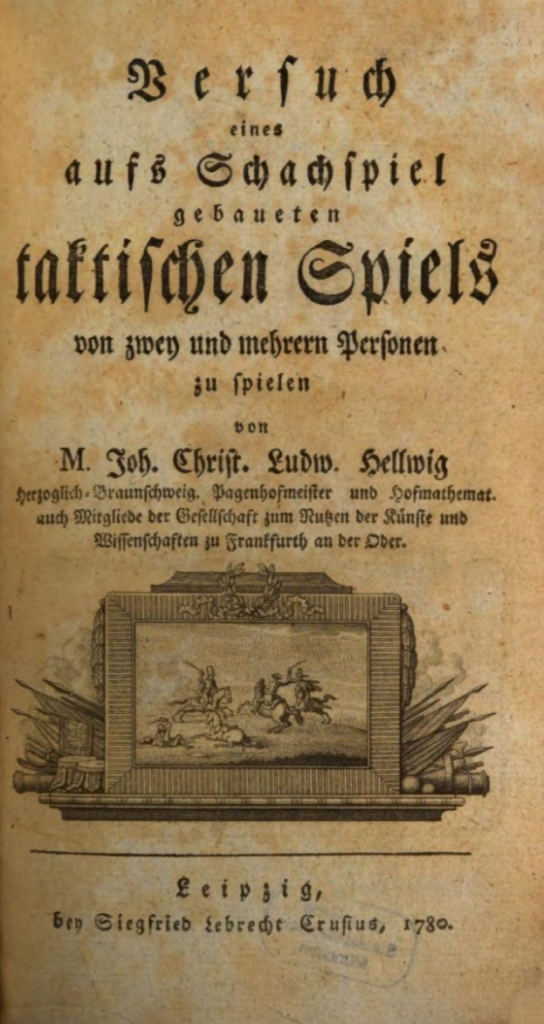
Johann Hellwig‘s 1780 “attempt at a tactical game” is generally considered the first wargame and has been since at least the 50s. The game has been reconstructed fairly recently, but I haven’t been able to find a complete translation, so I OCR’d the version held by the Bavarian State Library and machine-translated it.
I uploaded the Bavarian State Library’s version on archive.org as well.
Attempt at a Tactical Game Built Upon Chess
To be Played by Two or More Persons
By M. Johann Christian Ludwig Hellwig, Ducal Brunswick Page-Master and Court Mathematician, Member of the Society for the Promotion of Arts and Sciences at Frankfurt an der Oder.
Leipzig, 1780
Translated from the German original. Public domain work.
Dedication
Dedicated with most humble submission to His Serene Highness the Duke of Brunswick-Lüneburg.
By the Author.
List of Subscribers
His Serene Highness the Duke of Brunswick-Lüneburg, Duke Ferdinand of Brunswick-Lüneburg.
His Serene Highness the reigning Duke of Saxony-Gotha.
His Serene Highness the reigning Margrave of Baden.
His Serene Highness Prince Leopold of Brunswick-Lüneburg.
His Serene Highness the reigning Prince of Anhalt-Dessau.
His Serene Highness Prince Carl of Hessen-Cassel, General.
His Serene Highness Prince August of Saxony-Gotha.
His Royal Highness Frederick William, Prince of Prussia.
Herr Schneller, Lieutenant-Colonel of the Engineer Corps, Hereditary Brunswick.
Baron von Brandenstein in Werdau.
Herr Privy Councillor Darjes in Frankfurt an der Oder.
Herr Christian Wilhelm Hennig in Gera.
Herr Erhard Heinrich Hennig, ibid.
Herr Chief Postmaster Himmelmann in Cassel.
His Excellency Herr Privy Councillor Baron von Frankenberg in Gotha.
Herr von Rheetz, Ducal Brunswick Major-General and Knight of the Order of the Dannebrog.
Herr von Raumer, Royal Prussian Colonel and Commander of a regiment.
Herr von Rothenborg, Royal Danish Major of the Funen Regiment.
Herr von Varendorf, Royal Danish [officer], ibid.
Herr von Harbou, Royal Danish [officer], ibid.
Herr Fiolditz, Royal Danish Lieutenant, ibid.
Herr Öfenerfen, Royal Danish Lieutenant, ibid.
Herr von Bille-Tilliseh, Royal Danish Lieutenant, ibid.
Herr von Both, Royal Danish Chamberlain and Lieutenant, ibid.
Herr von Pinzer, Royal Danish Captain of the Artillery Corps.
Herr von Warnstädt, Ducal Brunswick Lieutenant-Colonel.
Herr von Grollmann, Royal Prussian Major and Commander of a cavalry regiment.
Herr von Schlaberndorf, Royal Prussian War Councillor at Küstrin.
Herr von Leyser, Royal Great British and Electoral Hanoverian Court Councillor in Celle.
Herr von Kotzebue, Captain in Erlangen.
Herr von Knebel, Chamberlain and Lieutenant in Ansbach.
Herr von Siegroth.
Herr Brehmer in Brunswick.
Herr Eynfer, Ducal Master of the Horse in Brunswick.
Herr von Blücher, Royal Danish Major-General, Knight of the Order of the Dannebrog, and Commander of the [Funen] Infantry Regiment.
Herr von Gersdorf, Royal Danish Major-General, Knight of the Order of the Dannebrog, and Commander of the Mön Infantry Regiment.
Herr von Destinon, Royal Danish Chamberlain and Lieutenant-Colonel of the [Funen] Infantry Regiment.
Herr von Czernikov, Lieutenant of the Royal Danish Artillery Corps.
Herr von Destinon, Royal Danish Major of the Mön Infantry Regiment.
Herr von Syburg, Royal Prussian Colonel and Commander of the [blank] Infantry Regiment.
Herr von Furtenbach, Lieutenant of the Royal Prussian [blank] Infantry Regiment.
[Several officers] of the Guard du Corps.
[Several officers] of the Saxon Life Grenadier Guards.
Herr von Thielau, [officer] of both [guards].
Baron von Brandenstein, ibid.
Herr von Staffen, Royal Danish Colonel of the [blank] regiment.
Herr von Wangenstein, [officer] of the Royal Danish Infantry Regiment Funen.
Herr Brokmann, Royal Danish War Assessor.
Herr Koppe, Professor in Göttingen.
Herr Count D. J. Neyron, ibid.
Herr von Florencourt, student, ibid.
Herr von Lenthe, Chamberlain in Gotha.
Herr von Veltheim, Ducal Brunswick Privy Legation Councillor.
Herr von Speth, Colonel of the Ducal Brunswick Troops in Canada.
Herr Schwaneflügel, Ducal Brunswick Lieutenant-Colonel.
Herr von Ditfurth, Major to His Most Serene Highness the Prince of Brunswick.
Herr von Görne, Lieutenant of the Royal Prussian Lossow Hussar Regiment.
Preface
The purpose of a tactical game is to make vivid the most important and significant events of the art of war. The larger the number of those who devote themselves to the art of war and understand its great importance, the more useful such a game becomes, even if it rests on one of the lower rungs toward perfection.
To cover the wings of the army with particular care; to maintain the communication between the various corps; after winning advantages, to exploit them with the utmost circumspection; to conduct a retreat that does not degenerate into shameful flight; to draw the greatest possible benefit from the nature of the terrain; to dislodge the enemy from his advantageous position through marches, diversions, seizure of magazines, etc.; to entice him into detaching forces and then to attack him when he has thereby weakened himself; not to give battle without cause before one has taken such measures as to be able to make proper use of victory — these and many other truths of the art of war this game demonstrates in a clear manner.
I have too much respect for the public and for my own honor to write anything whose groundlessness everyone might easily discover, and which could readily be refuted by palpable experience. But my readers will also be so fair as not to pass judgment on this game until they are in a position to play it themselves, or at least until they have watched others play it with sufficient attention. For whether a game is perfect or imperfect can surely only be judged when one has a tolerably complete overview of it as a whole.
The game, I confess, still has its imperfections. In order to be sufficiently useful to the general public, it would need to be easy to learn, it would need to take up little space, and not cost much. One will readily grant me that one can approach perfection more nearly when one has no conflicting constraints to contend with. When conflicts arise, a lesser evil is always a good thing if a greater evil is thereby avoided, even though a lesser evil remains an evil. This is the case with this game.
Allow me to cite an example. With the present arrangement of this game, the ratio of the size of a day’s march of a corps carrying artillery to the range of the artillery is as 4 to 3. Here the range is too great. The size of a day’s march should therefore either have been made larger, or the range of the artillery smaller. Had I assumed a smaller range, the artillery in this game would not produce proportionally the effect that is produced by that which it is meant to represent; but if I had wished to enlarge the day’s march and make it large enough that a suitable ratio of it to the range of the artillery would result, the plan would need to be at least sixteen times larger than it is now. At present it is approximately 11 square feet in area, and would therefore in that case be 176 square feet. How many people would there be who would have room to set up and play such a game? To avoid this inconvenience, that ratio remains, and with it at the same time several imperfections that would otherwise be overcome — of which I will mention only one further example, namely that I have had to assume the ranges of all pieces of artillery to be equal.
In order to facilitate the learning of this game, I had to reduce the number of rules as far as possible. This too has had an adverse effect on the perfection of this game. Had I not been constrained in this regard, I should have determined the alternating moves of the players quite differently from how it has now been done. But in that case, a hundred additional rules would scarcely have sufficed to specify the order of moves under a more natural arrangement.
These imperfections of the game will already be apparent from a mere reading of its description, and one may perhaps, without further examination, consider them so serious that one deems it not worth the trouble of investigating how great an influence these imperfections have upon the perfection of the game itself. But I beg one not to judge too hastily, but first to learn the game; then, if I do not flatter myself too much, the judgment of it will turn out more favorably than one might suppose from the imperfections indicated. At least this is an empirical finding to which not a single exception has yet contradicted.
But is the learning of it connected with difficulties? That is the great question, on whose answer it will depend how many will resolve to learn this game. The twelve-sheet description of it does not seem to recommend it in this regard. But this is only an appearance. Half of the Ducal Brunswick pages — who are all between thirteen and fifteen years of age — have learned this game from mere observation, and all play it at a tolerable degree of proficiency. Draw your own further conclusions.
It is not everyone’s talent to learn a science from a book without oral instruction. I may therefore not expect that everyone will learn this game from my description, however clearly I have sought to explain everything. But at most places there will be someone with sufficient patience and ability to think through these rules and to explain them orally to another person sufficiently that the latter can then help himself further by means of this description, provided he has some knowledge of chess.
I shall gladly hear proposals as to how the game might be perfected, whether through public periodicals or through letters, provided one is so kind as not to put me to any expense in the latter case.
It was with great pleasure that I learned, after the announcement of my invention, that others had had similar ideas. Herr Colonel von Raumer, of the Royal Prussian [blank] Infantry Regiment, wrote to me that some thirty years earlier he had devised a similar game, had played it with a good friend, and had even made progress in it, but that separation from that friend had brought an end to its continuation. From a letter from Professor and Captain Mauvillon in Cassel, I saw that someone in Darmstadt had had a similar idea, and had perhaps carried it out. Perhaps various inventions arise simultaneously and come to light together, giving rise to the greatest game.
May this game drive away the thoughts of those young warriors who fill their hours of idleness not with serious and worthy, but with mindless, ignoble pastimes! I desire no greater reward for my invention than this: in such a case, as I know from my own previous experience, the thinking head will always know what to do. The young warrior of this kind thereby acquires a pastime more worthy of him, highly entertaining and most agreeable, and at the same time a means by which he is brought closer to his great vocation and made attentive to it. This attentiveness can lead him to those means by which he can become that great man for whom nature laid the foundation within him, and who would otherwise perhaps remain uncultivated. For a man without a head, Faro, Vingt-un, Quinze, and the like will of course always remain the best entertainment.
Complete war-game sets may be ordered from the publisher of this description in Leipzig, and from me, for four pistoles, and better-made sets for five pistoles.
Dated the [blank] of October 1780.
The Author.
Table of Contents
I. General Considerations (§.1 to §.7 a)
- The purpose of a tactical game, §.1.
- The present game is only an imitation of a land war, §.2.
- The most important subjects of tactics are listed, §.3.
- The main classes of troops and their essential distinction, §.4.
- The nature of a theatre of war, §.5.
- The essentials of the equipment required for war, §.6.
- Other necessities of an army, §.7.
- This tactical game is founded upon chess, §.7 a.
II. What can be retained from chess for the tactical game, and what must be altered? (§.8 to §.21)
- The object of war. The victor, §.8.
- The conquest of the enemy’s country brings the war to a natural end, §.9.
- When a country is conquered, §.9 a.
- The outcome of the war represented by chess is not natural, §.10.
- A tactical game must end with the conquest of the enemy’s country and the fortresses lying therein, §.11.
- On making peace, §.12.
- On ending a great game by negotiated settlement, §.13.
- Some pieces from chess can serve as infantry, others as cavalry in the tactical game. Artillery does not exist in chess, §.14.
- The properties of some chess pieces must be somewhat altered for use in the tactical game, §.15.
- Why this change affects the pawn of chess, §.16.
- Reasons for introducing several more pieces into the tactical game that do not exist in chess, §.17.
- All chess pieces are found also in the tactical game, except the king, §.18.
- The war-game must differ from chess in that in the former, larger parts of the whole can move simultaneously, §.19.
- In the tactical game one does not warn one’s opponent, §.20.
- In the war-game the moves also take place alternately, §.21.
III. On the nature of the plan upon which the theatre of war is depicted in the tactical game (§.22 to §.30)
- On the terrain for chess all parts are of the same kind: this must be changed for the war-game, §.22.
- Designation of the parts of the terrain in the war-game which nature has provided with no obstacles, or only insignificant ones, §.23.
- Designation of completely impassable terrain, e.g. high trackless mountains, §.24.
- Designation of deep marshy places that cannot therefore be crossed, §.25.
- We assume in the tactical game that there is no time to make the places in §.24 and §.25 passable, §.26.
- Defiles, §.27.
- Bodies of water, §.28.
- Buildings, villages, and towns, §.29.
- The war-game is played according to the first or the second school, §.30.
IV. On the nature of the pieces by which the movement of troops is imitated in the war-game (§.31 to §.42 a)
- Pieces retained from chess for the tactical game, §.31.
- Their designation on the engraved plates belonging to this description, §.31 a.
- In capturing pieces in the war-game, the method remains as in chess, §.32.
- Conditions under which some of these pieces can capture several enemy pieces in a single move, §§.33, 34.
- Pieces that can never capture more than one enemy piece in a single move, §.35.
- Movement of the pawn in the war-game, §§.36, 37, 38, 39, 39 a.
- The pawn remains in the tactical game what it was at the beginning of the game, §.40.
- Pieces for the tactical game not found in chess, §§.41, 41 a, 42.
- Classification of the pieces, §.42 a.
V. On the Artillery (§.43 to §.73)
- Description of the device used in the war-game to represent artillery, §.43.
- The device described in the preceding § represents cannons, §.44.
- The movement of the artillery device, §.45.
- Effect of the artillery device on the terrain. The position of the artillerists. Artillerists, §.46.
- Designation of this device on the engraved plates belonging to the description. Fields exposed to the effect of artillery. Area of effect. Effect of [artillery], §§.47, 47 a, 48.
- Effect of the artillery on enemy forces, §§.49, 49 a, 49 b, 50.
- Moving the artillery counts as one move; so does its effect, §.51.
- Freedom of the owner of the artillery, §.52.
- In how far several artillery devices can be moved simultaneously without this movement counting as more than one move, §.53.
- Artillery is driven from its position by a stronger [force] of the enemy, §§.54–58.
- How the effect of artillery is impeded by the terrain, §.59.
- Ricochet shots, §.60.
- Wheeling of the artillery, §§.61 [to 63].
- This counts as one move, §.64.
- Variety of cannons, §.65.
- On howitzers, §.66.
- Combined artillery, §§.67–69.
- How one takes the enemy’s artillery from him, §§.70, 70 a.
- Mobility and immobility of the device, §.71.
- How we render our artillery useless so that it does not fall into the enemy’s hands, §§.72, 72 a, 73.
VI. On the effect of howitzer fire on buildings (§.74 to §.81)
- How a building is set on fire. Designation, spread of the fire. Resulting change in the terrain, §§.74–76.
- Demolishing buildings to prevent the spread of fire, §§.77, 80.
- Purpose of setting fire, §.81.
VII. On the movement of several pieces simultaneously, to imitate the movement of entire corps (§.83 to §.102)
- The transporter, §§.83–85.
- When the transporter can be moved, §.86.
- How the transporter can be moved, §.87.
- Where one cannot move the transporter, §.88.
- What one can place on the transporter, §.89.
- What one can move simultaneously with the transporter in addition to the pieces, §.90.
- A transporter can be moved while under enemy fire, §§.91, 92.
- One cannot move the transporter and leave the piece on it behind in its place, §.93.
- A piece on the transporter can move off it individually, §.94.
- Wheeling with the transporter, §§.95, 96.
- When the movement of one or more transporters together with one or more artillery devices can occur in one move, §§.97, 97 a, 98.
- A transporter occupied by pieces of both players is immovable, §.99.
- Movement with the transporter counts as one move, §.100.
- When one can remove the transporter from the game, §.101.
- A further special advantage of a transporter, §.102.
VIII. On Entrenchment (§.103 to §.134)
- Purpose of entrenchment. Consideration regarding a suitable sign for it in the war-game, §.103.
- The sign, §.104.
- A breastwork. To entrench oneself, §.105.
- How this is done, §.106.
- The sign of a breastwork to illustrate this description, §.106 a.
- The entrenchng piece, §.107.
- No piece can entrench a position without regard to its distance from it. This distance is determined, §.108.
- All pieces have the authority to entrench a position. How this can be done by the pawn, §.109.
- What an entrenched position effects with respect to the movement of pieces and [enemy action], §.110.
- What it effects with respect to enemy artillery, §.111.
- What it effects with respect to one’s own artillery placed behind the breastwork, §.112.
- When the purpose we wish to achieve through a breastwork ceases, §.113.
- By what means a breastwork can be defended, §.114.
- How a breastwork is defended by artillery, §.115.
- The defense of a breastwork by [infantry], §.116.
- By what means a breastwork can be attacked, §.116 b.
- How a breastwork is attacked by artillery, §.116 c.
- The attack of a breastwork by [infantry], §.117.
- When one can seize a breastwork, §.118.
- Occupying an abandoned redoubt, §.119.
- How the obstacles laid by a breastwork are to be cleared away, §.120.
- How one ruins an occupied breastwork, §.121.
- Another means, §.122.
- In how many moves a breastwork can be ruined by artillery, §§.123, 124.
- The strength of the defense of a breastwork by pieces, §§.125, 126.
- The strength of the attack on a breastwork by pieces, §.127.
- Comparison of the strength of the attack with the strength of the defense, §.128.
- Escalade of a redoubt, §§.129–134.
- A position attacked just as strongly by enemy pieces as it is defended cannot be entrenched, §.134 a.
- Nor can a position lying within the area of effect of enemy artillery; but a position lying within the area of effect of our own artillery can be entrenched even if it were attacked by enemy pieces just as strongly, §.134 b.
- A breastwork prevents wheeling over a position on which it lies, §.134 c.
- Positions that can be entrenched, §.134 d.
- A case when part of the surface of a transporter is entrenched, §.134 e.
- Breastworks that are found ready-made [on the plan], §.134 f.
IX. On Bridges in General (§.135 to §.152)
- Nature of the bodies of water assumed on the plan used for the war-game. Bridges. Bridge-transporters, §.135.
- Explanation of the sign of a bridge-transporter and of the bridges belonging to it, §.136.
- Main face and auxiliary face of the bridge-transporter, §.136 a.
- Each face of the bridge-transporter can be occupied by pieces. The bridge-transporter is moved like the artillery device, §.137.
- A case in which the bridge-transporter can be used like another transporter, §.138.
- Immovability of the bridge-transporter and the bridges on it when not occupied by any piece, §.139.
- The movement of the bridge-transporter or of a bridge lying on it counts as one move, §.140.
- [Illustration of bridge-transporter signs] for the clarification of this description, §.141.
- Throwing a bridge, §§.142, 143.
- The main face of a bridge-transporter must be occupied by a piece if one wishes to take a bridge from it in order to throw it across a river, §.144.
- The position of a bridge-transporter when a bridge is to be taken from it and thrown, §§.145, 146.
- Effect of a thrown bridge, §.146.
- An unoccupied bridge-transporter is treated as passable terrain, §.147.
- Wherein bridge-transporters agree with the other transporters, §.148.
- A bridge-transporter whose surface has been entrenched, §.149.
- When bridge-transporters stand one above another, how they are to be moved, §.150.
- In how far occupied bridge-transporters do not prevent bridges from being taken from them and thrown across a river, §§.151, 152.
X. On the Demolition of Bridges (§.153 to §.158 a)
- To demolish a bridge, §.153.
- Who can demolish a bridge, §.154.
- Demolishing a bridge counts as one move, §.155.
- What is to be observed in the demolition of a bridge, §§.156, 157, 158, 158 a.
XI. On the Destruction of Bridges (§.159 to §.166 a)
- To destroy a bridge, §.159.
- Distinction between the demolition and the destruction of bridges, §.159 a.
- The first means of destroying a bridge, §§.160, 160 a.
- The second means, §.161.
- The third means, §.162.
- The fourth means, §§.163, 163 a, 164 b, 164 c.
- The fifth means, §.164 a.
- The sixth means, §.167.
- The seventh means, §.166.
- The eighth means, §.166 a.
XII. On the means of preventing the throwing, demolition, and destruction of bridges.
XIII. On those objects that place obstacles in the way of the free movement of pieces (§.168 to §.180)
- These obstacles arise from the terrain, from pieces, from devices, and from certain arrangements made expressly on the terrain for this purpose, §§.168, 169.
- Obstacles of the terrain, §§.170, 171.
- In how far they affect the knight, §.172.
- Obstacles to wheeling in broken terrain, §§.173, 174, 174 a, 175, 176.
- Obstacles that pieces can place in the way of movement, §.177.
- Obstacles that devices place in the way of movement, §.178.
- Arrangements expressly made on the terrain to prevent movements, §.179.
- Obstacles to which the effects of artillery are subject, §.180.
XIV. On Moves, §.181.
XV. On the Cutting-off of an Enemy Corps and the Resulting Capture of the Same (§.182 to §.184)
XVI. On the Fortress, its Conquest, and the End of the Game Thereby (§.185 to §.190)
- How the game ends, §.185.
- The fortresses lying on the plan are explained, §.186.
- How a fortress is conquered in the war-game, §§.187, 188.
- Rules by which a fortress in the war-game is compelled to surrender through lack of provisions, §§.189, 190.
XVII. On the Number of Pieces and Devices, etc., belonging to a War-Game, on certain further related Remarks, and on the Plan on which the War-Game is Played (§.191 to §.200)
- Both players have equal advantages at the start of the game, §.191.
- What each player has in pieces, devices, etc., §.192.
- Colour and base of the pieces, §.193.
- Some remarks on the manufacture of transporters, bridge-transporters, etc., §§.194–196.
- By what one distinguishes the devices, etc., of one player from those of the other, §.197.
- The plan on which the war-game is played, §.198.
- The boundary of both players on the plan. Countries and provinces of each, §.199.
- Description of a [plan] convenient for [the game], §.200.
XVIII. On Setting Up the Pieces and Devices on the Plan (§.201 to §.216)
- The armies of both players have the same formation at the start of the game, §.201.
- The game is played according to the first or the second school, §.202.
- Sorting the pieces, devices, and signs, assuming they are lying mixed together in disorder, §§.203, 204, 205.
- Repetition of the signs one must understand when one wishes to set up the game, §.206.
- What must be agreed upon before setting up the game, §.207.
- How to view the formation taken before the start of the game, §.208.
- What the first or the second formation is, §.209.
- Setting up the game according to the first and according to the second formation, §§.210, 211.
- Rules to be observed when setting up, if everything is to be done with precision, §§.212, 213.
- List of pieces, devices, etc., which are found on the five tables required for setting up the game, §.214.
- Setting up the game is easy, §.215.
- One draws lots for the first move, §.216.
XIX. A Method by which the War-Game can be Played by Four Persons (§.217 to §.233)
- Two players play against two others, §§.217, 218.
- One of them draws up the plan for the whole campaign, §.219.
- Deliberation of the two allied players regarding the continuation of the campaign, §.220.
- When playing in fours, the game is set up according to the first formation, §.221.
- The dividing face of the plan, §.222.
- Its purpose, §§.223, 224, 225.
- A circumstance of which the allied players can audibly inform one another, §.226.
- Order of moves, §.227.
- How long this applies, and when it must be altered, §§.228–232.
- When a game of four becomes a game of two, §.233.
XX. On the Tactical Game in the Second School (§.234 to §.239)
- The objects with which the second school additionally concerns itself are heights and the provisioning of troops, §.234.
- On heights, §.235.
- Only two kinds of heights are distinguished, §§.236, 237.
- Advantage of heights in the war-game with respect to artillery, §§.238, 239.
XXI. On the Provisioning of Troops in the War-Game (§.240 to §.253)
- What we assume regarding the maintenance of troops when we play the game according to the first school, §.240.
- General consideration on the surest maintenance of troops, §§.241, 242.
- Location of the main magazine, §.243.
- Establishing a depot. Sign we use for this purpose, §.244.
- Where a depot may be placed, §.245.
- A depot does not make a position impassable, §.246.
- Condition under which a depot may be placed in a position, §.247.
- Area of effect of a depot, §.248.
- Which troops must be within the area of effect of a depot, §.249.
- Means of destroying a depot, §.250.
- Consequence thereof, §.251.
- Capture of a depot, §.252.
- A further consequence when a depot has been destroyed or captured, §.253.
XXII. On the Communication of the Depot with the Main Magazine (§.255 to §.259)
- It is not necessary to introduce signs to indicate the actual transport of supplies from the main magazine to the depots, §.255.
- Communication of depots with the main magazine by land and by water, §.256.
- Interrupted communication by water, §.257.
- Interrupted communication by land, §.258.
- Consequences of interrupted and unrestored communication, §.259.
XXIII. Means of designating various further kinds of terrain, and of altering the plan without verbosity (§.260 to §.262)
I. General Considerations
§.1.
The purpose of a tactical game is to make vivid the essentials of the most important episodes of war. The more closely nature is imitated, the nearer the game will approach its perfection.
It does not seem to me superfluous to set forth some general principles on which I have based this imitation. They also serve to enable one to judge how close I have come to the goal I set myself.
§.2.
With respect to the theatre on which wars are conducted, it is customary to divide them into naval and land wars. The imitation of a naval war lies entirely outside the scope of this tactical game.
§.3.
The nature of the troops (§.4), the terrain (§.5), and the equipment required for war (§§.6, 7) are general headings under which the greatest and most important part of all the subjects of tactics can be brought. Let some general considerations on these objects therefore precede.
§.4.
There is infantry, cavalry, and artillery. These various kinds of troops will form the three main classes, whose distinction is contained in the following propositions:
- Infantry cannot undertake movements as rapid as those of cavalry.
- The greater weight of a cavalryman, arising from the union with his horse, and his superior speed for the same reason, makes the charge of cavalry more effective than the assault of infantry, provided the circumstances are otherwise equal.
- Infantry and cavalry cause harm chiefly on the spot that they occupy through their movement. Fire from small arms makes no exception to this, since its effect at any distance is of no significance.
- Artillerists cause harm at a noticeable distance, by means of specially constructed machines.
It follows from this that a tactical game, if it is to have any value, must represent and make clear this distinction among troops.
§.5.
In the nature of a theatre of war (§.3) we find that some parts of it place no obstacle in the way of the movements of troops and the effects of their machines acting at a distance, while others have the opposite effect. These obstacles can sometimes be removed, but not always — the time available often does not permit it. It is established that this property of the terrain can, depending on circumstances, bring benefit or harm. Therefore in a tactical game, when devising a plan on which the theatre of war is depicted, account must be taken of this matter and this distinction must be made visible.
§.6.
Concerning the equipment required for war (§.3), little of a general nature can be said. The purposes to be achieved thereby differ too much from one another; nevertheless, without any loss of perfection in the tactical game, they can be reduced to a very small number. But all agree in this:
- That they have no movement of their own, but that both this and all changes to be made with them depend on the arbitrary decisions of persons.
- That their movement is much slower than the movement of troops, and that they therefore place many kinds of obstacles in the way of the free movement of the army.
These truths must not be lost sight of in the tactical game.
§.7.
The needs of an army, which one distinguishes from its necessary equipment, are very manifold. The men and animals with it require various kinds of sustenance. But it would be superfluous in the tactical game to attend to the variety of these needs and to all the equipment belonging to them. It is enough to unite them all under the general name of “necessities,” to arrange the procurement as well as the distribution thereof in a manner suited to the nature of this subject, and yet to keep the law of greatest brevity in view when imitating.
§.7 a.
Since I wish to found my tactical game as far as possible upon chess, I must examine what can be retained from chess and what must be altered.
II. What Can Be Retained from Chess for the Tactical Game, and What Must Be Altered?
§.8.
In war, one seeks to enforce one’s rights by force of arms. The victor is he whose arms maintain the upper hand. But this can never always be inferred with certainty from the lesser loss in troops or resources.
§.9.
The most natural way to end the war even against the enemy’s will is to deprive him of those means without which he cannot wage war. But each of the warring parties draws these principally from his own country. The conquest of the enemy’s country must therefore bring the war to a natural end.
§.9 a.
One has not yet conquered a country merely by having penetrated into it; one must also be able to maintain possession of it with ease, if one wishes with justice to claim the honor of having conquered a country. The enemy’s country can therefore only be called conquered when we have taken possession of the fortresses in which those necessities belonging to war, which an army must have close at hand, can be safely kept. The natural outcome of war thus depends on the conquest of the fortresses of a country. The enemy is therefore not yet wholly defeated as long as he can maintain himself in possession of a fortress of any importance.
§.10.
If we compare this natural outcome of war with that by which the war represented in chess is ended, we find an important difference. Chess stipulates that the capture of a piece called the king shall entail the loss of the entire game. But since the loss of one person, even if he should be the first in the state, never absolutely causes the rest to lay down their arms, the outcome of the war represented by chess is not natural.
§.11.
If therefore in the tactical game we wish to approach nature as closely as possible, we must base the means of overcoming the opponent on the principles established in §.9 and §.9 a, and in this respect depart entirely from chess. The tactical game must consequently end with the conquest of the enemy’s country and the fortresses lying therein.
§.12.
One can also end the war by the agreement of both sides, or make peace. In this case one cannot say that one party has been entirely defeated. The most common case, as with all settlements, is that both parties give way somewhat on their demands, and it is customary for the party that finds no advantage in continuing the war to cede some land to the opponent, or to pay a sum of money, or to formally renounce certain claims.
Whatever means one uses to bring one’s opponent to desist from continuing the war, the purpose is always the same: to obtain a greater advantage by accepting a smaller one.
§.13.
[Games] whose successful execution depends solely on the knowledge and skill that the players acquire through practice have enough attraction in themselves without mixing material self-interest into the matter. One will therefore be able to play the tactical game with the greatest attention without playing for money. If one does play for money, the whole of the staked sum falls to the player who has completely overcome his opponent. If the game ends through a negotiated settlement — the imitated war through a peace treaty — the victor receives a part of the prize, of whatever size may be agreed upon by mutual consent. This is clear and comprehensible without my reminder.
But if one plays the tactical game for pleasure, content with the honor of having overcome one’s opponent, I propose the following means of recognizing the winning party from the defeated at the continuation of the tactical entertainment:
- Each player shall have flags made of different sizes, in the color of the troops with which he plays.
- If the game ends with the complete defeat of the opponent, the winner receives from the defeated a large flag, which he places in his fortress at the start of a new game.
- If the war ends through a peace treaty, the winner receives one or more small flags.
- If it is agreed that 4 small flags shall count as one large one, then the winner through a peace treaty can receive at most three small flags.
- If fortune reverses in a new war, the former victor returns the victory-trophies received, in proportion to the magnitude of his present defeat — some or perhaps even all of them — and may perhaps be compelled to surrender to the enemy some of his own flags as well.
§.14.
The tactical game must make the essential distinction between infantry, cavalry, and artillery vivid (§.4). But since we also wish, as far as possible, to found it upon chess (§.7 a), we must examine what, in this regard, can be retained from chess for the tactical game. The following propositions are beyond dispute:
- The queen, the rook, and the bishop of chess, on account of their speed, in which they surpass the pawns and knights, could serve in the tactical game as cavalry; but the pawns and knights, on account of their opposite nature, as infantry.
- In chess there are no machines by which the effect of artillery could be represented (§.4, no. 4).
§.15.
The charge of cavalry is more effective than that of infantry, when circumstances are otherwise equal (§.4, no. 2). But in chess, a move undertaken by the queen, rook, or bishop can at most take only one enemy piece — as is also the case with the pawn and the knight; so in chess, cavalry has over infantry no advantage in this respect that it rightfully ought to have by its nature. If then one wishes to use the queen, rook, and bishop as cavalry in the tactical game, one must alter the nature of these pieces so that their charge, under certain circumstances, achieves more than the attack of the pawns and knights. This can be done by granting them, under certain conditions, the liberty to cut down several enemies in a single move, which does not happen in chess. I will explain this alteration more precisely below.
§.16.
The pawn in chess moves only forward and never changes its front. For the war-game this would be a most unnatural restriction. If therefore the pawn of chess is also to be retained in the tactical game, this cannot be done without some alteration of it.
§.17.
The queen of chess is a piece composed of the rook and the bishop; she is therefore less restricted than either of these simple pieces, and consequently a more perfect representation of cavalry. It would therefore not be inappropriate to introduce still more composite pieces in the tactical game besides the queen.
§.18.
Thus the queen, rook, and bishop are retained as cavalry, and the knight and pawn as infantry in the tactical game; the king, however, as indicated in (§.10 and §.11), is omitted. And so only a suitable sign for the artillery in the tactical game still needed to be added to those already in chess, as well as any further [pieces] required by the purposes [of the game].
§.19.
If we observe the movement of the troops of an army with some attention, we find that entire corps, consisting of varying numbers of individual soldiers, move simultaneously. The war-game must therefore differ from chess in that in the former, larger parts of the whole can move simultaneously than in chess.
§.20.
In chess one often warns one’s opponent of the danger confronting him. In the tactical game this is dropped for natural reasons.
§.21.
The players in chess move their troops alternately. This too seems not well suited to the nature of war; it has rather the appearance of both parties being thereby restricted in the freedom to move. Nevertheless, this rule must be retained in order to avoid a great quantity of rules that such an alteration would entail. Considering that in most cases the movement of the enemy must determine our counter-movement, I do not find this arrangement so unnatural as it might seem at first glance. If one considers further that in the tactical game arrangements will be made so that corps of varying strength can move simultaneously — that is, in one move (§.19) — so much of the unnaturalness in this arrangement falls away that the remainder deserves to be taken into consideration.
III. On the Nature of the Plan Upon Which the Theatre of War is Depicted in the Tactical Game
§.22.
The surface on which chess is played is a square divided into 64 smaller equal squares, which are distinguished from one another by two different colors according to the well-known rule. On this surface the pieces of chess move without encountering any semblance of the obstacles that exist in nature and that are almost always of the most important influence on the whole (§.5). In this respect it is therefore similar to a place on which troops first learn the simplest evolutions — a place in the choice of which one must look for a not noticeably interrupted level ground, so that the commander, who here takes the place of a teacher, may more easily survey even the smallest errors. In short, this surface is a parade ground, not a theatre of war. The surface belonging to the tactical game is likewise divided into equal squares. But the most important obstacles of a terrain have been made visible on it by various illuminations, and where these did not suffice, by added signs.
§.23.
Some squares of the plan belonging to the tactical game, contained on the third plate, are black and others white, as on the chess board. I call these the main colors of the plan. On these the troops move as freely as the nature of their movement always allows. They are parts of the terrain that nature has furnished with no obstacles, or only entirely insignificant ones.
§.24.
Other squares are entirely illuminated in red and designate terrain that one cannot occupy nor pass through, on account of the natural obstacles lying thereon. The artillery also has no effect beyond such terrain. Under this sign one can therefore imagine high trackless mountains. Terrain of this kind is found on the plan over squares 82, 114, 115, 306, 381, etc.
§.25.
Deep, marshy, and boggy places likewise prevent passage, but one can nevertheless fire artillery over such ground and consequently act on the far side of it, if the distance does not otherwise forbid it. It was therefore necessary to distinguish such places from those mentioned in the preceding paragraph; hence I have illuminated places of this kind entirely in green. Such places are found on the plan over squares 221, 222, 19, 160, etc.
§.26.
In my tactical game it is assumed, regarding both kinds of impassable terrain (§§.24 and 25), that there is not time enough to remove the obstacles and make it passable (§.5).
§.27.
Squares illuminated in red or green, not far from one another and separated by black and white fields, therefore form defiles. Thus in the plan, squares 25, 26, 27, and 28, 123, 224, 406, etc. lie in defiles.
§.28.
Bodies of water in a terrain demand the greatest attention in war. I have illuminated these blue on the plan, and have assumed that they are so deep that one can pass through them neither on foot nor on horseback.
§.29.
The squares divided by diagonal lines into triangles, of which one half is illuminated in red and the other is white, signify buildings. Hence various adjacent squares of this kind, depending on the remaining circumstances, constitute either towns or villages. Buildings of this kind are found on the plan over squares 514, 565, 564, 563, 516, etc. These buildings do not make the terrain on which they stand impassable, since one assumes here that the passage goes between them. They are therefore, in this respect, of the same nature as the terrain illuminated by the main colors (§.23). But where they differ from these is that they can be set on fire and the troops therein thereby driven out.
§.30.
In order not to discourage the learner of the tactical game through too great a variety of objects, I divide the game into two schools. The rules are the same for both; only the first school has fewer objects than the second, which I intend to treat separately at the end of this description. I mention this here so that if one misses among the obstacles of the terrain the heights — which I reserve for the second school — this will be understood.
IV. On the Nature of the Pieces by Which the Movement of Troops is Imitated in the War-Game
§.31.
All pieces of chess are found also in the tactical game, namely:
§.31 a.
By the Latin letters assigned to the pieces in the preceding §, I designate them on the engraved plates. Thus, for example, square 290 on the plate is marked K. One may imagine the field further marked by queen, rook, etc.
§.32.
With respect to the manner of capturing pieces, everything remains as in chess. We capture enemy pieces by removing them and occupying the place of the captured piece.
§.33.
With regard to how many enemy pieces the queen, rook, and bishop can capture in one move — this has been somewhat altered, since they serve in the war-game as cavalry.
The pieces serving as cavalry in the war-game can capture, at will, as many enemy pieces as they encounter unprotected in a straight line. The attacking piece, in this case, takes the position of the last enemy piece it captured in this move.
§.34.
I will illustrate this case with examples.
- If on the second plate a rook stands on 195, a knight on 153, and another rook on 132, these are all captured in one move by the enemy bishop attacking from 237 against the rook on 195, provided the pieces on 195, 153, and 132 are not protected. The attacking bishop thereby arrives at 132. Nevertheless it is at his option also to take only the rook standing on 195 and the knight on 153 in one move, in which case he occupies the knight’s square. If it is in his interest to capture only the rook standing on 195, this freedom too remains available to him.
- The bishop standing on 237 could have taken the rook standing over 195, but from there could not have taken in one move the knights standing on 218 and 241, even if he found them unprotected, because the latter do not lie in the straight line that the bishop must traverse when attacking from 237.
- If the queen standing on 280 attacks the rook on 236, and the queen is not first taken by this rook, and she then takes this rook, she can in the same move also take the bishop and knight standing on 192 and 170, if they are protected by no piece other than the rook on 236. For by the queen’s taking the rook, the pieces standing on 192 and 170 lose their protection, on the assumption that they are protected by no other piece.
§.35.
The knights and pawns can never capture more than one piece in a single move (§.4, no. 2).
§.36.
The pawn, as long as it moves individually, moves forward, and — on account of §.16 — also backward and sideways, to the nearest square. In other respects it moves as in chess, only diagonally. This restriction brings the pawns closer to the idea they are meant to represent. They remain infantrymen who move not only on their own, but also [in formation]. This [formation movement is explained in the following section].
§.37.
I have, however, found it necessary to give the pawn yet another mode of movement. This happens by means of a wheeling maneuver. In order to make visible the change that this mode of movement produces, it was necessary to mark the front of each pawn; a spot of ink at the front of the head and at the front of the foot, or on the base of the pawn, is sufficient to mark pawns made in the usual manner for this purpose.
§.38.
I will illustrate the movement of the pawn with examples:
- The pawn b stands on plate 2 at square 185, and turns its front toward the direction the upper part of b indicates, namely toward side AB of the plate; it then captures on 164 and 162, and can move from 185 to either 163, 184, 207, or 186. But it does not thereby change its front. This still remains turned toward side AB.
- The pawn stands on 190 and turns its front toward AB as before; it can then:
a) Turn left — that is, it remains on 190 but turns its front toward side AC of the plate, which makes it possible in the next move to capture on 85 and 211, etc.
b) Turn right — it remains on 190 but turns its front toward side BD of the plate. In the next move it will thereby be possible to capture on 213, etc.
§.39.
Each move of the pawn consists of either no. 1 or no. 2 from §.38.
§.39 a.
A pawn standing on 190 and facing toward AB, can therefore in two moves change its front in such a way as to face toward CD, which at the same time makes it possible for it to capture on [the corresponding squares]. It thereby attains the same position as if it had turned right or left in one move.
§.40.
The pawn in chess, having advanced to the last rank of the enemy’s territory, would be useless in [the tactical game], because according to the rules of that game it cannot return from there. This led the inventor [of chess] to transform the pawn that had advanced so far — a transformation that does not accord with the dignity of the game. The pawn therefore remains in the tactical game what it was at the beginning of the game.
§.41.
On account of the reason given in §.17, I have also introduced into the tactical game queens, rooks, and bishops combined with the knight’s move. Queens with the knight’s move may be called leaping queens — SK; rooks with the knight’s move, elephants — E; and bishops with the knight’s move, leaping bishops — SL. Those who care more for words than for substance may name them differently. These new pieces move according to the nature of those from which they are composed, but in any one move only according to the property of one simple piece. For example, if on the second plate the leaping bishop standing on 202 moves as a bishop to 271, he cannot continue the same move as a knight, and consequently cannot from there reach 291, 314, etc. If in another move he moves as a knight, he cannot continue this as a bishop, etc.
§.41 a.
- The third piece on the first plate represents a leaping queen, the fourth an elephant, and the fifth a leaping bishop, as I have had these pieces made for myself.
- By the letters SK, E, SL placed beside the leaping queen, the elephant, and the leaping bishop in the preceding §, I designate these pieces on the engraved plates.
§.42.
What was said in §.33 about the queen, rook, and bishop applies also to the leaping queen, the elephant, and the leaping bishop. These too can therefore cut down in one move as many enemies as they encounter unprotected in a straight line.
§.42 a.
The cavalry in the tactical game therefore consists of queens, rooks, and bishops. The infantry consists of knights and pawns. And the troops composed of both cavalry and infantry consist of leaping queens, elephants, and leaping bishops.
II. The aforementioned pieces can further be classified as follows, namely into:
A. Simple pieces. These are:
- the pawn,
- the knight,
- the rook,
- the bishop,
- the queen.
B. Doubly composite pieces. These are:
- the queen [rook + bishop],
- the elephant [rook + knight],
- the leaping bishop [bishop + knight].
C. Triply composite pieces:
- the leaping queen is the only piece of this kind [queen + knight = rook + bishop + knight].
This distinction must be noted in order to determine the strength of the defense of a breastwork or bridge, etc.
III. Individual pieces do not represent individual cavalrymen or infantrymen, but a number of them.
V. On the Artillery
§.43.
In order that my explanation of how the use of artillery is imitated in this game may be as readily comprehensible as possible, I will here first describe the device I use to represent it. See the sixth figure on the first plate. A thin rectangular board (parallelepipedum), as wide as and twice as long as the side of one square of the plan belonging to the tactical game (Table III), forms the base of this device. Let the surface of this board be called abcd; divide it by [a line] ef into two equal square portions.
On the surface abcd of this board, fix a cube in the half abef, cut or beveled diagonally on one of the three faces ab, bg, or fg. Color the cube green, and stipple the surface acef in black. In the center of this surface acef, fix it with a thin pin, whose color must determine to which of the two players the device belongs. This pin is movable and stands, when playing is in progress and circumstances do not require any change, perpendicularly on the surface acef. It serves partly for convenience when advancing the device, and partly also to draw the opponent’s attention to it, and to the surface acef to which it is attached. If one inserts some pin-needles ikm into the face of the cube opposite the beveled surface, parallel to the base of the device, and bends them over the small face otky, the knobs lmn thereof are turned toward the direction in which the slope of the cube descends, and the device is ready, as I have had it made for my own use. I will now describe its use. From this the essential [features] will be clear, and one will thereby be in a position to modify it, while retaining the essentials, in whatever way one’s skill and ability for improvement may suggest.
§.44.
The artillery, whose representation I described in the preceding paragraph, occupies two squares of the plan and represents cannons. The device is placed with its train above the corresponding squares.
§.45.
The movement of the artillery device is like the movement of the rook in chess, but more restricted, in that it can be moved at most to the 4th square, counting from the square on which it stands. For example, the artillery device placed in the second plate over squares 319 and 320 can therefore be moved in one move only:
I. Forward: to 297 and 298; 275 and 276; 253 and 254; 231 and 232.
II. To the right side: to 320 and 321; 321 and 322; 322 and 323; 323 and 324.
III. To the left side: to 319 and 318; 318 and 317; 317 and 316; 316 and 315.
IV. Backward: to 341 and 342; 363 and 364; 385 and 386; 407 and 408.
§.46.
The part of the device that actually contains the artillery makes the position on which it stands impassable for as long as it is located there (§.6, no. 3), just as if that position had been illuminated green (§.25). On the other hand, the surface acef, where the pin is fixed, can be passed over just as freely as the main-colored terrain. The surface acef is therefore just as passable as terrain that has no obstacles (§.23). I have thus designed [the device] so that the part on which the artillery actually stands makes the position impassable. But if the surface acef is occupied by a piece of whatever kind it may be, the device can be moved with the piece on it according to §.45, and can produce on the spot the effect which I will explain below. I will therefore call the surface acef on this device, for brevity, the artillerists’ position, and the pieces occupying this position, as long as they are on it, artillerists. These artillerists are those on whom the movement and effect of the device — of which I will now give a more detailed account — depend.
§.47.
Let the artillery device stand, for example in the second plate, over squares 282 and 283. The part of the sign of the artillery device located over 282 designates the surface fitted with the pin, that is the artillerists’ position, which in this case is occupied by a knight; but the part located over 283 designates the cube or the artillery proper. The slope of this cube descends toward the direction where the knobs lmn are found, thus in this case toward 261, 239, and 217. These three squares lying beneath the standing artillery are exposed to its effect. I will henceforth call three such adjacent squares swept by the artillery the area of effect of the artillery. Everything of enemy troops that is found on the three squares of this area of effect is, when it is the owner of this artillery’s turn, removed in one move, without either the device or the artillerists on it being moved. (§.4, no. 4.)
§.47 a.
It is at the owner of the artillery’s discretion whether he wishes to have the artillery act on the whole area of effect, or only on part of it. Thus, for example, the artillery on square 283 of the second plate can destroy what stands on 239, while leaving untouched what stands on 261.
Since the area of effect of the artillery is located only on one side of the device — namely on the side toward which the slope of the cube descends — one can be very close to it on the remaining sides without having to fear any danger from its proximity. So, for example, with the position of the artillery given in §.47, enemy troops can be on squares 262, 284, 306, 305, and 304 of the second plate without running any danger from this artillery, as long as its position is not changed.
§.48.
[The area of effect consists of three squares in a line extending from the artillery. What lies within this area is removed on the owner’s turn without moving the device or artillerists.]
§.49.
The effect of the artillery also extends to enemy artillery that comes into the area of effect of ours. Naturally, and when circumstances are equal, our artillery, having already taken up a position, prevents the enemy artillery from establishing itself in our area of effect. If therefore the enemy artillery ventures — through an oversight, or in the hope of remaining undetected — into our area of effect, it will, when we notice this, be destroyed, and the device is removed from the game to indicate this.
But if the enemy artillery has the good fortune of not being detected by ours, and our artillery finds itself within the enemy’s area of effect, then ours — when the opponent’s turn comes — suffers the same adverse fate that in the reverse case the enemy’s would have suffered.
§.49 a.
The enemy artillery can come into the area of effect of ours, while the artillerists belonging to it are outside of it. If in this case the artillery is destroyed, the artillerists remain standing at the same position on the plan, and the device is removed from beneath them.
Furthermore:
- If the enemy artillerists without their artillery come into the area of effect of ours, these could be shot, but the enemy artillery would remain standing. It thereby becomes entirely immovable and useless until the artillerists’ position is again occupied. (§.46.)
§.49 b.
I will illustrate the cases described in the preceding paragraphs with examples.
First case. Our artillery stands in the second plate on 301 and 302; the enemy advances into the depicted position on 287 and 286; then the enemy artillery on 286 is within the area of effect of ours. If it is our turn, we remove the enemy artillery standing on 285 and 286 from the game. But the knight standing on 285, who was performing the function of artillerist, remains standing on 285, since he is not within the area of effect of our artillery.
Second case. We do not detect the enemy artillery standing on 295 and 296; we remain in this position with our artillery, and the opponent moves; his artillery destroys ours over 351 and 352. The bishop standing on 351, who was performing the function of artillerist, remains on 351 on the plan, because he was not within the area of effect of the enemy artillery.
Third case. Our artillery stands on 439 and 440. The enemy advances into the depicted position on 418 and 396, so that the enemy artillery with the pawn on 396 is within the area of effect of our artillery, and can be destroyed by its effect; therefore both the artillery and the pawn can be removed from the game as soon as it is our turn.
Fourth case. Of the artillery on 373 and 374, only the artillerist standing on 374 is within the area of effect of the enemy artillery on 439 and 440. He can therefore be shot. If this happens, the artillery thereby becomes immovable until the artillerists’ position over 374 is again occupied.
§.50.
We see from §.48 the possibility of being able to drive away enemy artillery that has already taken up a position, by means of ours. We need only ensure that the enemy artillery comes into the area of effect of ours, without thereby bringing our artillery into the area of effect of the enemy’s. If, for example, the enemy places his artillery in the second plate on 396 and 418, in such a way that he can thereby sweep the squares 417, 416, and 415, then we can drive his artillery from here by our artillery placed on 439 and 440, which sweeps squares 418, 396, and 374.
§.51.
The effect of the artillery counts as one move; so does moving it from one position to another. He who moves the artillery cannot therefore use it to fire in the same move. (§.21.)
§.52.
It is at our discretion whether the artillery shall fire whenever an opportunity presents itself, whether we shall make a different move and postpone the effect of the artillery to another occasion, or whether in a particular [situation] we shall not have the artillery fire at all.
§.53.
When two artillery devices stand next to one another in such a way as to form a rectangular figure, they can be moved simultaneously without this counting as more than one move. For example, if [the artillery] stands on 434 and 435, 456 and 457, the following moves are possible in a single move:
I. Forward: to 412 and 413, 434 and 435; 390 and 391, 412 and 413; 368 and 369, 390 and 391.
II. To the right side: to 457 and 458, 479 and 480; 458 and 459, 480 and 481; 459 and 460, 481 and 482; 460 and 461, 482 and 483.
III. To the left side: to 455 and 456, 477 and 478; 454 and 455, 476 and 477; 453 and 454, 475 and 476; 472 and 453, 474 and 475.
IV. Backward: to 478 and 479, 500 and 501; 500 and 501, 522 and 523; 522 and 523, 544 and 545; 544 and 545, 566 and 567.
This applies when these squares are not occupied by troops, or no other obstacles are found on them.
§.54.
It is natural that artillery which has nothing unfavorable in its area of effect should not cause itself any harm — that is, it should be able to take up a position in advance of anything of the same kind [from the enemy]. This is the basis of the decision regarding the case when our artillery and the enemy artillery should reach each other within the same area of effect, which I believe I have handled in §.49 in a manner conforming to the laws of equity. Equally natural is it that artillery can be driven from its position by a stronger [force], when circumstances are otherwise equal. This leads me to establish the following rule:
Artillery placed directly behind itself in double formation drives, by advancing into the area of effect of the simple enemy artillery, that artillery from its position.
§.55.
I will define the rule established in the preceding paragraph more precisely:
- If artillery placed directly behind itself in double formation is to drive simple enemy artillery from its position by advancing into the latter’s area of effect, both must advance together in one move. The possibility of doing this is clear from §.53. For if they were to advance separately one at a time, each would be destroyed by the enemy artillery. (§.49.)
- The movement of several artillery pieces in one move requires that their devices form a rectangle. (§.53.)
- This advance must go far enough that the enemy artillery comes at least within the area of effect of our foremost artillery.
- Our foremost artillery must be so positioned as to come within the area of effect of the artillery behind it, with which it advanced simultaneously.
§.56.
An example will make everything more comprehensible. It is required to drive the enemy artillery standing on 326 and 327, whose area of effect lies over squares 349, 371, and 393, by advancing our artillery into its area of effect.
- Place one artillery device, for example, over 414 and 415 so that its area of effect falls on 393, 371, and 349.
- Place the second over 436 and 437 so that 415, 393, and 371 become its area of effect; then both devices stand on the rectangle 414, 415, 436, and 437. (§.55, no. 2.) In this position, neither the enemy artillery on 326 and 327 can harm our artillery on 415, 414, 436, and 437, nor can ours harm the enemy’s. For the enemy’s acts at most on 393, and ours only up to 349. (§.47.) But if we advance our double artillery placed on 414, 415, 436, and 437 so that it comes to stand on 392, 393, 414, and 415, then 371, 349, and 327 become the area of effect of our artillery on 393. Therefore the enemy artillery on 327 is now within the area of effect of ours. Since ours, through its connection with the artillery behind it on 415, may be regarded as doubled, the enemy artillery on 327 must withdraw if it does not wish to be destroyed by ours. (§.49.)
§.57.
Just as double artillery in this way drives simple artillery, so triple drives double, quadruple drives triple, etc.
§.58.
What was said in §.49 about the effect of [our] artillery on the enemy applies equally when the enemy artillery and ours are combined. Therefore double artillery against double, triple against triple — but single cannot drive single, as one force cannot overcome a force equal to itself.
§.59.
Red-illuminated squares prevent the effect of the artillery from reaching a position that would otherwise be close enough to be shot at. Green or blue illuminated squares, however, do not prevent this. The reason is clear from §§.24, 25, and 28. For example, the effect of the artillery standing in the second plate on 96 and 118, which could sweep squares 95, 94, and 93, is prevented by the red-illuminated square 95. Therefore, in this case, enemy troops can stand on 94 and 93 without having anything to fear from this artillery. On the other hand, the effect of the artillery on 76 and 77, which commands squares 98, 120, and 142, is not prevented by the green-illuminated square 98. Enemy troops on 120 and 142 can therefore be shot by this artillery. Similarly the artillery on 80 and 81 fires upon squares 102, 124, and [146].
§.60.
When the area of effect of our artillery is occupied by both our troops and enemy troops, and ours are located between our artillery and the enemy pieces, they do not prevent the shooting down of the enemy. In this case one imagines that the enemy are killed by ricochet shots. For example, our artillery placed on 76 and 77, which sweeps squares 98, 120, and 142, kills the enemy piece on 142 even if one of ours stands on 120.
§.61–§.63. Wheeling of the Artillery.
[The wheeling of the artillery piece can be of three kinds: a small, a larger, and the greatest wheeling. In each case, one part of the device — either the artillerists’ position or the gun itself — remains on its square while the other part is moved to the adjacent position.]
Example of a small wheeling: The artillery stands on 387 and 388 in the depicted position. A wheeling of this kind can change its position as follows:
- The artillerists’ position remains on 387, the gun moves from 388 to 365, coming through 366 in 365. The gun sweeps 363 and 364.
- The gun remains on 388, the artillerists’ position moves from 387 to 410, coming from 366 in 365. The gun sweeps in 363.
- The artillerists’ position remains on 387, the gun moves from 388 through 409 to 410. The gun sweeps in 410.
- The gun remains on 388, the artillerists’ position moves from 387 through 409 to 410. The gun sweeps the squares 387, 386, 385.
For a larger wheeling: The artillery stands on 289 and 290 in the depicted position; it can change this position by a wheeling of this kind as follows:
- The artillerists’ position remains on [289], the gun moves from 290 over 268, 267, and 266, or over 312, 311, and 310 to 288.
- The gun remains on 290, the artillerists’ position moves from 289 over 267, 268, and 269, or over 311, 312, and 313 to 291.
The greatest wheeling differs from the larger wheeling only in that the part of the device set in motion takes a longer path to reach its changed position. There are four possible changed positions in each kind of wheeling.
For wheeling of combined artillery (§.53), there is nothing special to note. One part of the device at the corner of the rectangle remains over its square, as with the wheeling of simple artillery, and one can perform with it all three kinds of wheeling mentioned in §.62.
§.64.
The wheeling of the artillery, whether simple or combined, of whatever kind it may be, counts as one move.
§.65.
Among the devices serving as cannons, I have had to introduce a slight variation. It consists in whether the cube is beveled toward bg (see Fig. 6), toward fg (see Fig. 7), or toward ab (of the first plate). Their areas of effect are the same. But not every particular problem can be solved with each type. For example, if one wished to place artillery on squares 390 and 391 of the second plate in such a way that squares 392, 393, and 394 would be swept by it, this problem could only be solved with the artillery of Fig. 6. Of these three varieties of artillery, signs for illustrating this description are found on 18 and 19, 20 and 21, 39 and 40 in the second plate. One must familiarize oneself well with these varieties, otherwise one will encounter some difficulties when setting up the game in positioning the artillery.
§.66. On Howitzers
Another kind of artillery is the howitzer (Mortiers or Haubitzen). The device I use for this differs from the device by which cannons are represented only in the following:
- In respect of appearance: instead of the three pins with which the cannon device is fitted, there is a curved wire ik, at the end of which a small red ball lm is fastened; the rest is the same as with the other device. Since I did not need to introduce a variety here as with the cannons, Fig. 8 of the first plate provides the necessary illustration of the howitzer.
- In respect of the area of effect, it too does not differ from the other device. The direction in which the slope of the cube inclines, made even more visible by the curved wire, determines the position of this area of effect. But since the effect of a howitzer shot strikes more of a point than a line, the howitzer does not act on all three squares of the area of effect at the same time, but only on one of them, at the owner’s discretion. The enemy piece on a square of this area of effect, or what is destroyed by this shot, is removed, without either the device or the artillerists being moved. (§.4, no. 4.)
One uses the howitzer to set thrown bridges and buildings on fire. More on this below. A breastwork captured from the enemy prevents [the howitzer’s effect — see below].
On the sign of the howitzer: on [square] 16 is found the artillerists’ position, on 17 the howitzer, whose [slope faces downward].
§.67. Combined Artillery
When the artillerists’ position of one artillery device is occupied by part of the device of another, and the artillerists’ position of the latter is provided with an artillerist, then both devices are effective. I will call this combination of artillery combined artillery. If in the combination they form a rectangle, both devices can also be moved in one move.
For example, in the second plate:
- One artillery stands on 331 and 353, another on 353 and 354 in such a way that the two artillerists’ positions overlap on 353. Both are therefore made effective by the artillerists on 353. This combined artillery sweeps the squares 309, 287, and 265, as well as 332, 310, and 288. But both cannot be moved simultaneously in one move, because the combination of both devices does not form a rectangle. (§.53.) However, it is at our option whether we move the artillery on 331 and 353 or the one on 353 and 354, together with the knight on it, and fire with the other.
- Over 397 and 398 stands one artillery; over 398 and 420 another, so that [the artillerists’ positions of the two devices overlap]. Both are therefore made effective by the artillerists on 420. This combined artillery sweeps 375, 353, and 331, as well as 399, 400, and [401]. But both cannot be moved in one move at the same time, for the reason given in the preceding case. In this case we do not even have the choice of which of the two devices to move. We can only set in motion the device on 398 and 420, because the artillerists’ position of the other device is not occupied by artillerists, and without this the artillery is immovable. (§.46.)
- Over 306 and 378 stands one artillery device, over 378 and 400 another, so that the artillerists’ position of the first device is occupied by the gun of the other. These combined devices act on the area of effect [comprising squares 356, 334, 312, and] 299 as double artillery, and can drive simple artillery from its position. They also form a rectangle; both can therefore be moved simultaneously in one move. The artillery on 356 and 378 cannot, for the reason given in the preceding case, be moved by itself under these circumstances; but the one on 378 and 400 [can], since the artillerists’ position of the latter device is occupied.
- Over 463 and 464 and over 464 and 465 also stand such combined devices that can be moved simultaneously in one move, but cannot act as double artillery in this position. We can also move either of these two devices, whichever we choose, because the artillerists’ positions of both devices are occupied by the bishop on 464.
§.68.
It is also permitted to combine more than two artillery devices together. Such a combination is found, for example, in the second plate, over 424 and 425, 446 and 447. If these stand in a rectangle, as is the case here, these combined devices can be moved from one position to another in one move. Nothing further of special note applies here.
§.68 a.
What comes within the area of effect of the combined artillery can be shot down simultaneously in one move. If, for example, something enemy is on 287 and 288 of the second plate, this could be destroyed in one move by the combined artillery on 331 and 354.
§.69.
In the combination of the artillery devices on 463, 464, and 464 and 465, one pin of this device obstructs the connection. Since it is movable, it can be laid down for the time being. (§.43.)
§.70.
When we occupy the artillerists’ position of the enemy’s artillery, that artillery is ours. This can happen:
- When we find this position empty. In this case we occupy this position either with one of our pieces or with our own artillery.
- When we strike the artillerists on the artillerists’ position with one of our pieces, without being struck again by another enemy piece — in short, when we hold this position.
§.71.
When we cause the enemy to have to abandon the artillerists’ position of one of his artillery devices, that device is for that time immovable and inoperative. (§.46.)
§.72.
The fear that an artillery device might fall into the enemy’s hands can move us to destroy it. This can happen:
- By shooting down such artillery with our own artillery. This means of destroying artillery needs no explanation.
- By occupying the artillerists’ position of the artillery to be destroyed with our own pieces — in which case the artillerists can then remove the device from the game beneath them. If, for example, we wish to destroy our artillery on 439 and 440 of the second plate by this means, we remove the device and leave the artillerist on 439, or move him to 481 or elsewhere on the plan.
§.72 a.
- By the means described under no. 2 of the preceding paragraph, we can also destroy combined artillery either wholly or in part. How much of it we wish to destroy is at our discretion.
- Since the artillerists’ position of the artillery on 456 and 457 in the second plate is not occupied, this artillery cannot be destroyed by the means described under no. 2 of the preceding paragraph.
§.73.
The destruction of the artillery counts as one move, whether it happens by the first or the second means (§.72); whether in the case described under no. 2 of §.72 one removes the artillerist on 439 from his position at the time of destruction or leaves him standing there.
VI. On the Effect of Howitzer Fire on Buildings
§.74.
If a building (§.29) comes within the area of effect of our howitzer, it can be set on fire by us, whether or not pieces, artillery, or other equipment are located on the square representing the building. This setting on fire counts as one move and is indicated as follows:
- Place on the building to be set on fire a sign made of red-colored cardboard, the size of one square of the terrain.
- If the enemy does not immediately withdraw his pieces, artillery, or other equipment from a building set on fire — that is, if after it is set on fire he first makes another move — then the forces in this burning building are lost. We remove them when it is our turn, and this counts as our move. The reason for this will be understood without further explanation. If adjacent buildings adjoin the burning one on our own side, these are set on fire by the former.
- To indicate this, when it is our turn again we mark the adjacent buildings with the previously described red sign. But this also counts as no move; we can still make our move separately, since the fire can now spread by itself without our contributing anything to it. Through this means, however, no more than two buildings can catch fire in each move.
- Burned-down buildings make the position on which they stood impassable for 6 moves — just as if the position had been illuminated green from the start of the game. After 6 moves, the red signs are removed and exchanged for black or white ones. The position on which buildings formerly stood thereby becomes level terrain illuminated in the main colors of the plan.
§.75.
I will illustrate the preceding paragraph with examples.
Player A’s howitzer stands in the second plate on 94 and 116, in such a way that squares 138, 160, and 182 form its area of effect. If it is player A’s turn, he can set on fire the building on 182. For this purpose he places a red sign on 182. This counts as one move. Player B now moves, and then player A again makes a move, during which he places red signs on 181 and 183 — on which buildings stand — because these catch fire from the buildings on 182. Player B now moves again. Player A follows, and at the same time places red signs on 180 and 205, etc. Through this fire, 180, 181, 182, 183, and 205 have therefore become impassable for 6 moves.
§.76.
In this case it is at the discretion of player A, who set the buildings on fire, whether all these buildings shall burn down or not — provided player B does not place the obstacles I shall describe in §.77 in the way of the fire. There is of course something contrary to the nature of the matter here. For very rarely does it depend on the person who sets a location on fire how far the fire shall spread — but equally little does it depend on the inhabitants. Rather, certain collateral circumstances determine the outcome. It is impossible to specify all of these, still less possible to take them into account in the tactical game. Therefore the extent of the outcome must be made to depend on the player. I find it fair that the attacker should have this advantage.
§.77.
If player B marks an adjacent building-square with a sign illuminated in one of the main colors of the plan, then the spread of fire in that direction is thereby bounded. But:
- One of player B’s pieces must be on the square that is to be marked with this sign.
- This piece must not be more than three squares distant from the square on which this sign is to be placed. For example, if the building on 182, set on fire by the effect of the artillery on 94 and 116, is not to set on fire the buildings on 181 and 180, then the leaping bishop on 202, or the knight on 224, or the rook on 247, has the right to mark square 181 with a sign illuminated in the main color of the plan. This then prevents 180 from also being set on fire. One must imagine that the buildings on 181 are being demolished.
§.78.
If square 181 is attacked by as many of player A’s pieces, not more than three squares distant from it, as by pieces of player B’s, then the marking of this square as described in §.77, to prevent the spread of fire, does not take place. The reason is clear: a force can prevent the effect of another force equal to it. The forces are calculated here, however, not by number but by their inner strength, as determined in §.42 a.
§.79.
Player B cannot demolish any buildings that lie in the area of effect of player A’s artillery.
§.80.
Marking a square with a sign [to prevent the spread of fire] counts as one move.
§.81.
Setting fire to a position is a means of depriving the enemy of shelter, obstructing his movement, and [defending against enemy attacks].
VII. On the Movement of Several Pieces Simultaneously, to Imitate the Movement of Entire Corps
§.83.
The war-game must differ from chess in that in the former, larger parts of the whole can also move simultaneously. (§.19.) To make this possible, there are in this game a number of thin rectangular boards, as wide as, and twice as long as, the side of one of the squares into which the plan belonging to the tactical game (Pl. III) has been divided — in short, exactly the same boards as those used for the artillery and described in §.43. The surface (Fig. 9 of the first plate) is divided perpendicularly by the straight line A along its width into two equal halves and stippled with black dots. In the middle, fix a pin of fine wire, approximately three inches long, and furnish it at the top with a tassel B, whose color must determine to which of the two players this board belongs. This pin serves partly for convenience when advancing the board, and partly also to make the opponent more aware of its presence, to which he must certainly direct his attention.
§.84.
These boards serve to move simultaneously, by moving them, all the pieces that are on them. I will therefore call them transporters.
§.85.
A transporter connects the surfaces of two adjacent squares, forming a rectangle. In the second plate are found [the following transporters, with their contents]:
- Over 1 and 23: [a piece with front toward AB]; the other face empty.
- Over 2 and 3: [a piece with front toward BD].
- Over 25 and 26: two pawns with fronts toward AB.
- Over 27: [a leaping queen].
- Over 26: [a leaping queen and a knight].
- Over [6]: a queen and a leaping [bishop].
- Over [7]: an elephant.
- Over 29: a rook and a knight.
- Over [30]: a bishop [is placed]; the other face is empty.
§.86.
A transporter is immovable when neither of its faces is occupied by a piece. On the other hand, it is movable when both faces, or only one of them, are occupied (§.6). Thus the transporters on 1 and 23, and on 2 and 3 are immovable; the remaining transporters mentioned in §.85 are movable.
§.87.
The movement of the transporter is like the movement of the artillery device — forward, backward, and to the side. The extent of this movement depends on the nature of the pieces on it. For if a transporter is occupied only by cavalry (§.42 a, no. I), it can be moved up to the 9th square; but in other cases only up to the 7th square. The square on which the transporter stands before this movement is counted. Thus, for example, the transporter on 339 and 340, occupied with both cavalry and infantry, can take the following positions in one move:
I. Forward: to 317 and 318; 295 and 296; 273 and 274; 251 and 252; 229 and 230; 207 and 208.
II. To the right side: to 340 and 341; 341 and 342; 342 and 343; 343 and 344; 344 and 345; 345 and 346.
III. Backward: to 361 and 362; 383 and 384; 405 and 406; 427 and 428; 449 and 450; 471 and 472.
IV. To the left side: to 339 and 338; 338 and 337; 337 and 336; 336 and 335; 335 and 334; 334 and 333; 333 and 332.
This applies when these squares are not already occupied.
§.88.
Where no troops can go, one cannot place the transporter either; consequently not onto red, blue, or green illuminated squares. (§§.24, 25, and 28.)
§.89.
On the fully or only partly empty transporter, one can place whatever one can place on passable terrain — consequently artillery, other transporters, etc. In general, everything that can be done on passable terrain can also be done on it.
§.90.
What stands entirely on the transporter can be moved together with it. But what stands only partly on the transporter can be moved with it only insofar as this forms with it a four-sided rectangular figure. Thus one can, for example, move the transporter on 502 and 503 and the artillery on 507 and 509 simultaneously in one move, because the combination of both devices forms a rectangle. On the other hand, one cannot move the transporter on 524 and 525, which is combined with the artillery on 525 and 547, simultaneously with the latter.
§.91.
A transporter occupied with artillery can be taken away, leaving the artillery in place. Thus the transporter on 524 and 525 can, for instance, move away with the bishop on 524 beneath the artillery, leaving it on [525 and 547].
§.92.
If one part of a device — e.g., artillery, or a transporter, etc. — is occupied by a piece, and this piece finds itself at the same time on a transporter, it can also be moved away beneath the device with this transporter. Thus the knight on 525, who is actually on the artillerists’ position of the artillery on 525 and 547, could nonetheless be moved away with the transporter, together with the bishop on 524, leaving the artillery in its position — because in this case the knight stands just as well on the transporter as on the artillerists’ position.
§.93.
When both faces of the transporter are occupied with pieces and one of them is to remain on its position, the transporter cannot be moved away and the piece on the other face of it [simultaneously moved forward]. Thus the bishop on 340 cannot be moved forward with the transporter, while the knight on 339 keeps his place. This restriction serves to simplify the game, which must always be kept in mind when no essential disadvantage is thereby incurred.
§.94.
A piece on the transporter can also move off it individually, provided it is done in the manner that the nature of its movement requires. Thus, for example, the bishop on 340 can leave his transporter and move to 363 and 386, or 361 and 382, etc. The knight on 339 would likewise leave his position and take his place on 363, 384, 382, 309, etc.
§.95.
With the transporter one can, under the condition established in §.86, make such wheelings as were shown for the artillery in §.62. The transporter on 339 and 340, occupied with a knight and bishop, can therefore take various positions through wheelings:
I. Through a small wheeling:
a) The knight remains on 339 and the bishop moves from 340 through 318 to [317].
b) The bishop remains on 340 and the knight moves from 339 through 317 to 318; or through 361 to 362.
II. Through a larger wheeling:
a) The knight remains on 339 and the bishop moves from 340 over 318, 317, 316 to 338; or over 362, 361, 360 to 338.
b) The bishop remains on 340 and the knight moves from 339 over 317, 318, 319 to 341; or over 361, 362, 363 to 341.
III. Through the greatest wheeling:
a) The knight remains on 339 and the bishop moves from 340 over [316, 317, 338, 360] to 361; or over 362, 361, 360, 338, 316 to 377.
b) The bishop remains on 340 and the knight moves from 339 over 317, 318, 319, 341, 363 to 362; or over 363, 363, 341, 319 to 318.
§.96.
Two or more transporters can, like combined artillery (§.63), be moved or wheeled simultaneously when they stand in such a way that their surfaces together form a four-sided rectangular figure. The whole difference in the movement of combined transporters from combined artillery consists in the fact that transporters can move further than artillery, and depending on the circumstances mentioned in §.87, sometimes up to the 7th, sometimes up to the 9th square. One need only apply what was said in §§.53 and 63 about the movement of combined artillery to combined transporters with this exception.
§.97.
One or more transporters can be moved forward or wheeled in one move together with one or more artillery devices, when they stand together in such a way as to form a four-sided rectangular figure. But since the speed of troops is diminished when they carry artillery with them, a corps on transporters moves, in the event it carries artillery, only up to the 4th square, as was shown for the artillery in §.45.
§.97 a.
The corps on 585, 586, 607, 608, 629, 630, 651, and 652 in the second plate can therefore make the following movements in one move:
I. Forward: to 584 and 606, [628 and] 650; to 605 and [627], [649]; to 582 and 604, 626 and 648; to 581 and 603, 625 and 647.
II. [Further positions — the corps can advance or move sideways according to the general rule.]
§.98.
It is not necessary to move an entire rectangle standing at various positions in one move in each case, when the moving part is a rectangle itself. Thus one does not need, for example, to move the entire rectangle over 585, 586, 607, 608, 629, 630, 651, and 652 in one move. The following parts of it can be moved in one move:
- What is on 585 and 586 — forward and to the side.
- What is on 585, 586, 607, and 608 — forward and to the side.
- What is on 585, 586, 607, 608, 629, and 630 — forward and to the side.
- What is on 651 and 652 — backward and to the side.
- What is on 651, 652, 629, and 630 — backward and to the side.
- What is on 651, 652, [629, 630, 607, and 608] — backward and to the side.
§.99.
If one player occupies one face of the transporter and the other player occupies the other face, the transporter is in this case immovable. If, for example, the knight on 339 belongs to one player and the bishop on 340 to the other, then the transporter on 339 and 340 is immovable.
§.100.
Movement with the transporter — whether with one alone, or with several simultaneously (§.96), or combined with artillery (§.97) — counts as one move.
§.101.
A player who abandons the transporter and finds it not occupied by an enemy piece can remove it from the game, provided the enemy does not hold it occupied at the same time. Abandoning the transporter and removing it from the game happens in one move.
If each player has enough transporters and even has some to spare, it is worth making a plan for the removal of a transporter. There are, at any given time, such important matters that one must not dare to occupy oneself with trifles.
§.102.
A piece on the transporter can in one move be brought to a position where, given the nature of its movement, it could have arrived only in more moves — and perhaps its nature could have reached at all. This is an advantage that departs somewhat from the analogy of nature, but which has not the slightest disadvantageous effect on the perfection of the game; on the contrary, it contributes somewhat to enhancing the advantage one has of keeping one’s troops together in corps.
§.102 a.
It makes no difference whether we move our pieces through our own or through enemy transporters.
§.102 b.
By means of a transporter one can transform combined artillery that cannot be moved in one move because it does not form a rectangle, into a rectangle. For example, if a transporter stands on 331 and 332 in the second plate, the artillery on 331, 353, and 354, in combination with this transporter, forms a rectangle and can be moved simultaneously with this transporter, provided the part of the transporter on 332 is occupied by a piece. Likewise, from the combined artillery on 397, 398, and [420], when a transporter stands on 419 and 420, a rectangle is formed. In this case it is also unnecessary, for the movement of this rectangle, that the part of the transporter on 419 be occupied by a piece, because the knight on 420 stands at the same time on one part of the transporter and thereby makes it movable.
VIII. On Entrenchment
§.103.
The main purpose of entrenchment is partly to prevent the enemy’s advance by means of inanimate objects, or at least to make it more difficult; and partly to diminish the harmful effect of enemy artillery. I therefore take entrenchment here in so broad a sense that one can understand by it the building of a breastwork, making an abatis, etc. Admittedly one cannot expect the same effect from all these means. At first glance it therefore seems necessary to introduce different signs in the tactical game to represent all these various means visibly. But one will grant me the correctness of the following observations:
- If a measure taken through one of these means is sufficient — as a means of preventing the enemy’s advance, or the greater effect of his artillery on our troops in a given case, at least for a certain time — it fulfils its purpose, and for this only one sign need be introduced in the tactical game, whether one achieves one’s purpose through an abatis, a breastwork, etc.
- But if such a measure is not such a means, it is useless and just as good as if it had not been taken. A sign for the presence of a thing that, in respect of the desired effect, is not present, is wholly superfluous.
In the war-game there is therefore one sign to designate everything that is understood by entrenchment in the most general sense.
§.104.
[The sign of a breastwork is described here — a flat piece colored according to the player’s color, placed on the square to be entrenched.]
On Artillery
§. 43.
In order to make it as clear as possible how the use of artillery is to be imitated in the game, I will first describe the machine I use to represent it. See the sixth figure of the first plate.
A thin rectangular board (Parallelepipedum), as wide and twice as long as the side of one of the squares into which the plan belonging to the tactical game (Plate III) is divided, forms the base of this machine. Let the surface of this board be aceg; divide it by the line af into two equal parts, namely acef and efgh. On one of these surfaces — efgh — fix a cube that is cut or bevelled diagonally along one of the three sides ab, bg, or fg. Colour the cube green, and stipple the surface acef black.
In the rectangle acef, on one of the two parts produced by the line af, fix a thin pin of fine wire about three inches long, and furnish it at the top with a small tuft, whose colour shall indicate to which of the two players the machine belongs. This pin is moveable at d, and stands perpendicular to the surface acef when the game is in progress and circumstances do not require any alteration. It serves partly as a convenience when moving the machine forward, and partly to draw the opponent’s attention to the machine and to the surface acef on which it is located.
If one sticks some pin-needles ikp through the face of the cube opposite the bevelled face, parallel to the base of the machine, and bends them over the small face otky, then the button-heads lmn face in the direction toward which the bevel of the cube descends. This is the machine as I have constructed it for my own use. I will now describe its use. The reader will thereby understand the purpose, and will be in a position to alter it — while retaining the essentials — as his means and ability to improve upon it may suggest.
§. 44.
The artillery piece, whose illustration I have described in the preceding section, occupies two squares of the plan and represents cannons. The machine for it is placed on a train above the two squares it occupies.
§. 45.
The movement of the artillery machine is like the movement of the rook in chess, but more restricted, in that it can be moved at most to the 9th square, counting from the square on which it stands. The machine placed in the second plate over squares 319 and 320, for example, can therefore move only:
Forwards:
- over 319 and 320 to 297 and 298
- over 297 and 298 to 275 and 276
- over 275 and 276 to 253 and 254
- over 253 and 254 to 231 and 232
To the right:
- over 320 and 321 to 322 and 323
- over 321 and 322 to 323 and 324
To the left:
- over 319 and 318
- over 318 and 317
(When these squares are not occupied by troops or other obstacles.)
§. 46.
The part of the machine that actually contains the gun makes the square on which it stands impassable (§. 6, No. 3) for so long as it is stationed there, just as if that square were illuminated green (§. 25). The surface acef, on which the pin is located, on the other hand, is to be regarded as passable; it is as if no machine were there, except that this surface — that is, the square on which the artillery piece actually stands — is rendered impassable by the part described above.
If, however, the surface acef is occupied by a friendly figure, the machine together with the figure on it can be moved according to §. 45, and can at once produce its effect, which I will explain below.
I will therefore call the surface acef on this machine the position of the artillerists, and I will call the figures that occupy this position — for as long as they are on it — artillerists. It is on these artillerists that the movement and effect of the machine, about which I will now give a more detailed account, depend.
§. 47. (Part 1)
Let the artillery machine stand, for example, in the second plate over squares 282 and 283. The part of the artillery sign located over 282 designates the surface bearing the pin — that is, the position of the artillerists — which in this case is occupied by a knight. The part located over 283 designates the cube, or the gun proper. The bevel of this cube descends toward the side where the pins (o) are located — in this case toward squares 261, 239, and 217.
These three squares are therefore within the range of the gun as placed. I will henceforth call such a group of three adjacent squares commanded by artillery the field of effect (Wirkungsfläche) of the artillery. Everything of enemy troops found on the three squares of this field of effect is taken away in a single move, when it is the turn of the owner of this gun, without either the machine or the artillerists on it being moved. (§. 4, No. 4.)
§. 47. (Part 4)
It is at the discretion of the owner of the gun whether he wishes to fire upon the entire field of effect or only upon a part of it. The gun over square 283 of the second plate, for example, may devastate what stands on square 239 while leaving what stands on 261 untouched.
Since the field of effect of the artillery lies only on one side of the machine — namely the side toward which the bevel of the cube descends — one may stand quite close to it on the other sides without having to fear any danger from its presence. Enemy troops may, for example, in the position of the gun described in §. 47, stand on squares 262, 284, 306, 305, and 304 of the second plate without running any risk of being harmed by this gun, so long as its position has not been altered.
§. 48.
The effect of the gun also extends to enemy artillery that comes within the field of effect of our own. Naturally, and when circumstances are otherwise equal, our artillery — once it has taken up a position — prevents the enemy artillery from establishing itself in our field of effect. If, therefore, the enemy artillery ventures into our field of effect by mistake, or in the hope of remaining undetected, it will be destroyed when we notice it, and the machine is removed from the board to indicate this.
However, if the enemy artillery has the good fortune of not being noticed by ours, and our artillery finds itself within the field of effect of the enemy, then our artillery — when the opponent takes his turn — suffers the same adverse fate that the enemy’s artillery would have suffered in the opposite case.
§. 49. (Part 1)
The enemy gun may come within our field of effect while its artillerists are outside of it. If in this case the gun is destroyed, the artillerists remain standing on the plan over the same position, and the machine is removed from beneath them.
§. 49. (Part 2)
If, conversely, the enemy artillerists without their own gun come within our field of effect, they may be shot down, but the enemy gun itself remains in place. However, it thereby becomes entirely immovable and unusable until the artillerists’ position has been re-occupied. (§. 40.)
§. 49. b.
I will now illustrate the cases described in the preceding sections with examples.
First case. Our artillery stands in the second plate on squares 301 and 352. The enemy advances to squares 287 and 286 in the described position. The enemy gun over square 286 is thereby within our field of effect. If it is our turn, we remove the enemy gun standing over 285 and 286 from the game. The knight over 285, who here served as artillerist, remains standing over 285, since he is not within our field of effect.
Second case. We fail to notice the enemy gun placed over 295 and 296, remain in this position with our gun, and the enemy takes his turn. His artillery destroys ours over 351 and 352. The bishop over 351, who performed the role of artillerist, remains on the plan over 351, since he was not within the field of effect of the enemy gun.
Third case. Our gun is over squares 439 and 440. The enemy advances to squares 418 and 396 in the described position. The enemy gun, together with the pawn over 396, is within our field of effect and can be destroyed by our fire. Accordingly, both gun and pawn may be removed from the game as soon as it is our turn.
Fourth case. Of the gun over squares 373 and 374, only the artillerist over 374 is within the field of effect of the enemy gun over 439 and 440. He may therefore be shot away. When this happens, the gun is for the time being immovable and useless until the artillerists’ position over 374 is re-occupied.
§. 50.
We see from §. 48. the possibility of driving away enemy artillery that has already occupied a position, by means of our own. We need only manoeuvre so that the enemy gun comes within our field of effect, without thereby bringing our own gun within the enemy’s field of effect. If, for example, the enemy places his artillery in the second plate on squares 396 and 418, such that he can thereby sweep squares 417, 416, and 415, we can drive his artillery from there by means of our gun placed over 439 and 440, which sweeps squares 395 and 374.
§. 51.
Firing the gun counts as one move, as does moving it from one place to another. Whoever therefore moves the gun cannot fire it in the same move. (§. 21.)
§. 52.
It is at our discretion whether the gun shall fire as soon as an opportunity presents itself, or whether we shall make a different move and postpone the firing of the gun to a later time, or whether we shall in that particular move not fire the gun at all.
§. 53.
If two or more artillery machines stand next to each other such that they form a rectangle, they can be moved simultaneously without this counting as more than one move. If, for example, they stand:
I. Forwards:
- over 434, 435, 456, and 457
- over 412, 413, 434, and 435
- over 390, 391, 412, and 413
- over 368, 369, 390, and 391
II. To the right:
- over 457, 458, 479, and 480
- over 458, 459, 480, and 481
- over 459, 460, 481, and 482
- over 460, 461, 482, and 483
III. To the left:
- over 455, 456, 477, and 478
- over 454, 455, 476, and 477
- over 453, 454, 475, and 476
- over 452, 453, 474, and 475
IV. Backwards:
- over 478, 479, 500, and 501
- over 500, 501, 522, and 523
- over 522, 523, 544, and 545
- over 544, 545, 566, and 567
(When these squares are not occupied by troops or other obstacles.)
§. 54.
It is natural that artillery which has nothing to its disadvantage in its field of effect should not be moved away at once before it has been attacked. Upon this rests the decision regarding the case — which I believe I have resolved equitably in §. 49. — where our artillery and the enemy’s might come to cover each other’s field of effect simultaneously. It is equally natural that artillery can be driven from its position by a stronger force, when other circumstances are equal. This leads me to establish the following rule:
Double artillery placed immediately one behind the other drives single enemy artillery from its position, by advancing into the latter’s field of effect.
§. 55.
I will now determine more precisely the rule set out in the preceding section:
- For double artillery placed immediately one behind the other to drive single enemy artillery from its position by advancing into the field of effect of the latter, it must advance together in a single move. The possibility of doing this is shown by §. 53. For if it were to advance individually one after the other, it would be destroyed by the enemy artillery. (§. 49.)
- For the movement of several pieces of artillery in a single move, it is required that their machines form a right-angled rectangle. (§. 53.)
- This advance must go far enough that the enemy gun comes at least within the field of effect of our foremost artillery.
- Our foremost artillery must be positioned so that it comes within the field of effect of the artillery standing behind it, with which it advanced at the same time.
§. 56.
An example will make everything more comprehensible. It is required to drive away the enemy artillery standing over squares 326 and 327, whose field of effect covers squares 349, 371, and 393, by advancing our own artillery into its field of effect.
- Place one artillery machine, for example, over squares 414 and 415, such that its field of effect falls on 393, 371, and 349.
- Place the second over squares 436 and 437, so that 415, 393, and 371 become its field of effect. Both machines then stand on the right-angled rectangle 414, 415, 436, and 437. (§. 55, No. 2.) In this position, neither the enemy artillery over 326 and 327 can harm our artillery over 415, 414, 436, and 437, nor can ours harm the enemy’s, since the enemy fires at most to 393, and ours only as far as 349. (§. 47.) If, however, we advance with our double artillery over 414, 415, 436, and 437 such that it comes to stand over 392, 393, 414, and 415, then squares 371, 349, and 327 become the field of effect of our gun over 393. The enemy gun over 327 is therefore now within our field of effect. Since our gun, by virtue of its connection with the gun standing behind it over 415, may be regarded as the stronger, the enemy gun over 327 must withdraw, if it does not wish to be destroyed by ours. (§. 49.)
§. 57.
Just as double artillery placed one behind the other drives away single artillery, so triple drives away double, quadruple drives away triple, and so on.
§. 58.
What was said in §. 49. about the effect of our gun upon the enemy applies equally when the relationship between the enemy gun and ours is reversed. Hence double artillery against double, triple against triple, etc., is equivalent to single against single.
§. 59.
Red-illuminated squares prevent the effect of artillery upon a location that would otherwise be close enough to be fired upon. Green or blue illuminated squares, on the other hand, do not prevent this. The reason for this is clear from §§. 24, 25, and 28. Thus, for example, the effect of the artillery standing in the second plate on squares 96 and 118, which could sweep squares 95, 94, and 93, is prevented by the red-illuminated square 95. Accordingly, enemy troops may in this case stand on squares 94 and 93 without having anything to fear from this artillery.
On the other hand, the effect of the artillery over squares 76 and 77, which commands squares 98, 120, and 142, is not prevented by the green-illuminated square 98. Enemy troops on 120 and 142 may therefore be shot down by this artillery. Likewise, the artillery standing over 80 and 81 fires upon squares 102, 124, and 146.
§. 60.
When our field of effect is occupied by both our own and enemy troops, and our troops are situated between our gun and the enemy figures, they do not hinder the firing upon the enemy. In this case one imagines that the enemy is killed by plunging fire (Bogenschüsse). Thus, for example, our gun placed over 76 and 77, which sweeps squares 98, 120, and 142, kills the enemy figure on 142 even if one of our own stands on 120.
§. 61.
(Reference to §. 45.) When the gun is moved and the artillerists remain, or when the artillerists are moved and the gun remains, or when the gun is moved to a new position — the gun stays in place and the artillerists’ position is altered.
§. 62.
I will now give examples to illustrate what is meant by a wheeling (Schwenkung) of the artillery — that is, a change of firing direction.
I. A small wheeling.
Let the gun stand, for example, in the second plate over squares 387 and 388 in the illustrated position; it can change this position through a small wheeling as follows:
- The gun remains over 388, and the artillerists’ position moves from 387 through 365 to 364. Through this altered position, the gun over 388 sweeps squares 365, 387, and 409 — or through the altered position coming to 366, it sweeps squares 363, 364, and 365.
- The artillerists’ position remains over 387, and the gun comes from 388 through 366 to 365. Through this altered position, the gun sweeps squares 387, 386, and 385.
- The gun remains over 388, and the artillerists’ position comes from 387 through 409 into 410. In this position the gun over 388 sweeps squares 387, 386, and 385.
- The gun remains over 388, and the artillerists’ position comes from 387 through 409 into 410. In this position the gun can sweep squares 387, 386, and 385.
II. A larger wheeling.
Let the gun be located, for example, in the second plate over squares 289 and 290 in the illustrated position; it can change this through a wheeling of this kind as follows:
- The artillerists’ position remains over 289, and the gun comes from 290 over 268, 267, and 266, or over 312, 311, and 310, into 288.
- The gun remains over 290, and the artillerists’ position comes from 289 over 267, 268, and 269, or over 311, 312, and 313, into 291.
III. The greatest wheeling.
This in fact differs from the previous wheeling in nothing other than that the moving part of the machine takes a longer path to arrive at its altered position. Thus, for example, with this type of wheeling the artillerists’ position remains over 387, and the gun comes to 365, but not — as with the small wheeling — over 366, but rather over 409, 408, 386, and 364. One employs this type of wheeling when something is positioned on 366 that one cannot pass over, of which we will speak more below.
With this type of wheeling, as with the small wheeling, four altered positions are possible. It is enough to have described the first by way of illustration.
§. 63.
With the wheeling of compound artillery (§. 53.), there is nothing special to note. One part of the rectangle — the part at the corner — remains over its square, as with the wheeling of simple artillery, and one can make all three types of wheeling described in §. 62. with compound artillery.
§. 64.
A wheeling of artillery — whether simple or compound, of whatever type — counts as one move.
§. 65.
Among the machines used for cannons I have had to introduce a small variation: namely whether the cube is bevelled along bg (see Fig. 6), along fg (see Fig. 7), or along ab (from the first plate). Their field of effect differs accordingly. Not every specific problem, however, can be solved with any given type. If, for example, one wished to place artillery on squares 390 and 391 of the second plate such that squares 392, 393, and 394 would be swept by it, this problem could only be solved with the gun of the 6th Figure. Of these three variants of the gun, signs are to be found over squares 18 and 19, 20 and 21, and 39 and 40 in the second plate, for the purpose of illustrating this description. One must familiarise oneself thoroughly with these variants, since otherwise, when setting up the game, one is exposed to some difficulties in positioning the artillery.
On Howitzers (Mortar Artillery)
§. 66.
Another type of artillery is the howitzer (Wurfgeschütz; mortars or howitzers). The machine I use for it differs from the machine representing cannons only in the following respects:
- In appearance: Instead of the three needles with which the cannon machine is fitted, it has a curved wire ik, at the end of which a small red ball lm is attached. The rest is the same as the other machine. Since I did not need to introduce a variation here, as I did with the cannons, the 8th Figure of the first plate gives the necessary illustration of the howitzer.
- In its field of effect: It is not different from the other machine either. The direction toward which the bevel of the cube inclines — made more obvious by the curved wire — determines the position of this field of effect. However, since the effect of a howitzer strikes more a point than a line, the howitzer does not act upon all three squares of the field of effect at the same time, but only upon one of them, at the discretion of its owner. The enemy figure, or whatever it may be, on one square of this field of effect that is destroyed by this shot is removed, without this machine or the artillerists being moved. (§. 4, No. 4.)
One uses the howitzer to set destroyed bridges and buildings on fire. But more of that below. The howitzer also prevents a breastwork erected by the enemy. In the second plate, the sign of the howitzer is over square 16; the artillerists’ position is over 16, the howitzer itself over 17.
§. 67.
When the artillerists’ position of one gun is occupied by part of the machine of another gun, and the artillerists’ position of the latter is furnished with an artillerist, both machines are operational. I will call this combination of guns combined artillery (verbundenes Geschütz).
If together they form a right-angled rectangle, both machines can also be moved in a single move. The following examples from the second plate illustrate this:
- Over 331 and 353 stands a gun, over 353 and 354 another, such that the artillerists’ positions of both lie one above the other on square 353. Both are therefore made operational by the artillerist over 353. This combined artillery sweeps squares 309, 287, and 265, as well as 332, 310, and 288. However, both cannot be moved simultaneously in a single move, because the combination of the two machines does not form a right-angled rectangle. Nevertheless, it is our choice whether we move the gun over 331 and 353, or the one over 353 and 354, together with the knight on it.
- Over 397 and 398 stands artillery, over 398 and 420 another, but such that the artillerists’ position of the latter lies over that of the former. Both are therefore made operational by the artillerist over 420. This combined artillery sweeps squares 375, 353, and 331, as well as 399, 400 (and further). However, both cannot be moved simultaneously in a single move, for the same reason as in the previous case. Here we also do not have the choice of which of the two machines to move. We can only move the machine over 398 and 420, because the artillerists’ position of the other machine is not occupied by artillerists, and without this the gun is immovable. (§. 46.)
- Over 306 and 378 stands an artillery machine, over 378 and 400 another, such that the artillerists’ position of the first machine is occupied by the actual gun of the second. These combined machines act upon their field of effect — squares 334, 312, and 290 — as double artillery, and can therefore drive away a single gun. They also form a right-angled rectangle; both can therefore be moved simultaneously in a single move. However, the gun over 356 and 378 cannot, for the reason given in the previous case, be moved by itself under these circumstances. Only what is over 378 and 400 can be moved, because the artillerists’ position of the latter gun is occupied by an artillerist.
- Over 463 and 464, and over 464 and 465 stand combined machines that can be moved simultaneously in a single move, but cannot in this position act as double artillery. We can also move whichever of these two machines we wish, since the artillerists’ position of both machines is occupied by the bishop over 464.
§. 68.
It is also permitted to combine more than two artillery machines with each other. Such a combination is found, for example, in the second plate over 424 and 425, and 446 and 447. When these stand in a right-angled rectangle, as is the case here, these combined machines can be moved from one place to another in a single move. Nothing further special is to be noted here.
§. 68. a.
Whatever comes within the field of effect of combined artillery can be shot down simultaneously in a single move. If, for example, something enemy were on squares 287 and 288 of the second plate, this could be destroyed in a single move by the combined artillery over 331 and 354.
§. 69.
With the combination of the machines over 463 and 464, and 464 and 465, one pin of this machine is an obstacle to the connection. Since it is moveable, however, it can be laid down temporarily. (§. 43.)
§. 70.
When we occupy the artillerists’ position of the enemy artillery, that artillery becomes ours. This can happen:
- When we find this position empty. In this case we occupy it either with one of our figures or with our gun.
- When we capture the artillerists on the artillerists’ position with one of our figures, without being captured in turn by another enemy figure — in short, when we hold this position.
§. 71.
When we cause the enemy to be obliged to vacate the artillerists’ position of one of his artillery machines, that machine is for the time being immovable and inoperative. (§. 46.)
§. 72.
The fear that an artillery machine might fall into the enemy’s hands may move us to destroy it. This can happen:
- By shooting down such a gun with our own gun. This means of destroying a gun needs no explanation.
- a) When the artillerists’ position is occupied by us, we can take the artillery machine out of the game from beneath the artillerists. If, for example, we wish to destroy by this means our own artillery located over 439 and 440 in the second plate, we remove the machine and leave the artillerists over 439 on either that same place of the plan, or remove them to square 481, etc.
§. 72. a.
- By the means described under No. 2 of the preceding section, we can also destroy combined artillery, either entirely or in part. How much of it we wish to destroy is up to us.
- Since the artillerists’ position of the artillery over 456 and 457 in the second plate is not occupied, this artillery cannot be destroyed by the means given under No. 2 of the preceding section.
§. 73.
Destroying a gun counts as one move, whether it is done by the first or the second means (§. 72.). In the case described under No. 2 of §. 72., it makes no difference whether one removes the artillerist over 439 from this place simultaneously with the destruction, or leaves him standing there.
On the Effect of Howitzer Fire upon Buildings
§. 74.
If a building (§. 29.) comes within the field of effect of our howitzer, it can be set on fire by us, whether or not figures, guns, or other equipment are present on the square representing the building. Setting it on fire counts as one move, and is indicated as follows:
- Place upon the building to be ignited a sign made of red-coloured card, the same size as one square of the terrain.
- If the enemy does not immediately — that is, directly after the building has been set on fire — (§. 54.) withdraw his figures, guns, or other equipment from a burning building, but instead first makes another move, what is inside this burning building is lost. We remove it as soon as it is our turn, and this still counts as our move. The reason for this will be understood without further explanation.
- Buildings adjacent to the burning building are ignited by it. To indicate this, when it is our turn again, we place the red sign described above upon the adjacent buildings. But this too counts as no move; rather we may still make our move additionally, since the fire can now spread on its own without any further action from us. However, by this means no more than two buildings may catch fire at each turn.
- Burned-down buildings make the site on which they stood impassable for 6 moves, just as if the site had been illuminated green from the beginning of the game. After 6 moves, remove the red signs and replace them with black or white ones. The site on which buildings previously stood thereby becomes ordinary terrain illuminated in the main colours of the plan.
§. 75.
I will now illustrate the preceding section with examples.
Player A’s howitzer stands in the second plate on squares 94 and 116, such that squares 138, 160, and 182 form its field of effect. If it is Player A’s turn, he can set fire to the building lying over 182. For this purpose he places a red sign on 182. This counts as one move. Player B now takes his turn, and then Player A again takes a move, and now places red signs upon 181 and 183, on which there are buildings, since these are set on fire by the building burning on 182. Player B then takes his turn again. He is followed by Player A, who at the same time also places red signs on 180 and 205, etc. As a result of this fire, squares 180, 181, 182, 183, and 205 have become impassable for a period of 6 moves.
§. 76.
In this case it is at the discretion of Player A, who set the buildings on fire, whether all these buildings shall burn down or not — provided Player B does not set the obstacles that I will describe in §. 77. It is admittedly somewhat contrary to the nature of the matter. For it is very rarely in the power of the person who sets a place on fire to determine how far the fire will spread — but equally it is seldom in the power of the inhabitants. Rather, certain incidental circumstances determine the outcome. It is impossible to enumerate all of these, and even less possible to take them into account in a tactical game. Therefore one must leave the extent of the outcome to the player. I find it equitable that the attacker should have this advantage.
§. 77.
The defender can limit the spread of the fire. If Player B places upon an adjacent square — one that has buildings on it — a sign illuminated in one of the main colours of the plan, the spread of fire on that side is thereby halted. However, the following conditions must be met:
- One of Player B’s figures must reach the square upon which this sign is to be placed.
- This figure must be no more than three squares distant from the square upon which the sign is to be laid. For example, if the building on square 182 — set on fire by the action of the gun standing over 94 and 116 — is not to ignite the buildings on 181 and 180, then the leaping bishop over 202, or the knight over 224, or the rook over 247 has the right to place a sign illuminated in the main colour of the plan upon square 181. This then prevents 180 from also catching fire. One must form the idea here that the buildings on 181 are being demolished.
§. 78.
If square 181 is threatened by equally strong figures of Player A — not more than three squares away — as by the figures of Player B, then the placing of the sign upon this square to prevent the spread of fire, as described in §. 77., cannot take place. The reason is clear: a force equal to another can prevent the effect of that other. The forces are reckoned in this case, however, not by their number but by their intrinsic value, as determined by §. 42. 2.
§. 79.
Player B cannot demolish buildings that lie within the field of effect of Player A’s gun.
§. 80.
Placing a sign on a square (to limit the fire) counts as one move.
§. 81.
(The occupation of a place) is a means of obstructing the movement of enemy corps.
On Transporteurs
§. 82.
The tactical game must differ from chess in this respect: in chess, larger bodies of pieces can be moved simultaneously — as in real war — whereas in chess this is not possible (§. 19.). To make this possible in the tactical game, a number of thin right-angled boards are included, as wide and twice as long as the side of one square into which the plan belonging to the tactical game (Plate III) is divided — in short, exactly such boards as we use for the artillery machines, and which were described in §. 43.
§. 83.
The surface of such a board (Fig. 9 of the first plate) is divided into two equal halves vertically by the straight line A, running across the width, and is stippled with black dots. Into the middle of it insert a pin of fine wire about three inches long, and furnish it at the top with a small tuft B, whose colour shall indicate to which of the two players this board belongs. This pin serves partly as a convenience in moving the board forward, and partly to make its presence — upon which the opponent must certainly direct his attention — more visible to him.
§. 84.
These boards serve to move simultaneously all figures that are on them. I will therefore call them transporteurs.
§. 85.
A transporteur connects two adjacent squares to form a rectangle. In the second plate the following are found (in the illustration):
- Over 22 and 23: occupied with two pawns, both facing front toward AB.
- Over 25 and 26: occupied with a pawn facing AB.
- Over 26 and 27: occupied with a leaping queen.
- Over 28 and 29: occupied with a queen and a leaping piece.
- (Further transporteurs) with an elephant, a rook and knight, and one with a bishop. The other surface is empty.
§. 86.
A transporteur is immovable when no figure is on it. On the other hand, it is moveable when one or both halves are occupied, as prescribed in (§. 56.). Thus the transporteurs over 1 and 23, and over 2 and 3, are immovable, while the remaining ones mentioned in §. 84. are moveable.
§. 87.
The movement of a transporteur is the same as the movement of the artillery machine: forwards, backwards, and to the side. The extent of this movement depends on the nature of the figures on it. For when a transporteur is occupied only with cavalry (§. 42. a, No. 1), it can be moved up to the 9th square; in all other cases only up to the 7th square. The square on which the transporteur stands before this movement is counted in. Thus, for example, the transporteur over 339 and 340, occupied with both infantry and cavalry, can take the following positions in a single move:
I. Forwards:
- over 317 and 318
- over 295 and 296
- over 273 and 274
- over 251 and 252
- over 229 and 230
II. Backwards:
- over 361 and 362
- over 383 and 384
- over 405 and 406
- over 427 and 428
- over 449 and 450
III. To the right:
- over 340 and 341
- over 341 and 342
- over 342 and 343
- over 343 and 344
- over 344 and 345
- over 345 and 346
IV. To the left:
- over 339 and 338
- over 338 and 337
- over 337 and 336
(When these squares are not already occupied.)
§. 88.
Wherever troops cannot go, neither can one place the transporteur — consequently not onto red, blue, or green illuminated squares. (§§. 24, 25, and 28.)
§. 88. a.
Upon a completely or only partially empty transporteur, one can place whatever one can place on practicable terrain — consequently guns, other transporteurs, etc. In general, everything that can be done on the plan can also be done on the transporteur.
§. 89.
Whatever stands completely on the transporteur can be moved along with it simultaneously. Whatever stands only partially on the transporteur can be moved along with it only insofar as it forms a right-angled rectangle with it. Thus one can, for example, move the transporteur over 302 and 303 and the gun over 503 and 503 simultaneously in a single move, because the combination of both machines forms a rectangle. On the other hand, one cannot move the transporteur over 524 and 525 together with the gun over 525 and 547 in a single move.
§. 90.
A transporteur occupied with guns can be removed from beneath the gun, leaving the gun in its place. Thus, for example, the transporteur over 524 and 525 with its bishop over 524 can move away from under the gun, leaving it over 525 and 547.
§. 91.
When part of a machine — for example, a gun, a transporteur, etc. — is occupied by a figure, and this figure is simultaneously over a transporteur, one can also move the figure away from beneath the machine with the transporteur. So, for example, the knight on square 525 is actually on the artillerists’ position of the gun over 525 and 547; nevertheless one could move the transporteur together with the bishop over 524 and the knight over 525 away from beneath the gun, and leave the gun in its position — because in this case the knight stands equally on the transporteur and on the artillerists’ position.
§. 92.
When both halves of a transporteur are occupied and one of them is on the transporteur’s own surface, one figure can be moved away with the transporteur while the other remains. Thus the bishop over 340 cannot be moved forward with the transporteur while the knight over 339 remains on his place. This restriction serves to simplify the game, which must always be kept in view, provided no essential disadvantage is thereby caused.
§. 93.
(Note on §. 92.) The above restriction applies when both faces of the transporteur are occupied and one of them is on its own surface. The bishop standing over 340 cannot therefore be moved forward with the transporteur, and the knight over 339 must retain his place. This restriction serves to simplify the game, which one must always bear in mind when no essential disadvantage is caused by it.
§. 94.
A figure standing on a transporteur can also move down from it individually, provided it does so in a manner consistent with its own mode of movement. Thus the bishop over 340 can leave his transporteur and move to 363 and 386, or to 361, 382, etc. Equally, the knight on 339 could do the same, and take his position on 363, 384, 382, 309, etc.
§. 95.
With a transporteur, under the condition established in §. 86., one can make such wheelings as were shown for artillery in §. 62. The transporteur over 339 and 340, occupied with a knight and a bishop, can therefore take the following positions through wheelings:
I. Through a small wheeling:
a) The knight remains over 339 and the bishop comes:
- from 340 over 318 to 317
- from 340 over 362 to 361
b) The bishop remains over 340 and the knight comes:
- from 339 over 317 to 318
- from 339 over 361 to 362
II. Through a larger wheeling:
a) The knight remains over 339 and the bishop comes:
- from 340 over 318, 317, 316 to 338
- from 340 over 362, 361, 360 to 338
b) The bishop remains over 340 and the knight comes:
- from 339 over 317, 318, 319 to 341
- from 339 over 361, 362, 363 to 341
III. Through the greatest wheeling:
a) The knight remains over 339 and the bishop comes:
- from 340 over 318, 317, 316, 338, 360 to 361
- from 340 over 362, 361, 360, 338, 316 to 317
b) The bishop remains over 340 and the knight comes:
- from 339 over 317, 318, 319, 341, 363 to 362
- from 339 over 361, 362, 363, 341, 319 to 318
§. 96.
Two or more transporteurs can, like compound artillery (§. 63.), be moved or wheeled simultaneously when they are positioned such that their surfaces together form a right-angled rectangle. The only difference in the movement of compound transporteurs from compound artillery is that transporteurs can move farther than artillery, and depending on the circumstances described in §. 87., sometimes up to the 7th, sometimes up to the 9th square. One therefore need only apply what was said in §§. 53. and 63. about the movement of compound artillery to compound transporteurs, with this exception taken into account.
§. 97.
One or more transporteurs can be moved forward or wheeled in a single move together with one or more artillery machines, when they are positioned together so as to form a right-angled rectangle. But since the speed of troops is diminished when they have artillery with them, a corps on transporteurs — in the case that it is bringing artillery along — moves only up to the 5th square, as was shown for artillery in §. 45.
§. 97. a.
The corps standing in the second plate on squares 585, 586, 607, 608, 629, 630, 651, and 652 can therefore move in a single move:
To the right:
- to 584, 585 (etc.), as far as 606, 607, 628, 629, 650, and 651
- to 605, 627, 649
- to 582, 604, 626, 648
- to 581, 603, 625, 647
(The corps forms its third and fourth position in the given variety.)
It is not necessary to move a rectangle standing in various positions all at once in a single move — one moves only the part that is a rectangle itself. Thus it is not necessary, for example, to move the entire rectangle over 585, 586, 607, 608, 629, 630, 651, and 652 all at once in a single move. The following parts of it can be moved in a single move:
- What is on 585 and 586 — forwards and to the side.
- What is on 585, 586, 607, and 608 — forwards and to the side.
- What is on 585, 586, 607, 608, 629, and 630 — forwards and to the side.
- What is on 651 and 652 — backwards and to the side.
- What is on 651, 652, 629, and 630 — backwards and to the side.
- What is on 651, 652, 629, 630, 607, and 608 — backwards and to the side.
§. 99.
When one player holds one part of a transporteur, and the other player holds the other part, the transporteur is immovable in this case. If, for example, the knight on 339 of the transporteur belonged to one player, and the bishop on 340 to the other, the transporteur over 339 and 340 would be immovable.
§. 100.
Moving with transporteurs — whether alone (§. 96.) or together with artillery (§. 97.) — counts as one move.
§. 101.
Whoever abandons his transporteur, leaving it to the enemy, can take it out of the game, provided the enemy does not also hold it at the same time. Abandoning the transporteur and taking it out of the game happens in a single move.
If each player has enough transporteurs — and indeed has some in excess — then it is not worthwhile to make a plan for capturing a single one. In most situations there are objects of such importance that one does not dare to occupy oneself with trifles.
A figure on a transporteur can reach, in a few moves — and possibly in one move — a position it might otherwise have reached only in several moves and perhaps by a different route. This is an advantage that, to be sure, borders on the unnatural, but has not the slightest detrimental effect on the perfection of the game; rather it contributes something to enhance the advantage one gains from it by keeping one’s troops together in corps.
§. 102. a.
It makes no difference whether we move our figures via our own or via enemy transporteurs.
§. 102. b.
With the help of a transporteur, combined artillery that cannot be moved in a single move — because it does not form a rectangle — can be transformed into a rectangle. If, for example, a transporteur stood in the second plate on squares 331 and 332, the gun over 331, 353, and 354, in combination with this transporteur, would form a rectangle and could be moved simultaneously with this transporteur, provided the part of the transporteur over 332 is occupied by a figure. Equally, out of the combined gun over 397, 398, and 340, when a transporteur stands on 419 and 420, a rectangle is formed. In this case it is also unnecessary for the part of the transporteur over 419 to be occupied by a figure, since the knight over 420 simultaneously stands on one part of the transporteur and thereby makes it moveable.
On Entrenchment
§. 103.
The principal purpose of entrenchment is to hinder, or at least make more difficult, the enemy’s advance through inanimate objects, and to diminish the harmful effect of enemy artillery. I take entrenchment here in so broad a sense that it may encompass the construction of a breastwork, the making of an abatis, and so on. One cannot, to be sure, expect the same effect from all these means. At first sight it would therefore seem necessary to introduce different signs in the tactical game in order to make all these various means visible. The reader will, however, concede to me the correctness of the following:
- If a properly executed measure is a means of preventing — at least for a certain time — the enemy’s advance and the greater effect of his artillery upon our troops in a given case, then it fulfils its purpose, and for this only one sign need be introduced in the tactical game, regardless of whether one achieves one’s aim through an abatis, a breastwork, etc.
- If, however, such a measure is not such a means, it is useless, and as good as if it had never been undertaken. A sign for the presence of something that — in respect of the required effect — is not really present, is entirely superfluous.
In the war game, therefore, one sign suffices to designate everything that is meant by entrenchment in the most general sense.
§. 104.
The sign by which entrenchment is indicated in the war game is a piece of card the size of one square, into which the plan belonging to the tactical game (Plate III) is divided. These signs are illuminated green, and marked for the use of one player with a yellow cross, and for the other player with a red cross. In the second plate, squares 552, 553, and 614 are found illuminated as if these signs had been laid upon them. Since the most common material for these signs can be had almost everywhere, they are not carried along by the troops of the player in question, but are kept in readiness so that they may be taken when needed.
§. 105.
(On the breastwork and its representation.)
§. 106.
Constructing a breastwork counts as one move. To this end, one lays three of the signs designated for this purpose on top of each other on the place one wishes to entrench. It is, however, permissible to augment these three signs by one further sign each time it is our turn. This strengthens the breastwork. Strengthening the breastwork counts as one move. Consequently one cannot strengthen a breastwork in the same move and also make other movements. If one wishes to place, say, 6 signs on a position to be entrenched, this can only be done in 4 moves.
The sign of a breastwork for the purpose of illustrating this description is a cross marked with more or fewer dots to indicate a stronger or weaker entrenchment, the number of dots showing how many signs are stacked one upon the other. Such signs are found over squares 15, 38, and 14 in the second plate, marked with one, two, four, five, and (six) signs for the purpose of entrenchment.
§. 107.
No one can make arbitrary use of terrain that is not in his power. A position on which a breastwork is to be thrown up must therefore not necessarily be actually occupied by a figure of the player wishing to entrench himself there, but must at least be capable of being occupied. I will call this figure the entrenching figure.
§. 108.
It would be contrary to nature to allow a figure to entrench a position regardless of its distance from that position. I limit this distance to the range of a cannon shot. Between the position to be entrenched and the one where the entrenching figure stands, there may therefore be at most two further squares in between.
Thus, for example, the breastwork on square 614 in the second plate could have been thrown up by the knight over 657, by the bishop over 677, or by the rook over 605, since between 614 and 657, and between 614 and 677, only two squares are in between. Had these figures been farther away, they could not have entrenched 614.
§. 109.
The authority to entrench a position belongs to a figure, unless it is prevented from doing so by circumstances. There is nothing special to note in this regard for most figures, except for the pawn. The pawn may only entrench the three squares in front of it that it can reach through its diagonal captures in one move. Thus in the second plate the pawn over 185 can entrench squares 163, 164, and 165, and the pawn over 527 can entrench squares 505, 506, and 528.
But if the pawn over 185 wheels to the left (§. 38.), whereby it changes its front from toward AB to toward C, it can then entrench the squares to its new front, etc.
[Continuation — Breastworks, Bridge-Transporters, Obstacles, Turns, Cutting Off a Corps, and Fortresses]
§. 110.
The position on which a piece has been transported cannot be attacked or crossed by the enemy — neither by artillery nor by other means — as long as the breastwork stands in the way. For this reason, preventing the enemy’s advance is one principal purpose that is achieved by a breastwork. (§. 103.)
§. 111.
However, the effect of artillery standing behind a breastwork that is in the enemy’s field of fire is obstructed. For example, the breastwork over square 555 on the second board, thrown up by Player B, obstructs the effect of the artillery over squares 533 and 534, so that the breastwork’s own effect prevents the artillery from acting on the squares beyond it. This was the other principal purpose that a breastwork can achieve. (§. 103.)
§. 112.
Whoever throws up a breastwork must arrange it so that he can use his artillery against the enemy advancing upon the breastwork. If, for example, Player B has thrown up the breastwork on square 555 of the second board and had placed the artillery standing over squares 533 and 534 behind it, he could drive away the enemy tower that has advanced to square 577 through this artillery, or — if he waits for the artillery’s effect — shoot it down.
§. 113.
A breastwork presents considerable obstacles to an enemy only insofar as it is properly defended. When the defence ceases, the enemy can very easily bring it into a condition where it no longer merits the name of a significant obstacle. Therefore the purpose we wish to achieve through a breastwork lapses:
1) When the breastwork has no more defenders (§. 121. 122.),
2) when it has no defence at all, or
3) when its defence is rendered ineffective by a superior attack.
How do we represent these cases in the wargame?
A breastwork can be deprived of its defence by a player:
1) Only through artillery. (§. 115.)
2) Only through pieces. (§. 116.)
3) Through artillery and pieces together. (§. 116. a.)
§. 115.
A breastwork is defended by the artillery in whose field of effect it lies. Thus the breastwork lying over square 555 on the second board is defended by the mortar standing over squares 489 and 511, by the howitzer over square 533, and by the cannon over squares 733 and [adjacent squares].
§. 116.
A breastwork is defended by those pieces that are not more than one cannon-shot distant from it, and that can reach the position on which the breastwork stands from the place where they stand. The breastwork located over square 614 on the second board is therefore defended by the piece over square 677, by the tower over square 680, and by the [following pieces].
§. 116. a.
Combining what was said in §. 115 and §. 116, we can easily see when a breastwork is defended by both artillery and pieces together.
§. 116. b.
A breastwork can be attacked in the tactical game:
1) Only by artillery. (§. 116. c.)
2) Only by pieces. (§. 117.)
3) By artillery and pieces together.
§. 116. c.
A breastwork is attacked by artillery and can be bombarded by it when it lies within the field of effect of that artillery. For example, the breastwork over square 555 is attacked by the artillery over squares 511 and 533, and can be shot at by it.
§. 117.
The enemy’s pieces attack our breastwork when they are not more than one cannon-shot distant from it, and when they can reach the position on which the breastwork stands from their own position. Our breastwork thrown up over square 614 on the second board is therefore attacked by the enemy pieces located over squares 677 and 680. A knight on square 636, however, would not attack this breastwork, because from there he cannot reach square 614 in his next available move.
§. 118.
We abandon a breastwork when none of our pieces defends it any longer, or when it no longer lies within the field of effect of our artillery. This may happen voluntarily on our part, or we may have been compelled to it by the enemy’s movements.
§. 119.
We occupy an abandoned breastwork when we either bring it within the field of effect of our artillery, or defend it with our pieces. In this case we exchange the signs previously placed there to indicate the enemy’s entrenching with our own signs. This exchange of signs counts as no move, since by it we only indicate the taking of possession of the breastwork and its arrangement for our own advantage. This breastwork, now in our possession, now works for us as it works for those who hold it.
§. 120.
We can clear the obstacles placed in our way by a breastwork:
1) When we ruin a breastwork held by us. (§. 121.)
2) When we shoot it to pieces with artillery. (§. 122.)
3) When we storm it. (§. 129. 130.)
§. 121.
Whoever is in possession of a breastwork (§. 219.) may, when it is his turn, ruin it. He removes the signs — however many may lie on top of one another — from the position. This counts as one move. A breastwork abandoned by both players (§. 118.) cannot therefore be ruined as long as it has not been occupied anew by one of them.
§. 122.
We can clear the obstacles presented to us by a breastwork with the help of our artillery. In this case we bring the breastwork within the field of effect of our artillery, and each time it is our turn we remove one of the signs with which the position on which a breastwork was erected was covered, until that position is empty of signs. That is, we bombard the breastwork until it is completely ruined.
§. 123.
A breastwork erected in one move consists of 3 signs lying on top of one another. (§. 106.) It can therefore first be cleared from our path by artillery after three turns of bombardment.
§. 124.
If a breastwork is bombarded by double or triple artillery (§. 54. 53.), then at each move two, three, etc. signs are removed respectively. A breastwork erected in one move can therefore be ruined by double artillery in two moves.
§. 125.
The magnitude of the defence of a breastwork by pieces is determined partly by the number of the defending pieces (§. 116.) and partly by their nature. With regard to this latter circumstance, one observes whether these pieces are single, double, or triple. (§. 42. No. 2.) In order to determine the strength of the defence of a breastwork by pieces, one should:
1) Count the defending pieces;
2) reckon the double pieces as two and the triple ones as three single pieces;
3) take the sum; this gives the strength of the defence.
§. 126.
For example, the strength of the defence of the breastwork on the second board over square 552 is 5, since it is defended by a triple piece over square 574 — namely a leaping queen — and by a double piece — namely a leaping bishop.
§. 127.
The magnitude or strength of the attack on a breastwork by pieces is determined according to the same rule by which the magnitude of its defence was determined in §. 125. One counts the pieces attacking the breastwork (§. 117.), reckons the double pieces as two and the triple ones as three single pieces, takes the sum, and this gives the strength of the attack.
§. 128.
Combining the considerations of §. 125 and §. 127, one can determine whether the defence of the breastwork is stronger, equal to, or weaker than the attack on it. If the defence is no stronger than the attack, the defence becomes ineffective. (§. 113.) The attacker can in this case force his way through the breastwork and draw further advantage — provided the defence is actually to be overcome. This is what happens when a breastwork is stormed.
§. 130.
If Player A therefore wishes in the wargame to storm a breastwork of Player B that is defended only by pieces, he shall:
1) Ensure that the sum of his pieces attacking the breastwork, as determined by §. 127, becomes greater than the sum of those defending it (§. 125.) — even if only by 1. When this is the case, then:
2) Player A, when it is his turn, removes in one move all the signs lying on top of one another of which the attacked breastwork consists, however many there may be. This counts as one move for Player A.
3) Thereupon Player B moves. When
4) the move comes back to Player A, he may now move as the rules of the game permit.
§. 131.
For example, the breastwork on the second board over square 552, defended by a leaping queen and a leaping bishop, must be attacked by at least enough pieces that their sum amounts to 6 single pieces, if it is to be stormed — since the strength of the defence is 5 (§. 126.).
§. 132.
One might object to §. 130 that in storming a breastwork it would be destroyed, and that it is therefore unnatural to remove the signs indicating the breastwork in the wargame in this case. But is it not essentially the same whether the thing is no longer there, or whether it is not where it originally was?
§. 133.
The signs of the breastwork removed in §. 130 No. 2 are returned to Player B for his further use. The enemy is to be regarded as having given up the breastwork.
§. 134.
A breastwork defended by artillery (§. 115.) cannot be stormed in the wargame (§. 129.), but it can certainly be bombarded by the enemy’s artillery. (§. 116. 93.)
§. 134. a.
If a position is attacked by the pieces of one player as strongly or more strongly than it is defended by the pieces of the other (§. 128.), it cannot be entrenched in the wargame.
Player B therefore cannot re-entrench in his next move the position from which Player A removed the signs in §. 130 No. 2, all the less so since that position, by the assumption under No. 1 of the same §., is attacked more strongly than it is defended.
§. 134. b.
A position lying within the field of effect of the enemy’s artillery cannot be entrenched by us, nor can a fortification already present there be strengthened. (§. 106.) On the other hand, we can entrench a position or strengthen one already entrenched that lies within the field of effect of our own artillery, even if the number of enemy pieces attacking it is greater than that of our own defending it.
§. 134. c.
A breastwork prevents, just like any other impassable position, wheeling over a space on which it has been thrown up.
§. 134. d.
The surfaces of transporters (§. 83.), of the artillerists (§. 46.), and positions where buildings stand (§. 29.) are nothing other than practicable terrain. When one has entrenched one part of the surface of a transporter and occupied the other part with one of our pieces, we can move the transporter together with this piece while the entrenching signs remain. If the enemy has entrenched part of the surface of our transporter, we cannot move this transporter, even if the other part of its surface were occupied by one of our pieces.
§. 134. f.
One cannot move the signs used for entrenching from one position to another.
[On Bridges and Bridge-Transporters]
The positions assumed in the game to represent water (§. 28.) are so deep that one cannot cross them without artificial means. There are various such means, but bridges are the most important in land warfare. I shall therefore in the wargame call all those means by which one can cross rivers by the general term bridges, and the equipment by which they are transported from one location to another bridge-transporters.
§. 136.
The second figure on the first board gives an illustration of a bridge-transporter. It differs not at all from the base of the artillery-machine described in §. 43; it is, like that one, a thin rectangular board, as wide as and twice as long as the side of a square into which the plan belonging to the tactical game (Board III.) is divided. The surface bceg is, like that one, divided by af into two equal squares, dotted with black points and furnished with a number. The pin dh is in no way different from the one used with the artillery. It serves partly for the convenience of moving the machine, and partly to draw attention to that part of the bridge-transporter to which it is attached.
To each of these bridge-transporters belong bridges. These are 4 pieces of fine cardboard of the same size and shape as the half-surface abfg of the bridge-transporter. They are covered with white paper and marked with 4 parallel black lines, between which appears the same number that marks the bridge-transporter to which these bridges belong.
The second figure on the first board gives an illustration of the surface of one bridge belonging to the bridge-transporter depicted in the first figure on the first board. Of these 4 bridges belonging to the bridge-transporter, at the beginning of the game two pieces are placed on part acef of the upper surface of the bridge-transporter, and two on the other part abfg.
§. 136. a.
The part of the surface of the bridge-transporter to which the pin is attached I shall call the main surface, and the other part the secondary surface of the bridge-transporter. Thus, for example, the surface acef (Fig. II. of the first board) is the main surface and abfg is the secondary surface of the bridge-transporter.
§. 136. b.
One can occupy each surface of the bridge-transporter — whether it has bridges on it or not — with pieces, and move it with them just as was said of the artillery-machine. What was said of the movement of the latter also applies to the movement of the bridge-transporter. It can also be seen that its base makes a one-sided figure, applying on two or more adjacent fields. Furthermore, one can also wheel with the bridge-transporters as was shown for the artillery-machines in §. 62; I therefore consider it superfluous to illustrate the movements of bridge-transporters with examples.
§. 137.
If there are no bridges left on the bridge-transporter, one can use it as any other transporter, and in that case what was said of the latter in §. 87 applies.
§. 139.
If the entire surface of a bridge-transporter is occupied by enemy pieces, neither the bridge-transporter nor the bridges on it can be moved (§. 6. No. 1.). But if only one part is occupied by a piece, at least what is specified in §. 137 can proceed under the conditions laid down there.
§. 140.
The laying of a bridge counts as one move, whether there are bridges on the bridge-transporter or not.
§. 141.
Squares 30 and 31, 10 and 11, 32 and 33, 12 and 13 [etc.] carry the signs by which I indicate the bridge-transporters — whether the bridges belonging to them are on them or not. This sign is a straight line connecting the centres of two squares that by their arrangement form a rectangle. At one endpoint of this line there is a zero, which designates the main surface, or that part of the bridge-transporter to which the pin dh (Fig. III. of the first board) is attached.
§. 142.
To take a bridge from a bridge-transporter and place it on a blue-illuminated position which in the wargame indicates water (§. 28.) is called laying a bridge.
§. 143.
Bridges taken from a bridge-transporter and laid over the water are indicated by the parallel lines found on the bridge piece. The dots between these and the bridge-transporter show from which part of the surface of the bridge-transporter the bridges were taken. Thus, for example, the bridges laid over squares 13 and 12 were taken from the main surface over square 12, and those over squares 56 and 78 were taken from the secondary surface over square 34 of the bridge-transporter.
§. 144.
No bridge may be taken from a bridge-transporter to be laid over a river (§. 142.) unless the main surface of the bridge-transporter (§. 136. a.) is occupied by one of our pieces.
§. 145.
The bridge-transporter from which one wishes to remove a bridge in order to lay it over a river must be brought so close to the river that it touches it. It is immaterial whether it touches the river with one of its sides or with the corner of one of its angles. Thus, for example, one can take the bridges from the bridge-transporter on the second board over squares 12 and 34 to lay them over squares 13, 35, 56, and 78, because the main surface of the bridge-transporter, which in this case is over square 12, is occupied by a piece, and because the bridge-transporter also touches squares 13, 35, 57, and 56. Likewise, the bridge-transporter over squares 147 and 169 can have bridges already laid over squares 124, 122, 101, and 103, because the river at 124 is touched by the corner of the bridge-transporter whose main surface is occupied by a piece.
§. 146.
The bridge taken from the bridge-transporter to be laid over a river must be placed such that it touches the bridge-transporter. The remaining ones are laid either in the same way, or such that they touch the already-laid bridges. Of the bridges on the second board over squares 122, 101, 124, and 103, laid from the bridge-transporter over squares 147 and 169, the one over 124 was laid first. Whether one then laid the one over 101 or the one over 103 first was immaterial. But the one over 122 could not be laid until the bridge over 101 was in place. The reason for this rule lies in the nature of the thing.
§. 146. a.
Through a laid bridge, a position that could previously not be occupied or crossed because of the water over it can now be occupied and passed over. Thus, for example, the leaping queen and leaping bishop standing on the second board over squares 574 and 595 can, because of the bridge now lying over the river at 618, occupy that position.
§. 147.
On the bridge-transporter one can place anything that can be placed on other practicable terrain. In general one can do on it everything that is permitted on practicable terrain, whether the bridges belonging to it are still on it or not. Insofar therefore as a bridge-transporter is occupied no further than by any bridges still remaining on it, pieces, artillery, and other transporters can be placed on it; indeed, breastworks can even be thrown up on it.
§. 148.
What was said in §§. 88, 90, 91, 93, 94, 99 about the other transporters also applies to the bridge-transporters, whether the bridges belonging to them are on them or not.
§. 149.
One can push the signs used for entrenching from one position to another. (§. 134.) A bridge-transporter on whose surface a breastwork is located can therefore be moved with it from one position to another. It is, however, also permitted to move the bridge-transporter out from under this breastwork.
§. 150.
One can also place on a bridge-transporter free of pieces — whether it has bridges on it or not — another bridge-transporter that may be loaded with bridges or empty. For the movement of bridge-transporters placed one on top of the other, the following applies:
I. When the surface of one bridge-transporter lies entirely over the surface of the other:
a) If both bridge-transporters are loaded with bridges, one can in this case move only one bridge-transporter in one move. It is immaterial whether it is the lower or the upper.
b) If only one bridge-transporter is loaded with bridges and the other is not, one can move both bridge-transporters in one move.
II. When the surface of the bridge-transporter does not lie entirely over the surface of the other, and both in this combination form a rectangle:
a) The parts of the surfaces of both transporters that lie over one another — with those of the remaining parts that are occupied by pieces — can both bridge-transporters be moved in one move, if one is empty of bridges (whether it is the lower or upper one). If both are still loaded with bridges, then only one of them, whichever one wishes, can be moved.
b) If only that part of the surface of the bridge-transporter that does not lie over the other is occupied by a piece, then only the bridge-transporter on which the piece is found can be moved.
III. When the surface of the bridge-transporter does not lie entirely over the surface of the other, and both in this combination do not form a rectangle, both can under no circumstances be moved in one move.
§. 151.
One can take bridges from a bridge-transporter to lay them over a river even when it is occupied with other transporters, artillery, or pieces, and even if a breastwork has been thrown up on it. In this case one takes the bridges out from under these machines or pieces and lays them at the position where a bridge is to be laid.
§. 152.
A bridge-transporter on which a piece stands is moveable, and if the main surface of it is occupied by a piece, bridges can be taken from it to be laid over a river. (§. 139. 144.) These pieces can stand either directly on the bridge-transporter, or they can stand over it by means of other machines. (§. 151.) Both are equally relevant regarding the moveability of the bridge-transporter and the bridges on it for laying over a river. Regarding this latter point, I shall note some cases.
I. When one bridge-transporter lies over the other such that the main surface of the one is also over the main surface of the other, and consequently the secondary surface of the one is over the secondary surface of the other:
a) The secondary surface is occupied by a piece but the main surface is not. In this case neither from the lower nor from the upper bridge-transporter can a bridge be taken to be laid over a river. Or:
b) The main surface is occupied by a piece. In this case, bridges can be taken from both the upper and the lower bridge-transporter to be laid over a river.
II. When one bridge-transporter lies over the other such that the main surface of the one is over the secondary surface of the other, and consequently the secondary surface of the one is over the main surface of the other:
a) Only the main surface of the upper is occupied by a piece, but not the secondary surface. In this case one can take bridges from the upper bridge-transporter to lay over a river, but not from the lower. Or:
b) Only the secondary surface of the upper is occupied by a piece, but not the main surface. In this case one can take bridges from the lower bridge-transporter to lay over a river, but not from the upper. Or:
c) Both the main and the secondary surfaces of the upper are occupied by pieces. In this case one can take bridges from either the upper or the lower bridge-transporter to lay over a river.
The further cases arising from this situation are evident from what has been said.
On Breaking Down Bridges
§. 153.
To break down a bridge in the wargame means to take a bridge from the position where it was laid, and to replace it on the bridge-transporter bearing the same number, so that it can be used again when occasion arises.
§. 154.
Whoever holds the main surface of a bridge-transporter occupied by one of his pieces can break down a bridge belonging to it as soon as it is his turn. For example, the knight on the second board standing over square 169 on the main surface of the bridge-transporter can break down the bridges (§. 136.) one by one and replace them on the bridge-transporter over squares 147 and 169.
The bridges over squares 122, 101, 124, and 103 can therefore be broken down in turn.
One need not necessarily replace the bridges on the same surface of the bridge-transporter from which they were taken. One can replace them on whichever surface — main or secondary — one sees fit.
§. 157.
When a bridge-transporter is occupied by its own machines or pieces, this does not prevent the replacement of broken-down bridges onto the bridge-transporter. One proceeds in this case as if those pieces or machines were not on it. Enemy pieces, however, that may be on the secondary surface of the bridge-transporter do indeed prevent the replacement of broken-down bridges on the secondary surface, just as under these circumstances one cannot take any from the secondary surface to lay over a river.
§. 158.
For a bridge to be capable of being broken down, it must either touch the bridge-transporter to which it belongs (§. 136.), or at least be connected to it through other bridges belonging to that same bridge-transporter. Thus, for example, the knight at position 169 on the second board can break down the bridge over square 122, because although it does not touch the bridge-transporter over squares 169 and 137, it is connected to it by means of the bridges over squares 101 and 124 belonging to that same bridge-transporter. But if the bridge over 124 were no longer there, then the bridges over 122, 101, and 103 could not be broken down, because they would no longer be connected to the bridge-transporter. The reason for this rule is natural and clear.
§. 158. a.
As long as any of our own or enemy pieces are standing on bridges, we cannot break them down. But machines free of pieces do not prevent this. The bridges are broken down and the machines found on them are removed from the game and can no longer be used in it.
On Ruining Bridges
§. 159.
To ruin a bridge in the wargame means to remove a bridge from the game entirely, so that it can no longer be used in the same game.
§. 159. a.
Breaking down a bridge differs from ruining it in the following:
1) Breaking down bridges concerns only bridges that have not yet been laid; ruining concerns both laid and unplaced bridges.
2) From broken-down bridges one can still make use again in the course of the game; from ruined bridges, no. (§. 153. 159.)
§. 160.
Whoever holds the main surface of a bridge-transporter occupied by a piece can ruin as many bridges belonging to that bridge-transporter — whether still on the transporter or already laid — as he pleases in one move, provided the latter only touch the bridge-transporter or are connected to it by means of other bridges belonging to the same bridge-transporter. The bridge-transporter is thereby removed from the game; the piece standing on the main surface remains on the position of the terrain where the bridge was ruined, or leaves it in the same move.
This is the first means of ruining bridges.
To illustrate this with an example: On the second board there is a bridge-transporter whose main surface over square 169 is occupied by a knight. The bridges over squares 122, 101, 103, and [further] belong to this bridge-transporter, as can be seen from the fact that these bridges bear the same number as the bridge-transporter. (§. 136.) The knight standing on the main surface has permission to remove and take out of the game as many of these bridges in one move as he sees fit. The fact that the knight cannot jump from 169 to 103, 101, and 102 is irrelevant here, because his position on the main surface of this bridge-transporter entitles him to ruin these bridges. Having ruined one, several, or even all of the bridges belonging to this bridge-transporter, he may in that same move remain on square 169, or also move to 189, 212, etc., without this ruining and his movement being counted for more than one move. If he ruined all the bridges, the bridge-transporter is removed from the game.
§. 161.
Whoever holds the secondary surface of a bridge-transporter occupied by a piece can ruin the bridges that may be found on that secondary surface. In the same move he may remain on this secondary surface, or leave it, without the ruining of the bridges on the secondary surface and the leaving of it being counted for more than one move.
This is the second means of ruining bridges.
§. 162.
When a piece stands on a bridge and departs from it, it can ruin that bridge. Leaving the bridge and ruining it simultaneously can happen in one move.
This is the third means of ruining a bridge.
§. 163.
A piece that is not more than one cannon-shot distant from a laid bridge — more precisely: a piece between which and a bridge there are not more than two squares, and which is not prevented from occupying that bridge from its current position by natural terrain obstacles or by intervening enemy pieces — may ruin that bridge. The bridge is removed from the game and nothing else is performed in that move. The piece that ruined the bridge may therefore not make a further movement in that move, as was permitted in the previous cases. One assumes in this case that this piece goes to the position where the bridge is located, cuts it down, and then returns to its previous post.
This is the fourth means of ruining a bridge.
Examples:
1) The tower on the second board at square 132 can ruin the bridge laid over square 129, because from 132 it can immediately occupy 129, and because it is not more than one cannon-shot from 129. The bridge is removed, but the tower must remain on 132 for this move.
2) The tower standing at square 195 cannot ruin the bridge laid over square 129 from this position. For, notwithstanding that it is not more than one cannon-shot from 129, it cannot from this position occupy 129, because the water at squares 151 and 173 prevents it.
3) If an enemy piece of Player B were located on square 130 or 131 between the bridge over 129 and the tower of Player A at square 132, the tower over 132 could not ruin the bridge over 129.
4) If between the bridge over 129 and the tower of Player A at square 131 there were another piece of Player B on 130, the tower over 131 can certainly ruin the bridge over 129.
5) The bishop standing at 192 can also ruin the bridge lying at 129, but not if he stood further away, e.g., at 213.
6) The knight standing at 153 can also ruin the bridge over 129, because he can occupy it in his next move. A knight standing at 152, however, cannot do this, because from there he cannot occupy 129.
7) The knight standing at 81 can ruin the bridge over 124, because 81 is connected to 124 by means of a route made practicable by the bridge over 103, and consequently he can immediately occupy this bridge over 124 from 81. The knight at 86, however, cannot ruin the bridge over 129, because 86 is not directly connected through a practicable position to 129, and consequently the knight from 86 cannot immediately occupy 129.
8) [A piece at 127 or 128 could ruin the bridge over 106, but the pawn at 106 cannot ruin this bridge, because in the next coming move it cannot occupy 106 through an ordinary move or by capturing.]
§. 164.
All bridges lying within the field of effect of our cannon can be ruined in one move. By this means, therefore, 3 laid bridges can be ruined in one move. (§. 47.) This ruining likewise counts as one move, so that nothing further is performed in that move. Which and how many of the bridges lying in the field of effect of our cannon one wishes to ruin is up to us. One can ruin all or some, the nearest or the most distant.
This is the fifth means of ruining bridges.
For example, the cannon standing over squares 620 and 621 can ruin the bridges lying over squares 617, 618, and 619 in one move. It is also permitted to ruin one of them, whichever one wishes, by this means and leave the remaining ones intact.
§. 165.
By our mortar we can ruin from the bridges lying within its field of effect only one laid bridge, and from those still on bridge-transporters only as many in one move as are located on a single square. (§. 66. No. 2.) This is the sixth means of ruining bridges. Thus, for example, by our mortar standing over squares 639 and 640 we can ruin only one of the bridges lying over squares 641, 642, and 643 in one move.
§. 166.
By our mortar we can also set a laid bridge on fire. In this case everything that was said in §§. 74, 75, 76, 77, and 78 about the effect of the mortar on buildings applies, with the modifications required by the nature of the thing. Thus one prevents here, for example, the spread of fire to adjacent bridges by breaking down or ruining the bridges. The position over which a bridge burned is immediately rendered impassable because of the water below it; consequently both the bridge and the red sign marking the fire are removed from the game after everything in the vicinity that one wished to destroy has been burned. This is the seventh means of ruining bridges.
§. 166. a.
[Supplementary note — this section in the source elaborates on the seventh means as described above.]
§. 166. b.
When a piece leaves a laid bridge, it can set that bridge on fire. Adjacent bridges can thereby also be set on fire and ruined. In this case everything applies that was said in §. 166 about setting laid bridges on fire by mortar. This is the eighth means of ruining a bridge.
On the Means of Preventing the Laying, Breaking Down, and Ruining of Bridges
§. 167.
What was said in §§. 114, 115, 116, 117, 118, 119 about the attack and defence of a breastwork also applies to the attack and defence of a laid bridge. Read those paragraphs with attention once more before taking up this subject; the following propositions, which relate to the specific subject matter, will then also be understood.
1) We cannot lay a bridge over a position that is attacked as strongly or more strongly by enemy pieces as it is defended by ours, unless this position lies within the field of effect of our artillery — for in that case we can assume that our artillery neutralizes the enemy attacking force equal in strength to ours.
2) We can lay a bridge over a position that lies within the field of effect of the enemy’s artillery, if we are willing to accept the risk of seeing it ruined by the enemy in the following move.
3) We can lay a bridge over a position that is attacked by enemy pieces more strongly than it is covered by ours, but we must fear that it will be ruined by the enemy in the very next move.
4) If a position on which we have laid a bridge lies within the field of effect of our artillery, the enemy can ruin it by his artillery, but not by his pieces, even if the attack by the latter is far stronger than the defence by ours. The reason for this was given under No. 1.
5) In the field of effect of the enemy’s artillery we cannot break down a bridge that has been in this field of effect for more than one move. Thus, for example, if the enemy advances his artillery on the second board to squares 80 and 81, the bridge laid over square 124 lies in the field of effect of this artillery. Nevertheless, the knight on square 169 on the main surface of the bridge-transporter can break down this bridge belonging to the bridge-transporter in the very next move. But if he fails to do so in that move, he can no longer break down this bridge for as long as it lies in the field of effect of this artillery.
6) If the enemy has attacked a laid bridge by pieces as strongly or more strongly than we have defended it, we cannot break it down, unless this bridge lies within the field of effect of our artillery.
7) The first means of ruining bridges (§. 160.) we can use under all circumstances. The pieces and machines that may be on the ruined bridges — whether ours or enemy — are lost and removed from the game.
8) By the fourth means (§. 163.), a bridge that is defended as strongly as it is attacked may not be ruined. Nor may one ruin by this means a bridge that the enemy or we have occupied with pieces.
9) By the sixth means (§. 165.) we can ruin a bridge on which a breastwork is located only after the breastwork has been ruined first.
10) By the seventh means (§. 166.) one cannot set fire to a bridge on which a breastwork is located. But if another bridge is on fire and the fire spreads to a bridge on which a breastwork stands, the breastwork is thereby also ruined.
On the Objects that Obstruct the Movement of Pieces
§. 168.
Much concerning this subject has already come up in the foregoing; it will nevertheless be useful to survey this topic once more in its entirety. I presuppose here that the reader is now well acquainted with both the movement of the pieces and machines belonging to the tactical game and with the nature of each type of terrain.
§. 169.
The obstacles set against our movement arise either from the terrain or from other objects. In the latter case they arise either from pieces and machines, or from certain arrangements expressly made for that purpose on the terrain.
§. 170.
The terrain in the wargame is either practicable — that is, capable of being occupied by pieces and machines — or impassable. Practicable terrain consists partly of white and black squares, and partly of those illuminated in both red and white. All three kinds of fields can be occupied by pieces as their nature requires; one can move over them and wheel upon them. On impassable terrain, on the other hand, neither pieces nor machines can be placed, one cannot move over it, and one cannot wheel upon it. These parts of the terrain are illuminated in red, green, and blue; of these the first two cannot be made practicable at all, while the last can be made practicable by means of bridges.
§. 171.
No illustration by examples is needed to show how far impassable terrain is an obstacle to the movement of pieces and machines moving in a straight line. But the movement of the knight and wheeling on broken terrain must be explained with examples.
§. 172.
A knight can occupy a position that is immediately connected with the one on which he stands by means of a practicable square. A position for which this condition does not hold he cannot occupy. The knight standing on square 94 on the second board can therefore reach square 49, because 94 is immediately connected to 49 through the practicable square 71. But from 94 he cannot reach 51, because 94 is not connected to 51 by means of one practicable square, but only by means of two — namely squares 73 and 71.
The same applies when a part of the terrain has been made practicable by a laid bridge. For the knight standing at 82 can now reach square 125, because the two fields 92 and 125 are connected by the bridge over 103. But from 82 he cannot reach 127, because that square is connected to 82 only through the two now-practicable squares 103 and 124.
§. 173.
All pieces standing behind and beside one another can be wheeled in one move if they form a rectangle (equilateral or non-equilateral right-angled quadrilateral). But it remains to be examined how far such a wheeling may be obstructed by adjacent impassable terrain.
§. 174.
If the rectangle over squares 477, 473, 494, 495, 516, and 517 on the second board wheels so that it assumes the position vwxy, then both these positions together form the rectangle wxmh. In this, the squares of the complement-rectangle of the previous rectangle (let eynh be called the complement-rectangle) can still be in the previous position — this is to be particularly noted. For if all the squares of the complement-rectangle are practicable, the rectangle acmn can assume the changed position vwxy. But if even one square of the complement-rectangle is impassable, this change cannot happen, at least not through the small wheeling.
For example, if the rectangle over squares 585, 586, 607, 608, 629, 630, 651, and 652 wheels so that it assumes position VWYX, then both these positions form the rectangle axmh, and eynh is the complement-rectangle, about which what has already been said applies.
§. 175 [§. 178 in the source — on wheeling of square formations]
When the rectangle to be wheeled is a square, a complement-rectangle of the kind found in the previous cases does not apply. We must therefore give another method by which we can determine whether the wheeling can happen in any given case or not. Two examples illustrate this.
1) What is located on the second board on squares 424, 425, 446, and 447 shall wheel so that what is on 424 does not change its position, but the rest comes to 402, 403, and 427; then both positions form the rectangle 402, 403, 424, 425, 446, and 447, and the wheeling went over 448, 426, and 404, which is the complement in this case, about which what was said in the previous cases applies. From the square of 4 fields, through the changed position and the complement, the square of 9 fields arises.
2) What is located on the second board on squares 424, 425, 426, 446, 447, 448, 468, 469, and 470 shall wheel so that what is on 424 does not change its position, but the rest comes to 380, 381, 382, 402, 403, 404, 424, 425, and 426; then both positions form the rectangle 380, 381, 382, 402, 403, 404, 424, 425, 426, 446, 447, 448, 468, 469, 470, and the wheeling went over 471, 472, 449, 450, 427, 428, 405, 406, 383, and 384, which in this case form the complement-rectangle, about which what has already been said about other complement-rectangles applies. From the square of 9 fields, through the changed position and the complement, the square of 25 fields arises.
§. 175. [§. 175 in the source — on larger wheelings]
The larger and largest wheeling is to be regarded as if it had come about through repeated smaller wheelings. One can therefore easily determine whether wheelings of this kind can occur in a given case or not.
§. 176.
What was said in §. 63 about wheelings of the artillery with regard to the part of the machine that does not change its position also applies here. For the rectangle over acmn may wheel as it will; one part of the rectangle lying in its corners must not change its position. Of the rectangles on the second board over squares 472, 473, 494, 495, 516, and 517, therefore, at any given wheeling either the rifleman over 472, the knight over 473, the pawn over 516, or the elephant over 517 remains in its position which it had before the wheeling.
So much for the obstacles set against the movement of pieces by the terrain. (§. 169.)
§. 177.
Of the obstacles that pieces and machines can place in the way of movement (§. 169.), there is little more to note here than what is known from chess. A piece moving in a straight line is prevented by another — whether enemy or our own — that meets it on the same line, from continuing its way along it beyond the square touching the one on which the obstructing piece stands. Even an entire corps transported on transporters with artillery and pontoons is prevented by such a piece from advancing further than the square adjacent to that piece. Furthermore, a piece — whether enemy or our own — located on the complement-rectangle (§. 174.) also prevents the wheeling.
§. 178.
Among the machines (§. 169.), none can obstruct movement except the artillery-machine — and specifically only that part of it on which the artillery itself is located. This part renders the terrain position over which it stands as impassable as if it were illuminated in green. One cannot therefore place anything on this part, nor pass over it, nor wheel when it is located in a complement-rectangle. But to shoot through artillery at something beyond another piece of artillery is certainly permitted. For example, through the artillery on square 440 on the second board the pawn on square 305 can be shot down, notwithstanding that another piece of artillery stands on 488.
The position of the artillerists at the artillery-machines, however, is — as I already said — practicable terrain. Likewise the surface of the transporters as well as the surface of the bridge-transporters — whether the bridges are on them or not — is throughout passable terrain.
§. 179.
Arrangements expressly made on the terrain (§. 169.) by which obstacles can be placed against both our own and the enemy’s movements are breastworks and positions set on fire. What was said in §§. 170 to 176 about those obstacles arising from naturally impassable terrain applies to these as well.
§. 180.
With regard to the obstacles placed against the effect of artillery fire, note the following rules:
1) Red-illuminated fields that lie within the field of effect of an artillery piece shorten this field of effect, and consequently prevent the effect of any artillery piece on a square lying beyond this red-illuminated field.
2) Blue- and green-illuminated fields present no such obstacles. Positions set on fire are treated the same as these.
3) Breastworks do not obstruct the effect of artillery fire.
4) Breastworks that have been bombarded by us prevent the effect of the enemy’s cannon on those that this breastwork covers, but they do not prevent the effect of our own artillery placed behind this breastwork against the enemy.
On Turns
§. 181.
The players move alternately, as already stated, and every movement undertaken by either of them counts as one turn, whether the movement is:
1) that of a single piece — whether it captures an enemy piece or merely moves without capturing;
2) that of several pieces at the same time, the possibility of which is shown in §. 83 and following;
3) that of a machine;
4) that of several machines of the same or different kinds at the same time;
5) effected by the laying of a bridge;
6) effected by the breaking down of a bridge;
7) effected by the construction of a breastwork;
8) effected by the action of the artillery;
9) effected by the ruining of enemy machines and works — with the exception of those cases in which it is also permitted to move the piece that ruined the machine in the same turn. (§. 72. No. 2, 160. 161. 162.)
All of this has already been mentioned in greater detail in the appropriate places above, so it is unnecessary to dwell further on it here. It goes without saying that each player takes the move that seems most advantageous to him, provided only that it is consistent with the rules of the game.
On the Cutting Off of a Corps and the Capture Resulting from It
§. 182.
As long as troops can pass from one corps to another, both corps are in communication; but as soon as this is prevented either by the nature of the terrain or by measures taken by the enemy, the communication is interrupted. If it is not possible for the player of the cut-off corps to restore the interrupted communication in 6 moves to be performed by that player, the cut-off corps lays down its arms for lack of provisions, regardless of the strength of the opposing corps that brought this about. The troops of this captured corps are removed from the game; the artillery, bridges, etc. that the enemy did not ruin beforehand go to the victor.
§. 183.
As soon as a corps of Player [A] is unable to restore the interrupted communication in 6 turns, this must be declared by Player B, so that Player [A] can count the 6 turns in which the fate of this cut-off corps must be decided. A corps, however, to which this has not been expressly declared in advance cannot be captured, even if it can subsequently be proven that it was deprived of communication for far longer than 6 turns.
§. 184.
Some examples:
I. A corps standing in terrain F on the third board, cut off from G, H, and I by the river [squares] 392, 386, 302–4–10, could not maintain communication with the corps standing in G, H, or I without bridges. If the corps in F had no bridges with it, or could not use them to restore the communication in 6 turns, and the corps standing in G, H, or I also could not restore this communication through bridges, then the corps in F would be cut off and would have to surrender after 6 turns.
II. Terrain I is enclosed by the river [10–28–5] and by mountains [115 and 82], and is connected to M through a defile [16, 17, 18]. If the enemy has occupied this defile such that no passage remains open through it for a corps in I, the same fate that in the previous case befell the corps in F would also befall the corps in I, under the same circumstances.
III. Terrain H is surrounded by marsh [592, 501, 500], by the river [499, 498–302–304, 285–278–507], and by mountains [504]. A corps located therein is, under the circumstances already indicated, cut off from the surrounding terrains when the defiles [506, 505, and 503] are occupied by the enemy in such a way that they cannot be traversed without the troops being captured.
On the Fortress, Its Capture, and the End of the Game Thereby
§. 185.
I have already shown in §. [11] that the tactical game must end with the conquest of the enemy’s land and the fortresses lying therein. There must therefore be laid out on the plan on which the tactical game is played at least one fortress for each player, upon the capture of which the wargame concludes.
Part Four: The Game Board, Fortresses, Figures, Machines, and the Second School of Play
§. 186.
The game is decided in favour of the conqueror when the enemy’s fortress has been taken, even if the defeated player should still have a greater number of troops than the victor. However, if each player has more than one fortress, the game is not entirely concluded so long as the enemy still possesses a fortress.
§. 186. [continued — Description of the Third Table]
The third table, which consists of four sheets A, B, C, and D, contains the plan on which the war game is played. On it there are two fortresses — that is, places in which a small force can defend itself securely and advantageously against a larger one. For one player, one such fortress is situated on sheet B between the squares 736–747–40–48, and for the other player on sheet C between the squares 892–873–1578–1570. Both are laid out in the same manner, so I need only describe the one on sheet B.
In designing it, I have taken care that certain parts of it bear some resemblance to parts of a real fortress, insofar as the nature of the chessboard permits.
The ditch — between squares 340–345–349–347–242–240–44–48 — separates the main fortress from the outworks. Of these outworks, a ravelin lies over squares 339 and 200, and the remaining ones form the covered way, which, like the main fortress itself, is fortified with bastions OO, connected by curtains. The ditches lying before the curtains are defended by these bastions in such a way that a direct assault on the curtains is made impossible. Whoever therefore wishes to take the fortress must direct his attack first and foremost against the bastions. One will be able to form a clearer idea of all this by consulting the fourth table, which depicts a fortress with its garrison. The artillery located in the bastions makes it impossible to make preparations to cross the ditch lying before the curtains. For as soon as the garrison throws down the bridges over the ditch, the enemy must construct new ones in order to cross, and these can be immediately destroyed again by the artillery standing in the flanks. There is therefore no other means of crossing the ditch than to silence the artillery in the bastions — which is why the attack must be directed against them.
§. 187.
When the enemy occupies the centre of a fortress, that place can in most cases be considered captured. I have therefore designated in the war game a particular place in the fortress, the occupation of which by the enemy determines the outcome of the entire game. This place is square 246 in the fortress for one player, and square 1372 in the fortress for the other player. In order to focus particular attention on these squares, they are specially marked, and are furthermore planted with a flag (Fig. B of the open table).
§. 188.
However, it is not sufficient for the conquest of the fortress that the enemy merely occupies this place with a piece or with artillery; he must also hold this place — that is, he must not be driven from that square by the move which the garrison makes immediately after the enemy occupies it. If he remains on that square undisturbed for one move, then the fortress is conquered, and the game is decided in favour of the conqueror.
§. 189.
One can also bring a fortress to surrender by means of a blockade. The rules by which this is effected in the war game shall be given in the following sections.
§. 190.
When the fortress has no communication (§. 182.) with any of the adjacent terrains, no more provisions can be brought into the fortress. The garrison therefore begins to consume its stores, and must ultimately exhaust them, if it receives no fresh supply, and this it cannot receive without re-establishing communication with one of the adjacent terrains. From this I derive the following rules:
1) As soon as there is no bridge over the outermost ditch of the fortress — e.g. over squares 40–745–736 — by which it would be possible to pass from the fortress into one of the adjacent terrains, the fortress is blockaded.
2) If, after the fortress has been blockaded, each player has made 50 moves, and in total 100 moves have been made without fresh provisions having reached the fortress, the fortress must surrender for lack of provisions, and the game is decided in favour of the besieger.
3) When the fortress is blockaded, the player undertaking the siege must inform the other player of this, so that they may count the moves together. So long as he has not done so, the fortress shall not be considered blockaded.
4) If, after the fortress has been declared blockaded, the garrison sends a piece across a bridge over the outermost ditch into one of the adjacent terrains, and that piece returns to the fortress, it shall be considered that this piece has brought fresh provisions into the fortress, and the surrender of the fortress for lack of provisions is thereby delayed by 20 moves in total.
5) If a corps advancing to relieve the fortress throws a bridge over the outermost ditch in such a manner that a piece from this corps enters the fortress, it shall be considered that this piece has supplied the fortress with provisions in such a way that it can hold out 20 moves longer without being required to surrender for lack of provisions.
On the Number of Pieces and Machines Belonging to a War Game, Some Further Remarks, and the Plan on Which the War Game is Played
§. 191.
At the outset, all players must have equal advantages. For this reason I have made the following arrangements:
1) I have given each player the same number of troops.
2) I have laid out the territory of one player in the same manner as the territory of the other.
Experience will, however, teach everyone that this deviation from reality has no adverse effect on the perfection of this game.
§. 192.
Each player has:
I. In Pieces:
- 5 Leaping Queens (SK.)
- 6 Queens (K.)
- 7 Elephants (E.)
- 8 Leaping Bishops (SL.)
- 4 Rooks (T.)
- 6 Bishops (L.)
- 30 Knights (S.)
- 40 Pawns (b.)
Their appearance is partly familiar from the ordinary game of chess, partly from my description, and from the 3rd, 4th, and 5th figures of the first table.
II. In Machines and Markers:
- 26 Transporters
- 40 Bridge-transporters, and for these 38 [sic] — 160 Bridges
- 6 Machines for cannon of Fig. 6
- 6 Machines for cannon of Fig. 7 of the first table
- 6 Machines for cannon of Fig. 8
- 5 Machines for howitzers of Fig. 9
- 120 Markers for breastworks
- 1 Flag, with which the central point of the fortress (§. 187.) is planted
§. 193.
The colour is immaterial, provided only that the pieces of one player are properly distinguishable from those of the other. In my game the pieces of one player are brown, and those of the other yellow. Particular attention must, however, be paid to the proper marking of the front of the pawns (p. 37.). The circular base of the pieces must have a diameter nearly as large as the side of the squares into which the plan on the third table is divided, so that I need not specify the size more precisely.
§. 194.
The transporters, bridge-transporters, and the boards on which the dice for the artillery are fixed, must be made of wood as thin as possible, yet thick enough that the pins can be firmly fixed in them without passing through.
§. 195.
The transporters must be cut — because of the pin of wire to be inserted in them — in such a way that the grain of the wood runs parallel to the narrow side of the transporter. The bridge-transporters and the boards on which the artillery dice are to be fixed, on the other hand, must be cut so that the grain of the wood lies parallel to the long side.
§. 196.
The board on which the dice for the artillery are fixed is exactly as large as the side of one of the squares into which the plan on the third table is divided. Its length is twice that width.
It is necessary to distinguish the pieces of the two players from one another — the bridge-transporters in particular — by means of:
1) Tassels of blue and yellow silk for the player who plays with the yellow set, and tassels of red and white silk for the player who plays with the brown set.
2) The numbers by which the bridge-transporters belonging to the yellow set are marked are 1, 2, 3, and so on up to 40. The numbers by which the bridge-transporters belonging to the red [brown] set are marked are 41, 42, 43, and so on up to 80. There are therefore 4 bridges marked with 1, 4 bridges marked with 2, and so on, until finally 4 bridges marked with 80. (§. 136.)
3) The small buttons on the pins belonging to the bridge-transporters and to the artillery (see Fig. 6, 7, 8, 9, 11 of the first table) are covered with blue taffeta for the yellow set, and with white taffeta for the brown set.
4) The small ball on the bent pin at the machine for the howitzer (Fig. 9 of the first table) is covered with red taffeta for both sets.
5) To know at a glance to which set the bridges belong, one reads the number on them. The bridges numbered 1 to 40 belong to the yellow set, and those numbered 41 to 80 to the brown set.
6) If one wishes to distinguish from which or to which set the transporters belong, one uses black or white markings.
§. 197. [Description of the Third Table / Game Plan]
The plan on which the war game is played is found in its natural size on the third table, which is divided into four sheets A, B, C, and D. It is a rectangle whose long side is divided into 49 equal parts, and whose short side into 33 equal parts. If one now draws through these division points parallel lines on both sides, the plan is thereby divided into 1617 equal squares. The four sheets are glued onto a board, so that the rectangle ABCD is formed, with AC opposite to BD, and AB opposite to CD. The colouring and other markings of the plan require no further description. The meaning of the red, blue, green, yellow, and white fields, and of the letters and numbers found upon them, is clear from the description. Here I must only note that I have had the white fields — which belong to those ordered from elsewhere — coloured yellow, so that they remain cleaner. For the same reason I also had the position of the artillerists at the artillery machines, the transporters, bridge-transporters, bridges, and the surfaces of the markers — except No. 6, §. 197 — left white, without colouring.
§. 199. [The Provinces]
The line which separates the territory of the two players from one another runs through squares 10–0–285–272–61–1608–1346–1333, and the following are the provinces:
| One Player | The Other Player |
|---|---|
| 1) The Fortress RR | 5) The Fortress OO |
| 2) Province WW | 6) Province PP, Q |
| 3) Province G | 7) Province — |
| 4) Province — | — |
| 8) Province HH | 8) Province P |
| 9) — | 9) — |
| 10) — | 10) W |
| 11) — | 11) — |
| 12) — | 12) M., N. |
Of these, the provinces of the two players bearing the same number also have the same position. A more precise definition of the boundaries of these provinces is unnecessary.
§. 200.
Beneath the board on which the plan is glued (§. 198.) one should have a sturdy table-frame made with drawers in which each player can store his pieces and machines. The interior of the drawers should be divided up with partitions so that nothing gets mixed together, and arrange them as follows:
1) In the first drawer: the pieces.
2) In another: the transporters.
3) In the third: the bridges, with each set of the same number together, arranged in order as they follow.
4) In the fourth: the bridge-transporters.
5) In the fifth: the markers for entrenchments.
On the underside of the board, attach in each corner a small wooden disc that can be swivelled out, so that a candle can be placed on it when one wishes to play in the evening.
On Placing the Pieces and Machines on the Plan
§. 201.
Before the game can begin, one must assign their places on the plan to the pieces and machines. Since in a game before it has begun, the advantage on both sides must actually be equal, both players in the tactical game must give their armies the same starting position. This again departs from nature, but does not harm the game in the least.
§. 202.
So that anyone who wishes to learn the tactical game is not deterred by having to learn too much at once, I divide the game into two schools.
In the first school, the game is played according to the preceding description.
In the second school, attention is also paid to the advantage given by hills, and the army is properly supplied through the establishment of magazines, of which I shall speak in a separate section.
One must therefore, before setting up the game, determine whether one wishes to play according to the first or the second school.
§. 203.
Let us suppose that the game is to be played according to the first school, and that the pieces and machines of both players — which together amount to nearly 900 items — are all in the greatest disorder. One should:
1) Separate the pieces of one player from those of the other.
2) As soon as this is done, take the pieces of each player separately.
3) Set up the game.
§. 204.
In order to separate the pieces, follow these rules:
1) Observe: the brown pieces are distinguished from the yellow ones.
2) Place with the yellow pieces the transporters with the tassels of blue and yellow silk.
3) Also with the same, the bridge-transporters and artillery with blue-buttoned pins.
4) Also the bridges numbered 1 to 40.
5) The yellow flag, and finally
6) The markers for breastworks with yellow crosses.
What then remains are the transporters with tassels of red and white silk, the bridge-transporters and artillery with white-buttoned pins, the bridges numbered 41 to 80, the red flag, and the markers for breastworks with red crosses — all of these are the brown player’s pieces.
§. 205.
As soon as this separation is done, one sorts each player’s pieces, machines, etc. as follows (Fig. No. 20. No. 2.):
- The leaping queens
- The queens
- The leaping bishops
- The elephants
- The knights
- The pawns
- The first kind of artillery
- The second kind
- The third kind
- The howitzers
- The transporters
- The bridge-transporters in order of their numbers
- The bridges
- The markers for breastworks, and
- The flag.
Then:
2) From the bridges, find those that bear the same number, and place them on the bridge-transporter of the same number, so that two bridges come to rest on each face of it.
3) The markers for breastworks should be arranged in three piles: in one those that are white on the reverse side, in another those that are black, and in the last those that are red. In this way the pieces and machines of each player are sorted sufficiently so that when setting them out on the plan one need not waste time searching.
§. 206.
Before one sets up the game, one must thoroughly understand all the symbols found on the 4th, 5th, 6th, 7th, and 8th tables, for the game is set up according to these. I have already explained these in the description, but since it would not be useless to repeat the explanation here, I shall do so again.
On the squares of these tables one finds:
- A plain transporter: a square with a single empty transporter.
- A bridge on two squares: the transporter with a bridge across the adjoining square, indicating that the pin affixed to it is on the second square.
- A marksman’s position: indicating the place for the artillerist on the first square.
- Artillery of the second kind.
- Artillery of the third kind.
- On the first and third squares, two bridges that have been carried underneath the bridge-transporter.
- On the fourth square, a breastwork, consisting of four markers stacked on top of one another.
The central square of the fortress — the occupation of which by the enemy decides the fall of the fortress and the loss of the entire game — is marked with a flag (Fig. 13 of the first table).
The letters SK., K., SL., E., T., L., S., b. indicate that a given position is occupied by a leaping queen, queen, leaping bishop, elephant, rook, bishop, knight, or pawn respectively. In the case of b. (pawn), one must note the direction of its point, in order to give the pawn the correct facing. Therefore:
- A symbol showing a knight and pawn on certain squares indicates a transporter occupied by a knight and a pawn, the latter facing toward MN.
- A bridge-transporter whose main face is occupied by a knight and whose secondary face is occupied by a bishop.
- Artillery of a certain kind, with the artillerist’s position occupied by a marksman.
- And so forth.
§. 207.
Once one understands the symbols described in the previous section and knows the pieces and machines they designate, one can set up the game without difficulty. Before this is done, however, both players must settle the following:
1) Which of the two players shall take possession of the fortress in corner C of the plan with its associated territory, and which shall take the fortress in corner B.
2) Which of the two shall play with the yellow pieces, and which with the brown. The lot must decide if they cannot agree.
§. 208.
One can alter the arrangement of the pieces and machines at the start of the game in innumerable ways without changing the essential nature of the game. However, I have specified only two different arrangements. This is enough to show that such variation can have an influence on the plan of operations. In any case, this initial position — chosen before the game begins — is to be regarded as if the armies had drawn together from their respective territories, and are setting out on their operations from there.
§. 209.
One of the two arrangements mentioned in the previous section is carried out according to the 4th, 5th, 6th, and 7th tables, and the other according to the 4th, 5th, 7th, and 8th tables. I shall call the former the first position and the latter the second position. Before setting up the game, one must therefore determine whether one wishes to play in the first or the second position. The rules of the game are not changed thereby.
§. 210.
If one wishes to set up the game according to, say, the first position, one takes the 4th, 5th, 6th, and 7th tables in order, and, using the numbers in the corners of these tables, locates the corresponding terrain on the 3rd table, of which each of these tables gives a reduced illustration. Each corner of these tables contains two numbers: on all tables the first number always applies to one player and the second to the other. So, for example, one player according to the fourth table seeks the terrain lying between 1578, 873, 1569, and 882, and the other player finds the terrain between 40, 745, 49, and 736; and each player proceeds likewise for the other tables.
§. 211.
I. According to the first position (§. 209.):
One player sets up:
1) The fortress C according to the 4th table,
2) Province GG according to the 5th table,
3) Province F and Z according to the 6th table, and
4) Province FF according to the 7th table.
The other player sets up:
1) The fortress B according to the 4th table,
2) Province — according to the 5th table,
3) Province — according to the 6th table, and
4) Provinces N and M according to the 7th table.
II. According to the second position (§. 209.):
One player sets up:
1) The fortress C according to the 4th table,
2) Province G according to the 5th table,
3) Province GG and F according to the 6th table, and
4) Province — according to the 8th table.
The other player sets up:
1) The fortress B according to the 4th table,
2) Province — according to the 5th table,
3) Province — according to the 6th table, and
4) Provinces N and M according to the 8th table.
§. 212.
I shall now give some rules to be observed when setting up the game, if everything is to be done with accuracy.
Let us suppose, for example, that fortress C is to be set up. One should:
1) Place the table according to which this is to be done in front of oneself in the same orientation as the fortress.
2) In the fortress there are 20 squares, each to be covered with 4 markers for breastworks. These 80 markers are taken from the three piles (§. 207.) in equal portions as far as possible, and used to cover the 20 squares of the fortress, without regard to how the 4 breastwork markers stacked on each square are coloured on their reverse sides.
3) The 40 remaining markers for entrenchments — some of which are coloured black, others white, and others red on the reverse side — do not go on the plan at the start, but are laid on one of the wooden discs fixed at C (§. 200.), until one wishes to make use of them in the course of the game.
4) Place the bridge-transporters on their indicated positions in the drawn arrangement, and lay the bridges that are to be laid.
5) Give the transporters their places.
6) Set up the artillery.
7) Give each piece its place, and finally
8) Plant the central square of the fortress (§. 187.) with the flag.
Then look through everything once more to see whether all is in its proper place and whether anything is missing. The illustrations given can be useful for this purpose.
§. 213.
Following the same rules as observed when setting up the pieces and machines in the fortress, proceed also when placing the pieces and machines in the provinces. If no errors have been made, each player will have remaining from all pieces and machines only 40 markers for entrenchments, which are not placed on the plan at the start of the game but are kept in reserve.
§. 214.
Inventory of the pieces and machines found in the five tables required for setting up the game:
I. On the 4th table there are:
Pieces:
- 1 Leaping queen
- 1 Queen
- [several figures listed incompletely in source]
- 3 Elephants
- 2 Leaping bishops
- 6 Knights
- 6 Pawns
Machines:
- 13 Bridge-transporters with their corresponding bridges
- 1 Transporter
- Artillery: 2 pieces of each kind
- 2 Howitzers
- 20 positions, each covered with 4 breastwork markers
- 1 Flag
II. On the 5th table there are:
Pieces:
- [various figures, partially legible in source]
- 2 Queens
- 2 Elephants
- 2 Leaping bishops
- 2 Rooks
- [more figures]
- 16 Pawns
Machines:
- 9 Bridge-transporters with their corresponding bridges
- 12 Transporters
- 6 pieces of artillery, 2 of each kind
- 2 Howitzers
III. On the 6th table there are:
Pieces:
- 2 Leaping queens
- 2 Queens
- 2 Elephants
- 2 Leaping bishops
- 2 Rooks
- 5 Bishops
- [Knights]
- 16 Pawns
Machines:
- 10 Bridge-transporters with their corresponding bridges
- 13 Transporters
- 6 pieces of artillery, 2 of each kind
- [Howitzers]
IV. On the 7th table there are:
Pieces:
- 2 Leaping bishops
- 1 Knight
Machines:
- [Bridge-transporters with bridges]
- 5 Bridges
§. 215. [= §. 215. in source numbering]
Since setting up the game takes approximately an hour and a half, this is — once one has done it a few times — not the most pleasant occupation for a thinking mind. Nevertheless, the method of setting up the game from the tables is so easy that even the simplest servant can learn it immediately when given oral instruction.
§. 216.
As soon as the game is entirely set up, one draws lots to determine who moves first, and the game commences. I can give no rules here on how to play the game well without citing nothing but well-known and established truths of the art of war. This will be instructive for the thoughtful player.
A Method by Which the Game Can Be Played by Four Persons
§. 217.
The war game is properly played by two persons. However, it can also be played by four persons without requiring many additional special rules.
§. 218.
When the war game is played by four persons, two of them play with combined forces against the other two. Of the two playing together, I shall call one AA and the other A; of the opposing pair, BB and B. AA and BB are field marshals, X is the general subordinate to AA, and B is the general subordinate to BB. The field marshal draws up the plan for the entire campaign and gives orders to the general subordinate to him, which the latter must execute.
§. 220.
Every half hour, field marshal AA confers with his subordinate general A about the continuation of the campaign, while the opposing generals withdraw. BB proceeds in like manner with B. Apart from this, the allied generals speak nothing to one another except what they are permitted by §. 226.
§. 221.
The game is set up in the first position (§. 209.) when four persons play.
§. 222.
The surface on the plan (Table 3.) that divides it lengthwise into two equal halves, and contains the squares 785, 786, 787, and so on up to 833, is called the dividing surface. On one side it separates the corps standing in V from the fortress B, from the troops in O, and from the corps in N and M; just as on the other side it separates the corps in G from the fortress C, from the troops in GG, and from the corps in FF and Z. On each side of this dividing surface two generals command against one another — specifically, on one side AA against BB, and on the other A against B. The lot must decide on which side AA and BB, and on which side A and B are to command against one another, that is, to make their moves.
§. 223.
No player may move pieces or machines standing on the far side of the dividing surface. Those that stand on the dividing surface itself may be moved by either he or his allied player.
§. 224.
Each player may move his pieces and machines standing on his own side of the dividing surface wherever he wishes, even if this takes them across the dividing surface. But if they stand on the far side, it is not he but his allied player who has the right to move them.
§. 225.
A rectangle, part of which stands on the dividing surface, can be moved by either of the two allied players.
§. 226.
When a player brings something across the dividing surface, it is permitted for him to tell his allied player aloud that he is sending him assistance.
§. 227.
The two opposing players AA and BB make their moves alternately, without reference to the moves of the other two — A and B — and vice versa. Under this arrangement it is therefore possible that AA and A together may make more moves in a given time than BB and B in the same time, and vice versa.
§. 228.
The arrangement of moves described in the previous section holds only as long as it does not give occasion for one player to delay his move to the detriment of the other, thereby gaining the advantage that his move and that of his allied player follow one upon the other in immediate succession. This gives rise to disputes. For since under the arrangement in §. 227 it is possible that, for example, players AA and A have both made their moves, BB and B would then be due to move. If BB moves, AA is again entitled to move — but so is B, since A had moved before. Very often a dispute arises here as to whether AA should move before B, or B before AA. It is therefore necessary to establish certain rules.
§. 229.
When the dispute-causing situation described in the previous section arises, the arrangement in §. 227 regarding the order of moves ceases to apply, and the moves are made, so long as the cause persists, by all four players in such an order that the allied players never make their moves immediately one after another. If therefore, for example, AA has moved, then BB moves, followed by A, then B. AA begins again, and the moves continue in this order for as long as the reason exists for departing from the arrangement in §. 227.
§. 230.
As soon as one player is dissatisfied with the arrangement of moves in §. 227, he determines the cases under which the game — in regard to the moves to be made by the players — may be found when this situation arises, and in each case establishes a rule founded on fairness.
§. 231.
When a player demands that the moves be made alternately among all four players, at the time this happens either:
I. The two allied players — say AA and A — have just made the last moves.
In this case:
a) One can determine which of the two moved first. Suppose:
- AA moved before A. — Here A, who moved last, must take back his move; then BB moves, A follows, then B. After this AA begins again, and the others follow in the previous order. Or suppose:
- A moved before AA. — Here AA, who moved last, must take back his move; then the others move accordingly.
b) One cannot determine who — AA or A — moved first. In this case, lots are drawn, and then one proceeds as in case a).
II. Two players from opposing sides — say AA and B — have just made the last moves.
One can again:
a) Determine which of these two moved first. Suppose:
- AA moved before B. — Here A moves first, then BB, then AA, then B, and so on.
- B moved before AA. — Here BB moves first, then A, then B, then AA, and so on.
b) One cannot determine which of the two moved first. In this case, lots are drawn, and one proceeds as in case a).
§. 232.
What has been said in the previous section regarding I. of AA and A also applies to BB and B; and what was said regarding II. of AA and B also applies mutatis mutandis to BB and A.
§. 233.
If one of the players — say A — no longer has any troops and therefore can no longer move, then the player opposing him — B — also does not move; and what was a game of four becomes a game of two. As soon as AA again sends troops to his allied player A (§. 224.), the game of four recommences.
On the Tactical Game in the Second School
§. 234.
The tactical game is played in the second school in exactly the same way as in the first, with the sole difference that in the second school several additional matters are taken into account (§. 30). Since I have already explained the rules for the first school in the preceding sections, there remain here only those matters to be treated with which we occupy ourselves in the second school. These are:
a) The hills.
b) The provisioning of the troops by means of depots.
On the Hills
§. 235.
Hills in a plan on which the tactical game is actually played cannot be indicated by mere colouring alone. For since one can occupy hills with pieces, the colouring would be covered, and one could not know without lifting the pieces whether the terrain is a hill or a plain. This is an inconvenience. Nor can we raise those parts of the terrain on which there are hills. For if the elevation is not noticeable, it does not stand out sufficiently; and if it is, this in turn causes inconveniences, which I have sought to avoid by the following means:
1) No hill occupies more than 4 squares of the plan.
2) These 4 squares must adjoin in such a way that they form one larger square.
3) At the point where these four squares meet, erect on the board on which the game is played a pin with a small flag; in this way one knows
4) by means of this little flag that the 4 surrounding squares constitute a hill when they should be occupied.
If one wants a hill that occupies a larger surface than four squares, one must place several simple hills side by side and repeat the described method of marking for each one.
§. 236.
There are two kinds of hills:
1) Those that are somewhat higher than the plain and completely dominate it, which I designate with a circle (Fig. 1 of the first table).
2) Those of the second kind, which are somewhat lower than those of the first kind. They therefore resemble those of the first kind if they are not too close to one another. In the flag designating them there are two small circles (Fig. 2 of the first table).
On a plan on which the game is not being played, one can use a circle to mark the hills. For example, on squares 170, 171, 192, and 193 of the second table, there would be a hill of the first kind, and over 175, 176, 197, and 198 a hill of the second kind.
Advantage of Hills in the War Game with Respect to Artillery
§. 238.
1) Artillery standing in the plain does not act beyond a hill.
2) Artillery standing in the plain, even if it is stronger than artillery on a hill, does not drive it from the hill. But if it is twice as strong, it does drive it off. Single artillery is therefore not driven from a hill by double artillery, but it is by triple.
3) Our artillery and enemy artillery, when located on hills of equal height, behave toward one another as if they were on level ground. In this case, therefore, the double drives off the single, the triple the double; in short, the stronger drives off the weaker.
4) Enemy artillery standing on a hill does not act on the plain beyond another hill lying in its field of fire, when both are of equal height. On the other hand:
5) Enemy artillery standing on hill A acts beyond hill B when B is dominated by A.
6) Artillery on a hill drives enemy artillery out of a trench even when both are otherwise equally matched.
7) Our artillery on hill A, which dominates another hill B, drives the enemy artillery from B when the latter is likewise on B.
§. 239.
Even if the rules established in the previous section regarding hills do not exactly replicate nature, they will nonetheless draw the attention of a student of the art of war to the advantage of hills.
On the Provisioning of Troops in the War Game When Played According to the Second School
§. 240.
When we play the tactical game according to the first school, we assume that an army, as long as it is not enclosed by the enemy, can sustain itself from the surrounding country. But this case is rare, and among these rare cases there are certainly few in which such sustenance can last for a long time. At most, these are the rarest exceptions to the rule.
§. 241.
The most reliable way of sustaining troops is when a main magazine — having its certain sources of supply — is established in a secure location, from which everything the army needs for its maintenance can be safely transported; when the army establishes a depot from this supply, and takes care of a secure communication between it and the main magazine, so that whatever is consumed can again be replenished by supply from the main magazine.
§. 242.
A secure system of supply therefore requires:
1) That the main magazine has its certain sources.
2) That the communication of the depots with the main magazine is kept free from the enemy.
3) That the communication of the army with the depots is likewise kept open and free from the enemy.
On the Main Magazine and Provisioning of the Armies in the War Game When Played According to the Second School
§. 243.
The fortress itself serves as the main magazine for each player, and has its certain sources of supply for as long as it is not blockaded (§. 186.).
§. 244.
The marker by which the establishment of a depot is indicated in the war game is a small piece of cardboard, coloured green and yellow for the player playing with the yellow pieces, and green and red for the player playing with the brown pieces. The place on which a depot is established is additionally planted with a small flag — about 4 inches long — of yellow or red colour, marked with a D, according to which player is laying the depot. This flag must be fixed in a corner of the square on which the depot is placed, otherwise it would prevent the field from being occupied by pieces or machines. The upper part of this flag is bent in such a way that one can tell from a distance which of the adjacent squares is designated by it. Covering a place with such a marker and planting it with the corresponding flag is called establishing a depot. This counts as one move.
§. 245.
Depots can be placed only on practicable terrain — that is, only on fields coloured white, black, or white-and-red. Transporters, bridge-transporters, and pieces standing over these fields do not prevent this. However, a depot cannot be placed on a spot made practicable only by a bridge.
§. 246.
A depot does not render the place on which it is found impracticable; one can therefore occupy it with pieces and machines, wheel over it, and march through it.
§. 247.
Whoever wishes to place a depot at a location must be able to occupy it with one of his pieces not more than the range of one cannon shot away from it. Moreover, one may establish as many depots as one wishes.
§. 248.
From a depot, the troops located on the 80 squares immediately adjacent to it can be provisioned. I shall call these 80 squares the field of effect of a depot. If, therefore, on the plan (Tab. 3.) a depot has been placed on square 818, then its field of effect is the large square bounded by 1010, 1018, 618, and 626, comprising 81 smaller squares.
§. 249.
Troops advancing on transporters, bridge-transporters with or without artillery must be within the field of effect of one of their depots (§. 248.), or must establish one within three moves after they have advanced (§. 244.), within whose field of effect they then find themselves. If they cannot do this, they must withdraw again. Individual pieces, on the other hand, may be advanced wherever one wishes, without having to take this circumstance into account.
§. 250.
The means of ruining a depot are as follows:
1) When the depot comes within the field of effect of our artillery, we can ruin it as soon as the move is ours. The markers of the ruined depot are removed from the game, and ruining it counts as one move.
2) When our depot is attacked by enemy pieces in greater strength than it is covered by our own pieces, the enemy can ruin it as soon as it is his move. Note here what was said in §. 125. However, no depot can be ruined by this means if it lies within the field of effect of our artillery. (§. 115., 134.)
3) Whoever holds a place containing a depot occupied with one of his pieces or artillery can ruin it as soon as it is his move. He may remain standing in that place with that piece, etc., during that move, or he may depart, without this being counted as more than one move.
§. 251.
When a depot has been ruined, all those troops who within three moves have not moved into the field of effect of another depot must lay down their arms.
§. 252.
Whoever occupies a place in which a depot is located, without being taken in the move immediately following by the opponent, may treat the depot as his own. In this case he simply exchanges the markers (§. 244.), and this exchange counts as no move.
§. 253.
The player whose depot has been ruined (§. 250.), taken (§. 252.), or who was forced to destroy his own depot, may not establish another depot until he has made 6 moves. This rule is necessary so that the purpose intended by a ruined depot (§. 251.) is not so easily frustrated, and so that every player takes the greatest care for the security of his depots.
§. 254.
The moves referred to in §§. 249, 251, and 253 are again counted jointly by both players to avoid disputes.
On the Communication of the Depot with the Main Magazine
§. 255.
To avoid prolixity, I have introduced no markers in the war game to indicate the actual transport of supplies from the main magazine to the depots. This is not strictly necessary. For when the communication of the main magazine with the depots is open, the supply can take place, and one can — without doing violence to reality — assume that it actually does take place. But if this communication is not open, then conversely there is the possibility that all such supply may fall into the enemy’s hands. In this regard it therefore only comes down to determining when, in the war game, the communication shall be considered interrupted, and when it shall be considered free and open.
§. 256.
The depots can have communication with the main magazine partly by land, partly by means of rivers. We must therefore examine how the communication on these two routes can be assumed to be interrupted in the war game.
§. 257.
A bridge thrown across a river and in the enemy’s possession interrupts our passage on the river. If, for example, the enemy had thrown a bridge on the plan (Tab. 3.) at square 1353, we could not navigate the river further than square 1354 on one side, nor further than square 1352 on the other side, for as long as the enemy is master of the bridge. He remains master of it for as long as he has the ability to ruin this bridge.
A section of a river lying within the field of effect of enemy artillery also interrupts our passage on it. If therefore the aforementioned square 1353 lay within the field of effect of enemy artillery, then what we have already said under No. 1 would apply.
§. 258.
Regarding land communication:
1) One can assume that the supply intended for the depots from the main magazine cannot pass — without falling into enemy hands — through any place that an enemy piece can occupy in the next move available to it. An enemy rook, for example, positioned over square 574 on the plan (Tab. 3.) would not permit us to bring any supply across the squares 995, 956, 897, 868, 799, 770, 701, 603, 575, 576, 577, 578, and 579. Equally, an enemy bishop standing on 801 would not permit us to pass through 867, 897, 951, 993, and 1067 with supplies.
2) The same applies to squares lying within the field of effect of enemy artillery.
§. 259.
When the communication of the main magazine with the depot is open neither by land nor by water, but has been interrupted by the means described in §§. 257 and 258, then all those troops whose depots have thereby been cut off from the main magazine must lay down their arms if the communication is not re-established within three moves. If it is impossible to reopen the communication within three moves, one must endeavour to withdraw as many troops as possible into the fields of effect of those depots that still have communication with the main magazine.
Means of Designating Still Further Kinds of Terrain, and of Modifying the Plan Without Inconvenience
§. 260.
If one wished to introduce still more kinds of terrain in the second school, one can easily find suitable markers for them by maintaining the essential principle which I have given for marking hills in §. 235. For example, a flag inserted at the point near square 134 on the second table, colouring the squares 111, 112, 133, and 134 accordingly, could indicate that the terrain of these 4 squares can indeed be occupied by infantry and cavalry, but not by artillery. Similarly, the terrain over squares 199, 200, 221, and 222 could be made practicable for cavalry only.
§. 261.
One can also play the tactical game according to the second school on the plan (Tab. 3.). However, one will do better to choose a larger one for this purpose. The design of such a plan need involve no difficulty, as soon as one can play the game fluently according to the first school. My plan on which the game in the second school is played has 66 squares in length and 40 in width, the size of one square as on Tab. 3. It thus contains 2640 fields, and can still be surveyed quite well.
§. 262.
If one has tiles made with the various colourings of the plan and of the size of one of the squares of the plan (Tab. 3.), one can thereby alter the terrain for each game without needing to have a new plan made. One can thereby increase and decrease the tactical complications of the terrain as one sees fit.
Errata
Page 3, line 3 from the bottom: read denselben instead of demselben.
P. 9, l. 2 from the bottom: Zug instead of Zuge.
P. 11, l. 9 from the top: the bracket is to be omitted.
P. 15, l. 3 from the bottom: Terrain instead of Tarrain.
P. 16, l. 4 from the top: demselben instead of denselben.
P. 21, l. 1 from the bottom: es instead of er.
P. 32, l. 7 from the bottom: third case of §. 49 instead of §. 48.
P. 38, l. 1 from the top: demselben instead of denselben.
P. 42, l. 10 from the top: “On howitzers” — strike out.
P. 50, l. 12 from the top: weißen instead of weisen.
P. 62, l. 4 from the top: wenn instead of 2.5.
P. 77, l. 14 from the top: No. II instead of No. 2.
P. 78, l. 6 from the bottom: verhindern instead of nötigen.
P. 83, l. 8 from the top: zugehörige instead of gehörige.
P. 84, l. 12 from the top: Fig. II instead of Fig. II.
P. 86, l. 9 from the top: Fig. II instead of Fig. II.
P. 89, l. 6 from the top: §. 134.d instead of §. 132.
P. 89, l. 9 from the top: §. 134.e instead of §. 133.
P. 89, l. 15 from the top: §. 134.f instead of §. 134.
P. 109, l. 8 from the top: hat instead of haben.
P. 112, l. 8 from the top: dem instead of den.
P. 112, l. 9 from the top: Rektangel instead of Rektangeln.
P. 113, l. 3 from the bottom: denselben instead of demselben.
P. 121, l. 7 from the top: Fig. 13 instead of Fig. B.
P. 135, l. 11 from the top: so gestellt instead of so gestalt.
Addendum: Announcement in July 1779:
### Announcement of a Newly Invented War Game.
High and exalted persons — soldiers, heroes, and fully competent judges among them — have encouraged me to make public an invention which, for all its imperfection (the imperfection in which inventions of this kind tend to remain at their first stage), will nonetheless not be unworthy of the attention of the thinking public. This invention is an attempt to represent the great manoeuvres of war, in a sensible [perceptible] form, through a game played by two persons against each other. The game of chess — which in fact contains a small foundation for carrying out this idea — first put me onto it, and I am surprised that no thinking mind long ago hit upon the notion of either building further upon that foundation, or of erecting a new and similar structure. To be sure, the execution of such an idea is not without its difficulties. The many objects of the art of war — who could possibly represent them all upon a small piece of terrain? So it appears at first glance, when one casts one’s eye across the wide field of the most difficult of all the sciences, the one that by far demands the greatest human acuity. But if one stands still and looks with a steady eye, and becomes aware that not all the objects of this art bear equally upon the whole; if one becomes aware that many of them do not differ essentially from one another, and that consequently the manner of handling them does not, at bottom, differ appreciably either — then the great multitude of these objects can be reduced, without doing violence to the nature of the matter, to a far smaller number. But should there still, even so, remain so many objects that one might with reason fear the game would be too difficult to become sufficiently useful to the public, then it accords with the purpose of this game not to seek perfection in the greatest completeness. It is useful enough for the whole if it possesses just so much inner perfection that an officer who holds the theory of his great science — which he perfects through experience and reading — finds in it a pleasant and entertaining occasion to lead a young student of tactics onto the theatre [stage/plan] of war, and, while playing, to give him instruction that will make the liveliest impression upon him with respect to his future high calling, and may keep many a youth back from the most worthless waste of time. To attain this aim, the learning of this game must not be bound up with too great difficulties. But even supposing it does require a stronger exertion of the mind to play such a game well, this is precisely the means of approaching the great purpose of the art. The same thing will happen here as happens in other important affairs of life. The first difficulties in a new career give us pause and often frighten us back from our undertakings; but once we surmount them, we grow bold, boldness redoubles our zeal, and zeal leads us to the goal we have set. These thoughts I had before my eyes in my attempt. Its inner arrangement I cannot set out in full here. I could only speak of it in general terms, and how easily, in doing so, one does the matter too much or too little. One thing only I must note: that whoever can grasp the game of chess will certainly also soon learn the war game, especially if he has the good fortune to play with a man experienced in war. I even advise anyone who does not yet know chess, and who has a taste for this tactical game, to learn the former first. For chess, with all its simplicity, nonetheless contains the essentials of military evolutions [manoeuvres] — though, to be sure, without regard to the chicanes of the terrain. But as certain as it is that one who knows the military evolutions, and has a head on his shoulders, can manage better in any terrain than one who is ignorant of them: just as certainly will the chess player take in [comprehend] the tactical game sooner than another, when all other circumstances are equal. From this it follows that I have indeed founded my war game upon the game of chess. I am resolved to make my attempt public. In it I shall set out the rules of the game in the clearest manner, and explain them sufficiently with examples that refer to the accompanying diagrams. The figures and machines belonging to the game, the procuring of which costs little, shall be described in it so exactly that everyone may have them made to that pattern in his own locality. Whoever pays in advance, by the coming Braunschweig Winter Fair, a half pistole — or 2 thalers 12 good groschen in convention coin — shall receive a copy on good writing paper, neatly bound, with illuminated [hand-coloured] plans engraved on copper. The work will appear with certainty at the coming Leipzig Easter Fair. The gentlemen subscribers will be listed at the front of the work as its kind patrons. Whoever sends in a subscription for 9 copies receives the tenth free. I ask that money and letters be sent to me carriage-paid ; in return I will deliver the copies as far as Berlin, Leipzig, Nuremberg, and Frankfurt am Main. The game may be inspected at my house any day, and instruction in it given on request. Braunschweig, 2 July 1779.
**M. Joh. Christ. Lud. Hellwig,**
Public Teacher of Mathematics at the Ducal Pages’ [Institute], and at both local Gymnasia.