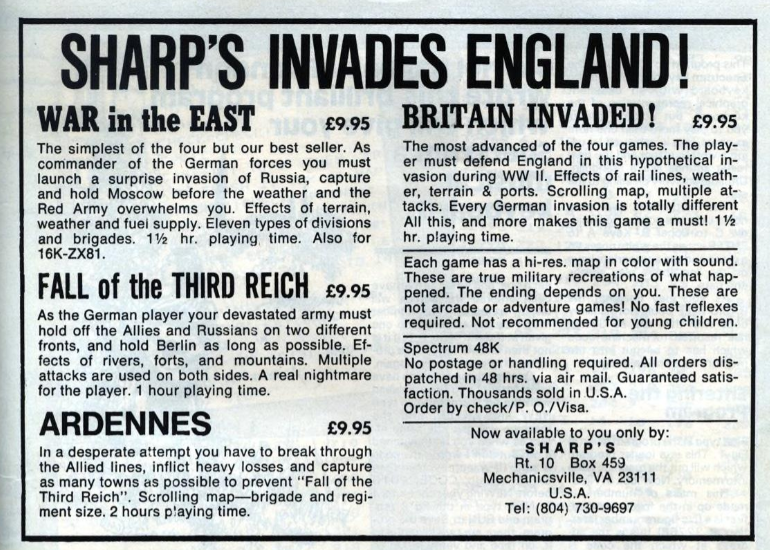
In 1985, a company called Sharp’s started advertising a set of 4 wargames in the various British Spectrum magazines. The games had been developed by Mark L. Stueber on Timex computers (official clones or quasi-clones of the Sinclair computers for the US market), but ported for the occasion on regular British Spectrum. In a move that probably made someone think they were being really clever, the American company called its transatlantic advert “Sharp’s Invades England”, and featured among others a game called “Britain Invaded!” – but by the Germans this time.
Sharp’s four wargames are not pure reskins like the Squadron Leader games, but they are simple games that share most of their ruleset. I don’t see myself doing four different articles on them – nor do I believe that I could keep anyone’s interest on those titles for more than one article. This will also allow me to showcase the features added over time on the engine.
So let’s roll!
Game #190-A: War in the East (1983)
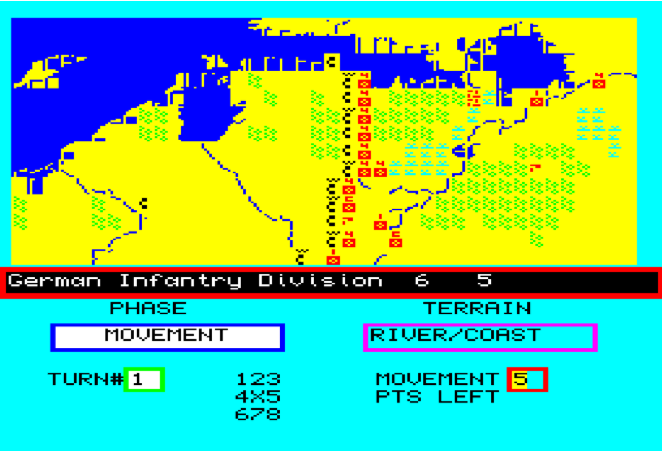
The first of Sharp’s wargames is War in the East, and as the manual makes redundantly clear, it is about the German Invasion of Russia in July 1941.
The objective of the War in the East is to control Moscow for as many turns as possible (4 turns for the best possible victory). The game opens with a fixed screen of the Eastern Front and a number of German and Soviet units. Ah, and one Romanian unit at the bottom.
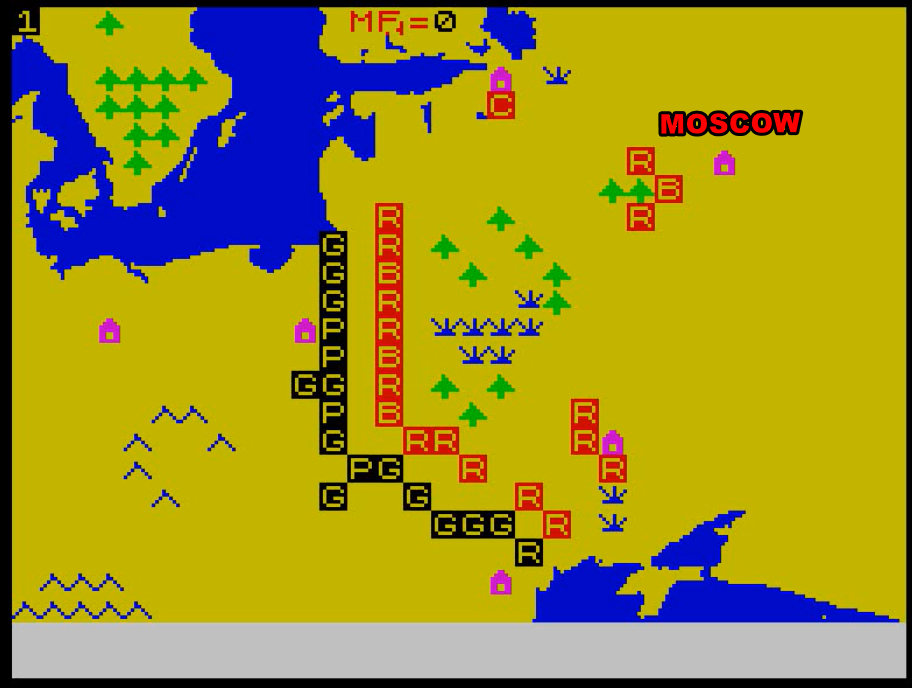
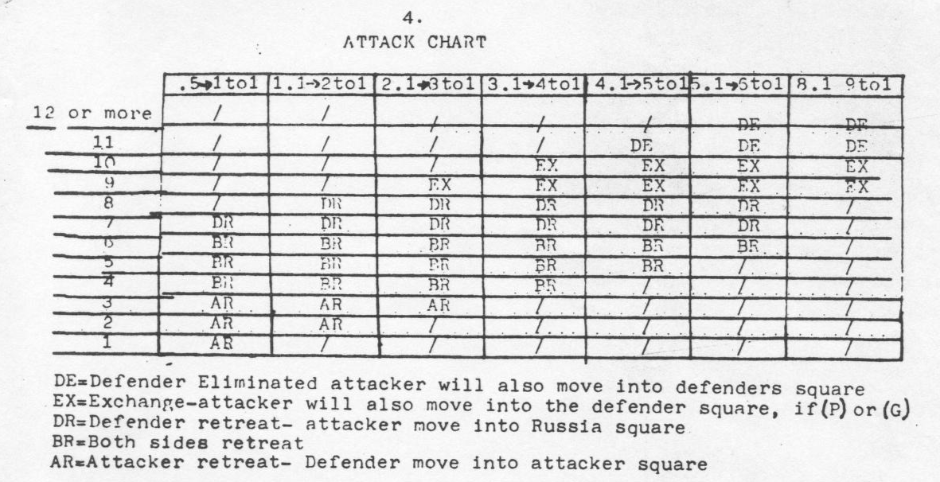
The only input the player has is movement and can only be done horizontally and vertically (up to 2 squares for infantry, 3 for tanks). When a unit is in contact with an enemy – including on a diagonal – it is stuck there until combat resolution – during which each Axis unit in contact with a Russian unit automatically picks one unit to attack – the combat is solved thanks to a Combat Result Table (CRT).
My first action is to advance everyone to contact. The rifle divisions are pathetic (strength= 1 vs 6 for my infantry and 9 for my tanks) and the Soviet line almost disappears on the first turn.
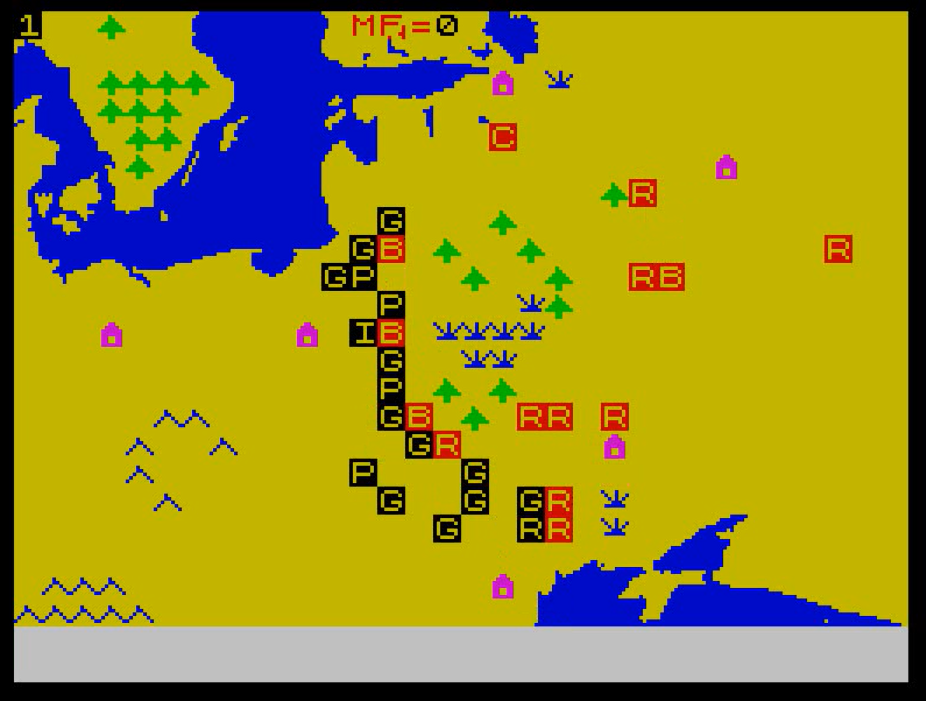
On the other hand, tank brigades “B” are hard to destroy – they have a strength of 3, so if you check the CRT above the only way to destroy them in result is a rare mutual destruction when attacking with my own tanks – everything else is a shoving match. There is a trick though: if you have a unit on the other side of your target and you force it to retreat, then the retreat is converted into a destruction. Alas, it is hard to pull off consistently: in addition to your limited mobility, attacks are resolved in a set order, so it is not uncommon for the enemy tanks to be pushed in one direction before the units you set up for the mortal push gets to attack. Additionally, when one of your units is in contact with several enemy units, you have no idea which one it is going to attack, so all-in-all this feels like a puzzle game in which you don’t see all the pieces.
The advance continues, but of course the Soviets keep receiving reinforcements, including Infantry divisions “I” which I can’t destroy except by blocking their retreat. I also cannot rush to Moscow as fast as I want due to my supply line: an invisible vertical line that moves East as the game progresses, and beyond which the strength of my units are halved.
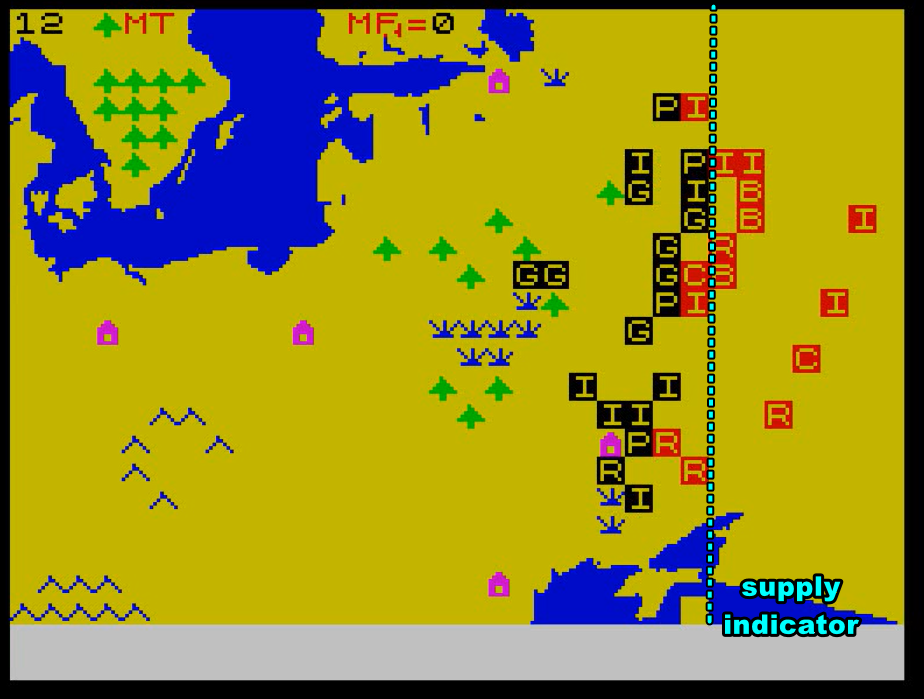
Summer turns into a short mud season (turns 11 and 12, axis movement limited to 1 and axis combat strength halved), and then into winter – whose only difference compared to summer is that marshes can be crossed easily.
I managed to reach Moscow for one turn, but was then was chased by the large number of I Infantry. At that point, I am also down to 3 Panzer divisions: one out of position to reach Moscow, one locked in a tug-of-war with an infantry division and one was received as reinforcement and is still on its way.
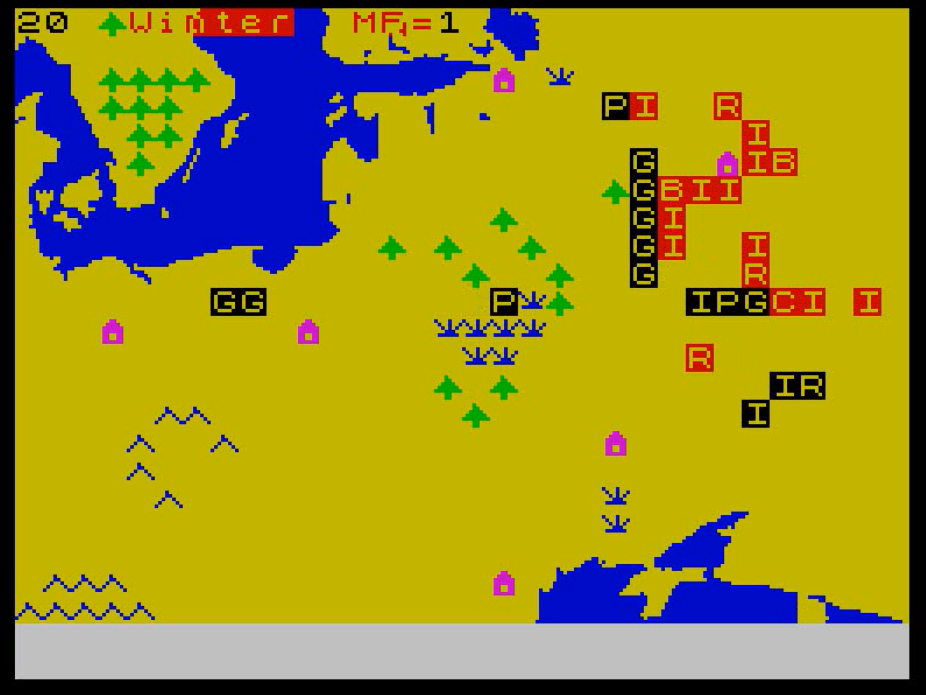
And then a miracle happens: a path clears in front of one of my infantry divisions. I imagine the cloud forming into the shape of a swastika and a choir of angels valkyries.
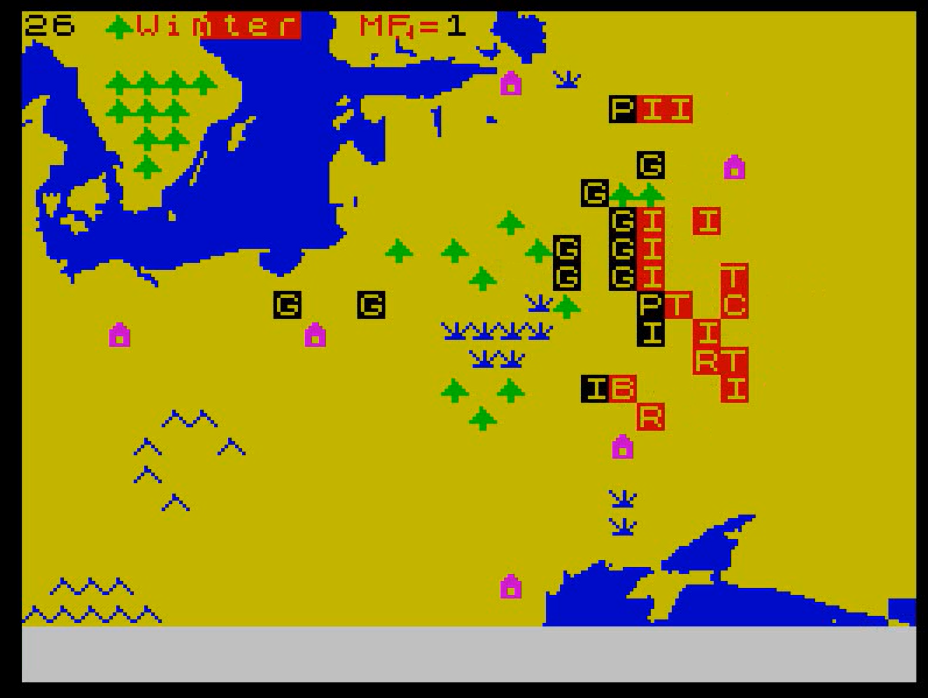
When fate hands you a wurst, you don’t ask whether it’s pork or chicken! My grenadiers waltz in and simply occupy Moscow – the Russians don’t seem to care even though they had available units to chase me.
Four turns later, I win the game:
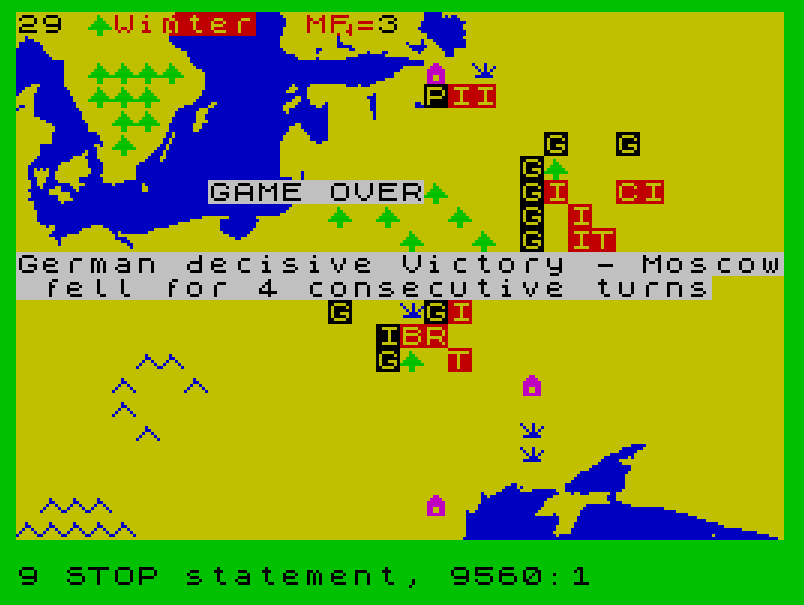
To be fair, this was my third attempt:
- I won my test game without ever reading the manual, but only due on insane amount of luck (one of my units was forced to retreat to Moscow, and then every turn it was pushed out of Moscow and then immediately after pushed back into Moscow by two successive attacks),
- I lost my second battle because the manual never states that you should not allow Soviet units in Germany – I would not have won anyway but it was a good pretext to try one last time and reproduce the result of my initial battle.
It’s not a good game, but given how easy it is to get into and how short it is (around 20 minutes from start to finish, with an emulator at x2 speed) I would not call it a bad experience – just a limited one. It has many obvious issues, but somehow I feel a decisive CRT table where most results are not “someone retreats” could have made it a much better game.
Final rating: Obsolete.
Game #190-B: Fall of the Third Reich
It’s about the Fall of the Third Reich.
The second Sharp’s wargame has a few additions and a brand new scenario: it’s the end of WW2, and the player must hold Berlin for 10 turns – in which case he will have done a better performance than the Germans historically.
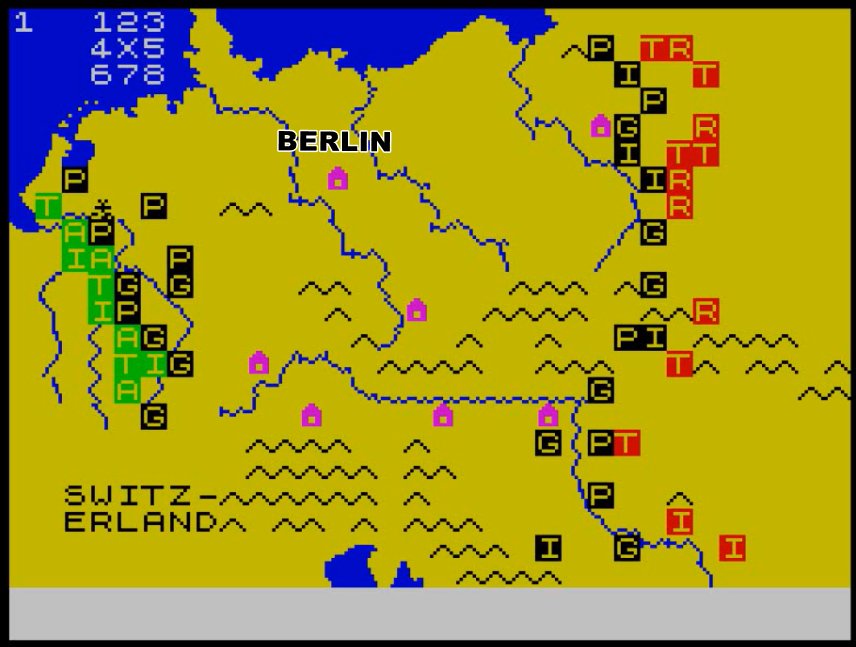
In addition to a rarely covered topic, Fall of the Third Reich offer several improvements: in particular players can choose not to attack when in combat (the unit remains stuck to its opponent though, even if it started its turn in contact). If you choose to attack, then you can pick your target and focus on an enemy unit with up to 2 units. You are going to use those options, because in Fall of the Third Reich, enemy units are better than yours:
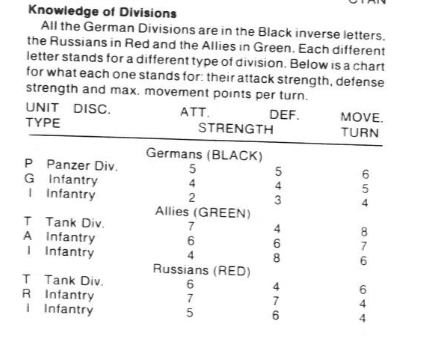
Fall of the Third Reich also removes the two-step units (all units are immediately destroyed if the CRT says so) and adds a terrain defensive bonus that, given the situation, will for once almost exclusively benefit the player. Add to this a CRT with moderately bloodier results and you have a ruleset in which units die quickly.
My strategy is to gain time by never attacking – except in Ukraine where I want to destroy the few enemy units ASAP to free mine. It works against the Western Allies, but in the East the Russians immediately blow through my line. I fall back to defend the Vistule.
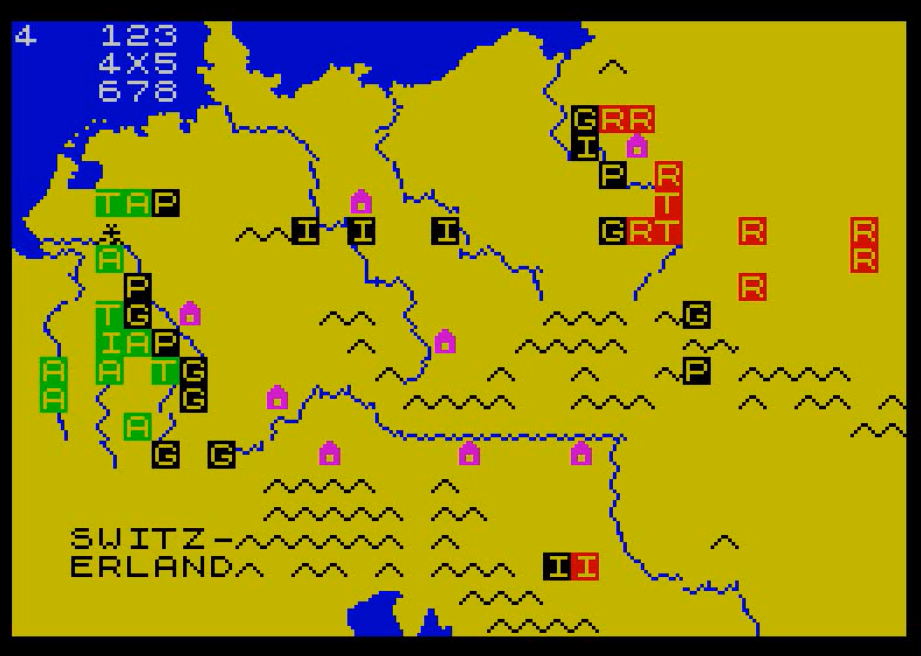
Every turn, all factions receive reinforcements: on my side, I receive between 1 and 2 weak “I” infantry units, whereas the Western Allies receive 2 strong “A” infantry and the Soviets two strong “R” infantry. When the Western Allies finally breach through in the West, all their reinforcements that had been blocked behind the front suddenly pour in. As for my defence in the East, I don’t hold the Vistule for long, and now I am down to one infantry division fending off the red horde on the Oder.
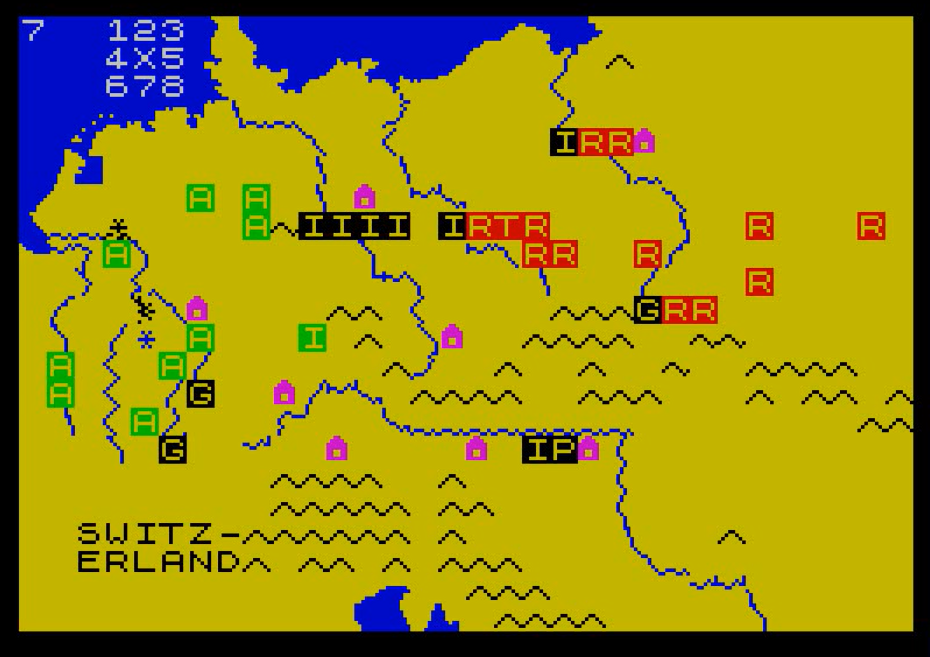
The Western Allies and the Soviets meet on the outskirts of Berlin turn 9, and at the end of turn 10 my capital falls – exactly when it historically did.
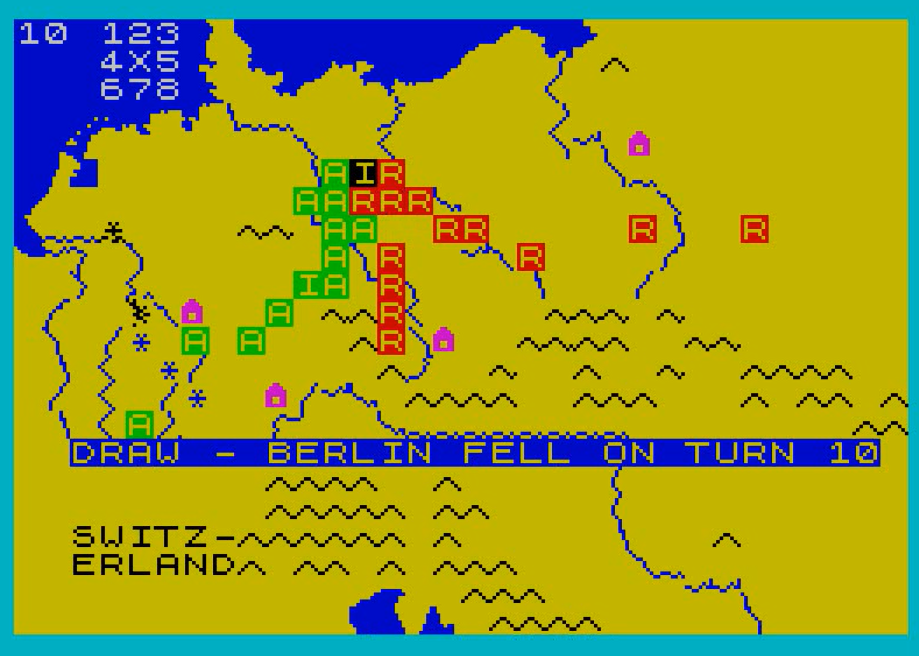
Fall of the Third Reich has a rare theme and I commend Sharp for designing a game where you have to lose, but it’s not really a fun game: most of your units are in contact of the enemy from the beginning of the game, and so you can’t move them to form defensive lines. The game may be fast to play (the same 20 minutes as War in the East – the AAR is my second game), but between the units stuck in combat, the two computer players moving their units and the long combat resolution, you won’t be actively playing a lot.
Final rating: Obsolete.
Game #190-C: Ardennes
For this third game, Mark Stueber kept the ruleset of Fall of the Third Reich but changed the scale: the scope is smaller (the battle of the Bulge as the Germans instead of the entire end of the war), but the map is much larger (around 1.3 screens horizontally and 1.5 vertically) and the unit count much higher:
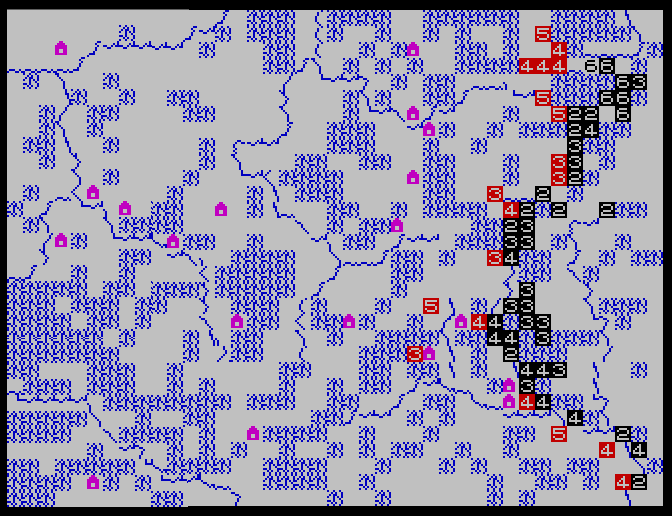
Instead of using a letter-code, Ardennes use numbers (the units’ strength), with the manual indicating that for the Germans, the 3 and 6 are armored and the 2 and 4 infantry.
The objective of Ardennes is not to exit units on the other side of the map. Instead, the player must destroy enemy units and take villages, with the result of the battle being determined by the ratio:
[Destroyed Allied Units + Villages controlled]/Destroyed German unitsIf after 18 turns, this ratio is above 1.6, then the Germans have won.
“Kill as many possible units on the map and grab villages more or less evenly distributed on the map” is not really a good objective to start with, but the ruleset is absolutely not adapted to the number of units featured in Ardennes. Both sides receive massive reinforcements, and by the beginning of turn 6 there were maybe 50 units on each side of the map:
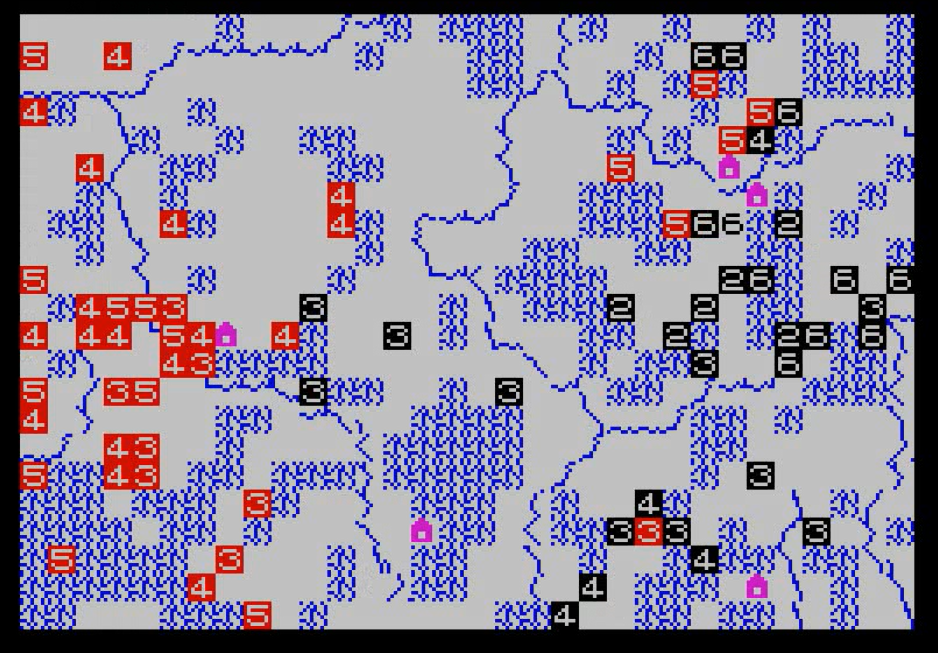
This made playing slow and frustrating: the initial position had been set up so units were called from top to bottom, but as units changed line and reinforcements arrived, the order in which the units were called felt increasingly random, with no indication as to which unit has already moved and the game constantly redrawing the map every time it had to focus somewhere else. Enemy turns took a long minute, with a significant amount of time dedicated to making back-and-forth movements because the computer does not know how to let the fast unit in the back pass in front of the slow one.
My strategy was to break-through the initial frontline with my fast “3” tanks to occupy villages as far West as possible. The breakthrough was easy, but my 3 tanks were quickly reduced to melted steel by the Allied onslaught starting turn 4.
My fall back strategy was to occupy the rivers (+2 strength bonus to the defender) and let the enemy attack me, only counter-attacking vulnerable units in open terrain with 2×6 in strength for a safe kill.
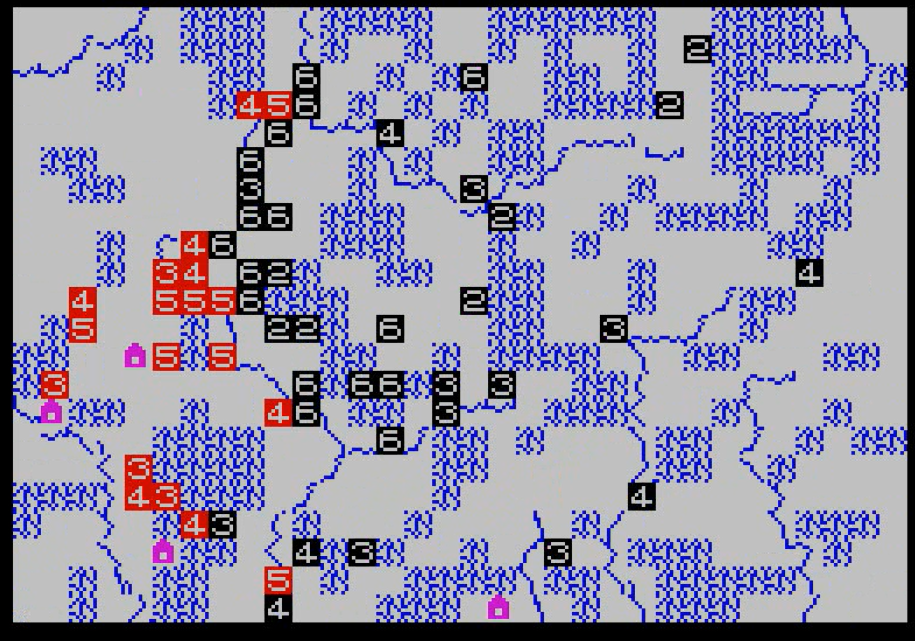
It took me a grueling 1H45 to play up to turn 18, and what was I rewarded with?
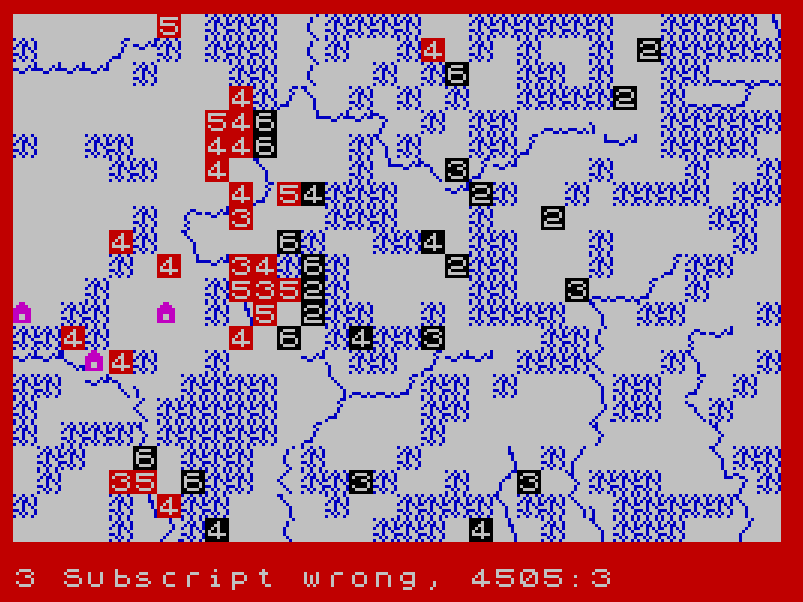
A crash during the last enemy turn!
For the record, I was clearly going to win:
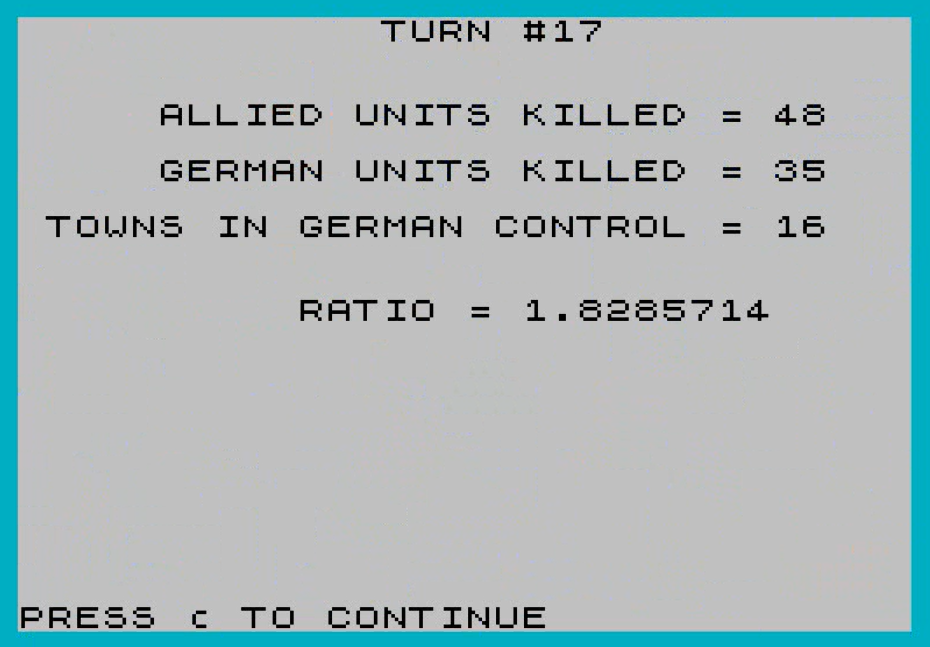
With 48 destroyed Allied units and 16 towns under my control, the Allied had to improve their score by 5 to force me below the 1.6 threshold, and only 3 of my units were really at risk. Therefore, I chalk that as a win, and I am not replaying this game a second time.
Final rating: Totally obsolete.
Game #190-D: Britain Invaded!
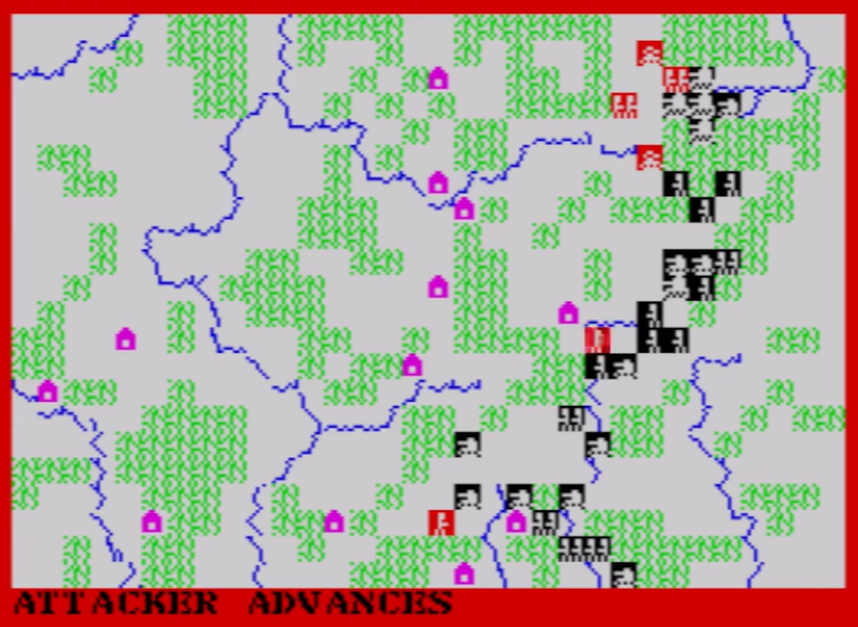
Now moving to the last one: Britain Invaded. It is the best title, but alas the only one whose manual is missing. It returns to the letter-code, but keeps the large map of Ardennes (or introduced it, if it was an earlier game after all).
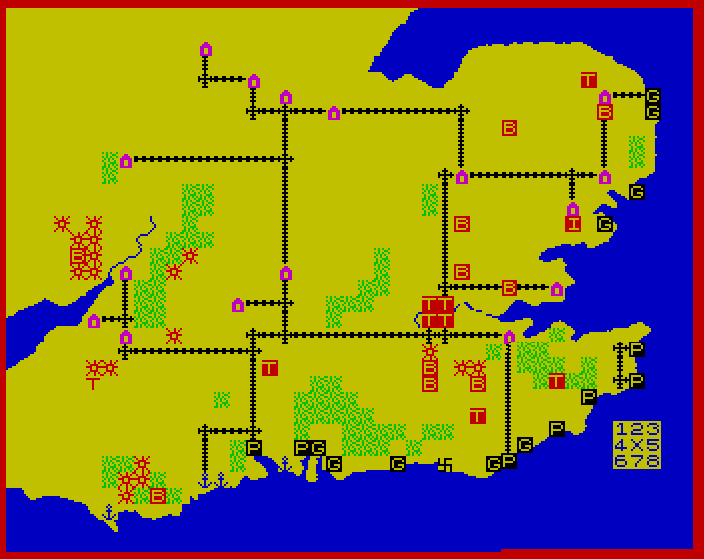
The objective of this one is to retake the German ports and destroy as many of their units as possible – as far as I understand at the end of the game [turn 15] the game checks the ratio of
[German Units + German Ports]/British UnitsIf it’s below 1, then the British win. Else, cue the Man in the High Castle. Additionally, losing London is also an instant loss for the British.
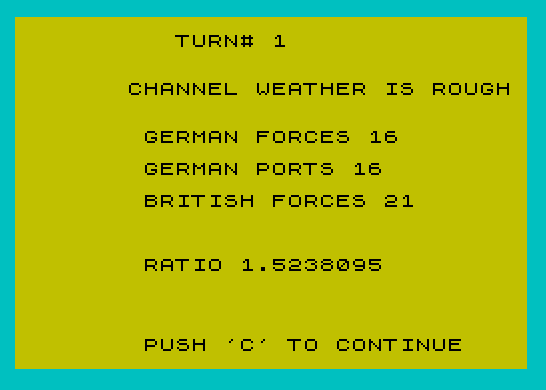
Turns start with a weather report and a unit count; presumably the weather determines how many units the Germans receive as reinforcement every turn.
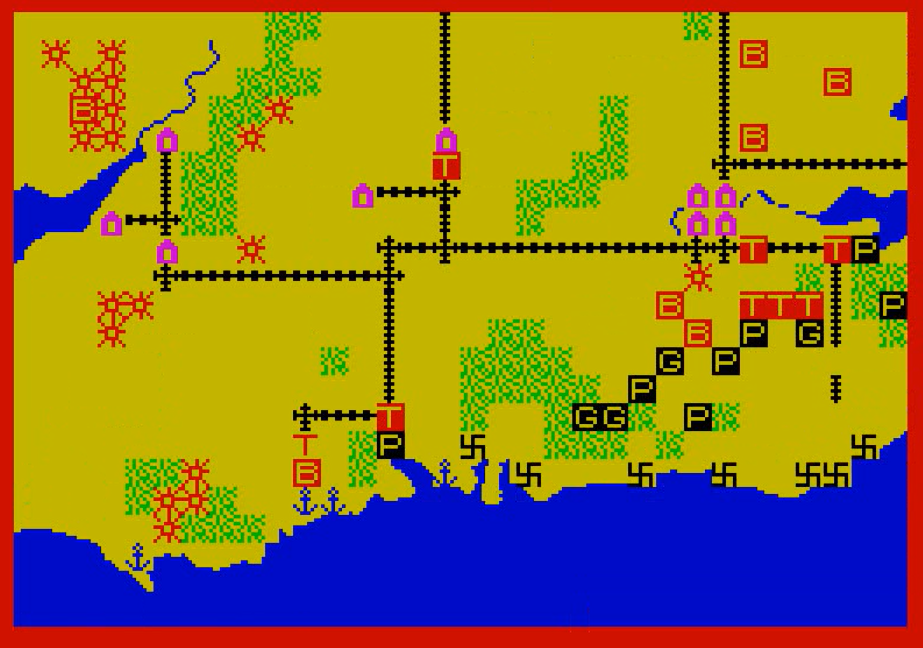
There are some German units in East Anglia, but really the bulk of the battle is in the South-East, as I am desperate to defend London.
The ruleset is otherwise the same as The Fall of the Third Reich, except for one critical difference: railways! British reinforcements spawn North-West of the map and must travel by train to the front. Germans automatically destroy railways by moving into them.
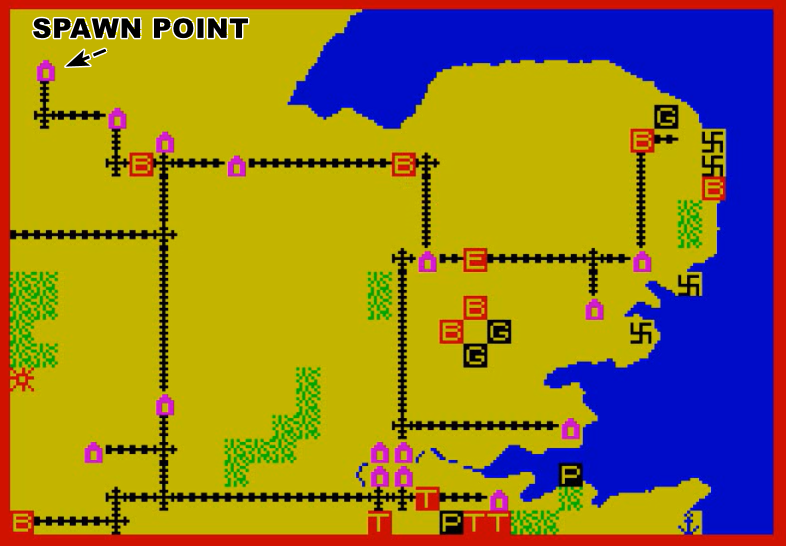
I try to send just enough force to hold London, while clearing up East Anglia to take ports and free my troops there. Unfortunately, I fail to fight efficiently and lose a few combats I thought I would win.
The Germans also try to flank London, and I intercept a Panzer division at the last possible moment
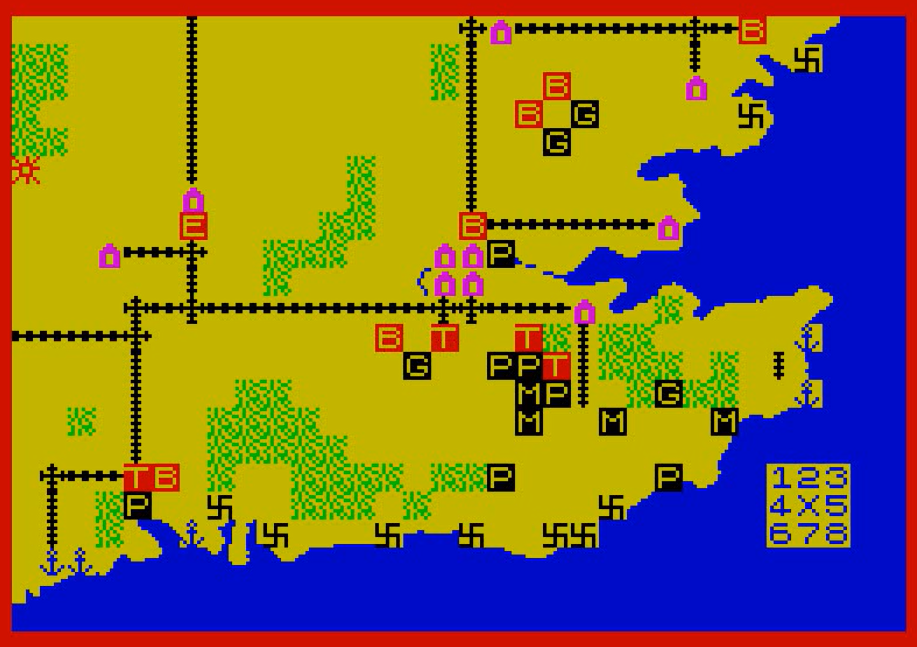
I finally clean up East Anglia around turn 13, and start to bring my reinforcements. That’s too late: turn 15 arrives before I can really leverage my advantage.
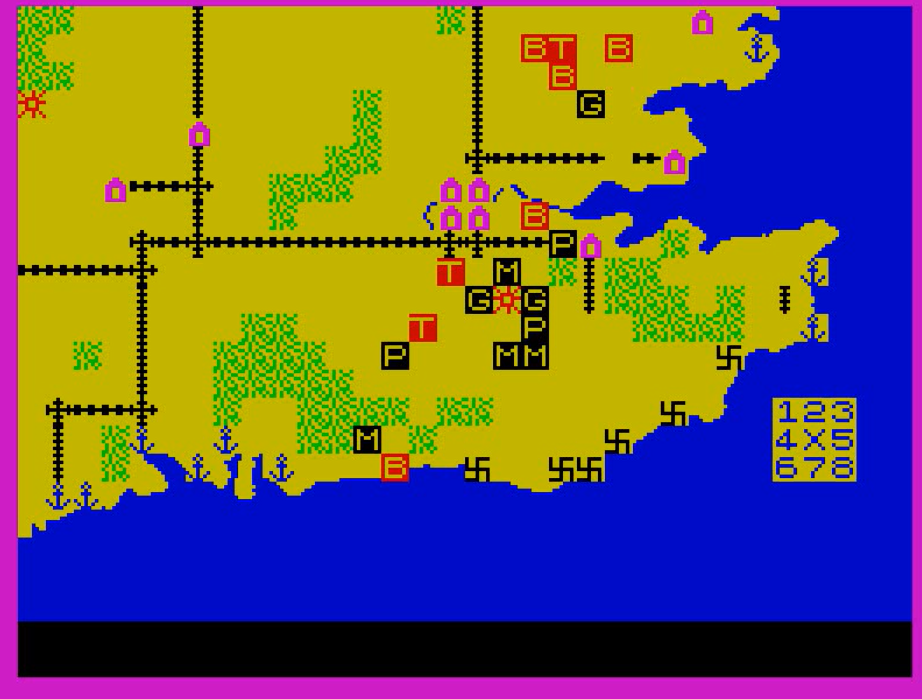
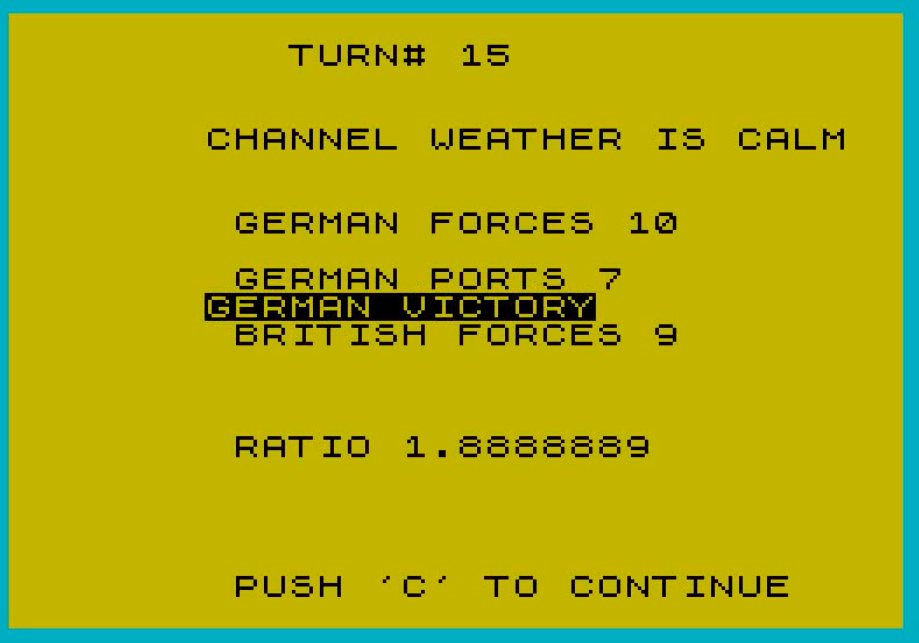
I had fun on this one, which took me half an hour. I really felt I would have performed a lot better with different tactics, but I also lost my second game.
Final rating: ☆
Ratings & Review
War in the East, Fall of the Third Reich, Ardennes and Britain Invaded! by Mark L. Stueber, published by Sharp’s, USA
First release: Started somewhere in 1983 on Timex Sinclair
Average duration of a scenario: 20-30 minutes, except Ardennes which takes close to 2 hours
Total time played : 5 hours
Complexity: Low (1/5)
Final Rating: From ☆ to totally obsolete
Context – Today’s games are the brainchild of Mark L. Stueber. Somewhere in the early 80s, Stueber had bought a grocery store from a man called Emmet Sharp and decided to keep the name. Passionate about his Timex T/S 1000 (an official ZX81 clone made for the US market), Stueber sold his first wargame War in the East from his store in 1983, then upgraded to Timex T/S 2048 (a Spectrum clone), for which he updated War in the East and created Fall of the Third Reich in 1984. He finally added Ardennes to the collection in either 1984 or 1985. As for Britain Invaded!, it was initially exclusive to the Spectrum and so was probably coded in 1985, just as Sharp’s invaded the British market with ads in ZX Computing from April 1985 onward.
Unfortunately, a lot has been lost. Stueber eventually moved from Sandston to Mechanicsville and created Sharp’s Computer Center, a shop that specialised in Timex and Spectrum computers until long after their prime. Its 1986 catalogue listed a Fall of Rome and a Redcoats, both lost. Additionally, War in the East was clearly modified year after year, and eventually the 1986 version for Sinclair QL included 4 different scenarios on a large 4-screen map. In March 1987, Stueber claimed to have sold 4000 copies of War in the East – all versions included.
Traits -I feel I already covered this in the AAR so to be short the Sharp wargames improved significantly over successive releases, but even by the time Britain Invaded! was released, most of the improvement had been done despite and not on the fundamental flaws in the engine – Britain Invaded! is better than its predecessor thanks to its scenario, not to its rules. The most frustrating “feature”, certainly, is the lack of control over your own units, due to units moving (or resolving their combat) in a set order, and units unable to disengage from combat. Both issues had simple solutions (a “skip” key and the allowance of a one-square movement out of a zone of control) but they were never applied.
Another issue I want to mention that is not clear from the AAR is the lack of feedback: the game tells you neither the strength of each side in a combat nor the result – actually it does not even show you whose combat it is resolved – it is directly applying the result. It is confusing in all games, but really crippling in Ardennes due to the size of the front and the number of units involved.
Did I take interesting decisions? Only in Britain Invaded! War in the East felt like a puzzle, Fall of the Third Reich felt like auto-mode as most units were engaged in combat and Ardennes felt like working a boring job.
Final rating: Britain Invaded! receives one star, War in the East and Fall of the Third Reich are obsolete and Ardennes totally so. There is a reason for which friend of the blog WhatHoSnorkers has a video called “Let’s Make It Better: Ardennes” – he focused the UI/UX and on how slowly the game loads the map.
Final rating:
War in the East: 117/187
Fall of the Third Reich: 121/187
Ardennes: 138/187
Britain Invaded!: 74/187
Reception
The only review worth quoting is found in the April 1987 issue of Sinclair User, which dedicated 2 pages to the series. Reviewer Garry Rook mirrors my own point of view quite closely: “the underlying game system then, is fairly simplistic, but it plays remarkably well nonetheless”. His key complaints is that units are called in a specific order and that you can’t disengage from combat. As for the individual titles, he reckons like I do that Britain Invaded! is the best of the lot (3 stars out of 5) and Ardennes a dull wargame (2 stars). He is a lot harsher than I am on Fall of the Third Reich, calling it a “repetitive slog” (one star), and finally considers War in the East merely “OK” (but still 3 stars). His general conclusion: Overall the four titles are not great games, but they would be worth having a go at if it weren’t for the price which is quite frankly ludicrous – £9.95 is too much for what you get.
We’re not done with the Spectrum, and we’re even less done with the Ardennes given the rest of the line-up!