Hellwig 1780 – Venturini 1797 – Giacometti 1801 – Hellwig 1803 – Opiz 1806 – Firmas-Périès 1809 – Reiswitz Sr. 1812
This is the second edition of Firmas-Périès’ wargame – the first edition is lost but I don’t believe it is too different. As I am native in French, I checked the translation and while I did some edits (a few are still pending in the second half of the document), the general quality is very good.
The rules are fairly similar to Hellwig’s, but without the trappings of Chess. The intro, however, is interesting for its historical note.
The original is here.
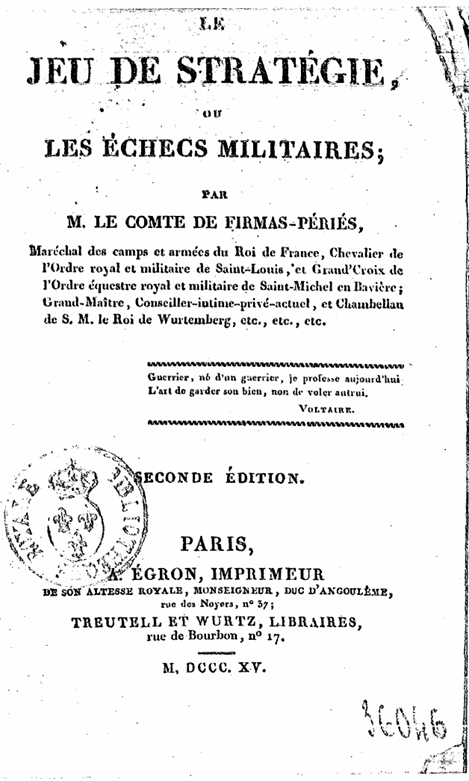
Le Jeu de Stratégie, ou Les Échecs Militaires — Complete English Translation
M. le comte de Firmas-Périès, 2nd edition, Paris, 1815
Complete English translation of every line of the original French text (scan pages 1–122), without page markers or separators.
THE GAME OF STRATEGY OR MILITARY CHESS;
BY M. THE COUNT OF FIRMAS-PÉRIÈS,
Marshal of the camps and armies of the King of France, Knight of the Royal and Military Order of Saint-Louis, and Grand Cross of the Royal and Military Equestrian Order of Saint-Michael in Bavaria; Grand Master, Actual Privy Counsellor, and Chamberlain of H.M. the King of Württemberg, etc., etc., etc.
"A warrior, born of a warrior, I profess today
The art of keeping one's own, not of stealing another's."
VOLTAIRE.
SECOND EDITION, PARIS,
A. EGRON, PRINTER
TO HIS ROYAL HIGHNESS, MONSEIGNEUR, DUKE OF ANGOULÊME,
rue des Noyers, no. 57;
TREUTELL AND WURTZ, BOOKSELLERS,
rue de Bourbon, no. 17.
M. DCCC. XV.
TO HIS MAJESTY
MAXIMILIAN JOSEPH,
KING OF BAVARIA.
Sire,
To offer Your Majesty the second edition of the Game of Strategy, or Military Chess, which You were pleased to allow me to dedicate to You, is to give only the feeblest expression of my deep and respectful gratitude for an approbation whose importance carried that of the public along with it.
A faithful image, as entertaining as it is instructive, of the great art of war — which every general, every officer ought to study even in an age when hearts aspire most to the blessings of peace — could this game, already well-known, have appeared under more fortunate auspices than under the protection of a Monarch whose grace makes dear whatever His approbation honours?
Honoured, overwhelmed by His August bounties, it would be sweet to celebrate the high qualities that make him the glory of Bavaria; but so much praise has been lavished in recent years that a rare merit must be revered in silence.
The most intrepid of the heroes of antiquity would relax, we are told, by playing chess. May Your Majesty, who yields to no prince in courage and loyalty, find pleasure in a game that more faithfully retraces the conceptions of the great military minds! May this slight monument of my admiration and love for Him endure as long as the wishes of the Bavarians for the prosperity of the dynasty that alone will ensure their repose and their happiness!
I am, with respect,
Sire,
OF YOUR MAJESTY,
The most humble, most obedient,
and most submissive servant,
The Count of Firmas-Périès.
PREFACE.
FOR a long time it was believed that the game of chess was an imitation of ancient tactics; to convince oneself of the falsity of this opinion, it would have sufficed to analyse the chessboard and its pieces.
The chessboard consists of sixty-four squares, alternately white and black; the pieces move across it without encountering the least of the obstacles that nature opposes at every instant to the movements and manœuvres of troops. The game is limited to the capture of a single piece; the players warn each other when that piece is in danger, it is the weakest of all and cannot sustain the slightest attack. The pawn, which by the slowness of its advance might seem to represent infantry, can only move forward and perpendicular to its front; it has neither the faculty of retreating nor that of wheeling to the right or left. Players can move, on each turn, only one piece — a rule contrary to every military maxim, which permits a general to move, as he sees fit and according to his needs, a large or small portion of his army.
The game of strategy now offered to the public, in the French language — in that language which has become that of the military art, of commerce, of the sciences, of the arts — has, on the contrary, for its object to imitate all that, in war, relates to the combination of manœuvres and movements of troops, to the effect of firearms, to the shock of masses, to the physical and artificial means of defence, to the calculation of supplies, and generally to all the combinations that constitute the science of the officer.
From two thousand six hundred and forty squares at the most, to one thousand six hundred and seventeen at the least, the different colours of the squares represent a highly irregular terrain, the irregularities of which the players may increase or diminish at will. Fields, forests, villages, rivers, marshes, and mountains, sometimes impassable and sometimes accessible, vary and frequently complicate operations.
Each general (and it is the player who fills this function) commands an army composed of infantry, light cavalry, line cavalry, siege artillery, field artillery, mortars, howitzers, and a bridging train; the men are independent of their horses. Each army has its divisions, commanded by major-generals [Translator’s note: “généraux-divisionnaires”— divisional generals] subordinate to the commander-in-chief; but since the various corps of troops composing one of our modern large armies are often, and almost always, at considerable distances from the headquarters of the commander-in-chief, and since, at such a remove, the generals commanding them never receive more than bare instructions, so likewise, in the game of strategy, the general cannot, for a certain number of moves or turns, issue orders to his lieutenant-generals; it falls to them, it falls to the general, to calculate whether the plan adopted remains practicable and to what extent it must be modified. When the period of silence has elapsed, each side holds a council of war, each player determines his manœuvres; these are discussed, examined in depth, censured, or approved: a plan for a new campaign is drawn up, and everyone hurries back to his post.
The movement of each piece is governed by its attributes. A hussar advances faster than a line cavalryman; a siege piece covers more squares than a field piece; mortars and howitzers set things ablaze; a superior fire kills, an equal fire is sustained with courage; the advance of columns is slowed by artillery, still more when it includes bridging trains; columns can only advance as far as they have provision depots; they can only subsist for as long as they keep their lines of operations intact and the link between forward depots and the main magazines is assured. Each side has, in its rear, fortified towns which serve it as refuges and as arsenals; the capture of all these fortresses decides the outcome of the war. The game may nevertheless end, as modern wars do, by a treaty of peace; thus an unfortunate player avoids total destruction, while still bearing the penalty of his false combinations.
One advances in column, forms in line of battle; one detaches corps to turn the enemy, seeks to take him in flank, deceives him with feigned attacks, occupies him with diversions; one builds entrenchments, throws bridges, destroys them; one seizes and destroys magazines; one occupies defiles or catches the enemy by surprise in them; one burns towns or villages; one recruits one’s army according to the terrain occupied; in short, it is a complete war, and courage itself finds its place in the boldness with which the generals conduct their operations.
With skilful players the game is prolonged: a single day is barely enough for one difficult operation; campaigns succeed one another over several weeks, often with very unequal fortune; for such is the severe and deep combination of this game that all faults against strategy are punished harshly, even when committed by a victorious army.
This invention is not new; the credit for it belongs to M. Hellwig, governor of the pages of the Duke of Brunswick-Lüneburg, who published in 1780 his Essay on a Game of Tactics Founded on Chess, and who, in 1782, published an account of a game played according to the rules and method taught in the first volume. Twenty-six years of reflection and experience led him to rework several elements of the game, to reduce the number of pieces, to change their movements; and he entrusted the translation of this work to M. Carles-Frédéric Crammer, former professor of philosophy at the University of Kiel. This scholar wrote a commentary in Paris in 1803 on M. Hellwig’s game, under the name War Game, and published an analysis of it. One cannot sufficiently regret that M. Crammer did not publish the entirety of M. Hellwig’s work.
The idea of applying chess to the study of the art of war is not new. The Chinese introduced new pieces for this purpose, such as mortars and cannons; the changes that Tamerlane took it upon himself to make, and the pieces he invented, had the same aim.
In 1770, there appeared in Prague, published by François-Augustin Haerchenberger, a small work entitled: Game of War, or Refinement of Chess. The board is enlarged, and cannons replace the rooks; but the game is still limited to capturing the king, and, as in chess, only one piece may be moved at a time.
In 1793, Francesco Giacometti also invented a chess variant, which he called the Game of War. It was merely a more complicated form of chess, and the game still had no other aim than capturing the king. Appointed consul-general in Provence, Giacometti believed, at that time, that he should eliminate the name of the essential piece; and, by successive changes, he came to replace it with a fortress — a fixed objective whose capture decides the game. It is only on this single point that Giacometti’s game resembles that of M. Hellwig; for in every other respect the two games have no analogy, and it suffices to compare them to be persuaded that the Italian author had no knowledge of the German invention. Although M. Giacometti’s work is later and very inferior to that of M. Hellwig, one must nonetheless credit him with improvements imagined to correct the defects of the alternating move, [Translator’s note: “l’alternative du trait” — the convention that players alternate single moves] and to imitate the movements and manœuvres of modern armies; and one must forgive him for having, in his 1801 edition, described his game as an invention to which no one has hitherto given thought.
M. Hellwig is the first to have undertaken to represent the irregularities and variations of terrain by means of the different colours of the squares on the board. This improvement, this discovery, gave rise to all the others, and it is to this that one must attribute the genius of M. Hellwig’s game. The formation of columns by means of rectangles is likewise an ingenious idea that allows players to set in motion, in a single move, a large or small portion of their army, and is sufficient by itself to correct the defects of the alternating move which had to be retained for the game’s simplicity. But what further, in M. Hellwig’s method,entirely eliminates the inconvenience of this alternation is the distinction between the two kinds of moves he indicated, and which we have distinguished as movements, or tactical and strategic moves.
Some French generals, having been detained in 1806 for a time near Memmingen, there made the acquaintance of this game, and were so struck by the beauty of its results, the simplicity of its means, and the soundness and ease of its rules, that they made us promise to draw up a concise and methodical account of it. It is this work, carefully revised, that is now offered to the military men of Europe, to the most enlightened class of the public, and to well-born young men who are destined for a military career.
May a general peace long confine the indispensable study of war to the manœuvres of instruction and to the pleasure of the game of strategy — a singularly engaging game, of which our friend, M. the Chevalier de Maimieux, inventor of a new art devoted to humanity [WargamingScribe: I removed a footnote about pasigraphie here], lately gave the most rapid and most faithful account, in these terms:
“Two, three, or four players, separately or in alliance, may, as they see fit, change the front and the army corps they command. Each general has his magazines, his arsenals, his aides-de-camp; each army has its manœuvres, its period. Dragoons serve mounted or on foot: every corps recruits itself. Entrenchments are raised and destroyed. Howitzers, cannons, mortars, bombs, artillery at will, batteries isolated or combined that may be positioned, turned, silenced, carried off by main force, or spiked; the faculty of retreating, withdrawing, or destroying pontoons; that of lighting or extinguishing a fire, of seizing provision depots, of protecting or intercepting convoys, of felling the gates of forests, of holding, sustaining, or preventing the crossing of bridges or destroying them — all this is enacted: the operations of a march, a skirmish, a cannonade, a rearguard action, a pitched battle, skilful retreats, a blockade or a siege, one or several campaigns, on a topographical chessboard. This board represents fields, buildings, ravines, mountains, passes, marshes, rivers — all the aspects that a country may offer — by means of coloured cubes arranged at will.”
[WargamingScribe: Another footnote on a novel removed]
It would have been very easy to swell this volume with examples on each rule and each case; but there was a fear of daunting and even discouraging learners: the difficulties of this game are already exaggerated far too much, and it is necessary to avoid reinforcing this error.
The game of strategy is easier and less complicated than chess. In ours, the pieces all have, with few exceptions, the same direction of movement; and the one significant difference lies in the speed of their advance, which is determined by the nature of the pieces or machines, by their known function, by the object of the action. A few hours’ attention is sufficient to grasp the mechanism of the game; practice and a few reflections will complete the task of making its rules familiar. As for the talent of playing it well, that will depend on one’s knowledge of tactics and strategy, on greater or lesser ardour and courage, and finally on practice itself; since the perfect mastery of any game whatsoever is only the product of exercise, time, and the intelligence of the one who devotes himself to it. As the game may be played by classes, and each class being divided
into school levels, players will be able to grow accustomed to the difficulties by degrees. Turenne would play it differently from Villars, and Wellington better than those who were once thought thunderbolts of war. Those who give themselves the leisure to meditate on this game will be able to recognise that the finest qualities of the mind, and more than one virtue of the heroic soul, find occasion to be deployed in it.
—
THE GAME OF STRATEGY.
—
CHAPTER ONE.
INTRODUCTION.
". . . . . This name, come from Greece to France,
"Means the great art, or the art par excellence."
VOLTAIRE.
§ I. The game of strategy has for its object to imitate all that, in the art of war, pertains to the mechanism of operations, to the manœuvres and movements of troops, to the effect of firearms, to the shock of masses, to the physical and artificial means of defence, to the calculation of supplies, and generally to everything that gives rise to military combinations.
§ II. Although what is called chance, and the personal valour of nations, cannot be imitated, nevertheless the character of the opposing side, and its genius interprising, bold, and active, must be studied; and it is from knowledge of the extent of his faculties or his defects that one forms one’s plan of operations.
§ III. If the intelligence that a general gathers through agents in enemy territory, or through espionage, cannot be imitated — since each player’s moves are visible to the other — there remains nonetheless always open to both sides the resource of seeking to mislead the opponent through the moves they make in order to conceal the true aim of their operations.
§ IV. The distance at which, in the modern system of war, the divisions of a single army find themselves from one another; the latitude of the instructions received by generals; the coincidence of the army’s operations across the entire extent of its vast line; the formation of a fixed plan before the campaign; the urgency of pursuing it obstinately; the danger of altering it entirely; the necessity of modifying it according to the enemy’s movements, while always keeping as close as possible to the line traced — all these are circumstances that one endeavours to imitate.
§ V. The alternating move had to be introduced, but the inconveniences of this
alternation are corrected by the distinction we have drawn between tactical and strategic operations or movements. Each player may, in a single move, cause any tactical movement to be executed by each of the pieces, figures, or machines of his army, while in that same move he can cause only a single one of his corps — large or small — to execute a strategic operation.
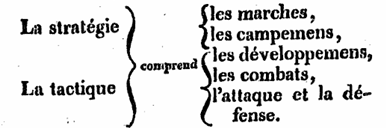
§ VI. Any operation that has the enemy as its ultimate aim, but not directly as its immediate object, is a strategic operation; whereas those that have the enemy directly as their immediate object are tactical operations. Thus one may define strategy as the Art of the positions and movements of troops, at such a distance from the enemy that there is nothing to fear from an attack and it is not necessary to be ready to fight — at a distance, in a word, beyond cannon range.
One may also define tactics as the science of movements executed in the presence of the enemy, in such a manner as to be visible and within reach of his artillery.
From which it follows that the only sign that clearly distinguishes tactics from strategy is that when troops within sight of each other make as if to act against one another, those are tactical operations; whereas the procedures involved in travel, marches to move from one place to another, as well as encampments, are strategic operations.
In brief, the player who has the move, wishing to make a strategic movement, will move a single corps of his army — large or small — without attacking the enemy; and with that same move he will not be able to undertake the least tactical movement. Likewise, wishing to execute tactical movements, he will not be able to undertake any strategic ones; but with the difference that, in that same move, he will be able to cause any tactical movement of his choice to be executed by each part of his army.
Thus in a single move he may:
1°. Change the front of the various corps of his army;
2°. Dismount dragoons and have them remount;
3°. Traverse the batteries (§ LI);
4°. Aim the cannons, mortars, or howitzers in a different direction;
5°. Have two corps situated side by side and not separated by a river exchange places mutually, provided the bridge of communication is not between them;
6°. Destroy as many corps as possible by cold steel, by musket fire, or by artillery;
7°. Raise or destroy as many entrenchments;
8°. Lay, withdraw, destroy, seize, or set fire to as many pontoons;
9°. Spike, seize, or destroy as many batteries;
10°. Set fire to as many buildings, or halt as many fires;
11°. Establish or destroy as many provision depots;
12°. Fell as many squares of woodland or forest as possible; employing for each operation different corps, figures, or pieces and machines which, in that same move, have made no tactical movement.
CHAPTER TWO.
OF THE BOARD.
I love to see rocks, streams, meadows.
DE LA BRETONNERIE. [WargamingScribe : A minor agricultural engineer with a popular book during the Napoleonic era and now completely forgotten]
§ VII. The extent of a modern theatre of war, its natural or artificial obstacles, and its variations cannot be fixed by principles: everything depends on the players; and therefore:
1°. As regards extent, one can only fix a maximum and a minimum, which for this game will be 66 squares in length by 40 in width, giving 2,640 in area for the maximum; and 49 by 35, or 1,617, for the minimum. Plate II is drawn on this principle. (1)
(1) To avoid hand-colouring Plate II (a very costly operation), the different colours of the squares are indicated heraldically: thus white remains white; black is designated, like sand, by horizontal and perpendicular lines red by perpendicular lines; blue by diagonal lines from right to left; blue by horizontal lines; and yellow by dots.
2°. The insurmountable obstacles presented by a field of battle are designated by squares of a single colour.
3°. Any square that is partly marked in black designates terrain passable for all figures, pieces, and machines. Black is employed in the ordinary chessboard; this analogy led to its retention here as designating open ground.
4°. Any square that is partly white announces terrain that is passable, but only for part of the troops, machines, and pieces. Such squares are used here to designate the natural obstacles of the terrain. White contrasts more strongly with the other colours and stands out more to the eye, which is why it was preferred to any other.
5°. Artificial obstacles of terrain, such as entrenchments and abatis, have a special mark. (§ LXXIV.)
6°. In order to be able to vary at will the theatre of the game of strategy, to increase or decrease the natural obstacles and ob-
stacles, and to represent any possible field of battle, 1,617 perfect cubes of 5 centimetres will be made for the minimum board. (2) They will be coloured as follows:
The first face, in white and black,
The second face, in red and black,
The third, in red and white,
The fourth, in green and white,
The fifth, in blue and white.
Two-thirds of the cubes will have the sixth face coloured blue; one-sixth will be coloured red; one-twelfth will have the sixth face coloured green; and the remaining twelfth, yellow.
The table on which the board is laid will be one metre forty-seven centimetres long by one metre wide; the borders will be forty-five millimetres deep, so that
(2) By applying, for Germany, to Joseph Beilner, craftsman at Kipstellegg, principality of Waldburg-Wolfegg-Waldée, sets may be obtained at a price of 55 Empire florins, 100 livres tournois, or 5 pounds sterling for the maximum board; and 36 florins, 96 livres tournois, or 3 pounds sterling for the minimum board; plus 2,640 or 1,617 cubes, painted or unpainted, for each set; 360 figures, pieces, or machines, very finely worked, in pewter.
the cubes may project sufficiently beyond the borders. The borders will be recessed, held in place by countersunk squares, so that everything is solid, fixed, and nothing catches or comes within reach of the hands or clothing. Each side border will be pierced with one hundred holes, so that the players may mark the moves or turns that need to be counted (§§ XCVIII, XCIX, C, CI, CVIII, CXXII).
The underside of the table will be fitted with compartmented drawers for storing the figures, pieces, and machines.
§ VIII. The military eye, or the habit of assessing terrain in military terms, is the fruit of more complex reflections than one might suppose; one must view terrain as a geometrician to gauge its extent; as a tactician to apply to it the movements of an army in relation to its forms and accidents; as an engineer [Translator’s note: “mécanicien” — literally “mechanician”; in the military sense, an officer concerned with engineering and obstacles] to discover in good time the possibility of creating or destroying obstacles. Consequently, although the layout or creation of the board depends greatly (§ VII) on the players’ imagination, it is to be expected that models will be drawn from nature itself, and preferably from the most recent scenes of the war just concluded, or from
the memoirs of the campaigns of illustrious generals of the great ages, in which victory was more often the fruit of genius that knew how to provide for everything than of the prodigal shedding of blood, treachery, or numbers.
But if, contrary to all expectation, an ideal field of battle were composed, one cannot too strongly recommend consulting actual localities, and never losing sight of the fact that the advantages of each portion of terrain, beyond its absolute strength, depend greatly on everything that surrounds it: that it will therefore be of the utmost necessity to survey the whole tableau, to seek to understand well the relationships linking its different parts to one another, to suppose enterprises against the most important points, to practise deploying all the efforts and all the stratagems that an enemy might attempt against a corps of troops assigned to defend the chosen and occupied terrain. This method of analysing all obstacles in this way, by threatening them all equally and bringing into play all means capable of forcing them, cannot but accustom one to viewing all objects from the most military point of view.
§ IX. If the players wish to combine
their operations on a known field of battle, the division they make of the board will be subordinated to the position that the belligerent forces will hold at the moment when they wish to begin following the operations. But if the board were laid out ideally, without having sought to imitate any particular theatre, which presupposes two imaginary fields of battle, the division should be equal between the two adversaries: Plate II is drawn for this purpose; the boundary line is designated by the dotted line passing through the points marked 10, 89, 108, 187, 206, 285, 272, 347, 370, 415, 468, etc.
§ X. When each player has a partner, squares 785–833 will form the line of demarcation between the two partners.
§ XI. When six persons play, the leaders of each side will have eleven squares in the centre and the other players ten squares; so that the lines of demarcation will pass through squares 491–559 for one side and through squares 1,079–1,127 for the other.
§ XII. Half-white, half-black squares designate terrain passable for all figures, pieces, and machines.
§ XIII. Red and black squares desig-
nate buildings which by their number and grouping form towns or villages; they naturally project above the terrain and present several obstacles to enemy operations; they block the fire of enemy artillery beyond the first square of the buildings that fall within its range. When occupied by infantry, that infantry is sheltered from enemy cavalry and even from infantry fire until the latter has penetrated the first square of the village.
Infantry, dismounted dragoons, and artillery occupying villages may nonetheless open fire, even though sheltered from enemy fire.
These buildings are liable to be set on fire by enemy mortars or by troops who have entered them.
§ XIV. Red and white squares designate mountains passable for all figures and all pieces: only machines cannot cross them.
§ XV. Green and white squares designate woodlands; only infantry and dismounted dragoons may pass through them: these woods project above the terrain and, beyond their first square, troops within them are sheltered from the effect of firearms and from the shock of enemy cavalry. These
woods are not liable to be set on fire as buildings are. To render a wood passable for cavalry and artillery, infantry or dismounted dragoons must be made to occupy it and to cover with white and black cards the green and white squares they cross in passing through. The speed of their advance is naturally restricted by the clearance of these woods; which is why these figures can only cover four squares instead of eight (§ XXV). Woods may also be felled to raise entrenchments. (§ LXXV, G.)
§ XVI. Blue and white squares designate boggy, marshy terrain, through which only infantry can pass, and where cavalry can only retreat by dismounting and abandoning their horses to the enemy.
§ XVII. Blue squares designate non-fordable water; this obstacle may nonetheless be overcome by throwing bridges.
§ XVIII. Yellow squares designate terrain so low-lying and boggy that even infantry cannot cross it.
§ XIX. These three obstacles (§§ XVI, XVII, and XVIII), presenting no projection above the level of the terrain, allow
the effect of firearms to carry across them to the squares beyond, insofar as those squares are within range of said arms.
§ XX. Red squares designate inaccessible mountains, which project above the terrain and consequently present an obstacle to the effect of firearms.
§ XXI. Green squares designate forests impassable for all arms. They may nonetheless be pierced by having their edge occupied by infantry or dismounted dragoons who, per move, will advance at most two squares, covering with a green and white card the green squares they have occupied in their advance. These forests will then be converted into woodland and may become terrain passable for all arms, according to the conditions prescribed in paragraph XV.
§ XXII. Squares situated between red, green, and yellow squares designate defiles.
The various obstacles of the terrain force players to combine their movements so as not to be halted in their advance or retreat; to form in advance their plans of operations according to the forms of the terrain and the layout of the board, etc.
CHAPTER THREE.
OF THE FIGURES.
“Ludimus effigiem belli.”
VID. SAC. LUD. [Translator’s note: “We play at the image of war.” — Vida, Scacchia Ludus.]
§ XXIII. The figures are employed in the game of strategy to represent infantry and cavalry, the latter subdividing into dragoons and hussars.
§ XXIV. Cavalrymen are independent of their horses; but with the unique difference that dragoons alone can dismount and remount at any moment, becoming, at the player’s discretion, cavalry or infantry; hussars, on the contrary, can only fight and act on horseback, and if they are unhorsed, their horses are deemed to have fallen as prey to the enemy. These dismounted hussars do not serve as infantry in the open field; they are sent to the fortress to perform that service there, until the player
to whom they belong has taken horses to remount them. In that case, they remain in the fortress or leave it at will as cavalry; but outside the fortress they cannot perform the duties of gunners or of pontoniers.
§ XXV. All figures, whether infantry or cavalry, have the same mode of movement — that is, the queen’s move in chess — and differ only in the speed of their movement, fixed as follows: line infantry moves eight squares, dragoons twelve, hussars sixteen, provided the figure does not encounter an obstacle arising from the nature of the terrain, from fortifications, or from troops.
§ XXVI. Hussars have, in addition to the queen’s move, the knight’s move in chess — that is, they go diagonally to the third square, provided the intermediate square is not occupied (having no ability, unlike the chess knight, to leap over intermediate pieces); and provided the third square, which they may reach by the knight’s move, presents no obstacle for hussars.
§ XXVII. All these figures may restrict their movement and are not obliged to reach the 8th, 12th, or 16th square. Their movement is also forcibly restricted by the obstacles presented by the nature of the terrain, by fortifications, or by opposing troops.
§ XXVIII. Infantry in general, and dragoons (§ XXIV) when having dismounted they have become plain foot-soldiers, have two ways of fighting: by fire, and by cold steel or by the shock of masses.
In the first case, they fight without moving:
1°. Against an enemy cavalry corps advancing against them across the squares of the first rectangle of their front (1), or the central square of the second rectangle;
2°. Against an enemy infantry corps attacking their flank;
3°. Against an enemy infantry corps which they attack, in conjunction with another corps, by superior fire; unless
(1) By the first rectangle of front is meant the square directly in front of a single figure, together with the two lateral squares enclosing it; the second rectangle contains the squares situated immediately beyond this first rectangle, etc.
the latter has the right to break them by cold steel.
In the second case — cold steel — each infantry figure destroys an enemy figure occupying the squares of the first rectangle of its front, and then takes the place of the figure it has defeated.
§ XXIX. Figures, pieces, and machines defeated by fire or by cold steel are deemed destroyed; they are removed from the game by the victor and set aside.
§ XXX. In general, cavalry has no force except in its charge with cold steel; its fire is nil, so that it must make a move in order to fight, whereas infantry fights while advancing and standing firm.
§ XXXI. Dragoons, when mounted, destroy — across the twelve squares of their advance (regardless of whether they march frontally or in any other direction) — an enemy infantry corps of equal strength, and take the place of the corps they have defeated.
When advancing frontally, they likewise destroy, across those twelve squares, as many enemy cavalry corps as they encounter, provided however that they stop in their advance after having destroyed the first enemy cavalry corps that has defended itself by cold steel or that has been protected by the fire of another of its corps.
§ XXXII. Hussars destroy:
1°. When advancing frontally, as many cavalry corps as they encounter across the sixteen squares of their advance, provided however that they stop after having destroyed the first enemy cavalry corps that has stood its ground by cold steel or by the fire of another of its corps;
2°. Whether advancing frontally or in any other direction, they destroy one enemy infantry corps of equal strength;
3°. Being unable to dismount, they cannot become foot-soldiers or serve a battery or a bridging train, nor render them mobile;
4°. As cavalry (§ XXX) they cannot, any more than dragoons, make use of firearms.
§ XXXIII. Figure I on the first plate represents a foot-soldier; Figure II a dragoon; Figure III a hussar; Figure IV a dismounted dragoon;
Figure V a dismounted hussar. The other figures will be explained in the following chapters.
§ XXXIV. Each figure represents not merely a single man of each arm, but a battalion or a squadron.
CHAPTER FOUR.
OF ARTILLERY.
"Dum flammas Jovis, et sonitus imitatur olympi."
VIRGIL. [Translator's note: "While it imitates the flames of Jove and the thunders of Olympus." — Virgil, Georgics I.328.]
§ XXXV. Artillery subdivides into: 1°. Siege artillery; 2°. Field or light artillery; 3°. Mortars or howitzers.
§ XXXVI. All these pieces follow the rook’s move in chess.
§ XXXVII. The speed of the pieces is set at seven squares for light artillery and mortars, and six squares for siege artillery.
§ XXXVIII. Siege artillery, mortars, and howitzers bear upon the squares of the first and second rectangles in the direction they are aimed, as well as the central square of the third rectangle. Field artillery bears upon the squares of the first and second rectangles of its front. These pieces fire upon the squares within their range.
One or more enemy corps dismount artillery pieces that are exposed to their flank or have no gunner to serve them, and destroy, within their range, pontoons and entrenchments.
A siege battery removes or destroys, per move, two heights of entrenchment, whereas a field battery destroys only one per move.
Mortars and howitzers have the particular property of firing upon only a single square of the seven within their range.
§ XXXIX. The strength of the pieces is regulated as follows: two field batteries equal one siege battery; howitzers and mortars are rated the same as field batteries, two equalling one siege battery.
§ XL. Every artillery piece requires manpower to be made operational. Every battery therefore needs gunners to serve it and troops to support it.
§ XLI. Figure VI on the first plate shows the form of a battery. The base of this piece is a rectangle one square wide and two squares long; its surface is divided into two
equal squares A, B, F, G, and A, C, E, F. On the first is placed Figure VII, representing a siege cannon; at point D a needle fitted with a button is fixed, its colour indicating to which player the piece belongs. This needle, placed vertically, makes it easier to move the piece and allows the batteries to be seen more clearly. The other square is called the gunners’ square, and as long as it is not occupied by a foot-soldier or by a dismounted dragoon, the piece is inactive and the battery immobile.
§ XLII. The battery’s gun position, with its cannon in place, renders its square impassable, as if it were yellow in colour (§ XVIII); in the contrary case, it is passable terrain where figures and pieces of all kinds may be placed. The same does not hold for the gunners’ square; if empty, it may receive a second piece.
§ XLIII. Figure VIII on the first plate represents a field piece; Figure IX a mortar or howitzer.
§ XLIV. In their movement and within their range, batteries may restrict their fire, and even have the ability to strike
a square without passing through those in between, thus simulating ricochet fire.
§ XLV. Artillery cannot, in a single move, both manœuvre and fire.
§ XLVI. Artillery having a direct line of fire and producing its effect only frontally, one may be beside it without fearing its fire as long as it keeps the same position; but one may also be reached by the gunner if one comes within its range.
§ XLVII. A battery established and manned by its gunner prevents an enemy battery from setting up within its range; but if the enemy artillery, through miscalculation or in the hope of going undetected, moves into that range, the opposing player having the move may dismount the piece and remove it from the game. If it was not spotted, on the next move the enemy destroys the pieces within the fire of the battery it had advanced — just as the opponent, with attention, could have dismounted that battery when his own turn came.
§ XLVIII. Batteries may be positioned such that the guns are within the fire of enemy artillery and the gunners beyond, and vice versa; in that case, all figures and pieces within the enemy’s fire are removed from the game, while
the others remain in place. But it should be noted:
1°. If it is the gunners who are within the fire of enemy pieces or figures, the piece they were serving, though remaining in place, becomes inactive until the slain gunner has been replaced;
2°. If, on the contrary, it is the battery itself that is within the fire of one of the enemy’s pieces, it is dismounted, and the gunner may, on the next move, either remain in place or follow his own movement.
§ XLIX. A battery may also be within the fire of enemy artillery without the latter being aimed at it directly; by this means one has the ability to repulse a battery with a battery, to advance artillery against an established battery, and to force it to change position.
§ L. Batteries, in addition to their rook’s-move movement (§ XXXVII), must in several cases execute one of three types of wheeling [Translator’s note: “conversion” — the wheeling of an artillery piece about a pivot point]. For each battery, the wheeling always takes place on one of its sides, which serves as the pivot, while the other is the moving wing: these three types are distinguished as ordinary, medium, and major.
1°. In the ordinary, the moving wing passes over only one square, called the complementary square;
2°. In the medium, the moving wing passes over three squares;
3°. In the major, the moving wing covers five complementary squares, not counting the square occupied and the one to be occupied.
There are cases where the complementary squares of the ordinary or medium wheelings are encumbered or rendered impassable by the terrain, by works, or by troops. One is then obliged to make a longer circuit and employ the major wheeling.
In the ordinary wheeling the pivot makes a quarter turn; in the medium, a half turn; and in the major, three-quarter turn, including the position occupied. By means of these three wheelings, a player may give four different directions to a single battery.
§ LI. The wheeling that a battery makes without the artilleryman changing position is a tactical operation (§ VI); when it is the battery that is the pivot and the artilleryman who moves, the operation becomes strategic.
§ LII. When two or more batteries combined form a rectangle, they may be set in motion in a single move; the player nevertheless always has the option of moving them individually.
§ LIII. The combination of several batteries produces batteries of different strength: single, double, triple, quadruple, etc. Each battery prevents another battery of equal strength (§ XLVII) from setting up within its fire; but it is likewise repulsed by a superior battery advancing upon it. For this last case, however, the rectangle must be moved in a single move, and in such a way that the battery one wishes to repulse is within the fire of the lead battery of the attacking rectangle.
§ LIV. Several batteries, whatever their nature, may be combined; from that point a single figure suffices to render them all active and mobile. But it should be noted:
1°. When the gunners’ squares of the batteries lie one upon the other and the batteries do not form a rectangle, they will be active if there is a figure on the interlocked gunners’ squares; but they will be mobile only individually — the player is free to move whichever of the two batteries he wishes, leaving the other in place and inactive;
2°. If the gunner’s square of one battery is occupied by another battery, and on the gunners’ square of the latter there is a figure, the two pieces will both be played in a single move — since they do not form a rectangle, it will not be possible to choose one to move independently; on the contrary, one will be compelled to move the second battery, which has its own artilleryman to serve it.
§ LV. It is most essential to distinguish pieces that are dismounted, spiked, or destroyed from those that are captured; the former can no longer reappear in the game, whereas the player may make use of the latter.
Every time a player can occupy the gunners’ square of an enemy battery — whether with an infantry or cavalry figure or by placing a piece there — the battery belongs to him. This may happen:
1°. When he finds the square empty and not covered by an enemy piece;
2°. When he strikes the gunners’ square of an enemy battery with one of his pieces, without being able to be struck there by enemy artillery — in that case he moves a figure there and the piece is captured.
On the other hand, when he strikes the gunners’ square with one of his pieces and enemy artillery bears on that same square, only those gunners are killed; the piece is not captured — it is merely inactive. It will only be truly captured when one player has managed to withdraw the enemy artillery covering the gunners’ square and has had it occupied by a figure.
The fear that a piece might fall into enemy hands may prompt a player to destroy it:
1°. The player occupying the gunners’ square of a battery may remove the piece from the game; in the same move the gunner may make a strategic movement, another tactical movement, or remain in place;
2°. Several batteries being served by the same figure, the player to whom that figure belongs may destroy them all in the same move;
3°. By firing his own artillery at his own or the enemy’s, he dismounts the pieces his artillery can reach;
4°. When he strikes the gunners’ square of a battery and that square is not under enemy artillery fire, he may destroy the piece without moving a figure there; whereas to capture the piece he must move a figure to that gunners’ square under fire.
§ LVI. Any building or bridge within the range of a mortar or howitzer may be set on fire.
§ LVII. If the building or bridge set on fire has others contiguous to it, the fire spreads to them of its own accord.
§ LVIII. As soon as one wishes to set something on fire, one announces that one is firing the howitzer; on the first move, for a bridge, or on the third, for a building, a red card is placed on the burning square. On the next move the attacker places as many red cards as there are buildings or bridges adjacent and contiguous to the one burning.
§ LIX. The adversary wishing to stop the fire demolishes one of the adjacent buildings and marks this destruction by covering with a black-and-white card the square to be preserved; but for this he must have figures or pieces bearing on the square to be protected, and their strength must be superior to the attacker’s; for if they were equal, the fire could not be stopped, since no force can be overcome by an equal force.
It should be noted that on each move only one building can be demolished, while the fire spreads on all sides at once: the attacker’s apparent advantage seems at first contrary to normal rules; but since the progress of the fire cannot be directed by him, it depends far more on circumstances. Nevertheless, since fire is in itself a very active element and inhabitants of a burning place can only with great difficulty arrest its progress, it was deemed necessary in the game of strategy to leave this advantage to the attacker, the adversary being required to find means of protecting himself.
The fire that troops set themselves (§ XIII) is marked, communicated than stop by the same means as any fire.
Prior warning (§ LVIII) does not apply here, since troops act at close range, whereas mortars — a type of weapon whose projectile traces a parabola — act at long range and rarely set fire at the first shot.
§ LX. If all the troops and all the pieces or machines on burning squares are not withdrawn on the move following the fire, they become prey to the flames.
§ LXI. Any burning square is impassable for six moves after it has been marked, and is treated as if it were yellow. After these six moves it is marked with a black-and-white card (§ LXXIII).
Fire is an effective means of driving the enemy from a post and temporarily cutting the communication that place provided; but this is where one must show reluctance toward any wanton destruction — destruction injurious even to the victor in the possible event of a reversal — where moral considerations make the Game of Strategy a practical exercise in prudence and humanity.
§ LXII. Although Chapter Two has explained the obstacles that nature presents to artillery fire, it is nonetheless necessary to summarise them here, since what applies to artillery may also apply to musketry.
1°. On level ground, no ranged weapon can fire beyond the least height;
2°. From a height, it cannot fire on a plain situated beyond a height equal to its own, even if that plain is within its range;
3°. The reverse holds when the occupied height is superior to the one separating it from the plain;
4°. Batteries on heights repel, with equal force, those on the plain or on lower heights;
5°. The least height increases the strength of each battery by one degree;
6°. Batteries on equal heights remain equal to each other;
7°. Although heights and buildings (squares with red) and forests (squares with green) obstruct ranged fire, it should be noted that squares with blue, or those coloured yellow, place no
obstacle, and permit firing on squares beyond them;
8°. Entrenchments are an obstacle to enemy fire;
9°. Artillery firing by ricochet can pass only over squares occupied by figures, pieces, or machines, without being able to fire beyond the least enemy entrenchment.
N.B. Some of the observations just read are not of military precision that has been demonstrated; nevertheless they were deemed indispensable for accustoming the players to calculating the importance of heights and entrenchments.
CHAPTER FIVE.
OF BRIDGES.
“…………………Portas
Explorant, pontesque et propugnacula jungunt.”
VIRG. Æ. [Translator’s note: “They explore the gates, and throw bridges and ramparts together.” — Virgil, Aeneid.]
§ LXIII. The waters represented on the Game of Strategy board are all presumed so deep (§ XVII) that they cannot be crossed without pontoons.
The equipment for transporting pontoons is called a wagon (haquet). This machine (fig. XX), entirely similar to the base of a battery, is included in this game solely to facilitate the movements of the pontoons, determine their junctions, and fix the conditions necessary for laying, withdrawing, or destroying them; for this reason this machine without pontoons is void, and one is free to place on a wagon anything that could be placed on passable terrain, whether the wagon is loaded with its pontoons or not; and when it is not occupied by a figure, artillery or
other pontoons or other wagons may be placed on it, and an entrenchment may be constructed upon it; all this even when the wagon already has its own pontoons, in whole or in part.
1°. Each wagon is numbered and contains four pontoons, two on each of its faces.
2°. These pontoons are squares of thin card bearing the number of the wagon to which they belong (fig. XXI). The two parts of each wagon must be carefully distinguished. The part on which the needle is fixed is called the principal, and the other the lateral.
3°. The reverse of each pontoon card will be coloured red, to mark fires and indicate their progress.
§ LXIV. Wagons are in the same situation as all machines that have no movement of their own and only receive motion by the attachment of infantry figures or dismounted dragoons; thus these wagons, although loaded with their pontoons, would be immobile without at least one pontonnier; but in that case they are wholly assimilated to batteries in their movements, junctions, and wheeling.
The speed of the wagons is set as follows:
A wagon loaded with four pontoons moves four squares; with three pontoons, five squares; with two pontoons, six squares; with one pontoon, seven squares — always in the rook’s direction.
§ LXV. Bridge trains are halted not only by squares impassable for artillery, but also by heights (§ XIV).
§ LXVI. The act of unloading a pontoon from a wagon and placing it on a river square is called laying a bridge; but this requires:
1°. That the principal of the wagon from which one wishes to lay pontoons be manned by a figure; for without a figure there is no action;
2°. That the wagon touch immediately against the river, on any of its sides or even its corners;
3°. That the first pontoon laid touch the wagon, and each subsequent one touch the one before it;
4°. That the squares on which one wishes to lay a bridge are not covered by enemy figures in force equal to the player’s; the player must have superior force.
5°. If one has batteries covering the squares on which one wishes to lay a bridge,
one may lay it without concern for the fire of the enemy’s mere figures, since these are assumed to be kept in check by the artillery protecting the operation.
6°. A bridge may also be laid in a position more strongly and better defended; but at the risk of seeing it destroyed on the following move.
7°. If the square where one wishes to lay the bridge is under the fire of both players’ batteries, the enemy may indeed destroy the bridge, but only by artillery, not by figures.
8°. Blue squares, which were impassable, cease to be so — that is, become accessible — when covered by a pontoon.
§ LXVII. With a pontonnier on the principal of a wagon and all the conditions of the preceding paragraph fulfilled, one may lay the bridge even when the wagon is encumbered by other wagons, pieces, or figures, or even when an entrenchment has been constructed upon it; for in that case the pontoons are drawn out from beneath these encumbrances and placed where they should be; but one of the following cases may arise:
1°. That one wagon be placed on another
in such a way that their principals and laterals are respectively overlaid; which presents two cases. If figures are only on the laterals, no pontoons can be laid. If the pontonniers are on the principals, either the upper or lower pontoons may be used as desired;
2°. That the wagons are one upon the other with the principal of the first upon the lateral of the second and the lateral on the principal. If the pontonnier is on the principal of the first wagon, only the first wagon’s pontoons may be laid; if on the lateral of the first, only the second’s, since the pontonnier is deemed to be on the principal of the second. If there is a pontonnier on each face, with both principals manned, both are available at will.
§ LXVIII. When each player occupies part of the same wagon, it is immobile and may be played by neither.
§ LXIX. The movement of stacked wagons presents the following cases:
1°. When the surface of one wagon exactly covers that of the other, and both are loaded with their pontoons, only one may be moved in the same move, but either at choice.
2°. When only one of the two is loaded and the other is empty, they may be moved together as if there were only one.
3°. If both are empty, they may be moved together.
N.B. The stacking must have been followed by the occupation of the wagons by a pontonnier who sets them in motion.
4°. When the surface of one wagon does not entirely cover that of the other and they form a rectangle, both may be moved in the same move if the stacked parts have a pontonnier and both wagons are empty, or only one is loaded; whereas if both are loaded and the stacked parts have a figure, only one may be moved at a time, at choice.
5°. If the pontonnier is on one of the non-stacked parts, only the wagon on which that pontonnier stands is mobile.
6°. When the surface of one wagon does not
cover that of the other, when their junction does not form a rectangle, and when the pontonnier is on the stacked parts, they cannot be moved together, but each separately, at the player’s choice.
5°. [sic] If the pontonnier is on a non-stacked part, only the wagon he occupies is mobile; and if each wagon has a pontonnier, each has its own separate, independent movement.
These details, arising from a single principle, will repel only the novice soldier who does not yet know how useful pontoons and wagons are. On re-reading § LXIX with the board and pieces before one, every intelligent officer will understand without the slightest effort and will retain these indications for life.
§ LXX. Everything entirely on a wagon may march with it, whereas what is only partly on it may not march in the same move unless it forms a rectangle; which presents the following observations:
1°. A wagon occupied by an entrenchment or a battery may be drawn out from under them and set in motion, even though
the entrenchment or battery remains in place (§ LXXXI).
2°. Two figures together on the same wagon: one may not move the wagon with one and leave the other in place.
3°. Any figure on a wagon may leave it alone, since it has its own intrinsic movement. This is to say that a person can descend from a carriage to walk: it still needs to be stated in setting forth a game which is a faithful image of the great art of war.
§ LXXI. There are circumstances in which one withdraws a bridge already laid, either to carry it elsewhere, to cut the enemy’s communication, or to slow their march; but there are also cases where one has not the time for this operation and is forced to destroy one’s own bridge; there are other circumstances where, fearing that a bridge train may be captured, one destroys it while still on the wagons; finally, it is also possible that, seeing the enemy about to lay a bridge, one wishes to ruin his train: for this reason one must very carefully distinguish a bridge withdrawn or captured from one destroyed or burnt.
1°. Withdrawing a bridge here means only a bridge one has already laid oneself.
2°. Bridges that have been laid, and those still on the wagons, are ruined, destroyed, or burnt.
3°. A withdrawn bridge serves the player who withdrew it, who may lay it again.
4°. Any ruined bridge is removed from the game never to reappear.
5°. What was said in § LV about the capture of batteries applies equally to complete bridge trains and to empty or loaded wagons, regardless of the number of pontoons; the player who can occupy a wagon with a figure becomes its possessor, whether the figure occupies the principal or the lateral.
§ LXXII. One withdraws a bridge by replacing the pontoons already laid on the wagon bearing the same number, without concern as to whether the two that were on the principal are back in exactly the same position; one notes only that each wagon can receive no more than four pontoons; but to be able to withdraw a bridge, one must:
1°. Occupy with a figure the principal of the wagon from which one wishes to withdraw the
bridge, whether the train belongs to one player or the other.
2°. That the wagon touch the laid pontoons.
3°. When two figures of the same player occupy both parts of one wagon, they do not prevent each other from withdrawing the pontoons.
4°. When each of the two players occupies a part of one wagon with their figures, the player occupying the principal cannot withdraw the pontoons, nor can the one on the lateral.
5°. Friendly or enemy figures on a pontoon prevent its withdrawal.
6°. Abandoned pieces or machines do not prevent withdrawal of the pontoons they occupy, but they themselves are deemed destroyed.
7°. The enemy having batteries covering laid pontoons prevents their withdrawal.
8°. If the enemy batteries have only just been established, one may, on the following move, withdraw the pontoons; but after that move it is too late, since those batteries have had time to be brought into action.
§ LXXIII. The destruction of bridges can be effected in eight different ways, which it is important to keep firmly in mind so as to employ whichever is most suited to the circumstance.
The player who occupies the principal of a wagon with a figure may:
1°. Ruin, in a single move, all the pontoons on that wagon, and in the same move continue the march of the figure or leave it on the square;
2°. If the wagon is in contact with pontoons already laid, that same figure may, in a single move, ruin both the laid pontoons and those still on the wagon, then continue its march or remain in place — that destruction and march counting for no more than one move. If all the pontoons are ruined, they are removed from the game along with their wagon;
3°. The player who occupies the lateral of a wagon with a figure may destroy only the pontoons on that lateral; but in the same move the figure may either remain in place or continue its march;
4°. A figure on a laid pontoon may, in the same move, destroy it and march;
5°. A figure only a musket-shot’s range from a laid pontoon, and not obstructed by terrain complications or enemy figures from communicating with the pontoon, may destroy it; but it may not march in the same move, unless one assumes that, having gone to the bridge to destroy it, it then returned to its place;
6°. All pontoons within cannon range may be ruined in a single move;
7°. On each move, mortars and howitzers can ruin only the pontoons on one square;
8°. Mortars and howitzers set fire at the first move to pontoons within their range, whether the pontoons are laid or still on the wagons; the fire spreads or is extinguished according to the rules prescribed for buildings (§§ LVIII, LIX, LX), with the following difference:
1°. If the pontoons are laid, the fire can be arrested by withdrawing or destroying the pontoons adjacent to the burning one;
2°. Pontoons having been withdrawn or destroyed, the squares they occupied automatically become impassable and need not be marked with a black-and-white card;
3°. As soon as the red markers are no longer needed to indicate the progress of the fire, they are removed from the game along with the burning pontoons;
4°. If the howitzer sets fire to pontoons on a wagon, or if fire spreads to them, it suffices to remove the adjacent pontoons to arrest the fire; and when the fire is extinguished, the squares occupied by the burnt machines are immediately passable again, without needing to wait the six moves required for buildings (§ LXI).
5°. A figure on an already-laid pontoon may set fire to it and abandon it.
N.B. Fortified pontoons cannot be destroyed by the fifth and sixth means, since the cannon would first have to raze the entrenchment covering the bridge; however, if by the seventh and eighth means fire is set to adjacent pontoons, it would of itself spread to the entrenched pontoons. Such observations are made solely to omit nothing, for one will know how to apply them all.
CHAPTER SIX.
OF ENTRENCHMENTS.
"D'un rempart de gazon, faible et prompte barrière
Que l'art oppose à peine à la fureur guerrière,
Que les bataillons rangés forment ce grand rempart,
Arrêtent une armée, et repoussent la mort."
VOLTAIRE. [Translator's note: "From a rampart of turf, frail and hastily made, / That art barely opposes to the fury of war, / Let the marshalled battalions form that great rampart, / Halt an army, and drive back death." — Voltaire.]
§ LXXIV. An entrenchment is an obstacle that art sets against the enemy; they are made from felled and stacked trees, from wagons, fascines, or earth; but all these different kinds of entrenchments having the common purpose of halting the enemy’s advance and providing some shelter from his fire, it was deemed possible to group them all and represent them by one single sign.
Figure X, first plate, shows a square of card equal in surface to a board square; it is red, with a yellow cross for one player and a brown cross for the other. Each player has as many of these markers as he wishes, since they represent nothing but earth, which one is assumed to
find everywhere. On one face is a second St Andrew’s cross in the player’s colours; this cross distinguishes the front of the entrenchment.
§ LXXV. To entrench a post, one must occupy the square or command it with an infantry figure or a dismounted dragoon.
1°. The commanding figure must not reasonably be more than a musket-shot from the square to be entrenched.
2°. As long as a square is under fire from enemy batteries, no entrenchment may be undertaken on it.
3°. A square under fire from each player’s figures in equal force may not be entrenched.
4°. Only single-colour squares (§ VII) cannot be entrenched.
5°. However, blue squares can be entrenched if covered by a pontoon.
6°. Covering a square with an entrenchment marker is called entrenching.
7°. Each figure may, in the same move, entrench only one black-and-white square; but it entrences three contiguous green-and-white squares (§ XV).
8°. On the first move, three entrenchment markers may be placed; but on subsequent moves only one may be placed per move. Thus it takes four moves to raise an entrenchment of six heights.
9°. Although one cannot (2°.) entrench a square exposed to enemy artillery fire, nor one covered (3°.) by equal enemy forces, an already-begun fortification may nonetheless be continued if protected by the player’s own artillery fire, even if the enemy’s artillery is superior; in this case one sends figures to reinforce the defence of this post under enemy artillery fire.
§ LXXVI. An entrenchment renders the square it occupies impassable in all circumstances, as if it were red. It shields from enemy fire the figures and pieces behind it.
The player who erects an entrenchment is assumed to have arranged to be able to fire over it.
§ LXXVII. An entrenchment constitutes an important obstacle for the enemy only insofar as it is more strongly defended than attacked; and in both cases (attack or defence) it may be defended by artillery
alone, by figures alone, or by figures and artillery combined.
§ LXXVIII. An entrenchment may be razed, demolished, or ruined.
1°. The player who occupies an entrenchment may, in a single move, raze it entirely, regardless of its strength; it suffices to remove all its markers, however many there may be; but he is not permitted to move to, pass through, or execute a wheeling on the razed square in the same move; the razed square is deemed to present obstacles to manœuvre, filled with rubble being cleared by villagers.
2°. Artillery fire demolishes entrenchments within its range; but this demolition takes more time than the preceding, which is assumed to be done by manpower or mines. A field battery demolishes one entrenchment marker per move; a siege battery, two; a double field battery, two per move; a triple, three; a double siege battery, four per move.
3°. Razing and ruining an entrenchment
are essentially synonymous; but (§ LXXVII), given the principle that an entrenchment constitutes an important obstacle for the enemy only insofar as it is sufficiently defended, one must distinguish the ruined entrenchment from those razed: any entrenchment more strongly attacked than defended is treated as non-existent, and in that case alone all markers designating entrenchments may be removed in a single move, regardless of their number, and on the following move one may advance as if the entrenchment had never existed; noting however that an entrenchment protected by artillery cannot be ruined, but only (a) demolished.
§ LXXIX. An entrenchment may be abandoned, stormed, or occupied.
1°. Any entrenchment is abandoned when it is sustained by no figure and is out of enemy reach; in that case it can be neither razed nor ruined by any player until one of them has first occupied it (§ LXXVIII).
2°. It should be noted that any entrenchment occupied by artillery cannot be taken by storm by figures
alone; and that figures combined with artillery can only demolish it according to the explanations already read (§ LXXVIII), which do not permit ruining but only demolishing entrenchments protected by artillery.
Moreover, since entrenchments cannot be simultaneously carried by figures without artillery, infantry is permitted in this case to mount an assault by placing themselves upon it and devoting themselves to inevitable death, since the defending infantry, if they face them frontally, destroys that corps even at equal fire. But after suffering this loss, the following corps of infantry advancing to the same square of the entrenchment (where each corps must nonetheless halt for one move) return to the ordinary fire rules, which are answered by equal fire and deemed to have no effect. In that case, the number of troops able to push the enemy with cold steel decides the victory and the capture of the entrenchment.
3°. An abandoned entrenchment is occupied by having figures support it or by placing it under artillery fire;
whereupon the occupying player changes the entrenchment markers and replaces them with his own colours. This change does not count as a move; it is a simple demonstrative act of possession, which places the occupying player in the position of the builder, so that the last occupant is thereupon permitted to raze the fortification.
§ LXXX. Entrenchments may be constructed on all manner of machines, even when occupied, whether:
1°. Part by one player and the other part by the opponent with a machine; or:
2°. Part by one player, the opponent occupying the other part with a figure; or:
3°. Part by one player with a machine, the other part unoccupied; or:
4°. Both parts occupied by machines of the same player; or finally:
5°. Part by one player’s figure and a figure on the other part. Only in this last case may the machine be drawn out from under the entrenchment and used.
§ LXVIII prohibits the first and second methods;
§ LXIV prohibits the third.
§ LXX alone is applicable to the fifth and last case described above.
§ LXXXI. An entrenchment of any strength defends infantry against enemy musketry fire, against field and siege battery fire, and against mortar battery fire; but only for the enemy’s first move. As for cavalry, it is protected against fire only when the entrenchment is of sextuple strength. Infantry placed behind an entrenchment destroys by musket fire any corps that advances within range, even at equal fire. A battery behind an entrenchment enjoys the same privilege against an equal or superior enemy battery.
CHAPTER SEVEN.
OF COLUMNS.
“D’un pas ferme et pressé, d’un front toujours égal,
S’avance vers nos rangs la profonde colonne,
Que la terreur devance et la flamme environne,
Comme un nuage épais qui sur l’aile des vents
Porte l’éclair, la foudre et la mort dans ses flancs.”
VOLTAIRE. [Translator’s note: “With firm and rapid step, with ever-equal front, / The deep column advances toward our ranks, / Terror before it and flame surrounding it, / Like a thick cloud borne on the wing of the winds / Bearing lightning, thunder, and death in its flanks.” — Voltaire.]
§ LXXXII. Rectangles having been established as the condition for the junction of batteries and bridge trains, rectangles shall likewise be the sole condition for the joining of figures and their assembly into army divisions, or for the formation of columns; thus as a general rule: all figures, pieces, and machines of the same player that, by their position, form, mathematically speaking, a rectangle, may be set in motion in a single move, in whole or in part.
§ LXXXIII. In order to make the formation of columns evident, to draw it to the opponent’s attention, and to observe it oneself, it seemed necessary to adopt a
machine that differs only in the position of the needle from those used for batteries and bridge trains; in this one the needle is between the two squares.
This machine is called a transporter (transporteur); figure XI of the first plate shows its form.
§ LXXXIV. The transporter is in the same situation as all machines that serve to transport artillery or pontoons and which, as long as they are not manned by figures, are immobile; but the transporter is not merely an accessory piece; it has this further particular character:
1°. Although transporters are applied solely to the transport of figures, it is not necessary that both their sides be manned; one side alone suffices to render them mobile;
2°. Transporters being, in the Game of Strategy, merely accessory pieces, have no movement of their own and receive their direction from the figures or pieces that man them (§§ LXXXV and LXXXVI);
3°. Thus a transporter is placed on the board only at the moment of forming a rectangle;
4°. Should it be abandoned, it
may be removed from the game by the player it inconveniences, whether or not the transporter belongs to him, and returned to its player who may use it when needed.
The Game of Strategy offers combinations too interesting for one to wish to amuse oneself by planning to capture accessory machines used in the game only to make column formation visible. The case is otherwise with the wagons: they represent pontoon-vehicles, constructed so as to serve only for the transport of the pontoons bearing the same number; thus their capture when empty offers the advantage that the laid pontoons cannot be withdrawn by the opponent, who is forced to ruin them or leave them in place. For the rest, transporters — as regards their junctions with one another or with batteries or wagons, their assemblies — are wholly assimilated to those machines.
§ LXXXV. One or more transporters move, like the queen in chess, over as many squares as allowed by the slowest troops subject to the action of the transporter; provided
that the said squares are not occupied by friendly or enemy troops, pieces, or machines, or by entrenchments, and do not themselves obstruct the march of the figures on the transporter.
§ LXXXVI. One or more transporters manned simultaneously by figures and pieces or machines move like the rook in chess over as many squares as the slowest march subject to the action of the transporter; thus:
1°. Two transporters joined and forming a rectangle, if loaded with a wagon carrying four pontoons, a field battery, and manned by an infantry figure, may move as a rook only four squares, since a wagon loaded with four pontoons (§§ XXXVII and LXIV) can cover only four squares per move.
2°. Two transporters joined and forming a rectangle, if loaded with a wagon carrying two pontoons, a field battery, and manned by an infantry figure, may move only six squares.
3°. Two transporters joined and forming a rectangle,
if loaded with a field battery and a siege battery, and manned by an infantry figure, may move only six squares, since siege pieces have (§ XXXVII) only that speed.
§ LXXXVII. Figures, pieces, or machines on the same transporter must follow all its movements; thus one cannot use the transporter to act with one figure and leave the other in place (§ LXX).
Nevertheless (§ LXX), a figure on a transporter may leave it alone, since it has its own intrinsic movement.
§ LXXXVIII. One is not obliged to move in the same move all the different sections of a rectangle; it suffices only that the parts set in motion together form a rectangle among themselves.
§ LXXXIX. A transporter often provides the facility of forming rectangles and of moving in a single move figures, pieces, and machines assembled, which — not forming a rectangle before their junction with the transporter — could only move individually.
§ XC. The manœuvres of transporters
assembled, called columns, although governed by general rules (§§ L, LI, LII, LIII, LIV; etc.) present some difficulties; thus:
1°. A single friendly or enemy figure, piece, or machine does not yield to give passage to a transporter; it halts the transporter at the square preceding it.
2°. Among the machines, only the battery position — loaded with its cannon — renders its square impassable; for the two squares of the wagons, and the gunners’ squares when not manned by figures, place no obstacle to the march of columns.
3°. What was said (§ LXVIII) of the neutrality of wagons applies to transporters.
4°. Every march of a transporter, whether alone or joined with artillery or a bridge train, is a strategic movement (§ VI).
5°. In the wheeling of transporters, when the swinging wing contains no figures (§ LI), the movement is only tactical; for as a general rule: a movement is strategic only when figures leave the squares they occupy, and
a movement is only tactical as long as figures merely pivot or change their front without quitting their squares.
6°. The march of transporters, alone or assembled, takes place only when the squares they must traverse are not occupied by friendly or enemy troops, pieces, or machines, or by entrenchments, and are not themselves obstacles to the march of the figures, pieces, and machines on those transporters.
CHAPTER EIGHT.
OF SUBSISTENCE.
“Alere et degere totum est.”
[Translator’s note: “To feed and to spend — that is everything.” — attributed.]
§ XCI. Frederick the Great gave us, in a single phrase, a just idea of the importance of military subsistence and the needs of an army. “The armies assembled today,” he said, “are migrations of peoples travelling while making conquests, whose daily-renewed needs must be satisfied. They are entire nomadic nations that it is more difficult to defend against hunger than against enemies. The general’s designs are consequently chained to the matter of subsistence, and the grandest projects are reduced to heroic chimeras if he has not first provided the means of securing provisions and forming magazines.”
A former general trained under this great captain has developed his master’s view.
“From the abundance of these supply points, their security, and the ease of communicating with them, the salvation of armies ultimately came to depend. The effort was therefore made to establish the magazines and fill them before opening a campaign. The positions where it was convenient to place them — so as to be sheltered from any insult — were calculated and maturely considered in advance; and at the same time steps were taken to manœuvre so as to cover them, to move away from them only with caution, and to maintain with them the links that would constitute the army’s strength and ensure its success. Plans of campaign were therefore formed; fortified places were designated as key points; in a word, a base was established where the magazines were set up, from which lines of operation were drawn, and which was intended to protect retreats as well as to favour attacks.”
“But when one was obliged to calculate with such precision the base of these lines of operation, it was necessary also to determine equally positively the goal toward which they were to be brought
to bear. War no longer had as its general and vague object to overcome the enemy and push him as far as possible; but to defeat him at a certain point, to expel him from a certain position, to pursue him to another, and to know when to halt at the right moment in one’s triumphs — less from a calculation relative to the enemy, over whom one would not have ceased to hold the upper hand, than relative to oneself, and so as not to exhaust one’s own forces.”
“Since one establishes a base only in order to have fixed magazines, and since it is the places where the magazines are housed that constitute the military base from which all operations must necessarily depart if they are to produce effect, it follows that when an army is encamped very close to its main magazine, there is no line of operation; for an army in that position is in full security; it is at the source of its existence, it is fed without convoys, and consequently need not manœuvre to protect its subsistence from the enemy’s attacks. Lines of operation therefore begin from the moment an army moves away from its magazines; for it is the convoys that, properly speaking, form these lines, and the reason why they must be
traced or combined in advance is to secure the convoys; but when the convoys are unnecessary, the lines of operation disappear and merge with the base.”
“It follows that the lines of operation always advance against the enemy’s country — I say the enemy’s country, and not the enemy himself; for the places that contain the elements of his military power must be, far more than the men, the object of modern warfare. Thus, to advance, in terms of operations, is not always to advance in the direction of the soldiers’ faces, that is, toward the point where the heads of columns are turned; but rather toward where the moral face of the army — that is to say, the soul of the one who leads it — directs its intention.”
Magazines are the heart which cannot be struck without annihilating the assemblage of men we call an army; the convoy lines are the muscles of the military body, which would become paralysed if they were cut. Since convoys arrive only from the flanks and the rear, it follows:
1°. That the major object of offensive or defensive operations is
to keep one’s rear and flanks intact;
2°. That one must avoid engagements, above all frontal ones;
3°. That in offensive warfare one is far more certain of forcing the enemy to retreat by manœuvring around him and threatening his subsistence than by dislodging him by force from a position; for he will soon find a second one where he will be firmly established again;
4°. That there is no position, however well protected against a frontal attack, however well chosen it appears to cover the country one wishes to hold, from which one cannot be expelled very quickly by enemy manœuvres on the flanks — especially if one faces an enemy superior in strength;
5°. That one must never properly wage defensive war, but must quickly transform it into the offensive by the simple expedient of throwing oneself on the enemy’s flanks and operating against his rear; even if weak, it is nonetheless in the power of a skilled general to force a superior army into retreat and the defensive by attacking its magazines and supply lines; and all the more so
since it suffices to approach the lines of operation to kill them — that is, to render them useless;
6°. That the dispersal of forces toward several objectives means one cannot act against any of them with the necessary energy. One weakens oneself, one provides the enemy with the opportunity to destroy one piecemeal; success can only be hoped for by bringing against all points a force superior to the enemy’s. Mass decides everything; but it will always remain true that strength comes from unity and weakness from disunion. It is as with a man who attempts a thousand enterprises at once — none comes to anything. Thus as a general rule: the more one divides, the more one claims to act effectively against several objects at once, the more poorly established is the base of operations, and the less capable one is of executing anything decisive; for everywhere one is too weak to resist even a moderately concentrated enemy, and one will be beaten and chased piece by piece if one has an adversary who understands the art of war;
7°. That since concentrated operations are most advantageous in the attack, eccentric operations must
necessarily enjoy the same privilege in the defence — everything being in opposition in two kinds of warfare having contradictory natures and interests;
8°. That one halts the enemy’s advance more effectively by placing oneself beside him than in front of him;
9°. That it is always possible to avoid a battle by not letting the enemy approach too closely;
10°. That one must never await an attack standing still, but must put oneself in motion to attack, even if it means leaving an impregnable position;
11°. That one must merely occupy and engage the enemy’s front, and that the serious attack must be directed on the flanks;
12°. That one must envelop the enemy — that is, have a broader front than he;
13°. That one envelops him when on his flanks, even if one is much inferior in numbers;
14°. That after a battle lost, one must think immediately of new offensive operations. In order not to be truly beaten, one need only imagine that one is not; this is the moment to begin the war of light troops, to avoid battles, and to be content with manœuvring.
The art of war and that of fencing have this in common: it is important to direct one’s opponent’s attention toward one point, while with a concentrated force one directs one’s attack toward another where he is exposed. In the art of arms this is called a feint; in the art of war it is a demonstration: both have the same principle and are founded on human nature.
It is above all impossible to think of one’s defence when attacked from the front, the flank, and the rear by several assailants at once; one must succumb, and before the battle even begins, most men so threatened will flee. The effect is the same if the action is engaged from a distance, as in the modern infantry combats, since musket balls, which have replaced pikes, are just as dangerous.
15°. That the operational plan adopted by generals must always be determined in advance and remain fixed; it being improbable that one can, without danger, change plans in the middle of a campaign and with impunity waste
precious time in new preparations, new combinations, or new dispositions; (1)
16°. Likewise, the point of attack on which one intends to deploy the greatest means — that point which, more than any other, is the key to the enemy’s country — must be carefully chosen. It is like the point one determines in advance in the enemy’s position when wishing to give battle, the point called the key to the position;
17°. One may also call strategic key the art of discovering, the talent of distinguishing the capital objective among those against which one operates;
18°. The enemy army’s subsistence must be, more than the army itself, the object of the attacker’s operations;
19°. It is absolutely necessary to have magazines, and fortresses to house and protect them;
20°. General Tempelhoff demonstrates that an army must leave between itself and its main magazines only as much distance as is necessary for the transport of provisions to replace, within three days, the delivery of the
(1) Catherine II would often say: “It is better to moderate than to change one’s resolution; only fools are irresolute.”
bakery’s supply in fresh flour, and for the supply vehicles to make the round trip from the bakery to the army within six days.
§ XCII. In order to conform as much as possible to the principles established, the following rules have been laid down for the Game of Strategy:
1°. Columns will be so dependent on the magazines that they cannot subsist beyond six moves in a country without magazines (§ XCI);
2°. Isolated figures, though representing corps (§ XXXIV), may in all cases subsist at the country’s expense;
3°. The main magazines will be established in the fortresses, and these immobile war machines will become, in the Game of Strategy, the central point of all operations, the general repository of all supplies, and the object of the game (§ XCI, 18°. and 19°.);
4°. Independently of the main magazines, an army will have intermediate depots which, by the regularity of their convoys, will supply all its needs;
5°. These depots, given the frequency (§ XCI, 20°.) and regularity of their convoys, can only be regarded as secondary magazines where troops will find provisions for no more than three distributions; for, being entirely unfortified, it would be imprudent to accumulate a considerable supply there;
6°. The depot’s service will be determined by its radius, without regard to the number of troops occupying that surface; this territorial assignment is not as far from a true image of war as might at first appear, since the provisions directorate always knows the strength of the corps entering the radius of each depot and takes steps to supply their needs. This method, being clearer, prevents an infinity of rules; it is therefore fixed at a perfect square of nine squares — eighty-one in total — with the depot square at the centre;
7°. The ease and importance of attacking convoys (§ XCI, 5°.), the difficulty of defending them, the kind of animals employed for draught, the slowness of their march, offer countless opportunities for interception; it was deemed not far from the image of war to regard communication between depots and main magazines as broken whenever a single figure or piece of artillery covers the road that convoys must travel; for the attacking forces need not always be superior to those defending and escorting the convoy — it suffices that the former are well led and charge with impetuosity. The attacker is almost always master of choosing a good position; he also has the advantage of surprise, the disorder he causes, and almost always the rigidity of manœuvre typical of an unexpected attack. These advantages, as marked for the attacker as they are damaging to the enemy, justify the assertion and obviate the need to create new signs to represent the march of convoys, making the game less complicated. Moreover, since depots are permitted to communicate by land and water with the magazines without regard to the direction of rivers — always here assumed to be favourable — it is believed that the disadvantages of convoys captured as soon as they are attacked have been compensated.
§ XCIII. Each player may establish as many depots as he wishes, with the sole exception of § XCIX; but it must be noted that
1°. Depots can only be established in passable places, that is, on squares partly marked with black (§ VII); thus on black-and-white or black-and-red squares. Blue squares made passable by pontoons cannot receive depots, being only momentarily passable;
2°. A depot does not render the place where it is established impregnable; thus the square may be occupied with figures, pieces, and machines;
3°. The player who wishes to establish a depot must occupy with a cavalry or infantry figure the square chosen as the depot’s centre; the figure must not be more than a cannon-shot from the square;
4°. When a square is covered with a card marker (fig. XII, pl. 1), illuminated in green with a yellow cross for one player and green with a brown cross for the other, and a needle (fig. XIII) in the player’s colours is fixed at one corner of the square, this signifies that the depot is established. It is noted that occupying the square with a figure, fixing the needle at a corner, or covering the square with the marker all count as one tactical move.
§ XCIV. A depot is destroyed:
1°. If it is exposed to the fire of the enemy’s artillery, even if it has artillery of its own to defend it;
2°. If, being undefended by artillery, it is attacked by a figure superior to the one defending it.
In these two cases, the opponent having the move would flip the depot markers without playing the attacking figure, unless the depot square is occupied by a figure; only in that case would it be necessary to defeat that figure; but the capture of the figure and the destruction of the depot together count as only one tactical move.
§ XCV. Any player who occupies a depot with a figure or a battery, or who, in the course of a piece’s or figure’s march, passes through a depot, may ruin it and continue his move, without that march and destruction counting for more than one strategic move.
§ XCVI. Any player who seizes a depot with a figure and remains there afterwards treats it calmly as conquered and uses it as if he had established it himself; he merely changes the markers indicating that the depot belonged to his opponent; but this taking of posses-
sion counts for neither a strategic nor a tactical move, so that he may, with the same move, undertake another movement.
§ XCVII. There may be circumstances in which, to prevent a depot from falling into enemy hands, one destroys it by one of the three means indicated in §§ XCIV and XCV.
§ XCVIII. Any depot that has no communication with the main magazine, whether by land or by water, is ruined (§ XCII) if, within three moves, the player to whom it belongs does not restore that communication; but the three moves do not begin to run until the moment when the opponent has notified the owner of the depot. These three moves are not played consecutively by the defender but alternately with the opponent, so that the player to whom the depot belongs must have played three moves since the moment of the declaration.
§ XCIX. A player who has lost a depot by force (§§ XCIV, XCV, XCVI), or who has destroyed it himself (§ XCVII), or who has allowed it to be ruined for lack of communication (§ XCVIII), may not, for six moves, establish a new one. This restriction is necessary to convey the importance
of such operations and to demonstrate their utility. A ruined depot is marked by turning over the marker fig. XII, which on its reverse is black.
§ C. When a depot has been ruined, destroyed, or taken by force, in any manner whatsoever, if the troops that were drawing their subsistence from it and that are still formed in column at the moment of the declaration cannot, within five moves, reach the dependency of another depot, they become prisoners of war together with their artillery pieces and their bridge trains. To avoid all dispute, the players must count jointly:
1°. The three moves (§ XCVIII) of broken communication;
2°. The five moves from the depot’s ruin to the troops’ submission.
It is left to the prudence of the players to withdraw in advance, into depots whose communications are open and whose positions are out of danger, as many figures, pieces, and trains from the threatened or destroyed depots as possible. Troops taken prisoner of war must be exchanged at each conference established hereafter; as for the pie-
ces and machines, they serve the player who captured them (§ LV), and after the exchange conference they are placed in the fortress.
§ CI. A corps that, having advanced in column, no longer has communication with its magazines, or that has been unable to restore it within six moves, is cut off and taken prisoner; but it must be noted that in this case only the figures and pieces that manœuvred in columns are affected, not those that were not so formed at the moment of the warning (§ XCVIII), and that during the six moves the defender must play, he may not, by dissolving the columns, exempt those figures and pieces from the fate of capture; but since the attacked player must not be restricted in his manœuvres, he retains the freedom to move the cut-off forces as he sees fit, whether in columns or individually. In this latter case only, every figure and every piece that quits the column shall be marked with a piece of paper, so as to be recognised after the six moves.
The distinction established between troops, pieces, and machines forming columns and those that are isolated — the former becoming prisoners for lack of subsistence
(§ XCII, 1°.), while the latter (§ XCII, 2°.) do not — is intended to make felt the disadvantages of large concentrations of troops, and the reasons that led to the adoption of the transporters, which are designed to indicate clearly the formation of columns.
For the art of war is not composed solely of Strategy and Tactics: far-sighted dispositions, wise deliberateness, unexpected movements, masterly retreats — such is the sum of the talent that characterises the captain of the first order. All emanates from his genius; he soars above empires, decides the fate of armies and nations, and, like Homer’s Jupiter, sends to some victory, and to others flight and death.
CHAPTER NINE.
ON THE OBJECT OF THE GAME.
“Metuantesque futuri in pace ut sapiens,
Aptarit idonea bello.”
Hor., lib. II, Sat. 2.
§ CII. The Game of Strategy seeking to imitate all military events, a game can end only by a peace treaty or by the total destruction of one of the two belligerent parties.
§ CIII. Games whose success depends on the combinations and skill of the players have sufficient attractions without the need to enhance them by a financial stake; nevertheless, should one wish to add a financial interest to the Game of Strategy, the following valuations would apply:
1°. Each infantry figure, or each dismounted dragoon or hussar, . . . . . . . . . . . 1
2°. Each mounted dragoon or hussar, . . . . . . . . . . . . . . . . . . . . . . . . 1½
3°. Each horse, . . . . . . . . . . . . . . . . . . . . . . . . . . . . . . . . . . ½
4°. Each siege battery, . . . . . . . . . . . . . . . . . . . . . . . . . . . . . . 8
5°. Each field battery or mortar battery, . . . . . . . . . . . . . . . . . . . . . . 4
6°. Each pontoon and each wagon (haquet), . . . . . . . . . . . . . . . . . . . . . 1
7°. Each square of the board, . . . . . . . . . . . . . . . . . . . . . . . . . . ¹⁄₁₆
8°. The citadel, . . . . . . . . . . . . . . . . . . . . . . . . . . . . . . . . . 50
9°. No value is assigned to the thirty transporters, on the grounds that they are merely accessory machines (§ LXXXIV), serving only to indicate column formation, and that they differ essentially from the wagons (haquets), since the latter are necessary for the transport of the pontoons.
Thus each player, having
776 squares, would stake the value of . . . . . . . . . . . . . . . . . . . . . . 48½
1 citadel . . . . . . . . . . . . . . . . . . . . . . . . . . . . . . . . . . . . 50
60 battalions of fusiliers or grenadiers . . . . . . . . . . . . . . . . . . . . . . 60
9 squadrons of mounted dragoons . . . . . . . . . . . . . . . . . . . . . . . . . 13½
7 squadrons of dismounted dragoons . . . . . . . . . . . . . . . . . . . . . . . . . 7
12 squadrons of mounted hussars . . . . . . . . . . . . . . . . . . . . . . . . . . 18
6 squadrons of dismounted hussars . . . . . . . . . . . . . . . . . . . . . . . . . . 6
203½
Carried forward . . . 203½
10 field batteries . . . . . . . . . . . . . . . . . . . . . . . . . . . . . . . . 40
2 mortar batteries . . . . . . . . . . . . . . . . . . . . . . . . . . . . . . . . . 8
5 siege batteries . . . . . . . . . . . . . . . . . . . . . . . . . . . . . . . . . 20
25 wagons (haquets) . . . . . . . . . . . . . . . . . . . . . . . . . . . . . . . 25
100 pontoons . . . . . . . . . . . . . . . . . . . . . . . . . . . . . . . . . . 100
Total stake . . . . . . . . . . . . . . . . . . . . . . . . . . 400 (approximately)
The board is composed, at a minimum, of 1,617 squares (§ VII); from these must be deducted 4 for the citadels, leaving 1,613 squares; but the frontier marked on plate II occupies 63 squares, leaving 776 squares for each player, which, at one-sixteenth, yield 48½ tokens.
The six squadrons of dismounted hussars and the seven squadrons of dismounted dragoons start in the fortress and must be counted. The hussars may only leave the fortress mounted. The dragoons, by contrast, may immediately take the field as grenadiers. According to this valuation, if a player wished to end the game by a peace treaty, with the move being his, he would withdraw from the game the value of the figures, machines, pieces, squares, and citadel in his possession; while the opponent, compelled to accept these terms,
would receive the remainder of the stake, winning the value of the figures, pieces, and machines that had been destroyed on both sides since the beginning of the game. By this rule the winner is compelled not to abandon without profit a strong position, and the losing player is compelled to avoid complete destruction.
§ CIV. If the game were pressed to extremity, it would end only with the total ruin of one of the two players, that is, by the submission of the entire portion of the board that had belonged to him, so that the entire stake of the unfortunate player would be forfeited; whereas under the peace treaty (§ CIII) he might have saved a portion of his stake, proportionate to the territory he controlled and to the figures, pieces, machines, and fortresses he still possessed at the time of the treaty.
§ CV. One cannot conquer a country and call oneself its master unless one has seized all the fortresses it contains. Thus in the Game of Strategy, one may not judge the loss of a player by the number of figures, pieces, or machines he has lost, but rather by the territory and fortresses that have been taken from him.
§ CVI. The fortress being, in the Game of Strategy, the general depot of the magazines (§§ XCI, XCII), its capture will entail the loss of the game, even if the defeated player has a greater number of pieces than the victor.
§ CVII. Although the enemy may have penetrated the fortress, whether by force or by surprise, the fortress shall not be deemed conquered until the victor has occupied the citadel and held it for one complete move. This square is too important not to be very distinctly marked: for this reason, besides being illuminated in a wholly distinctive manner, it is designated by a flag, fig. XIV on plate I.
On plate II, the citadel of player B is at square no. 246, and that of player A at square no. 1372.
On this same plate only the citadels have been indicated; the construction of the fortress is left to the choice or genius of the players if they play on an imaginary plan; alternatively they may imitate the fortresses that form part of the theatre of war they have adopted. By way of example of how to construct fortresses (the game being played
by two players), one would suppose, for the fortress of player B, that squares 659, 613, 727, 728, 729, 639, 646, 453, 950, 551, 58, 139, 156, 54, 141, 152, 437, 246, 535, and 550 are each stacked four high; that wagons are placed at squares 442, 559, 243, 248, 541, 546, 635, 636, 250, 359, 259, 252, 557, 550; that three pontoons from wagons 442 and 559 are laid on squares 533, 541, 550; that one pontoon from wagons 243 and 248 is laid on square 249; that one pontoon from wagons 541 and 546 is laid on square 549; that three pontoons from wagons 635 and 636 are laid on squares 641, 732, 759; that two pontoons from wagons 250 and 359 are laid on squares 251 and 358; that three pontoons from wagons 259 and 252 are laid on squares 255, 252, and 256; and finally that three pontoons from wagons 557 and 550 are laid on squares 534, 535, and 536; that the three siege batteries are placed at squares 638 directed toward AC, 438 directed toward AB, and 151 directed toward CD; that field batteries are placed at squares 649 directed toward BD, 452 directed toward AC, and 155 directed toward CD; that the two mortar batteries are placed at squares 449 directed toward AB, and 140 directed toward
CD; grenadiers, dragoons, or dismounted hussars are placed at squares 637, 446, 143, 631, 455, 152, 448, and 141 to perform the service of gunners.
For player A, the citadel is placed at square 1372, and the fortress is comprised between nos. 1578, 8-5, 1569, and 882, corresponding to the numbers for player B, namely: 1598 to 40, 873 to 745, 1565 to 49, and finally 882 to 756, etc.
The siege and mortar batteries are here all placed within the fortress, but only as examples; the players may deploy them elsewhere and have them follow the army in the field.
The construction of the fortress would imitate, as far as the nature of a board permits, a real fortification: a moat 540-545-549-547-242-240-44-48 would separate the main body of the place from the outworks; 539 and 250 would form a demi-lune; the bastions 52-54-152-150 and 437-439-637-535 would be joined by the curtain 245-346; the artillery of the bastions would cover the moat of the curtain, and it would be impossible to attempt the crossing before silencing those pieces.
When the board is at the maximum,
or even at the medium, two fortresses would be constructed for each side; and if the game were played by six persons on a board at the minimum, the fortress would need to be compressed so that no communication passed through the inner works themselves, but only beyond the outworks, so as not to have two commanders of the fortress.
§ CVIII. For the fortress to be taken by blockade, it must have been so completely surrounded by the enemy’s forces that no communication exists for the garrison troops with a neighbouring province by means of pontoons laid across the moats. At the moment this communication is cut, the fortress is summoned and fifty moves are counted per side. If during these one hundred moves the garrison, or enemy troops posted outside the fortress, fail to restore the interrupted communication — either by passing a battalion or squadron out through the outworks and back into the interior, or by bringing in troops from neighbouring provinces — the garrison is compelled to lay down arms and submit to the victor for lack of sub-
sistence. If, on the contrary, the garrison succeeds in restoring communication and procuring provisions, twenty additional moves per side are added, each time communication is re-established, to the moves still remaining to the garrison counting from the summons, and so on until the besiegers finally succeed in completely cutting off communication or find themselves compelled to abandon the siege.
§ CIX. If the besieged is without hope, he may surrender; and in the peace treaty or capitulation (§ CIII) he shall withdraw from the game for the citadel as many tokens as he has moves still to play, in addition to those accruing to him for the figures, pieces, and machines he possesses.
CHAPTER TEN.
ON RECRUITMENT.
“……………… Socios que revisit,
Quorum de numero, qui sese in bella sequantur,
Præstantes virtute legit.”
Virg., Æn.
§ CX. The Game of Strategy would be incomplete, and a game might remain undecided for lack of combatants, if provision had not been made for the replacement of the men taken by war. Although conscription was generally established throughout Europe, it was nonetheless a horrible scourge upon humanity, born in the era immodestly proclaimed the most enlightened of centuries. But the necessity of replacing the dead in the Game of Strategy, having none of the drawbacks that our philanthropic calculators so long concealed, it will not be giving way to any abuse to fix here the rate of recruitment on the surface of the territory each party possesses, without regard to its
cultivation, which could be evaluated according to the colours of the squares; but this mathematical exactitude would require overly abstract calculations, which is why the following general rules have been established:
1°. That at every conference (§ CXXII, 6°.), after the exchange of prisoners, each general shall recruit two mounted dragoons or two mounted hussars, or alternatively three infantry, per hundred squares of surface he possesses;
2°. That the figures, pieces, and machines killed or destroyed having been removed from the game and set aside (§ XXIX), it is from among these figures that recruits shall be raised. Alas! Death, once announcing its victims on horrible fields of battle and along the great roads, did not lay so many millions of exterminated warriors in drawers where one could find them again to bring the best back for new battles!
3°. That the recruited figures shall be placed in the fortress, for the time needed to train them there, and from there sent, by strategic movements and according to the speed of their marches, to the various corps and wherever the general finds it appropriate.
§ CXI. The country being naturally bound to supply only the recruits necessary, it is well understood that each player can raise only the men he has lost, and that thus, when at the moment of the conference a player has not lost all the men, horses, and machines that his territorial possession entitles him to raise, he shall take only those he lacks to bring his forces back to strength.
Let us not imitate Napoleon’s universal conscription — that general harvest of the male race, first reaped before its maturity, then mown down in its flower. The Game of Strategy is a school of the great art of true warriors, into which no bad example must enter.
CHAPTER ELEVEN.
OF ARSENALS.
“Si vis pacem, para bellum.”
[Translator’s note: “If you want peace, prepare for war.” — attributed to Vegetius.]
§ CXII. It is no less indispensable to replace, militarily speaking, pieces, machines, and war equipment than the men themselves; thus every player shall replace, per hundred squares he possesses: at each even-numbered conference, one complete bridge train; at each odd-numbered conference, two field or mortar batteries, or one siege battery. Thus: first conference, one bridge train; second, two field batteries or mortars, or one siege battery.
§ CXIII. If a player has lost wagons without pontoons, he may replace his wagons at the rate from § CIII — one wagon per pontoon. Thus, supposing he has lost five wagons without pontoons, he withdraws the
five wagons; likewise, if he has lost five pontoons and no wagons, he replaces the five pontoons. But in no case shall figures be replaced by machines, or vice versa.
§ CXIV. Each player always completes his bridge trains; he takes the wagons and pontoons of the same number.
§ CXV. Pontoons and wagons that have been captured rather than destroyed by a player may also serve the capturer (§ LXX, 5°.). It may also happen that a wagon was captured without its pontoons, or vice versa; in that case, at the exchange conference, the player who possesses part of the train may complete it, on the assumption that he has had the missing part manufactured. It is nonetheless understood that captured trains are only completed after the player’s own trains are completed; and that a captured train can only be completed insofar as the non-captured part has been destroyed, since one must avoid having multiple wagons bearing the same number, or more than four pontoons for the same wagon.
§ CXVI. What was said in § CXI about not exceeding one’s recruit quota applies equally to pieces and trains: a player can only complete and replace what he has lost, never increase the total number.
§ CXVII. The pieces, trains, and machines just replaced shall be held in depot within the fortress, from which they are sent, by strategic movements (§ CX, 3°.), wherever needed; in that case they are rendered mobile by their junction with infantry figures — either newly recruited or veterans — at the player’s choice.
CHAPTER TWELVE.
OF THE RULES OF THE GAME.
“It belongs to time, it belongs to the world:
Criticism itself will one day serve it;
Instead of carrying it away, its tooth will polish it.”
Du Mazurier, Epistle to Common Sense on the art of poetic description.
§ CXVIII. The figures in the Game of Strategy must be yellow for player A and brown for player B; all machines bear a pompon in the colour of the player to whom they belong; the flags designating the citadels and the needles indicating the depots have staffs in those same colours; the muzzles of the cannons and mortars must be illuminated in red to make the direction of fire more visible. The markers serving as entrenchments are red and bear a cross for player A; on the reverse, one half of each marker is illuminated in red and the other half in black and white, so that the same markers can indicate entrenchments, fires, or their extinction.
These markers bear a brown cross for player B.
Although seventy needles per player would suffice to operate the ten field batteries, two mortar batteries, three siege batteries, twenty-five wagons, and thirty transporters that each player or general initially has at his disposal, there shall nonetheless be twenty extra needles per player, so that when batteries and wagons are captured, the needles indicating by their pompon colour to which player those machines belong may be changed at once.
Each player shall have twelve depot needles (fig. XIII) and twelve depot markers (fig. XII), so as to be able to mark at once any depots captured from the adversary.
Instead of the figure shapes indicated on plate one (figs. I–V), one may prefer those shown in figs. XV–XIX. This slight change makes the game’s equipment more accessible; a consideration that can only greatly contribute to propagating the use of a game as useful and agreeable as this one.
§ CXIX. If the players have set up the board according to a known position and wish to imitate the military operations of a campaign, they must, history book in hand, place their troops according to the order of battle of the armies whose manœuvres they wish to follow. If the board has been set up in an ideal configuration, each player deploys his troops on his terrain as he sees fit.
§ CXX. Any strategic movement executed by a single corps or by a rectangle — regardless of its size — counts as one move (trait), that is, one played turn; after which the other player or general must in turn play his move (faire son trait), since their turns must alternate, as at chess. But by foregoing strategic manœuvre, each player may simultaneously execute one tactical movement with every figure, piece, or machine he possesses, within the space of a single move or turn.
§ CXXI. To learn the Game of Strategy, it is useful to divide it into two schools, each with two classes.
In the first class of the first school, the board presents only
black-and-white squares and blue squares.
In the second class of the first school, the board offers, in addition to black-and-white squares, all imaginable terrain irregularities; but subsistence rules do not yet apply: every corps that maintains free communication with the fortress is assumed to receive everything it needs.
In the first class of the second school, the game is played in its full scope; all combinations relating to subsistence, munitions, and the establishment of secondary magazines or depots are employed.
In the second class of the second school, the game is played in its full scope, with all combinations relating to subsistence, munitions, and the establishment of secondary magazines or depots.
§ CXXII. Two persons suffice to play this new form of chess; but it is possible to increase the number of players without being obliged to observe a very great quantity of particular rules. The following will suffice:
1°. If four players take part in the same game, they shall be two against two: player A’s partner shall be called AA; player B’s shall be called BB.
2°. If playing with six, there shall be three against three: A’s second partner shall be called AAA; B’s shall be called BBB, etc.
3°. Players A and B shall be the commanders-in-chief; the others their lieutenant-generals.
§ CXXIII. The commander-in-chief plans the campaign, issues the orders his lieutenant-generals must execute, and prescribes the movements and diversions they are to undertake.
§ CXXIV. Each general marks the moves he plays with a peg, using the hundred holes pierced around the edges of the board (§ VII).
§ CXXV. When each general has played fifty moves, the game pauses so that allied generals may confer secretly with their partners, issue orders for the continuation of operations, etc.; but outside this conference moment, the general may not speak to his associates or lieutenant-generals, and vice versa — except in the case provided for by the prisoner-exchange conference, where captured pieces are exchanged at the rate in § CIII.
§ CXXVI. Exchanged figures shall be placed in the fortress, but each
player may withdraw them from it and march them wherever he judges appropriate.
§ CXXVII. Each player moves the figures, pieces, and machines on his own terrain and those on the separation squares; never, under any pretext, those on the other side.
§ CXXVIII. Each player may send his own figures across the demarcation line; but once they are beyond the separation squares, they come under the authority of the partner on whose terrain they now stand.
§ CXXIX. When a player sends one or more of his figures, pieces, or machines across the demarcation line, he is permitted to notify his partner and to point out the support he is sending him.
§ CXXX. Generals A and B play alternately, without regard to the moves of their lieutenant-generals AA, BB, AAA, BBB, and vice versa; so that in the same span of time it is possible for one partner to have made more moves than another.
§ CXXXI. Nevertheless, if one player notices that one of his adversaries delays his moves so that they coincide with those
of one of his partners, he may demand strict alternation; thus the game being supposed played by four persons, and AA having played, A has the move, then B, then AA, then BB, then A; etc.
§ CXXXII. When a player demands strict alternation, two questions must be settled: which side played last? Which of that side’s partners played last?
Questions on which players cannot agree must be settled by lot. Thus, knowing which side played last and which partner had the last move within that side, one proceeds as follows, for example: AA and A having both played last, and AA having played before A, A’s preceding move is annulled; then BB plays, then A, then AA, BB, A, B, etc. But if it is A who played before AA, then it is AA whose last move is annulled; after which B plays, then AA, BB, A, B, etc. But if it is two adversaries who both played last, one must again determine which of the two played first. For example: if it is AA and B who played together, one must find which of the two played first; if it is AA who played before B, then A plays, then BB, AA, B, A, etc.:
if B played before AA, then BB has the move, then A, B, AA, BB, A, B, etc.
§ CXXXIII. If one of the partners has no more figures, his vis-à-vis also ceases to act, and the game becomes four-handed; but as soon as the partner sends forces across to the depleted player’s terrain, the game reverts to six players.
§ CXXXIV. By putting a player out of action, the game may also be reduced from four to two persons.
§ CXXXV. In the two cases provided for by §§ CXXXIII and CXXXIV, the adversary who still has pieces on the other side of the demarcation line may continue to move them until the depleted player, having received new troops, allows the game to revert to four or six players.
§ CXXXVI. It would have been impossible to give an idea of modern warfare without this division and subdivision of corps.
In former times, armies, always united, traversed the same intervals at the same time, though spread across different columns; dispositions were almost always general; the whole army received the same orders at the same
time; the march of this machine was simple; the commander could keep before his eyes the detail of all the operations of his army. But today the excessive size of our armies, the impossibility of overseeing the detail of all the operations in the countries they occupy, and the more complex operations they are charged with executing or opposing, have made war something entirely new.
A single one of our great armies is in reality the union of several armies; they are divided into 1st, 2nd, 3rd, 4th, etc. corps of the Grand Army. Each corps has its divisions; these corps or the divisions attached to them are sometimes thirty or forty leagues from general headquarters and never fully reunite even temporarily; from that point the generals commanding them can in the ordinary course of things only receive and follow general instructions; and so the bloodiest pitched battles, delivered or received in confined positions — those great victories that would once have decided the fate of a campaign and perhaps of a war — now have importance only insofar as they are linked to a general offensive. It even seems, from
a learned tactician of our century (1), that one can no longer give the name of battle to anything but these interlocked actions, in which the strongest positions are merely posts or points of a general line that only the mind can grasp, and which are all attacked and defended simultaneously. Marches, always forced, are continuous manœuvres and combats, and manœuvres before the enemy, simultaneous shocks and charges. The only decisive successes in this form of warfare can be the result of grand strategic movements and a multiplicity of outpost engagements — combined, linked, sustained by forces superior enough to penetrate despite the most vigorous resistance, despite all the obstacles of nature and art, and to seize at a stroke either the whole, or at least a considerable part, of the theatre of war. An army in motion — whether to take up a position guaranteeing it against a general attack, or to dislodge the enemy army — wherever the action begins, it spreads rapidly across the vast theatre of war, and the duration of these ter-
(1) M. the lieutenant-general, comte Mathieu Dumas.
rible battles is counted no longer in hours but in days and in the number of days. The object of these vast operations is no longer merely to seize a position, to bring down an important fortress by advancing beyond the country it covers and the communications it commands, but to force the enemy to evacuate an entire country all at once.
In these general actions the movements of troops are no longer merely forced marches, but journeys of fifty to sixty leagues undertaken with so little hesitation, executed as rapidly as if it were merely a matter of detaching a simple advance guard.
But as the means grow and become more complex, the goal expands and simplifies; so that outflanking the enemy’s wings, turning him, and ruining his supports — regardless of their individual positions — are today the only maxims of offensive warfare, while those of the defensive are restricted to concentrating the wings, occupying the chord of the arc on which one forces the opposing side to extend and weaken its means of attack; in short, by multiplying combinations, all points of the vast line are such
ment linked, their relationships so firmly established, so thoroughly assimilated to the centre and to the flanks of the position, to the centre and to the wings of the army, that one can no longer make, on any of these three parts, isolated combinations without coordinating with them the composition, the disposition, and the movement of the others; and, since the matter concerns turning the distant supports of one of the enemy army’s wings while holding it in check on its front, one cannot attack the centre before this grand movement is complete; finally, war has ceased to be an art and has become a science which, soon having reached its highest period, will end by reducing to principle the possible, or even the impossible, in this domain.
The first madman who, among the moderns, thought to glorify himself by saying, in the manner of Tamerlane: my grande armée, failed too greatly to recognise that the true honour of successes is born from the wise employment of well-proportioned means; he excited the most fatal emulation in committing enormous massacres, and tended to disorganise all civilised States, by leaving no just proportion between life, death, reproduction, and finance.
One cannot honour with the name of tactics
nor with that of strategy, the talents that have shone only at the expense of strategy and of tactics; who have made of the great art of war nothing but a simplified destruction; who have caused a regression in a few years to those barbarous times when one nation threw itself pell-mell upon another; when armies knew how to do without transport trains and ambulances, roaming Europe with no stores but their own ravages.
At the least, the innocent war that we have named the Jeu de Stratégie, agreeably occupying the leisure of officers, exercising their faculties, giving scope to foresight, to invention, even to genius, by familiarising players with the care of managing every kind of resource to obtain victories that will cost no blood, will make felt the value of that blood and will counsel its economy — precious results, a habit which alone can restore to the soldier esteem, honour, glory, nobility of character, and that heroic humanity which neither brute valour nor horrible massacres can bestow.