Hellwig 1780 – Venturini 1797 – Giacometti 1801 – Hellwig 1803 – Opiz 1806 – Firmas-Périès 1809 – Reiswitz Sr. 1812
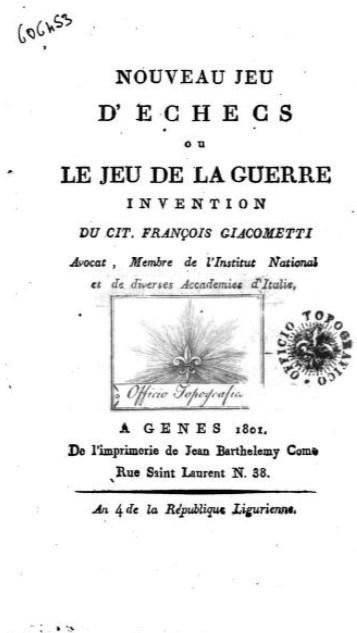
This is the second edition of Giacometti’s ruleset, first published in French in 1794 (and possibly in 1793 in Italian). I was unable to find the first edition, but I don’t believe there was substantial difference with this one.
Note that since I am a native French speaker, I could for once check this machine-translation (by probing around 10 different pages) and it’s excellent.
The original can be found here.
New Chess Game, or The Game of War — François Giacometti (1801)
English translation of Giacometi1801_125p.pdf (OCR transcription in Giacometi1801_FR.md)
NEW CHESS GAME
or
THE GAME OF WAR
INVENTION OF CITIZEN FRANÇOIS GIACOMETTI
Lawyer, Member of the National Institute and of various Academies of Italy.
AT GENOA 1801.
From the printing house of Jean Barthélemy Comte, Rue Saint Laurent No. 38.
Year 4 of the Ligurian Republic.
Ludimus effigiem Belli. (“We play out the image of War.”)
Vid. Sac. lud.
TO THE GREAT GENERAL NAPOLEON BONAPARTE,
OF THE FRENCH REPUBLIC, FIRST CONSUL, PRESIDENT OF THE NATIONAL INSTITUTE OF SCIENCES AND ARTS, FRIEND AND PROTECTOR, AS A MONUMENT OF ESTEEM AND HOMAGE TO HIS VIRTUES AND HIS GLORY, FRANÇOIS GIACOMETTI VENTURES TO PRESENT AND DEDICATE THIS WORK.
The game of chess, which gave me the idea for the one I am presenting to the Public, is so ancient that no one knows which people first played it. Everyone knows this game, and regrets that the name of the man to whom we owe this interesting recreation has remained buried in oblivion. Some attribute its invention to Palamedes, a Greek captain, who perished by the artifices of Ulysses; others claim that we owe it to the Greeks and Romans; the latter are mistaken, for the soldiers’ game Latrunculi, and the game of counters Calculi and Scrupuli, bear no resemblance to the game of chess.
The novelists who have written of the Saracens portray them as very skilled at this game.
Princess Anna Comnena, in the life of her father Alexius, Emperor of Constantinople, in the eleventh century, tells us that the game of chess, which she calls Zatrikion, passed from the Persians to the Greeks; and the Persians say they received it from the Indians under the reign of Khosrow called the Great, at the beginning of the sixth century. The Chinese, who call it the game of the Elephant, likewise agree that they received it from the Indians, from whom they got it in the sixth century. The Persian historians have preserved on this subject some singular circumstances, which I shall suppress here. The name Schatreingi, or Schatrack, given to it, means the game of Schack, or of the King. The Greeks made of it Zatrikion; and the Spaniards, to whom the Arabs brought it, changed it into Alxedres, or Alxadres. The Latins called it Scaccorum ludus, whence comes the Italian Scacchi.
Whatever the origin of the game of chess, it is astonishing that since it has been played, no one has thought to make changes to it. The art of war has been enriched by the invention of gunpowder and of artillery, and military tactics have changed. The invention of chess, which is an allusion to ancient wars, was capable of undergoing new combinations, such that the game, imitating in its course modern tactics, would become in some way the image of our wars. The Chinese have indeed introduced a few more pieces under the name of cannons and mortars; but they have changed nothing either in substance or in the rules of movement.
I thus one day conceived the idea of changing the game and making another of it, which, while giving an idea of our wars, would be more interesting both in its course and in its chances. I presented it to the Public in 1793, after devoting to this work time I stole from other studies. My game was well received in Italy; it was even reprinted in Turin; but it needed, as I myself had said, and as happens with every invention, to be perfected. The board was too large; there were too many pieces, and too few combinations. The game lasted too long, and was even a little tedious in its conclusion, in that the players, to win the game, were obliged to pursue a King who fled across so vast a space. Having soon afterward had the honor of serving my Country as Consul General in Provence, in the early days of the French Republic, I removed the King from it, and substituted for him a fortress to be captured — a fixed objective for winning the game.
Pleased with this change, I set myself to find a way to build this fortress, to defend it, to attack it, and to take it. I made a smaller board, a narrower river; I reduced the infantry by a third, the cavalry by half; I changed their movements, I gave more combination to their forces; I introduced entrenchments, bridges, and ladders for mounting assaults, and better-directed artillery. In short, I almost entirely reformed my game, applying myself to giving it every possible perfection, and to retracing in it the principal military operations carried out on a field of battle. That is why I have named it the game of war; chess players will learn it more easily than others.
CHAPTER I.
GENERAL IDEA OF THE GAME.
The board is composed of 153 squares, alternately white and black, and represents a field of battle divided in two by a river nine squares long and one square wide. This board has, in its entirety, 9 squares of width and seventeen of length. Within the first two rows inclusive, one builds the fortress, composed of nine bastions; and the citadel, which is the object of the game, is placed outside the board at the head of square 5 for one army, and at the head of square 149 for the other; one places in the fortress two soldiers, two cannons, and a mortar for its defense, and a General in the citadel.
There is no fixed rule, as in chess, for encamping this army; it is only natural that a General be free to arrange his camp internally as he sees fit. Once all the pieces have been placed, the game begins, and moves are made
alternately by one side and the other; at each move of the game, the player has the ability to move successively three different pieces, without however being obliged to move more than one. By composing his move of three pieces, the player shortens the game and produces a more pronounced and consequential maneuver. The placing of an entrenchment, a ladder, a bridge, as well as their removal or destruction, counts as one of these three moves. The citadel, the bastions, and the entrenchments are immobile. It is quite ridiculous to see, in the game of chess, a rook wandering about the field of battle; just as it is equally ridiculous that the first piece of chess should be a queen. Indeed, the piece called the queen did not originally bear this name. In Latin verses of the twelfth century it was called fercia, which comes from the Persian word Fertz, which in Persia is the name of this piece, and means a Minister of State, a Vizier. In the game of chess the pawns can only move forward; in my game the Infantrymen, like the other pieces, advance and retreat just as in a battle. The cannons and the mortars fire their cannonball or bomb without moving from their place. The artillery is dismounted, spiked, and when captured, it serves the army that has seized it. The crossing of the river is contested, the bridge is broken, one fortifies oneself with entrench-
ments, which are sometimes taken by assault, or destroyed. Approaches are made to open a breach in the Fortress, which is also taken by assault with ladders. Prisoners are also taken; they are exchanged. There is promotion within the army for pieces that distinguish themselves by bravery. There is even occasion to negotiate peace.
Two players of equal strength can make this game last several days, and even a month. But this should not alarm you. The game of chess, which has fewer pieces and fewer combinations, can last just as long, but is usually seen to finish in four or five hours, and sometimes in less time. My game usually does not last longer; but it amuses and interests more than the game of chess. My game can also be played by three or four people, as you will see in the explanations that follow.
If one does not have the time or patience to finish the game, there is always some action to be enjoyed: the capture of a fortification, a battle on the river, a battle and the defeat of a corps that has just crossed it, the capture of a battery — these are always something, even if one does not achieve a complete victory through the capture of the fortress or the citadel.
I shall now detail the rules to which the pieces will be subject according to their different types, and develop the combi-
nations; and to make this easier to understand, you may refer to the plan of a battle that I have placed at the end of the book, and which you can try out on the board.
It may be observed that in my game there is something not quite similar to what happens on a field of battle, and that something is missing from what occurs in an army; I shall reply that the same shortcomings are found in the game of chess; that it is not possible to include and represent everything, and that it is inevitable that something be omitted, because otherwise the game would take too long, and because the board, the troops, and the artillery are made of wood.
If one asks of what use such an invention can be, I shall reply that it offers as much use, and more enjoyment, than the game of chess, which is highly esteemed, and which many people of wit prefer to card games as a more honest amusement.
CHAPTER II.
Of the Board, or Field of Battle.
The board, as we have said, has seventeen squares of length and nine of width, and contains on its surface 153 squares, counting them one after another; each white square gives an even number, and each
black square an odd number. In the middle of the board is a river one square wide and nine long, which divides it into two camps.
There are two squares outside the board: one at the head of square 5, and the other at the head of square 149. A Citadel is placed in each of these two squares. The bastions of the fortress are placed on the first two rows of each field. In these two fields, two armies are encamped, in the third row beyond the bastions — that is to say, in the fifth row of the field inclusive. This article applies to the game for two.
When playing for three or four, there are likewise in the game only two Citadels and two fortresses. Each of the Citadels is placed respectively in the square found at the two ends of the river. The fortress, and the whole army, are placed on either side, on the first two lateral rows of the board; there is then no longer a river: it becomes a common dividing line indicating that each army is divided into two allied armies; this division distinguishes four armies on the board, two on one side and two on the other.
For a more exact idea of the board, see Table I.
CHAPTER III.
Of the Foot Soldier, or Infantryman.
The Infantryman, advancing, makes two steps, not counting the square on which he stands, whether he moves in a straight line, or moves obliquely to the right or left. He makes one step to his sides, and one step backward; but he has, going backward, no oblique line for his retreat; See T. 2. fig. 1. He cannot cross the first square swept by the enemy Infantryman, or by a superior piece, nor the first two squares swept by the enemy cannon. He moves along the line swept by the piece he wishes to capture; but if, as has just been said, there is another piece sweeping the square over which he must pass to reach the one where he wishes to capture, then he can no longer cross that first square.
When he is in a swept line, he may withdraw backward, following the rules of his movement, unless the position of some other piece of the army prevents him.
CHAPTER IV.
Of the General of Infantry.
The General of Infantry moves like the Infantryman, with the difference that he has the advan-
tage of taking one extra step on all the lines on which the Infantryman moves. He has, like the latter, only one line of retreat backward, but he retreats up to two steps. See T. 2 fig. 1.
The cannon halts the movement of the General of Infantry as it does that of the Infantryman; that is, he cannot cross the first two squares swept by the enemy cannon. He is subject to the same obstacle as the Infantryman, if he encounters in his path the first square swept by a piece of equal or superior strength.
The General of Infantry, no more than the Infantryman, halts the movement of superior pieces.
CHAPTER V.
Of the Cavalryman.
The Cavalryman moves like the Knight in chess, both forward and backward (See T.2. fig. 1.) and captures wherever he moves.
CHAPTER VI.
Of the General of Cavalry.
The General of Cavalry moves like the simple Cavalryman, with the advantage that he doubles the cavalry’s step forward. He can never double it backward, nor return on the se-
cond leap to the lines from which he departed. He cannot double it either if the square on which he makes the first leap is occupied by another piece, or if the square is one of the first two swept by the enemy cannon. He captures wherever he moves; See Table 2. fig. 2.
CHAPTER VII.
Of the Lieutenant-General.
He moves in every direction, and makes up to four steps on the three lines forward, three steps to his sides, and three steps on the three lines backward: he therefore has three lines of retreat. See T. 1. fig. 5. He cannot cross the first square swept by the enemy Lieutenant-General, or by the General-in-Chief, or by the enemy cannon; he captures wherever he moves.
CHAPTER VIII.
Of the General-in-Chief.
He moves up to four steps in every direction, both forward and backward, as well as to his sides. He cannot cross the first square swept by the enemy cannon or by the General-in-Chief. He captures wherever he moves.
CHAPTER IX.
Of the Cannon.
The cannon moves like the Infantryman, but always one step at a time, even on the three forward lines. It captures wherever it moves like another piece, but this capture is not its “shot”; it is the gunner’s action, which is presumed to accompany it in the game.
The cannon fires to a range of four squares inclusive, not counting the square where it is placed, and without moving from its square. It only hits the first piece found on the line on which its muzzle is directed; and when one wants it to fire on another line, it must be turned toward that line. This change of direction counts as a move for it, so that one cannot give it a new direction and have it fire in the same move. When it is advanced from one square to another, it may be given whatever direction one wishes, and this then counts as only one move.
If it makes the gunner’s shot, by placing itself on the square of the captured piece, it cannot also make the cannon’s shot in the same move; and if it makes the cannon’s shot, it cannot make the gunner’s shot.
The gunner, presumed to accompany each piece of artillery in the game, never halts the movement of any piece.
The cannon dismounts an enemy battery —
that is, the enemy mortar or cannon — when the enemy mortar or cannon is within a distance of three squares inclusive on the line on which it fires. But at the fourth square, it does not have enough force to dismount it.
If two enemy cannons or mortars have their respective direction on the three squares of the same line, the one with the advantage of the shot dismounts the other.
To knock down an entrenchment, to open a breach in the fortress, and to break the bridge over the river, the cannon must be at the same distance fixed for dismounting an enemy battery. To destroy a bastion, the cannon must always have its direction perpendicular to the front of the bastion one wishes to demolish, and never at an oblique angle. The piece destroyed by the cannon or mortar is removed from the game. See Table 2.
The gunner’s shot does not dismount artillery, but it captures it; it does not open a breach, but it can destroy the bridge, the ladder, and the entrenchment, as we shall see in the following rules.
The loss of a cannon or mortar is very harmful, because the enemy uses it to fire on you; when you cannot save it, you must throw it into the river, or spike it; but to throw it into the river, you must be on the bridge, or beside the river; and to spike it, it must be in a
square that the enemy pieces do not sweep. When you capture a cannon or mortar from the enemy, you place it in one of the eight empty squares, swept or not, that are beside the victorious piece, and you turn it over (overturned) to indicate that it is not yet in service. If you take the artillery by force (which you turn over, as has been said, beside the victorious piece), you may, in the following moves, mount it back up in the same square, or move it to another following the rules of its movement, and give it whatever direction you wish; if the enemy recaptures it, mounted or not, the same rule applies. If you believe you cannot keep this prize, you may spike it or throw it into the river; but in the latter case, the river square into which you wish to throw it must be empty and close to the piece that captured it; all this is then done in the same move. But to spike it, you must wait for the following move, and it must be in a square not swept by the enemy. You may then move it according to its movement into an unswept square, and spike it in the same move. If there is no free square, you cannot spike it.
You may nevertheless move the artillery onto squares swept by the enemy and advance it against those same squares as you do with other pieces.
The artillery of a camp that remains without per-
sonnel in the camp; the artillery of the fortress that remains without personnel in the fortress no longer has any activity and falls into the enemy’s power, if he is present there; and if the enemy is not present, it falls into the power of the first one who arrives, and after the interval of one move of the game, it regains its activity.
Artillery does not move into the river; if it enters it, it is considered lost and is removed from the game. It does not climb to the assault of the entrenchment or of the fortress: its shot does not open a breach in the Citadel, and does not kill the piece that is in the Citadel. To destroy a bridge with one shot, it follows the rules fixed for knocking down an entrenchment. If it destroys the bridge, everything on it is considered to fall into the water and be lost. But it may choose to kill or destroy only what is on the bridge, without ruining the bridge, just as it may choose the ladder or what is on it; but in ruining the ladder, it kills at the same time the pieces that have climbed onto it. See Table 2 fig. 3. 5. 6. 7.
CHAPTER X.
Of the Mortar.
The bomb’s shot describes a curved line and strikes only the third square of the li-
ne on which its muzzle is turned. The piece that is on this third square struck by the bomb’s shot can only escape it by withdrawing to another square, since the entrenchment or another piece it might have in front of it could not serve as a defense. On this third square, the artillery is dismounted, the entrenchment is knocked down, and the bridge is ruined along with everything on it. The bomb’s shot does not open a breach in the bastions, and does not strike inside the Citadel, which is presumed to have a vault proof against bombs.
The bomb cannot choose when there is one piece upon another; it strikes both in one shot. In other respects it follows the rules of the cannon.
A piece of artillery of any kind defends the piece that is behind it, like any other piece, in the sense that it halts the movement or shot of another; so that one must capture the artillery piece before capturing the piece behind it; but it does not defend against the bomb’s shot, nor against the cavalry’s leap. See Tab. 2. fig. 3. 6. 7.
CHAPTER XI.
Of the Bastions.
These are strips of wood the length of the board’s squares, of a height proportional to the pieces of the game, and notably to the cannon’s carriage, which must fire from the square where the bastions are placed. The carriage must raise the cannon so that the muzzle’s line of fire grazes the horizontal surface of the bastion. The bastions shall have a thickness of one third of a square, so as to preserve, in each bastion square, a space on which another piece may be placed. See T.1.fig.13. There are 9 bastions, which you will place on the front of the second row of your field. Each bastion belongs invariably to the square in which it is placed. With the bastions, the fortress is built in two ways, the plan of which is shown on Table I; you may choose either for the game for two, but when playing for three or four, you must always use the fortresses found on Table I at the two ends of the river. These bastions are immobile; only the cannon, at a distance of three squares, can ruin them.
b
CHAPTER XII.
Of the Citadel.
The Citadel is a piece the size of a square on the board, and of the height of a bastion. It is placed at the head of the fifth square, which is outside the board, as seen on Table I. These squares outside the board number four: two for the game for two, and two for the game for three or four; two consequently always remain unused, and are not included in the game. The Citadel is immobile; it is formed of rock, and cannot be struck by any artillery piece; it must be taken by assault, by means of the ladder; once the Citadel is taken, the game is won by the one who captures it.
CHAPTER XIII.
Of the Entrenchments.
The entrenchment is formed by one or more strips of wood, thinner than the bastion. See the T. 1. fig. 11. whose corners are cut vertically along the diagonal of a perfect square, so as to be able to form one or two right angles by joining two or three strips; when a single strip is placed on the front
of a square, the obliquity of its two sides gives access to two oblique lines. See Table 2. fig. 8. line 1. square 2. An entrenchment is placed on the front, or on the corners, or on the sides of a square to defend some piece; but it can only be placed on the square occupied by one of one’s own pieces, or in the square next to one of one’s own pieces; it can never be placed next to an enemy piece, nor at the intermediate point of the line swept by the enemy cannon. The same rules apply to removing it from the game when one wishes to destroy it, without making use of artillery. One may likewise entrench the bridge, by placing one or more strips, following the preceding rules. If one wishes to fire upon enemy pieces posted opposite the front of the entrenchment, the cannon must be behind it and rest against the entrenchment; but if there is an empty square between the cannon and the entrenchment, the cannon can only hit the entrenchment, and not the enemy pieces beyond it in the same direction, because the entrenchment would stop its shot. See T. 2.
Any piece found behind an entrenchment strikes, like the gunner’s shot, the square at the foot of the entrenchment without leaving its place; but it cannot strike beyond that square on the line in front of the entrenchment. See T. 2. fig. 8.
The entrenchment is immobile; it can
b 2
be destroyed by a bomb’s shot, or by the cannon of either army: it can equally be destroyed by one of the pieces of the army to which it belongs when it is next to that piece, just as it can be by an enemy piece that has seized it. This destruction is carried out, in conforming, for removing it from the game, to the same rules prescribed for placing it; however it is destroyed, it always counts as one of the three moves of the game. Once removed from the game, the entrenchment is of no further use. There are eight entrenchment pieces, which the player holds in reserve outside the board to use as needed. It is prudent to keep them, because they become necessary at the end of the game to form the approaches before the fortress and open the breach. Entrenchments also have the advantage of sheltering the besieger from the fortress’s fire.
CHAPTER XIV.
Of the Bridge.
The bridge serves to pass artillery into the enemy’s camp, and to facilitate the army’s crossing, whose pieces, in crossing the bridge, retain the full strength of their movement. The same rules observed for placing and removing an entrenchment must be observed in placing and removing
the bridge; any piece, even an enemy one, that takes possession of it removes it from the game in the same way an entrenchment is removed, with the difference that the bridge may be replaced, if it has not been destroyed by a cannon or bomb shot. The bridge is common to both armies; if the enemy removes it from the game, he can then replace it likewise. A piece that wishes to descend from the bridge into the river, or to climb from the river onto the bridge, follows the same rules as a piece entering the river, or leaving it, as we shall see in the rules of the river. There are four bridges in the game, and these bridges are square pieces the size of a square; they may be given as little thickness as desired, and made narrower than a square; the essential thing is that each bridge placed on a square touch, with its two ends, both banks of the river. The bridge serves to join the two camps and does not defend the pieces in any way. See T. 1. fig. 9.
CHAPTER XV.
Of the Ladders.
The ladders number four; they have the shape of a quadrangular pyramid truncated at its summit and on one of its faces. The base measures half a square; the height is equal to that of an entrenchment. See T.I.F.12.
The ladder rests against an entrenchment or a bastion; then its summit, being level with the summit of the entrenchment or bastion to which it is joined, forms a larger horizontal surface on which the climbing piece stops, to descend on the following move into the interior squares of the entrenchment, or into the fortress. If it is applied to a corner, or to one of the exterior faces of the Citadel, then it produces only one degree of elevation, by means of which the piece climbs, stops, and then enters the Citadel. The ladder resting against a bastion or an entrenchment gives access to pieces by five lines — two lateral, two oblique, and one direct on the front — on any of which the pieces may advance to mount the assault. For the rest, the rules of the bridge are observed. One should carefully avoid losing all the ladders, if one wishes to take the Citadel and win the game.
CHAPTER XVI.
Of the Defense of the Fortress and the Citadel.
As soon as the fortress has been built in either of the two ways indicated, one places for its defense a General, two Infantrymen, two cannons, and a mortar. Each infantryman in the fortress has a movement of two steps in every direction. The artillery also has one step in every direction. When the fortress is built for the game
for three or four, and is consequently closed on all sides, the two lateral bastions on the first row are imagined each to have an exit by a drawbridge, for the pieces of the fortress only, which go out and return according to the rules of their respective movements. The garrison, composed as has been said, may sortie during the game; it may also later be reinforced by other pieces. The artillery may only sortie once a piece of artillery from its camp has passed into that of the enemy, or once a piece of artillery has been lost in its own camp. When there is no one in the fortress, it ceases to be active in defense, and is no longer considered to fire any shot, but it regains its strength and activity as soon as some piece of the army re-enters it. If the enemy enters the fortress and finds no one there, the artillery belongs to him, and after the interval of one move of the game he puts it into service.
Care must be taken to defend well the three bastions whose destruction would give access to three points of the Citadel. See fig.6 of T. 2. (note: in fig. 6 of T. 2, the breach in the bastion in front of the Citadel was omitted.) When the breach is open, it may be closed by an entrenchment piece; and just as one may enter the fortress through the breach, one may likewise exit through it. The Citadel is situated at the head of the
square that is in the middle of the first row of the board; it is bomb-proof, and cannot be ruined by cannon fire, so that the piece placed there is perfectly safe unless taken by assault. The piece on the Citadel is not obliged to make any move. It does not activate the fortress’s artillery. It can be blockaded by the enemy. The Citadel cannot be taken by a single piece. The fortress’s cannon, to fire, must be in the square of some bastion, from where it can be directed and fire on three different lines. If the cannon is not placed in the bastion’s square, its shot, starting from a square behind, is stopped by that same bastion. The squares at the foot of the bastions are regarded as ditches, defended by the fortress’s garrison; the enemy may enter them, but loses his life there. There are, however, squares around the bastions that are sometimes undefended; one may stop there with impunity, but must withdraw if some piece of the fortress approaches to defend them. To understand this defense well, imagine any piece, even artillery (cavalry excepted), placed in square 11 of the fortress; squares 10, 19, 20, and 21 are defended by this piece, which would move there if not prevented by the bastions; and this piece, without leaving its place, kills the piece that stops on the said
squares. The piece that wishes to overturn and destroy the ladder placed by the enemy against the bastions climbs onto the bastion and overturns it; and on another move descends back into the fortress. Artillery does not climb onto the bastions. And generally, any piece that is in a bastion square fires one step along its lines of movement without leaving the fortress, but if the breach is open, it must exit to fire along the line on which it can move.
The Citadel, when occupied by a piece, has three ditches: one at the front, and one at each of the two squares adjoining the two front corners. Enemy artillery found in a ditch defended as described above remains inactive; that is, the piece defending the ditch fires its shot and kills the gunners; but to capture the artillery, a piece must be outside the fortress, or able to exit it. The artillery thus left inactive may resume its movement and gradually its strength, if a piece of the army to which it belongs approaches and withdraws it from the ditch.
CHAPTER XVII.
Of the Assault and Capture of the Fortress and the Citadel.
To assault the Fortress and then seize the Citadel, one must advance
with all possible force, for fear of being defeated piecemeal and reduced to the impossibility of taking it. Cavalry is not considered capable of overcoming the bastions, nor of using the ladder; it may enter the fortress once the breach is open; but to enter, as to exit, it must have reached, by its movement, the square where the destroyed bastion stood, or the square where the open gate is.
The Cavalryman may nevertheless transform into an Infantryman, and the General of Cavalry into a General of Infantry, when an Infantryman or a General of Infantry has been lost; but they cannot then resume their former state. To assault the fortress without opening the breach requires the loss of many men without even being sure of succeeding in taking the Citadel. It is therefore more expedient and less dangerous to attack the fortress with artillery, opening one or more breaches through which to enter.
Approaches are made using entrenchments to place one’s batteries under cover from the fortress’s cannon fire. The cannon intended to open the breach must be within range of three squares, and in a direct line facing the bastions, never obliquely: the cannon, being three squares from the bastions, can be dismounted by the fortress’s cannon fire; it will therefore be necessary, in accordance with the prescribed rules, to place in front of your cannon, and on the
same square, an entrenchment, which, by its position, will be outside the half-range of the enemy cannon; and while the fortress’s cannon is occupied destroying the entrenchment, your cannon has time to fire and open the breach. From this one sees it is very advisable to husband one’s entrenchments in battle, since it is by their means that one can form one’s lines of attack, dispense with assaults, avoid exposing one’s batteries, and finally avoid being reduced to renouncing the capture of the Citadel. See Table 2. fig. 4.
As soon as you have opened the breach by destroying a bastion, you have entry by three lines: the line at the front, and the two oblique lines. If you open the breach at the square where the oblique line leads you to the Citadel, you gain a very great advantage over the enemy, and if you can also open a breach on the other side at a similar square leading to the Citadel, you put yourself in a position to take it with two Infantrymen, and more easily with two Generals. See Table 2. fig. 6.
The bastions of the fortress numbered 12, 14, and 16, for example, are the most important, as are, in yours, bastions numbered 138, 140, and 142 (we always speak of the fortresses marked at the head of the board on Table I). Here is the proof: place an Infantryman on square 12, and the other on square 14 or 16; place the ladder at
square 4, 5, or 6 — the only three where it can be placed; suppose, for example, it is at square 4, and that you have climbed up; if the piece in the Citadel wishes to capture you on square 4, you place another ladder at square 6, and climb it, since you have three moves to make with three different pieces; then the piece guarding the Citadel captures the piece on square 4, and returns to the Citadel on another move; and you capture, with the piece on 6, the piece that has returned to the Citadel, of which you become master. If it does not capture you at square 4, you capture it in your turn, and you win the game, being then on the Citadel. No entrenchment is placed on the Citadel, which is strong by itself; the piece defending it goes out and returns without a ladder, according to its movement in all directions; but if it goes out, one must try to cut off its retreat to the Citadel.
CHAPTER XVIII.
Of the Defense of Entrenchments.
An entrenchment is defended by troops and by artillery. We shall speak first of defense by troops.
An Infantryman, a General of Infantry, or either of the two senior or principal Generals defend the entrenchment in two ways.
First: if one of these pieces is on the same square as the entrenchment, it defends the square at the foot of the entrenchment without leaving its place; if the enemy approaches it, he is killed, and if he climbs the ladder to then descend into the entrenchment, the piece behind, unable to fire without moving, in turn climbs onto the entrenchment without a ladder, and captures the piece on the enemy’s ladder; it should also be noted that if the latter is not supported by artillery or another piece, it should not risk climbing to the assault. See T. 2. fig. 8.
If one of these pieces is on either side of the entrenchment, or in a square from which it can move onto the square at the foot of the entrenchment, it then captures the piece that has arrived on that square to seize the entrenchment. The gunner may, in this case, make the same move. See T. 2. fig. 8.
An entrenchment is doubly defended by the cannon. The cannon has, as has been said, the gunner’s shot, or the Infantryman’s, and the shot of its cannonball; in this case, it is more difficult to approach it. But if the cannon or mortar is not on the entrenchment’s square, the enemy can advance onto the square at the foot of the entrenchment, and seize it, provided the artillery’s fire is not able to strike, from elsewhere, the square through
which he must enter to take possession of it. The cannon or mortar is not considered able to climb onto the entrenchment to capture the enemy piece that has climbed to the assault; but the cannon can kill it with its shot if it is aimed at the said piece. The entrenchment only defends the piece behind it, and only against shots coming from the line in front of the entrenchment. The “front” also refers to the oblique line, if the entrenchment is placed on the oblique line. See T. 2. fig. 3.
When there are two entrenchments joined together on a square, forming a right angle, then the piece behind can strike three squares without moving there, and along three defended lines. See T. 2. fig. 8.
If a piece of artillery enters the square at the foot of a defended entrenchment, it remains inactive until withdrawn, as has been said in the rules concerning ditches. The Cavalryman does not defend the square at the foot of the entrenchment without leaving it, yet he is nonetheless defended by it.
CHAPTER XIX.
Of the Assault and Capture of the Entrenchment.
There are four ways to capture an entrenchment from the enemy.
First, by assault; second, by destroying it with artillery; third, by turning it, which is done by capturing, from the side or from behind, the piece occupying its square; fourth, by seizing it when found undefended. One should never assault an entrenchment unless one has no artillery to knock it down, or has a pressing need to take it; when one wishes to take it by assault, the ladder is used, following the rules discussed in the assault of the Fortress. See T. 2. fig. 7.
It is destroyed by cannon fire according to the rules given for opening a breach. It is also destroyed by a bomb shot, which may be directed as desired onto the front line or the oblique line. The bomb chooses, on the same square, either the entrenchment or the piece defending it. The cannon shot likewise chooses if its direction is toward one of the two sides. See T. 2. fig. 3. l. 2.
The cannon does not ruin the angle formed by two entrenchments. See T. 2. fig. 3. l. 1.
One seizes the entrenchment by capturing the piece defending it, provided however that the piece seizing it remains victorious without being captured in turn. See T. 2. fig. 7. l. 1 and 2.
Finally, one seizes it, when undefended, by approaching it — that is, by entering the square at the foot of the entrenchment, or the one behind it; the en-
trenchment thus captured serves the defense of the piece that has become its master. It may be recaptured again. If one wishes to avoid this drawback, it is destroyed according to the same rules prescribed for its placement.
CHAPTER XX.
Of the River.
The river separating the two camps is not considered so deep that it cannot be crossed without a bridge. The bridges serve to pass artillery, and to facilitate the army’s crossing. A Soldier, or a simple General, takes only one step when entering the river, and one step when leaving it; place a Soldier one square from the river — that is, with one square between him and the river — and he then makes both steps in a single move, since he ends his movement on the river square itself; if, on the contrary, he is on the bank, he makes only the step onto the said river square, where he stops because of the water that prevents him from continuing; if he then wishes, on this or another move, to leave the river to move forward, backward, or to either side, he always makes one step. If a simple General is placed so that there are two squares between him and the river, he makes all three steps, stopping in the river, and if he is closer,
he follows in every direction the Infantryman’s rules, and like him makes only one step when in the river. The General of Cavalry, on touching the water, makes only the step of the simple Cavalryman, and the Cavalryman always follows his own movement. The two principal Generals, on touching the water, make only two steps, thereby following the rules of the Infantryman and the simple General in proportion to the privilege of their movement; all pieces retain the order of their movement if they cross on the bridge. See T. 2. fig. 5.
One cannot place an entrenchment or a ladder in the river; but they may be placed on the bridge when nothing opposes it. Artillery can only cross the river on the bridge. If artillery enters the river, it is lost.
A piece on the bridge wishing to descend into the river, or one in the river wishing to climb onto the bridge, must follow the rules stated above — that is, the Infantryman and the simple General make only one step, and the other principal Generals make two.
One may play for two without a river; in that case there is only a single camp in the game; the game for three and for four is always played without a river.
CHAPTER XXI.
Of the Encampment.
In the game of chess, players are obliged to encamp always in the same man-
ner. It would be absurd to prescribe to a General the manner of placing his camp, as well as the order of march and battle: in the new game, the construction and placement of the fortress and the citadel had to be determined, because it is natural that a General, on taking command of an army, should not begin by building the fortress, which is already presumed to exist. Likewise, the location of the encampment has been prescribed only insofar as was necessary to prevent one from encamping facing the enemy, at points where he can strike with his artillery and his troops. There is therefore a place where the army gathers and organizes itself, in order then to march against the enemy and make, without danger, its first movements.
The location of the camp is therefore between the first and fifth rows inclusive for the troops, and between the first and fourth inclusive for the artillery. Within this space the player arranges the army as he sees fit, after first having built the fortress and the citadel in one of the two prescribed ways, on the first two rows, likewise arranging there
as he sees fit the garrison and the artillery intended to defend it.
It is unnecessary to point out that care must be taken to arrange the army so that the pieces can mutually defend one another, placing the infantry with the artillery, the cavalry on the wings or in the rear, and the Generals where they can protect their troops; the two games I give to the Public will give you an idea of this arrangement. Once all the pieces of the game have been placed, except for the entrenchments, bridges, and ladders, which are kept in reserve outside the board to be used as needed, one may begin to move on either side.
CHAPTER XXII.
Of the Army’s March.
Each move of the Army consists of the movement of one, two, or three pieces; but one may never move more than three pieces to execute the army’s move: when you place an entrenchment, a bridge, or a ladder; when you transform a horse into an Infantryman, or a General of Cavalry into a General of Infantry (a change made on the same square where the piece to be transformed is found), each of these pieces is considered to have made one of the three
moves of which the army’s move may be composed. The same applies to the change of direction of an artillery piece on the same square, which also counts as one move. The removal of a ladder or a bridge, as well as their destruction; or the destruction or demolition of an entrenchment, is yet another move. In short, every piece that is placed, removed, destroyed, transformed, or made to change direction or position always makes one of the three moves permitted by the game. There is no obligation to make all three moves. One may limit oneself to making only one. The piece in the citadel is not obliged to move. Each piece captures on the square onto which it moves. Recall that artillery is presumed to have the gunner’s shot — that is, it captures wherever it moves, and it fires its cannonball or bomb without moving from its post.
Each moving piece cannot cross the first square on which another enemy piece, of equal or greater strength, has its immediate move. Cavalry is not subject to this rule, neither actively nor passively. The General of Cavalry observes it in the double leap we spoke of, if on his first leap he touches one of the two squares that are between the cannon and the inter-
mediate point of its shot. One may move onto the first square swept by a piece one wishes to capture, provided another piece does not obstruct this by its immediate move, as already noted. Artillery is not subject to this rule, neither actively nor passively. The cannon prevents the passage of the Infantryman, the General of Infantry, and the General of Cavalry over the first two squares of the line from which its shot departs. It likewise prevents, on these two squares, the placing and removal of an entrenchment, a ladder, and a bridge. It also forbids passage on the first square of its shot to the Lieutenant-General and to the General-in-Chief, although the latter is the first and most important piece of the game.
Artillery remains without movement and without activity if, in the camp where it is found, there remains no piece of the army to which it belongs; in that case the enemy seizes it, and uses it after the interval of one move of the game. Care must therefore be taken not to send artillery across the river without some piece of the army following it, nor to leave it abandoned in one’s own camp, in one’s fortress, or in the enemy’s fortress when an enemy piece is still present there. It regains its activity if, not yet having fallen into enemy hands, some piece of its own camp arrives in the camp or fortress
where it is found. A piece that is in the river is considered to be in one camp as much as in the other; and consequently its artillery may act in both camps, and when the game for two is played without a river, it suffices, to activate the artillery, to have one piece in the camp, just as in the fortress.
CHAPTER XXIII.
Of Promotions in the Army.
In the game of chess, a pawn that reaches the last row of the board, that is, the enemy’s first row, is promoted to the rank of Queen, Rook, etc.
In the game of war, it is also necessary that promotions take place for pieces that distinguish themselves by their bravery and courage. A piece that takes by assault a defended entrenchment, and enters the fortress when it is defended by two pieces of whatever kind, immediately passes to the rank above its own. The Cavalryman who enters through the breach, or who, having been transformed into an Infantryman, performs some similar action, may also be promoted.
If there is no General-in-Chief, any piece may become one by entering the fortress by assault, that is, with the ladder,
provided however that there are at least two pieces in the fortress defending it. The promotion sequence is established as follows. The Infantryman is promoted to General; the General to Lieutenant-General; the Lieutenant-General to General-in-Chief; the Cavalryman who enters through the breach or through the gate into the Fortress, to General of Cavalry; the General of Cavalry to Lieutenant-General. But to pass from one rank to another, there must be a vacant position, and when there is none in the established order, one passes immediately to a higher one. If there is no vacant position at all, there can be no promotion.
CHAPTER XXIV.
Of Prisoners of War and the Manner of Exchanging Them.
When you have any piece (artillery excepted) on a swept square, and you can no longer save it because its retreat is cut off on all sides, it is better then to yield it to the enemy as a prisoner of war. The surrender of the prisoner piece does not count as a move of the game.
One may then request the return of the prisoner. This restitution is made by giving the enemy a piece of the
same rank, if you have one among the pieces you have taken from him; failing a piece of the same rank, it is fitting to give him two or three inferior pieces, in proportion to the importance of the prisoner returned to you; you will place the prisoners returned to you on the rows where the encampment is formed at the start of the game, or in the Fortress or in the citadel, in such a way, however, that they are not in a position to immediately strike the enemy. The restitution and placement of these pieces do not count among the three moves of the game. To prevent any dispute over exchanges, agreements must be made before playing, declaring whether or not one wishes to take prisoners.
Here is a rule for making exchanges when one does not have pieces of the same rank; you may follow it if you judge it suitable.
Give, for example, two Infantrymen for a General of Infantry, two Cavalrymen for a General of Cavalry; an Infantryman and a General [for a Lieutenant-General]; an Infantryman, or Cavalryman, and a General of Infantry for the Lieutenant-General; an Infantryman, a Cavalryman, and a General, for the General-in-Chief, or else an Infantryman and the Lieutenant-General.
CHAPTER XXV.
Of Victory, and of the Indecisive Game.
The game will certainly remain indecisive when both players find themselves without a ladder to climb to the Citadel, which is the object of victory.
It likewise remains indecisive when there remains only one piece on each side, even if the artillery were still intact; unless, for example, the piece leaving the citadel should manage to capture the enemy piece found in the camp, in which case this first piece would remain victorious, no longer able to be threatened by the artillery, which would by then have lost its activity. Otherwise, the piece attempting to attack its enemy remaining in the citadel would go to be captured for nothing.
The game may remain indecisive when one has lost the artillery or the bridges needed to move it across; or when one no longer has entrenchments to form the approaches before the enemy fortress, which is in a good state of defense; or when the two armies do not have enough men to mount an assault.
It never happens that all the pieces are killed or captured on both sides; there will always remain one man on the field of battle.
CHAPTER XXVI.
Of the Reduction of the Game.
If the players wish to command a smaller army, and to see the game end sooner, they need only reduce the army, and fight with a smaller number of pieces. The army may be reduced in four ways.
- The same pieces, but a smaller stock — that is, four entrenchments, two bridges, and two ladders.
- A smaller fortress consisting of the citadel, seven bastions, one cannon, one mortar, and two Infantrymen as garrison.
In the camp: one cannon and one mortar, or two cannons, six Infantrymen, two Generals, two Cavalrymen, the General of Cavalry, the Lieutenant-General, and the General-in-Chief; four entrenchments, two bridges, and two ladders. - A smaller fortress with the citadel and five bastions, one cannon and two Infantrymen as garrison.
In the camp: one cannon, four Infantrymen, two Generals, two Cavalrymen, and the General-in-Chief. Two entrenchments, two bridges, and two ladders. - The citadel without bastions, one Infantryman as garrison.
In the camp: one cannon, four Infantrymen, two
Cavalrymen, two Generals, and the General-in-Chief; two entrenchments, two ladders, and two bridges.
By choosing whichever of these four ways of reducing the army one wishes, one may play without a river, just as in playing the great game for two. The last two modes of reduction require a smaller camp; you may play on one side only, on the camp on this side, or on the one beyond the river; and place yourselves respectively on the first two rows; or else you may suppress three or four rows, which you leave vacant at each end of the board, without using the river; and if then you make your moves with only two pieces at a time, the game will be better combined. But this game is not as interesting nor as pleasant as the game composed of all the pieces; apart from that, it is shorter without a river.
CHAPTER XXVII.
Of Conventions.
There is no game in which the player cannot make variations or conventions that alter or evade its rules. Players are therefore free to make their conventions before beginning the game. If an expert
player happens to play against a weaker opponent, he may grant the latter some advantage to balance the contest; and, to gain more glory from victory, he should, for example, command an army inferior in strength, or allow his opponent to encamp closer to the river.
CHAPTER XXVIII.
Of Peace Treaties.
Wars usually last for years, and sometimes the outcome of a single battle ends them within a few days. Sometimes a small army defeats a much larger one; the Trojan War lasted sixteen years; all the Punic Wars lasted a long time. Cortés conquered part of the New World with a handful of men; and recently Bonaparte, in less than a month, marched an army that crossed the Alps in the heart of winter, delivered Italy for the second time by the Battle of Marengo, and retook fortresses whose conquest had cost the Austrians more than a year of labor.
This game, which is an imitation of war, reproduces and presents to you these various movements and these various outcomes in a figurative sense; the duration of the game always depends on the bravery that balances fortune between the players.
But as it sometimes happens that players, weary of fighting, prefer to make peace rather than risk seeing the battle decided in favor of one of them, there is then occasion to conclude treaties fair and advantageous to both belligerent parties. The one who has greater need of peace may, to obtain it, cede one or two extra rows to the enemy for encamping when starting another game; or even allow him to place a portion of his army on the other bank of the river, or some similar advantage.
CHAPTER XXIX.
Game for Two.
I do not present this game for two to you as a well-played game, but simply to acquaint you, through practice, with the strength of the pieces, their movements, and the combination of the game.
After learning the rules for each piece, number the squares of the board with white lead diluted in water, which you can erase after playing; the first row, made up of 9 squares in width, like all the others, will bear the numbers 1 through 9; then the second row will begin with 10, and continue marking always as if you were writing a letter, beginning on the left and ending on the right, until you have marked
all the squares, which number 153.
The player who places himself at the head of the board, where the numbering begins, will command the Black Army, which we shall now encamp first. The other player, who places himself at the other end, where the numbering of the board’s squares ends, will command the White Army, which we shall also encamp shortly.
Place your fortresses at the spot and in the manner shown at the two ends of the board on Table 1. As for the other two fortresses, which are on the two sides, although they could be used likewise, we shall leave them for the game for 3 or 4.
After having built your fortresses with their citadels, place their garrison there; that is, a General on the citadel; a cannon (speaking of the black fortress) on square 12; a mortar on square 13; another cannon on square 15; all this artillery should have its direction toward the front. Place an Infantryman on square 2, which is the right gate of the fortress, and the other on square 8, which is the left gate. Place an equal garrison with the same arrangement in the other, white, fortress.
There you have your fortresses well defended by a garrison, stationed inside the place, which can later sortie, and which can be reinforced by playing with the artillery and troops of the camp. All that remains is to arrange the Armies in their camps, between the rows that
the rules of the game give you as limits: let us now put this arrangement into practice.
[Wargaming Scribe’s note: I removed an incredibly long AAR here]
CHAPTER XXX.
Reflections on the Said Game.
This game could have been finished in fewer moves, but it was necessary to include a greater number of incidents to serve as instruction for players: you may have found some moves useless, and others somewhat poorly directed; but my goal was only to teach you the movement of the pieces, their strength, and the combinations of the game, so as to guide you in the other games you will play yourselves, which will always differ from one another in duration as in events, even though the pieces retain the same established rules. You will tell me that the game ends with the destruction of both armies, and that almost the same pieces remain to the victor as to the vanquished.
I shall reply that the same thing would happen between two armies disputing a fortress, unable to recruit new troops, and whose Generals and soldiers are of equal bravery; and the same happens then in the game of chess.
You will add that in chess, one can deliver checkmate in three moves and win the game without both armies being destroyed.
First, I would say to you that this is rather a flaw, and would be even more so in my game; since it is not natural that in three moves one should cross the river, defeat an army, take a Fortress, and then a Citadel, even if the army defending it were very poorly commanded. The necessary time must elapse in proportion to the greater or lesser resistance, otherwise there is no longer any plausibility, and the game would be defective.
Secondly, checkmate in 3 moves is always a surprise sprung on an inexperienced and unwary player, and this surprise occurs all the more easily the narrower the board, because many pieces move from one end to the other, and because it is easier to capture a King, who has only one step, than to cross a river, defeat a fortified army, and take a defended Fortress and Citadel.
Thirdly, the surprises that occur in real armies likewise occur in mine, but with time proportioned to the nature of the game and of battles. While one army is ready to fight, or to attack the enemy Fortress, the enemy can do as Scipio did when he went to Africa while Hannibal threatened Rome; he can, with a light detachment, make a diversionary march and surprise the other Fortress, succeeding more easily in taking it, or at least
forcing the enemy to return to his own camp and lift the siege of the Fortress to fly to the rescue of his own.
If one player were weaker than the other, or more skilled at sustaining attacks than at delivering them, or if he preferred to remain only on the defensive, he need only advance his artillery to the 6th row, fortify himself there, and make his moves between his fortified lines according to the enemy’s movements. This fortified and well-defended 6th row is a very strong position; the enemy cannot strike it with his artillery from the riverbank, but is obliged to fight on the river and on the bridge, or to cross it, and to fight on the two rows remaining between the river and your entrenchments; his maneuvers are more difficult, slower, and more perilous. Your artillery, being within three squares inclusive of the river, strikes the opposite bank and strikes the bridges over the river; and with the ditches of the entrenchments defended, the enemy has only one row, or a front of a single square, where he can move with less risk. It is necessary, however, that the General — the player — who comes to attack you be brave and more skillful than you in order to defeat you; and that he sacrifice at least more men than you to break through your lines; and all the braver to then win the game, despite the inferior number of pieces remaining to him after such a battle.
CHAPTER XXXI.
Of the Game for 3 and for 4.
If all four Players wished to play on the same board, each commanding an army, so that they are two against two — that is, two allied armies against two others — they shall arrange themselves as follows.
First, the two sides of the board become two fronts; and the two fronts, or ends, of the board become the sides. The Citadel is built at the head of the river outside the board, as can be seen on the board of Table 1, and the other on the other side, with their fortresses inside the second row. The river becomes simply a dividing line separating the two camps as well as the two fortresses. Each of these two fortresses belongs half to one of the two allied armies and half to the other; and the middle line, at the head of which is the Citadel, is common to both. It suffices, however, that there be a single piece in the fortress to activate all its artillery. The bastions of the fortress remain joined and materially form only a single one. The two bastions on either side of the first row are imagined to have a gate with a drawbridge, so that the pieces to which the fortress belongs, or will belong if it is captured, may freely exit and enter. These two bastions are subject to destruction by the same means as the others.
Once the fortresses have thus been built, one facing the other, with their garrisons as in the game for two, placing the two cannons at the corners so that they can strike the middle of the two camps along the oblique line, the two armies are arranged facing the two enemy armies — that is, one of the black armies to the right and the other to the left of the fortress on the two rows of the camp, with the artillery on the first row. These two armies are formed by dividing the whole army in half, as we shall see below; the same is done on the other side.
The rules are the same as those of the game for two, except that only two pieces are moved for each of the 4 armies, or one if desired; so that a move of the game consists of 4 moves for Black and 4 for White, from which it follows that this game has 2 more moves than the other. A piece that passes from one allied army into the other cannot be moved by the latter in the same move, otherwise it alone would make 2 moves at once. Pieces that, in the camp, in the fortress, or in the citadel, are found on the middle dividing line are common to the 2 allied armies as long as they remain on that point; that is, they may be moved either in the moves of one or of the other, but not by both in the same move; the 2 allied Generals may consult between themselves. To better understand the game for 4, here is a battle which you may try on the board, as you did for the game for two.
CHAPTER XXXII.
Battle for Four.
The numbers you marked for the game for two will serve for the game for 4. Remember, however, that the two fronts and the two sides of the camp are switched, as I said in the previous chapter. Build the two fortresses as shown marked on Table I.
Black.
Let us begin with Black. Build the Black Fortress so that it encloses squares 62, 63, 71, 72, 80, 81, 89, 90, 98, 99, and the Citadel at the head of no. 81, all in the manner and place indicated on Table 1.
Garrison it with artillery and troops. Place the mortar on square 80, direction toward the front; a cannon on square 62, direction right oblique, and the other cannon on 97, direction left oblique; a General in the Citadel, an Infantryman at 72, and the other at 90.
Right Army. First row. The General-in-Chief at 54; Infantryman at 45; mortar at 36, direction toward the front; cannon at 27, direction toward the front; Infantryman at 18; General at 9.
2nd row. Cavalryman at 53; Infantryman at 44; Infantryman at 17; Cavalryman at 8.
Left Army. First row. Infantryman at 108; General of Cavalry 117; cannon at 126, direction toward the front; Lieutenant-General at 135; General at 144; Infantryman at 153.
2nd row. Cavalryman at 107; Infantryman at 116; Infantryman at 143; Cavalryman at 152.
Wherever there is a General-in-Chief, there is one additional artillery piece, namely the mortar; and wherever there is only one cannon, there is the General of Cavalry and the Lieutenant-General; so that the two armies remain equal in pieces, and nearly equal in strength as well.
White.
Build the Fortress in the same manner as the other, with the same garrison and the same artillery in the same place and with the same direction.
Right Army. First row. The General of Cavalry at 109; cannon at 118, direction toward the front; General at 127; Lieutenant-General at 136.
2nd row. Infantryman at 101; Infantryman at 110; Cavalryman 119; Cavalryman at 128; Infantryman at 137; Infantryman at 146.
Left Army. First row. General-in-Chief at 37; cannon at 28, direction toward the front; mortar at 19, direction toward the front; General at 10.
2nd row. Cavalryman at 147; Infantryman at 38; Infantryman at 29; Infantryman at 20; Infantryman at 11; Cavalryman at 2.
The bridges are useless; there is no river here. Divide the entrenchments: 4 for each
of the 4 armies, and likewise two ladders for each army. That done, all that remains is to begin the battle; and as soon as the two allied armies have each moved two pieces, the other two move in their turn. Let us begin then with the Black armies. It is declared that no prisoners of war will be taken.
[Wargaming Scribe note: Another AAR was removed here]
CHAPTER XXXIII.
Reflections on the Said Game for Four.
In this game, as you will have observed, there was little resistance: not much use was made of entrenchments, and some imprudent moves were risked; but the purpose was only to make you understand the manner in which the game for 4 is played; the rest was almost unnecessary. No prisoners of war were taken, and consequently the game became shorter. It could have been shortened further by opening the breach more quickly, without wasting time attempting to assault the fortress.
CHAPTER XXXIV.
Of the Game for Three.
The game for 3 is the same as the game for 4. The position of the fortress, the division and position of the army, are the same, as the rules for the movement of pieces are always the same. There is no other difference except that one player commands the two armies of the same color, while the other two players each command one of the other two armies. This game can also be played for two, with a difference in the placement of the camps and in the position of the fortresses.
PIECES OF THE GAME and EXPLANATION OF THE TABLES
Pieces of the Game.
1 General-in-Chief.
1 Lieutenant-General.
1 General of Cavalry.
3 Generals of Infantry.
4 Cavalrymen, or mounted Soldiers.
10 Infantrymen, or foot Soldiers.
4 Cannons.
2 Mortars.
9 Bastions.
1 Citadel.
8 Entrenchments.
4 Ladders.
4 Bridges.
As many pieces for the other army.
Explanations of the Two Tables.
Table One,
Fig. 1 The General of Infantry.
2 The General of Cavalry.
3 The General-in-Chief.
4 The Lieutenant-General.
5 The Infantryman.
6 The Mortar.
7 The Cavalryman.
8 The Citadel.
9 The Bridge.
10 The Cannon.
11 The Entrenchment.
12 The Ladder.
13 The Bastion.
14 The Cannon with the entrenchment in front.
Chessboard in the Middle of the Table.
1 and 3 are the squares for placing the Citadels for the game for two.
2 and 4 are the squares for placing the Citadels for the game for 3 and for 4, and they are on the two ends of the river that separates the two camps in the game for two.
The two Fortresses defending the two Citadels 1 and 3 serve only for the game for two, and they are made up of 9 bastions joined together.
The two Fortresses defending the two Citadels 2 and 4 serve for the game for 3 and for 4; they are likewise made up of 9 bastions. These two fortresses, being closed on all sides, are mentally given two gates with a drawbridge at the lateral bastions touching the edge of the board; and these two fortresses also serve for the game for two, by building them in place of the other two.
When playing for two, the two squares 2 and 4 for the Citadel are not part of the board; and likewise the two squares 1 and 3 are not part of the board for the game for 3 and for 4.
Table II. Fig. I,
Line 3. Square 3. Movement of the Infantryman.
Line 4. Square 4. The Cavalryman, who jumps from said square 4 to the squares marked
with a small c, that is, from white to black; and if he were on white, he would jump to black, as can be seen in this figure, in such a way that he has 8 squares on which he strikes.
Line 4. Square 6. Movement of the General of Infantry. You see that he has the same movement as the Infantryman, with the advantage of one extra step.
Fig. II.
Line 5. Square 5. The General of Cavalry has the same 8 jumps as the ordinary Cavalryman. From each of these first 4 forward jumps, he makes another 4 jumps, in the manner shown marked on Table 2; he therefore has 18 squares on which he moves and on which he strikes.
Fig. III.
Line 1. Square 6. Cannon that knocks down the entrenchment at a distance of 3 squares, including the square of the entrenchment, and not including the square it itself occupies.
Line 2. Square 1. Cannon, whose shot can target either the Infantryman or the entrenchment, and which is dismounted by the bomb’s shot.
Square 4. Entrenchment to the front defended by the Infantryman, both struck by two cannons on either side. The Infantryman defends, without leaving the entrenchment,
square 4 of line 8, where he also kills without leaving; for all other squares, he must come out if he wants to capture.
Squares 1 and 7. Cannons whose shot can target either the Infantryman or the entrenchment. These two cannons could kill the Infantryman at a distance of 4 squares, but then they could no longer choose, since the entrenchment is only knocked down at a shorter distance.
Square 1. Entrenchment that is knocked down by the bomb’s shot, which can choose its target.
Square 2. Another entrenchment, which joins with that of square 1 and forms a complete defensive front, and which is knocked down by the cannon’s shot; two shots are needed to knock down the two entrenchments, that is, one shot for each.
Line 3. Square 9. Cannon that, with its shot, knocks down an entrenchment placed in front on the oblique line.
Line 4. Square 1. Mortar that, with its shot, knocks down the entrenchment placed on the right side of square 4 of the same line.
Square 6. Mortar that, with its shot, can target either the Infantryman or one of the two entrenchments on square 9 of line 1, and which can be captured by the Infantryman of square 4, line 2.
Line 5. Square 1. Mortar that, with its shot, can target either the cannon or the entrenchment.
Square 2. Cannon that knocks down the entrenchment.
Square 4. Cannon that knocks down the entrenchment defended by the Infantryman.
Square 9. Cannon that dismounts the enemy cannon, which knocks down the entrenchment, and which could even dismount it at a distance of 3 squares.
Line 6. Square 3. Cannon whose shot can target either the Infantryman or the entrenchment.
Square 6. Infantryman who defends the entrenchment, and who is killed by the cannon of square 3.
Entrenchment struck by two cannons, one to the front and the other to the side.
Square 9. Cannon showing the full strength of its shot.
Fig. IV.
Attack on the Fortress, which defends itself.
Citadel defended by the General of Infantry, who is upon it.
Line 1. Squares 4 and 6. Infantrymen defending the Fortress; they have two steps in every direction, according to the rules for pieces that are within their Fortress.
Line 2. Square 3. Cannon that strikes and knocks down the entrenchment.
Square 4. Mortar that, with its shot, dismounts the other mortar.
Square 7. Cannon that strikes and knocks down the entrenchment. The gunners of these 3 pieces of artillery defend the ditches, from square 2 up to and including square 8, which are on line 3 beneath the Fortress.
Line 3. Squares 1 and 9. Two Infantrymen who would capture the two enemy cannons if they could cross squares 2 and 8, defended by the two Infantrymen of line 5.
Line 4. Squares 4 and 6. Two Cavalrymen waiting for the two bastions on squares 3 and 6 of line 2 to be knocked down, so they can enter and capture the two cannons of the Fortress.
Square 5. Infantryman likewise waiting for the opening of the two breaches to capture one of the said two cannons.
Line 5. Square 2. Infantryman who defends the cannon by striking the square in front of it.
Square 3. Cannon that strikes the bastion of square 3, line 2.
Entrenchment struck by the cannon of the Fortress.
Square 4. Mortar that, with its shot, strikes the cannon of square 7 of the Fortress, and which is in turn struck by the shot of the Fortress’s mortar.
Square 5. General of Infantry, waiting for the opening of one of the two breaches to enter the Fortress.
Square 7. Cannon that strikes the bastion of
square 7 of the Fortress. Entrenchment that is struck by the cannon of the Fortress.
Square 8. Infantryman who defends the cannon by striking the square in front of him.
Fig. V.
Line 5. Square 5. General-in-Chief, his movements in every direction.
Line 6. Square 5. Lieutenant-General, his movements in every direction.
Line 0. River, which divides the board into two camps.
Line 8. Square 1. Infantryman entering the river.
Line 7. Square 2. Infantryman entering the river.
Line 6. Square 3. General entering the river; once closer, he moves like the said two Infantrymen.
Lines 8, 7, 6, 5. Lieutenant-General entering the river at 4 different distances.
The same rule is observed by the General-in-Chief.
The Infantryman and the General of Infantry, on leaving the river, take only one step. The Lieutenant-General and the General-in-Chief take two.
Line 4. Squares 4 and 7. Movement of the cannon and the mortar.
Fig. VI.
Two breaches opened in the Fortress, which still defends itself.
The Citadel defended by the General, who is upon it.
Line 1. Square 4. Infantryman who defends the cannon, and strikes the entrance of the breach and the ditch along the right oblique line.
Square 5. Mortar that, with its shot, strikes the Infantryman on square 5 of line 4.
Square 6. Infantryman who defends the cannon, and strikes the entrance of the breach and the ditch along the left oblique line.
Line 2. Square 1. Infantryman who defends the passage, and strikes, without being defended, the Infantryman of square 1 of line 4, by whom he is in turn struck.
Square 2. Corner of the Fortress, undefended on the outside.
Square 3. Breach defended by the Infantryman of line 1 and by the cannon’s shot.
Square 4. Cannon turned to face the right side, defending the entrance of the breach and square 2 of line 2.
Squares 6, 7, 8. Defended and struck like the others on the right side.
Square 9. Infantryman, who plays the same role as Infantryman 1 on the right side of the same line.
Line 4. Square 1. Infantryman who strikes the enemy
Infantryman, without being defended, and by whom he is struck in turn; who could enter the Fortress along the right oblique line, but would be killed by the cannon. Infantryman 9 plays the same role.
Square 4. Cavalryman who could jump onto square 3, where the breach is open, but would be killed by the cannon. The Cavalryman can play the same role at the other breach.
Square 6. Infantryman who could enter through one of the two breaches, and who is struck by the shot of the Fortress’s mortar.
Line 5. Square 3. Cannon with its entrenchment, which opened the breach in the Fortress, into which it strikes as far as the first line.
Square 5. General who could enter the Fortress through one of the two breaches.
Square 7. Another cannon with its entrenchment, which likewise opened the breach in the Fortress, into which it strikes as far as the first line.
Fig. VII.
Assault on the Entrenchments supported by artillery.
Line 1. Square 3. Entrenchment defended by the Infantryman, which is attacked by the Infantrymen on the two oblique lines, and by the
Cavalrymen who are on squares 2 and 4 of line 3.
Square 5. Entrenchment at the left oblique corner, and the Infantryman who defends it, who is attacked by the Infantryman of square 4, line 2, and by the Infantryman of square 5, line 3.
Square 9. Entrenchment defended by the cannon, which is struck by the Infantryman of square 7, line 3, and by the shot of the mortar of line 4, square 9. This cannon strikes the Infantryman on square 9 of line 2; failing him, the Infantryman behind him; and if neither is present, it strikes the mortar, which strikes it in turn.
Line 2. Square 2. Infantryman who attacks the one in the entrenchment, and who can climb the ladder to assault the entrenchment.
Square 3. Infantryman, who can climb the ladder just as above.
Square 4. Infantryman as above, who also attacks the Infantryman of the other entrenchment.
Square 6. Infantryman who can climb the ladder on the left.
Square 9. Infantryman who can climb the ladder to the front.
Line 3. Square 2. Cavalryman who attacks the Infantryman of square 3, line 1.
Square 3. Infantryman who defends the two Infantrymen he has in front of him on the oblique lines, and the one he has to his front.
Square 4. Cavalryman who attacks the two Infantrymen of the first line.
Square 5. Infantryman who attacks the Infantryman of square 5, line 1, and who defends the two Infantrymen he has in front of him on the two oblique lines, and the Cavalryman to his left; he can also climb the ladder that is on square 6, line 2.
Square 7. Infantryman who defends the Infantryman on the left oblique line, and who attacks the cannon of the entrenchment on the right oblique line.
Square 9. Infantryman who defends the Infantryman in front of him, and who can climb the ladder as soon as the other withdraws from it.
Line 4. Square 7. Cavalryman who defends the Infantryman of square 5, line 3; of square 6, line 2; and of square 9, line 3.
Square 8. Cavalryman who defends the Infantryman of square 9, line 2.
Square 9. Mortar that strikes the cannon of the entrenchment on square 9, line 1.
Line 5. Square 1. Infantryman who defends the entrenchment.
Square 2. Ladder on which the cannon strikes; it would defend a piece if one were on the ladder.
Square 6. Cannon that strikes upon the ladder, and which would defend a piece if one were upon it.
Square 9. Mortar that strikes upon the ladder of square 6, line 2, and on which it would defend the Infantryman of that same square, or of another, should Infantryman 9 climb up.
Line 6. Square 3. Cannon that strikes upon the ladder
of square 3, line 2, and which there defends the piece that will climb.
Square 4. Cannon whose shot can target either the entrenchment of square 7 or the Infantryman of square 8.
Square 7. Entrenchment made up of two pieces, forming an angle in front of the square, and which defends the 3 lines to the front, that is, the middle one and the two oblique ones.
Square 8. Infantryman who is struck by the cannon, because the entrenchment does not cover him on the side of the square through which the shot passes.
Fig. VIII.
Line 1. Square 2. Entrenchment to the front, defended by an Infantryman who strikes, without moving, square 2 of line 2; for the others, he must come out.
Square 4. Entrenchment on the left oblique corner, defended by an Infantryman who strikes, without moving, square 5 of line 2.
Square 6. Entrenchment to the left side, defended by an Infantryman who strikes, without leaving, square 7 of the same line.
Square 8. Two entrenchments joined at the corner, defended by an Infantryman who strikes, without leaving, squares 8 and 9 of line 2 and square 9 of line 1.
Line 5. Square 2. Three entrenchments forming a fortification with two angles and three fronts, defended by an Infantryman who
strikes, without leaving, squares 1 and 3 of the same line, and squares 1, 2, and 3 of line 6.
Square 4. Entrenchment to the front, defended by an Infantryman who strikes the enemy Infantryman advancing onto his square, and by whom he is likewise struck.
Square 6. Entrenchment at the corner, defended by an Infantryman who strikes the enemy Infantryman at square 6, line 6, advancing onto his square, and by whom he is likewise struck, just as they would strike each other along with the Infantryman of square 7 of the same line.
Square 7. Infantryman who strikes the Infantryman of the entrenchment of square 6, and by whom he is struck, just as he is also struck by the Infantryman fortified in square 8, who is not obliged to leave it in order to strike him.
Square 8. Infantryman fortified by two entrenchments, or even three or four; this Infantryman is defended on the right and left by another entrenchment, behind which another Infantryman of his army is fortified. The entrenchment to the front joins with the other one also to the front, and prevents the Infantryman on square 9, line 6, from passing to attack him. The first strikes, without leaving, square 7 of line 5, where the enemy Infantryman is found, and squares 7, 8, and 9 of line 6, where the enemy Infantryman is found on the last square.
Square 9. Infantryman likewise defended by three Infantrymen, who also strikes, without leaving, the
squares 8 and 9 of line 6, and square 8 of his own line, if the enemy were there instead of one of his own.
Line 6. Squares 1, 2, and 3. Defended by the Infantryman above, and on which he strikes without leaving his entrenchment.
Square 4. Defended by the Infantryman above, on which he strikes without leaving his entrenchment.
Square 5. Infantryman struck and captured by the two Infantrymen above, who are likewise struck by him, and one or the other is captured.
Square 6. Infantryman who strikes and captures the Infantryman above, by whom he is likewise captured.
Squares 7, 8, and 9. Defended and struck by the Infantryman of square 8 above, without his needing to leave, and by the Infantryman of square 9 above.
Infantryman ultimately struck and killed by one of the two Infantrymen above, without his needing to leave the entrenchment.
If these entrenchments, instead of being on the edge of the squares where they are shown, were placed on the edge of the neighboring squares, they would produce the same effect, since they would defend and would likewise be defended.
CONCLUSION.
I have refrained from entering into a minute detail of everything that can be done in the game. Some writers on the game of chess have believed it necessary to explain everything; for my part, I would have thought it discouraging to the reader, putting him in the position of having to read a thick volume.
When a player knows the strength of the pieces and how to arrange them at the various points of attack or defense, and knows the general rules by which he must direct and coordinate their movements to bring about a favorable chance, it is up to the subtlety of his own genius to suggest to him, at the right moment, the moves that decide the winning of the game.
Those who know the game of chess have even less need of a thick volume.
Should unforeseen difficulties arise, one must always resort to the expedient that has the greatest plausibility and resemblance to our battles, provided that it does not disrupt the overall game, and does not contradict the particular rules to which each piece is subject.
Every experienced player may add or remove whatever he judges most fitting. No invention has ever been brought to perfection at first attempt; but with time, experience, and reflection, one may make the appropriate changes and amendments to it.
I may perhaps be the first to make them, and even to publish a second volume, which will serve as an appendix to this one, which I nevertheless believe sufficient to teach my game of war — an invention which, until now, no one has thought of.
Table III.
I have included this third table to represent the movable pieces of the game; this is how pieces for the game of chess are depicted. As these pieces are made on a lathe, their price is very modest, and they do not cost as much as those shown on Table 1.
Explanation
Fig. 1. General-in-Chief.
2 Lieutenant-General.
3 General of Infantry.
4 Infantryman.
5 General of Cavalry.
6 Cavalryman.
7 Cannon.
8 Mortar.
INDEX.
Foreword — p. 1
General Idea of the Game — 4
Of the Board, or Field of Battle — 7
Of the Foot Soldier, or Infantryman — 9
Of the General of Infantry — 9
Of the Cavalryman — 10
Of the General of Cavalry — 10
Of the Lieutenant-General — 11
Of the General-in-Chief — 11
Of the Cannon — 12
Of the Mortar — 15
Of the Bastions — 17
Of the Citadel — 18
Of the Entrenchments — 18
Of the Bridge — 20
Of the Ladders — 21
Of the Defense of the Fortress and the Citadel — 22
Of the Assault and Capture of the Fortress and the Citadel — 25
Of the Defense of the Entrenchments — 28
Of the Assault and Capture of the Entrenchments — 30
Of the River — 32
Of the Encampment — 34
Of the March of the Army — 35
Of Promotions in the Army — 38
Of Prisoners of War, and the Manner of Exchanging Them — 39
Of Victory, and of the Drawn Game — 41
Of the Reduction of the Game — 42
Of Conventions — 43
Of Peace Treaties — 44
Game for Two — 45
Reflections on the Said Game — 73
Game for 3 and for 4 — 76
Battle for Four — 78
Of the Game for Three — 96
Pieces of the Game — 97
Explanation of Table 1 — 97
of Table 2 — 98
of Table 3 — 113
Conclusion — 111
Printed in both Italian and French.
ERRATA / CORRECTIONS
In the Game for Two.
P. 46, l. 19 and 20 — 13 and 15 → 14, 16
56, l. 9 — 89 → 79
57, l. 2 — left → right
57, l. 22 — “capturing the General” → (delete it)
67, l. 18 — 127 → 109
Three artillery moves slipped through against the rule; let this serve as a notice for another game.
In the Game for Four.
P. 78, Black, l. 9 — 97 → 98
79, White, l. 14 — 147 → 47
In Table II.
Fig. VII and VIII.
P. 107, l. 29 — “the” → “a”
30 — “9” → “there”
109, l. 8 — “the enemy Infantryman” → “the enemy Infantrymen”
l. 9 — Square 6 → Squares 5 and 6
ibid. — “his” → “their”
l. 10 — “struck” → “strike”
last line — “Infantrymen” → “Entrenchments”
Do you want to play a game for two with all the movable pieces, which does not last as long as the other? Build the Fortress on line 3 with 5 squares to the front and three to the side, as you see it marked for the game for 4; place the camps up to and including line 6, and the artillery between line 5; do not place entrenchments except at the cannon that wants to open the breach; remove the river, and take no prisoners.
Plate — Table I.
Engraving depicting the pieces of the game corresponding to Table I: Fig. I (General of Infantry), Fig. II (General of Cavalry, mounted), Fig. VIII (Mortar), Fig. X (Cannon), Fig. XI (Bastion). [Illustrated plate, non-textual.]
Verso of the Table I plate — ghost image (transparency) showing in negative the figures (horses, cannon) from the previous plate, with a blue library stamp visible. [No usable text.]
Plate — Table II.
Engraving depicting the board and the diagrams corresponding to Table II: Fig. I (numbered board), Fig. IV and Fig. VIII (diagrams of movements and entrenchments). [Illustrated plate, non-textual.]
Page heavily damaged in scanning (library stamps and a numbered ruler visible, verso of Table II). [No usable text.]
Plate — Table III. Tavola III.
Engraving depicting the movable pieces of the game corresponding to Table III: Fig. 1, 2, 3 (General-in-Chief, Lieutenant-General, General of Infantry), Fig. 4, 5 (Cavalrymen), Fig. 6, 7, 8 (Cannon, Mortar, Infantryman). [Illustrated plate, non-textual.]