Hellwig 1780 – Veterini 1793 – Hellwig 1803 – Opiz 1806 – Firmas-Périès 1809 – Reiswitz Sr. 1812
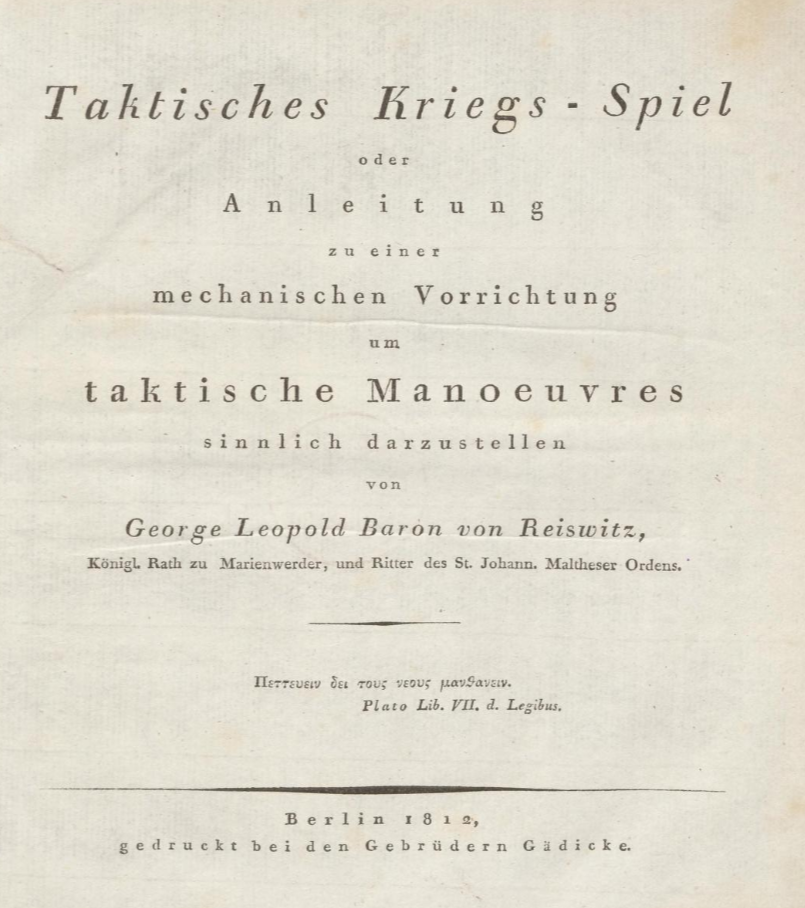
While Reiswitz Jr. ‘s 1824 Kriegsspiel is well-known and has been translated into English, as far as I know Reiswitz Sr. ‘s 1812 Kriegsspiel rule has never been translated and has been the subject of little English or French scholarly work.
In December 2024, the original ruleset was [finally?] digitalized. I ran an OCR on it and then machine-translated it. The result is below.
The original has been uploaded here.
Tactical War Game
or
Instructions for a Mechanical Apparatus for Representing Tactical Manoeuvres
Author: George Leopold Baron von Reiswitz,
Royal Counsellor at Marienwerder, and Knight of the Order of St. John (Maltese Order)
Originally published: Berlin, 1812
Printed by the Brothers Gädicke
Motto (Plato, Book VII, On the Laws):
“Παιδεύειν δε χρη τους νεους εν τοις πολεμικοις παιγνιοις”
(Young men should be educated in the games of war.)
Translator’s Note: This is a complete English translation of the 1812 Taktisches Kriegs-Spiel by George Leopold Baron von Reiswitz, translated from a digitised OCR scan of the original German text. The work is in the public domain (published 1812, author long deceased). Section numbering (§.1, §.2, etc.) and structural divisions follow the original. Where the OCR was damaged or ambiguous, the most probable reading has been adopted. Numerical tables of firing effects have been retained in their original form where legible.
Preface
When a civilian ventures to write on military subjects — and especially on purely scientific ones — it seems an indispensable first duty to demonstrate the authority he believes himself to possess for treating publicly a subject so foreign to his station. I believe I can best fulfil this duty to my readers by faithfully recounting the circumstances that first brought me in my early youth to the idea of constructing such a game, and that in my later years led me to develop those youthful attempts into the form in which I now present them to the public.
My original calling was the military profession. My father was a captain in the Regiment of Prince Dietrich; he had already attended the Battle of Mollwitz as a volunteer, and was compelled against his will, by the consequences of the Seven Years’ War, to take over the estates of my grandfather, a former Royal Prussian Court Marshal, which caused him much trouble. He most readily dispelled his tedium with chess, which he played well and with the vehemence characteristic of him; and since there was rarely anyone at hand to play with him, I was strictly made to learn the game. I could not while away my leisure time with children of my own age: I was entirely isolated in the country, and fell upon my father’s military library, in which I found a great many descriptions of wars and battles in all manner of languages, which I studied with childish eagerness. Above all, the colourful spectacle of the current war (1756–1767) as depicted by Raspe in Nuremberg drew me in, and first taught me the manner of drawing a military situation and the various ways of indicating troop formations.
When my family moved near the town of Pleß, and the then-reigning Prince Friedrich Erdmann of Anhalt-Pleß — my unforgettable benefactor — permitted me to be the playmate of his hereditary prince, the now-reigning Prince Friedrich Ferdinand, I there first became acquainted with Helwig’s War Game. At that moment the chess ideas that had been forcibly impressed upon me awoke again, along with the military images of real manoeuvres which I had seized upon with passion. We played incessantly, but found ourselves very often in difficulty when the leaping queen was overthrown by the leaping rook across the pawns, and the fine grenadier-caps of the Helwig pieces were hurled from the troop-carrier into the jaggedly drawn rivers.
Fate soon separated the two playmates. I was earlier deprived of the free use of my left arm by an unfortunate fall and clumsy physicians, and so the civil career was chosen for me. My father died, and I hastened to continue in Halle the scientific course of study I had begun at the monastery of Bergen under the meritorious Director Gurlitt. A mentor accompanied me there who cut me off from ordinary society; chess and my war game were my favourite occupations. To buy a Helwig War Game was too costly and cumbersome for me. Some friends and I therefore made ourselves a terrain on which we retained the chess squares but did not colour them black and white; on it we represented our leaping queen, rook, and so forth by squares illuminated in the manner of troop formations drawn on plans. This seemed to us delightful, and in order to move these squares more easily we gave them little flags, as Opitz had done, attached to pins, which facilitated the movement of each individual piece. Among those who joined in this version of the Helwig game were the late public inquisitor Tschiersky and the worthy Senior Hagen of Breslau, both of whom devoted themselves to the game with something approaching passion.
These two diligently continued to improve the game in Breslau and Brieg, to which their new appointments had called them, and played it by correspondence when they were separated. A clerical error — as the correspondence files of both friends attest — once cost an infantryman his life; a case that may well have occurred at other times also. I returned to Pleß and worked at the Princely Judicial College as a referendary, where I communicated my improvement of the Helwig game to my dear companion of youth, the hereditary prince, and for his sake first had made, in the year 1785, a gaming board in bas-relief furnished with engraved rivers and various elevations — a board which, in its highly imperfect form, may still be seen at the castle of Pleß today, and which best settles the question whether I was truly the inventor of this type of war game (namely, with terrain in bas-relief).
By that time account had already been taken of the shock of cavalry and the effect of infantry fire; the chess-like moves had been abolished and we manoeuvred actively, until my guardian brought me into the cameral service at Breslau. From the year 1786 onward I laid the game entirely aside, both in Breslau and in Warsaw, to which I was subsequently transferred.
But at last a period of enforced leisure arrived in the year 1807: I had lost my office and my livelihood through the cession of the Polish provinces; my son showed an overriding inclination for the military profession; and in my idle days at Gleiwitz, amid other literary occupations, I took the game up again, and taught my son to play it, as well as I could still recall from memory its never-written-down rules. An article in the Silesian Provincial Journal of June 1809 especially rekindled the old fondness for the game, and a fortunate chance brought me together in the winter of 1810 with my old university friend Hagen, who, with an even livelier interest in this invention, very kindly communicated to me all his improvements of it, his correspondence with the late Tschiersky of Brieg, and his remaining papers.
We jointly conceived the idea of now making the matter publicly known, with the subsidiary intention of allowing something to flow to the widow of our deceased friend Tschiersky, who lives in straitened circumstances, should any surplus over costs result. My official position at the time, however — as district deputy of the Neustadt district — prevented me from putting my hand to the work; an extremely arduous business occupied me, and I therefore took the Hagen papers and my own notes with me to Berlin when I travelled there that year in order to complete various matters of interest to me.
I found the hoped-for support and now made the well-known trials with the sample game constructed here, whose terrain was, however, fixed and immovable. This deficiency was criticised above all by all the perceptive military men who were good enough to attend the trial games, which some of my military friends played before Their Royal Highnesses the Crown Prince and the Princes Friedrich and Wilhelm, and which were also played partly at my own house. We ourselves — the players — noted that although we had already adopted moves and effects based on ten-minute intervals and a distance scale of 100 paces, we nonetheless departed too far from reality, and that, if the game was to be instructive and attractive, the terrain would have to be formed according to every given situation map, and that moves, movements, and effects would have to be reduced to one-minute intervals, while troop formations would have to be reduced to such small detachments that their frontage would be no greater than 50 paces. We also missed and then invented the representation of the skirmisher (tirailleur) manoeuvre — which had become so important in recent wars — and the various ways of moving troops in the presence of the enemy whose strength, type, and numbers the enemy cannot determine.
The game thereby attained a greater degree of perfection through the kind assistance of the following persons.
Major von Petersdorf, formerly serving in the Life Regiment, specified above all the tirailleur manoeuvres and the manner of operating with concealed troop formations, and also proposed the one-minute move intervals and the smaller distances.
Lieutenant Eckard revised the particularly important rules for artillery, and Lieutenants Freitag and Peuter likewise took a friendly part in this.
To Captain Meinert I am especially indebted for the instruction I needed in order fully to develop the theory of altering the terrain by means of planar and elevation types.
Kriegsrath Phemel generously shared with me his own invention of a war game based on the Venturini game, together with the very good mechanical apparatus by which he alters the terrain at will using illuminated lead plates.
Several important observations on the tactical deficiencies of the game came from Lieutenants Count von Pinto and von Plotho I, who also supported me with good advice concerning the formation of troops and cavalry manoeuvres.
On the movements of infantry and their effects, as well as on ranges, Lieutenant von Wussow of the Life Regiment communicated many very applicable observations, and on the basis of the Venturini game, as Kriegsrath Phemel had also done, invented a similar game of his own, on the improvement of which he is still working, and which will be distinguished by its precise calculations.
But a mechanical apparatus requires quite exceptional craftsmen to execute it, especially when it is intended for higher purposes; and it was only through men of talent and knowledge that I was able to reach the point where my mechanism was delivered with clarity and precision, and where the elegance of the pieces and the apparatus was achieved — an elegance especially necessary for persons of higher rank, to prevent them from taking a dislike to the thing.
After I had squandered time, labour, and money through the use of many ordinary tradesmen who erred not from ill will but from lack of prior knowledge, Banker Ezechiel at last introduced me to the very meritorious sculptor Herr August Patzig; to him alone I owe the fact that I fully achieved my purpose and can deliver such a mechanism as allows a terrain to be constructed in bas-relief with order, precision, and clarity.
With regard to the game pieces, I was very fortunately supported by State Councillor Paosenstil, Model Master Riese, and my worthy friend Factor Kriegar, and through them I obtained exceptionally fine pieces of porcelain as well as well-made pieces of cast iron, which are capable of beautiful colouring and, when covered with copal lacquer, present a very pleasing appearance. The drawing and colouring of the types has been improved and, I believe, well executed by Government Draughtsman Müller, to whom I therefore publicly owe thanks.
In herewith publicly expressing my most obliging thanks to these my fellow workers, friends, and helpers, and in gratefully and conscientiously determining the share each has had in the whole invention, I should also be permitted — in order to avoid all misunderstandings — to note what my own merit in the whole affair actually is, and in these statements I shall demonstrate the same truthfulness and conscientiousness that I have shown towards my friends.
First and foremost, the idea conceived as early as 1783 — of inventing, instead of a war game like those of Venturini, Opitz, and Helwig (which represented an entire campaign, each move representing the effect of seven days’ work, four times per month) — a battle game that should be purely tactical in character was my own; and without our having communicated with each other on the subject, Senior Hagen and I were the first to arrive at this idea independently.
The invention of a gaming terrain in bas-relief, which has so many advantages over a mere drawing; its present development into a movable terrain capable of representing any given situation with tolerable accuracy on a reduced scale — this I claim as my own invention. Count Firmas-Peries in Stuttgart invented something similar, but it is not a bas-relief, only an alterable gaming terrain in the manner of Helwig.
The editing and combination of the many ideas of my predecessors Helwig, Venturini, and Opitz, and of the manifold ideas of my kind fellow workers; the application of the tactical principles communicated to me to the game; the mechanical representation of these principles — these are my work, and the game owes them to my labours.
The banishment of chess-like squares, and even of the grid drawn over the terrain; the invention of simple scales by which the pieces are moved according to definite rules; the ranges or effect areas by which every distance within which a troop acts can be quickly judged without anxiously counting individual squares — all this is my own contribution.
The same calm examination of proposed improvements, the same diligent and firm pursuit of the ideas indicated towards a still greater development of the game — I shall continue to devote to this matter, and shall receive well-founded criticism with thanks and put it to use; I shall also gladly answer individual enquiries from players who require explanation, provided I receive them free of postage.
Many aspects of tactical theory are not yet fully settled and beyond dispute; opinions on the subject are in part still divided. It is particularly easy for the various arms of service to rate each other’s effectiveness too low, and in this respect some of the principles adopted by my fellow workers and myself may find contradiction. But I believe this contradiction can easily be overcome by the observation that too great a precision would convert the game into drudgery, would complicate it excessively, and would yet be of no benefit — since small differences occur in reality itself, and the same infantry that ordinarily makes 175 paces in a minute will sometimes make 200, and so forth.
If the various cases that arise during manoeuvres and actions, and the various uses of the arms in movements and attacks of different troop types, are correctly represented in their general outlines; if every significant departure from reality, every significant improbability, is avoided — then one can set aside small differences of half a minute or ten paces, and one will generally have to concede to my fellow workers and me that we have already approached reality fairly closely. I can leave it to anyone whether, without becoming entangled in the greatest difficulties, he can go still further; just as I leave it to anyone to form better terrains from sand, clay, wax, or other materials and devices, combining the advantage of possible alteration with that of durability and solidity in use.
I must also mention that I did not wish to provide a visual representation of military operations extending beyond the span of a single day’s action, and have therefore deliberately omitted everything concerning entrenchments and their defence or attack. Should one wish to represent these operations as well, one could use the preliminary work furnished by my friends Hagen and Tschiersky and others — which my collaborators here have already seen — together with Venturini’s ideas on the subject, as a supplement to this guide; on which I cannot work, as I am wholly restored to my earlier calling and was able to complete this work only with great effort and sacrifice.
Much as I would have wished to have the highly skilled papier-mâché manufacturers, Messrs. Schwizky and Menke, oversee the mechanical aspects of the game, this was not possible because the variety of the types — especially the anomalous form of the connecting types — would have required a very considerable number of moulds and matrices, whose manufacture would have involved me in even greater cost and expenditure than I have already had to bear and lose, given the small number of participants. Moreover, the wooden mass itself does not readily receive the impression of the pins, which could not be entirely dispensed with; otherwise a new material would have had to be invented and papier-mâché combined with wood pulp, which would always have led again to imperfections.
Since the mechanical part of the game is purely sculpture work, and since in the event that enthusiasts should wish to order other forms of types, these can best be ordered individually from Herr August Patzig, it was also necessary to protect the maker of this mechanism from imitation, and to forgo the production of illustrative engravings — which, with the clear description of the terrain, the pieces, and the apparatus, can be dispensed with when one has the mechanism itself before one at the same time. The price of this guide has accordingly been reduced, and Herr Kommissionsrath Gädicke and Herr Academy Sculptor Aug. Patzig will, in a closing notice to be appended to this guide and also otherwise announced, give more precise details of the prices both of the guide and of the apparatus, to which each enthusiast should apply directly and to whom the amount is to be paid.
Berlin, 19th March, 1812.
G. L. B. v. Reiswitz.
Literary and Critical Notes on War Games of the Ancients and Moderns
The visual representation of warlike movements and attacks through games is one of the oldest inventions, progressively improved together with the art of war itself. The oldest form of war game among the Greeks is named by Homer in Odyssey II, v. 104: the 108 suitors of Penelope play the Petteia, the game of five, so called because it was played with five pieces, which were called Pessoi or lithoi, also kyboi aglaoi. Hence the player was called Petteutés and to play the war game — Petteuein. The gaming board, Plinthion, was divided by five lines — grammoi — horizontally and diagonally, rather like the children’s game of Wolf and Sheep; the middle line was called the sacred line — hiera grammé; the place where the pieces stood was called the city — Polis; the individual spaces were called pandriai choroi — enclosures, places. The middle of the five pieces was called the king — Basileus — and was larger than the warriors — Megistos — standing beside him. Originally the game had been played with round, flat pebbles gathered on the seashore. This imitation of the most ancient form of combat between small parties, given the small number of pieces and the restricted space of the board, appears to offer little interest; yet it stood in such repute that Plato in Book VII of the Laws included the passage cited on the title page as a motto, making it a duty of young men to learn the war game, and in Book II of the Politics he asserts that one must have learned this game from childhood in order to play it well. Athenaeus names as remarkable undefeated players Diodorus of Megalopolis, Theoxenus, and Leo of Mitylene.
The Zatrikion of the later Greeks, mentioned by Anna Comnena, was the Indian game of Chaturanga or chess, which had already become known to the Westerners from Assyria (i.e. Persia) by that time.
Nor should one confuse a game played with pieces and dice simultaneously — like backgammon, the Greek Kybeia — with the Petteia. It is the Kybeia that Palamedes invented, whose gaming table — abakous — he hung in the temple of Nemean Jupiter; that Euripides has Ajax and Protesilaus play in the Iphigenia; that Achilles played earlier, and the Emperor Zeno later on an elegant board. It was also called Latrunculi.
The Romans received the Petteia from the Greeks and called this game the little soldiers’ game — lusus latrunculorum — and they valued it greatly, mentioning it frequently in their writings.
That they called it a war game is demonstrated by several classical passages that explain the name latrunculus, derived from latro — soldier (mercenary). Latro comes from latron — pay — and latrocinium, mercenary service, from latreuein — to serve for pay.
Plautus, in Miles Gloriosus, Act I, Sc. I, v. 85:
“Nam Rex Seleucus me opere oravit maxime, ut sibi latrones cogerem et conscriberem.”
The same, Act I, Sc. IV, v. 1–2:
“Nam Ego hodie misi parasitum meum ad Seleucum Regem, ut latrones quos conduxi hinc ad Seleucum duceret.”
This soldiers’ or war game is mentioned in: Ovid, de Arte Amatoria, v. 207, Bk. II: “Sive latrocinii sub imagine calculus ibit, face pereat vitreo miles ab hoste tuus.” — The same, Bk. II, v. 357: “Cautaque non stulte latronum proelia ludat, unus cum gemino calculus hoste perit.” — “Bellator tuus prensus sine corpore pugnet,” etc. — The same, Tristium, Bk. III, 477: “Discolor at recto grassetur limite miles, cum medius gemino calculus hoste perit.” — Martial, Epigram XX, Bk. XIV: “Insidiosorum si ludis bella latronum, gemmeus iste tibi miles et hostis erit.” — And Epigram XXI: “Sic vincas Novium Publiumque, mandris et vitreo latrone clusos.” — Also Lucan in the Eclogue to the Pisos: “Callidiore modo tabula variatur aperta calculus, et vitreo peraguntur milite bella. Ut niveus nigros, nunc et niger alliget albos, ut citus et fracta prorumpat in agmina mandra.”
The Romans called the pieces calculos, latrunculos, also milites. The board was abacus. The position where pieces stood was called laterculum, ergastulum (barracks of slaves), urbs, septa, and mandra; to move a piece was ciere — hence our German word ziehen. When a piece had reached a position from which it could no longer move, it became adincita; when a piece came between two opponents (the gemini hostes), it was captured — captus. When enclosed by one opponent, it was alligabatur; and when a player had only one piece left, it was called adunatus (i.e., ad unum redactus) — monokhoron.
Among the Latins, Mucius Scaevola and Seneca distinguished themselves in this game; the latter played on the very day of his death and took the officer who arrested him as witness that he had won the game. Nero had a more developed war game with chariots of ebony, according to Suetonius, Chapter XXII.
Backgammon — the Greek Kybeia — was known to the Romans under the name tesserae lusus and was played in an alveus, a hollowed-out gaming board, one of which, very magnificently made, Pompey carried with him in a triumph.
In an altogether different quarter of the globe, as an imitation of a different kind of warfare, chess was already a war game even by its Indian name, invented by the Brahmins. Its name, convincingly demonstrated by Günther Wahl, is the Indian Chaturanga, meaning the four parts of the army: Hasty the elephant, Aswa the horse or horseman, Rata or Roth the war chariot, and Padam the foot soldier — it is thus a proper war game. The terrain is larger than the Petteia. The formations are more varied, and the arrangement of the army and its command entirely accord with Oriental customs. The Shah or Sheikh at the head of the army, supported by the Vizier — Persian Ferge or Fierge, whence the French made Vierge, Virgo, Regina, Dame, etc. — with the Fil (elephant), Arasp (horseman), and Roch (war chariot) on the two wings, and the Paada (foot soldiers) in front. The Shah is the passive principle, the Vizier the active one; the humblest soldier can, if he conducts himself well, become Vizier. The loss of the game is bound up with the person of the Shah, who moves with Oriental grandeur.
The game was thus formed in India, and in the years 550–560, during the reign of King Anushirvan, was sent to Persia from India by the usurper Portabehand along with the book Kelila wa Dimna, in exchange for which he received the game of Nard, or draughts. Portabehand had not invented it himself; it had been devised in earlier times, probably by the Brahmins. In the Bhavishya Purana, which W. Jones communicates in his treatise On the Indian Game of Chess (translated in Asiatic Researches), there is a conversation between a Brahmin named Wiassi and a prince named Indischtira, in which the former explains the rules and course of the chess game. The account of how it came to Persia is taken from Tarrik Myrchond, who was librarian to the Prince of Chorassan, Emir Ali Sheikh, and lived in the 15th century.
Chess was improved and extended by Timur Lenk (Tamerlane); possibly also by Attila. The Chinese extended the game in accordance with their form of warfare and placed a river in the middle of the board to separate both parties.
Literary-Critical Notices on the War Games of the Ancients and Moderns
The visible representation of warlike movements and attacks through games is one of the oldest inventions, which was gradually improved along with the art of war itself.
I. The Greeks
The oldest form of war game among the Greeks is named by Homer in the Odyssey, Book II, verse 104. The 108 suitors of Penelope play the Petteia — the game of five — so called because it was played with five pieces named Pessoi or Psephoi, also Laoi. Hence the player was called Petteutēs, and to play the war game was Petteuein. The board, Plinthion, was divided by five lines (graphai) horizontally and diagonally, much like the children’s game of Wolf and Sheep; the middle line was called the sacred line (hiera), the position where the pieces stood was called the city (polis), the individual squares were called phandriai choroi — enclosures, places. The middle of the five pieces was called the king (basileus) and was larger than the warriors (megistoi) standing beside him. Originally the game had been played with round, flat pebbles gathered on the seashore.
This imitation of the oldest form of combat between small parties seems, given the small number of pieces and the confined space of the board, to offer no great interest; yet it stood in such repute that Plato, in the seventh book of On the Laws, incorporated the passage cited as a motto on the title page and makes it a duty of young men to learn the war game; and in the second book of the Politics he asserts that to play it well one must have learned the game from youth. Athenaeus cites as remarkably undefeated players Diodorus of Megalopolis, Theoxenus, and Leo of Mitylene.
The Latrion, Zatrion, and Zatrikon of the later Greeks, mentioned by Anna Comnena, was the Indian Chaturanga or chess, already known to the West from Assyria (i.e. Persia) at that time.
Equally, one must not confuse a game played simultaneously with pieces and dice — like backgammon — with the Petteia. It is the Kubeia that Palamedes invented, whose gaming board (abakos) he hung in the temple of Nemean Jupiter; which Euripides has Ajax and Protesilaus play in Iphigenia; and which Achilles played earlier, and the Emperor Zeno later, on an elegant board. It was also called Diagrammismos.
II. The Romans
The Romans received the Petteia from the Greeks and called it the little soldier’s game — lusus latrunculorum — held it in high esteem, and mention it frequently in their writings.
That they called it a war game is proved by several classical passages that illuminate the name latrunculus, derived from latro — soldier, mercenary. Latro comes from the Greek λατρον (pay), and latrocinium (mercenary service) from λατρευειν (to serve for pay).
Plautus, Miles Gloriosus, Act I, Sc. I, v. 85:
Nam Rex Seleucus me opere oravit maxurne, / Ut sibi latrones cogerem et conscriberem.
The same, Act I, Sc. IV, v. 1–2:
Nam Ego hodie misi parasitum meum ad Seleucum Regem, / Ut latrones quos conduxi hinc ad Seleucum duceret.
This soldier’s or war game is also mentioned in: Ovid, De Arte Amandi, v. 207, Book II: Sive latrocinii sub imagine calculus ibit / face. pereat vitreo miles ab hoste tuus. — and Book II, v. 357: Cautaque non stulte latronum proelia ludat. / Unus cum gemino calculus hoste perit. — Ovid, Tristia, Book III, 477: Discolor at recto grassetur limite miles / cum medius Gemino calculus hoste perit. — Martial, Epigr. XX, Book XIV: Insidiosorum si ludis bella latronum / Gemmeus iste tibi miles et hostis erit. — and Epigr. XXI: Sic vincas Noviumque Publiumque / Mandris et vitreo latrone clusos. — Lucan, Eclogue to the Pisos: Callidiore modo tabula variatur aperta / Calculus et vitreo peraguntur milite bella. / Ut niveus nigros, nunc et niger alliget albos / Ut citus et fracta prorumpat in agmina mandra.
The Romans called the pieces calculi latrunculi, also milites. The board was the abacus; the position where pieces stood was called laterculum, ergastulum (slave-barracks), urbs, septa, and mandra; to move a piece was ciere — hence our German ziehen (to move). When a piece had reached a position from which it could no longer be moved, it was adincita; when a piece fell between two opponents (gemini hostes) it was captured (captus); when it was enclosed by one opponent, it was alligabatur; when a player had only one piece left it was called adunatus (ad unum redactus) — monochōros.
Among the Latins, Mucius Scaevola and Seneca excelled at this game; the latter played it before his death and called the officer who arrested him as witness that he had won the game. Nero had a more sophisticated war game with chariots of ebony, according to Suetonius, Cap. XXII.
Backgammon (Triktrak), the Greek Kubeia, was known to the Romans under the name tesserae lusus and was played in the alveus, a hollowed-out board, one of which, very magnificently crafted, Pompey carried with him on a triumphal procession.
III. Chess and Its Origins
In a completely different part of the world, as an imitation of a different form of warfare, chess was already by its Indian name a war game, invented by the Brahmins. Its name — very convincingly demonstrated by Günther Wahl — is the Indian Chaturanga, meaning the four parts of the army: Hasty (elephant), Aswa (horse or rider), Rata or Roth (chariot), and Patadam (foot soldier); it is thus formally a war game. The terrain is larger than the Petteia, the evolutions more varied, and the order and conduct of the army entirely in accordance with oriental custom. The Shah or Sheikh at the head of the army, supported by the Wazir (Persian Ferge or Fierge, from which the French made Vierge, Virgo, Regina, Dame, etc.); on both wings the Fil (elephant), the Arasp (rider), and the Roch (chariot); in front the Paada (foot soldiers). The Shah is the passive principle, the Wazir the active; the humblest soldier, if he conducts himself well, can become Wazir. The loss of the game is tied to the person of the Shah, who moves with oriental grandeur.
Thus the game was formed in India, and in the years 550–560 under the reign of King Anushirvan was sent to Persia, together with the book Kelila wa Dimna, by the Indian envoy Portabchand, who received the Nerd or backgammon as a counter-gift. Portabchand himself had not invented it; it had in earlier times probably been devised by the Brahmins. In the Bawishia Puran, communicated by W. Jones in his treatise On the Indian Game of Chess (translated in the Asiatick Researches), there is a conversation between a Brahmin, Wiassi, and a prince, Indischtira, in which the former explains the rules and course of the chess game. The account of how it then came to Persia is taken from Tarikh Mirkhond, who was librarian to the Prince of Khorasan, Emir Ali Sheikh, and lived in the fifteenth century.
Chess was improved and extended by Timur Lenk (Tamerlane); possibly also by Attila. The Chinese extended the game in accordance with their form of warfare and placed a river in the middle of the board to separate both parties.
The best work on the theory and practice of chess is probably that of the preacher at St. John’s Church in Magdeburg, Herr Joh. Friedr. Wilh. Koch, published 1801–1803 at Keil in Magdeburg, under the title: Die Schachspiel-Kunst nach den Regeln und Musterspielen des Gustav Selenus, Philidor, G. Greco Calabrois, Phil. Stamma und der Pariser Clubs. For the history of chess, the most accurate work is probably the little treatise by Günther Wahl published in 1798, entitled Der Geist und die Geschichte des Schachspiels bei den Morgenländern, by S. F. Günther Wahl. Halle, bei Curt, 1798. In this history Wahl provides, from pages 1–13, proof that chess is a war game, and cites among others Friedrich the Great as a witness to this assertion.
IV. The Decline of the War Arts and the Rise of Modern War Games
The military arts of the Middle Ages did not advance further — rather they regressed; their evolutions became ever less the customary man-against-man style of combat, and in this period tournament games kept the spirit of sensory representation alive, and people found in them occasion for a vivid, if only mechanically lifeless, representation through figures.
Only when personal strength and individual courage became increasingly rare and superfluous — since the invention of firearms and tactical movements in modern warfare had given the entire art of war a different direction — did men then come, slowly and late, to think of making tactical movements and attacks visible; and thus partly tactical, partly strategic games were invented.
Most of the inventors of such games were, however, so captivated by the greatness of an entire war, of provinces and countries, that they placed their players in the position of a commander-in-chief directing a war on the grand scale with strategic art, rather than presenting the case — more often occurring in reality — where a subordinate general, with a small force, covers himself with glory in a single active day, by showing himself a greater tactician, and through cleverly devised manoeuvres beats a superior enemy. The inventors of strategic games had therefore to extend the field of the art of war over the entire field of warfare: supply, siege of fortresses, peace negotiations, reinforcement of the army, and the like had to be incorporated into their plan, which leads to a time-scale so remote from reality that it yields very irregular and improbable results of movement and attack, and the representing figures stand in no relation either to the nature of the arms or to the troop numbers they are meant to represent. This is the general character of the strategic games whose inventors are mostly German.
V. The Oldest Strategic War Game: Opitz
The oldest strategic war game of which we have knowledge was, unquestionably, the invention made known only 46 years after its creation by the Imperial Royal Bohemian Bank- and Estates-Inspector Joh. Ferd. Opitz of Czaslau in Bohemia, whose son G. E. Opitz published it in Halle at Händel’s in 1806, in octavo, with 145 pages and 1 copperplate. The game itself had already been invented between 1759 and 1761 by the author — a Jesuit at Klattau in Bohemia — and the then Jesuit lieutenant Petrus Novax, as well as the Jesuit and later Professor of Mathematics at Prague, D. Stanislaus Wydra, who took part in the invention at the time, then 19 years old.
This war game has, in addition to all the similar works previously noted, the particular distinction that its figures and the course of their movements are determined by dice, which leave to chance the luck that in reality so often governs the outcome. It encompasses the recrutment, desertion, disease, the victualling of troops, and even sets an overall commander and 2 sub-generals for each party before the eyes of the players. Its inventor does not quite correctly call his invention a tactical board game.
It appears that Franz Augustin Höchenberger had some knowledge of this invention and published an improved (refined) chess game — verfeinertes Schachspiel — in which cannons take the place of the bishops. I know this work only from the Allegate of Count Firmas-Peries, of which work I shall give further notice below. A year later Prince George of Hessen-Homburg invented a war game, whose existence is known to me only through correspondence.
VI. Hellwig’s War Game
Without knowledge of any of these inventions, and guided solely by the coincidence of ideas, some six years later the Ducal Brunswick Hofpagemaster Herr Ludwig Hellwig published his Versuch, eines aus dem Schachspiel gegründeten taktischen (strategischen?) Spiels — Attempt at a Tactical (Strategic?) Game Founded on Chess — in Leipzig in the years 1780 and 1792, in octavo, in 2 parts, classical work in its kind. It was the first of its kind to appear before the public, was recommended by its novelty, and met with approval. It is, however, likewise rein-strategisch in character, and the possession of a single point on the board decides the outcome of the game. The figures are chess figures; the method of moving them is chess-like; the static, chess-like terrain is finally divided into two countries, each with several provinces.
A year later Crusius in Leipzig published, in 1783, Mehler’s Kriegsspiel, which purports to represent this new kind of chess game; of which, however, I know only from the Allegate of the Genoese Consul Francois Giacometti, who published his Jeu de la Guerre first in 1793, a game most recently republished in 1901 (sic — read: re-issued), in which the game ends with the capture of the king and the storming of a fortress. The author calls his work: Invention à qui personne n’avoit songé jusqu’à present. In 1793 the Ducal Brunswick Engineering-Lieutenant Georg Venturini published a description and rules of a new war game for the use and entertainment of officers, especially for use in military schools in Schleswig, which in 1805 experienced a new edition under the title:
Darstellung eines neuen Kriegsspiels zum Gebrauche für Officiere und Militärschulen. Leipzig, bei F. C. Heinrich.
VII. Venturini’s Game
This latest edition contains substantial improvements: it is noted for the first time that the author takes account of the length of time required for each move and of the head-count of each figure. The author has even introduced the variety of seasons of the year, and differs from Opitz in the form of the figures and the terrain — following a different path without using Opitz, since Opitz published his work two years later. Venturini’s game is, however, entirely strategic in character. A very apt observation by the author in the preface to the second edition is especially worth noting: namely, that such inventions ought properly to be called games (Spiele). In 1805 Carl Friedr. Cramer, formerly Professor of Philosophy in Kiel, published under the name Jeu de Guerre an extract of Hellwig’s game in Paris, which he distributed publicly by means of a Cours du Jeu de Guerre which he taught orally.
Simultaneously with Opitz there appeared in Breslau in 1806 the Prussian Nationalschach of Freiherr von Hoverbeck, formerly a Rittmeister in the Regiment Graf Henkel Cuirassier at Breslau, whose yield was dedicated to a regimental school, and probably made known to the public through a particular essay in the Silesian Provincial Journal of June 1809, recommended by its author, Herr Rector Günther at Oels. A review of this work is found in this same issue of the Provincial Journal, pages 175–188, in the Literary Supplement. This game is not strategic or even tactical, but an extended and doubled chess game with military figures; the terrain is, however, chess-like and offers no representation of actual situations. Only insofar as chess itself is a war game can this invention be cited here.
* * * *
VIII. Günther on Terrain
Herr Günther feels the deficiencies of the terrain of all hitherto known war games so keenly that on page 517 of the cited journal he expresses himself in the following words, to which my present invention owes in part its origin:
“Above all, however, a game based upon the four Silesian battlefields — and if need be on the camp at Bunzelwitz and the engagements at Peilau and Burkersdorf — one that would spare the journey thither, yet bring the terrain so close before the officer’s eye that he might with Opitz’s figures repeat and study those war scenes upon it — something that the author of this essay cannot well describe in dead words, but which he is prepared at least to demonstrate to an eager young tactician — such a game would certainly be one of the most useful occupations of the young officer in his quarters, since the Freiherr von Hoverbeck is very right when he says here and there: this, that, and the other cannot be learned on the parade ground.”
“Should invitations reach him, the author of this essay will show, at least on the battlefield of Leuthen — where he believes he could find his way blindfold — how one may conjure the remaining eternally memorable theatres of war of Silesia into one’s room, in order to manoeuvre upon them variously with Opitz’s figures, since, as Frederick says in his instruction to his generals, on a single square mile fully 100 positions are possible.”
IX. Firmas-Peries’s Game
In 1809 one of the most recent works of this kind appeared in Ulm at Stettin and in Meiningen at Joh. Rein, authored by Count Firmas-Peries, grand-maître des Cuisines et Chambellan de S. M. le Roi de Würtemberg, under the title: Jeu de Stratégie ou les Échecs militaires. It is printed in octavo, accompanied by explanatory copperplates, and little known in northern Germany. This work is entirely founded on the Hellwig game, but contains the most essential improvements thereof that I know of, especially through the alteration of the terrain. For this purpose there are at most 2,640 cubes, or at least 1,617, whose face-colours indicate the variety of the terrain one wishes to represent. The number of figures is 940; the board is 4 metres and 7 centimetres long and 1 metre wide; the ledges enclosing the cubes are 1.25 metres deep. At the edge of the board there are holes for marking the number of moves — a good idea. A very fitting motto graces the title, borrowed from Vida’s poem on chess: Ludimus effigiem belli.
The price of the text was 2 fl. 45 kr. on subscription and 3 fl. 30 kr. at the retail price. The game itself, on account of its mechanism, costs with 8,640 cubes 55 fl. Reichsgeld or 102 livres tournois, and with 1,617 cubes 49 fl. Reichsgeld or 96 livres tournois.
Firmas-Peries precisely distinguishes the concept of tactics from strategy; has calculated the value of the figures; and likewise introduced loss markers, which even indicate the value of the terrain held by each player, and of the villages and fortresses he occupies. When players on the same side are separated by the enemy, they may not make agreements with one another. A peace treaty and the ransoming of prisoners often ends the game, which in 1807 received strong support from Marshal Ney, Duke of Elchingen, and was made known in the French armies — and which is in my opinion one of the best of these inventions.
X. Conclusion and Proposal
Each of the war games named here has its own particular merit, and since the visible representation of strategic operations can certainly be just as useful to military men who wish to train themselves for higher purposes, as the visible representation of tactical movements is useful to those who must prepare for the lesser roles in this great tragedy, anyone would render a service who extracted the best from all these inventions and delivered it in a new form to the military public and to military schools.
The terrain would then no longer need to be delivered in bas-relief, but — owing to the smaller scale that would then have to be employed — would have to be drawn. The mechanism of Count Firmas-Peries’s six-sided cubes and my method of drawing the individual terrain objects, the bends and courses of rivers and roads, could be combined with Lehmann’s or any other method of drawing hills, and in this way, by changing the cubes, any map of a province or neighbouring state could be represented, since 2,640 cubes multiplied by 6 give 15,840 surface-squares, with which an infinite number of terrain forms can be constructed. The calculation of the time of movements, effects, and masses of troops can be applied to this purpose by analogy from my war game; and one will be able to achieve in strategic terms what has been attempted here in tactical terms.
Since, however, in strategic war games the siege of fortresses cannot be passed over, the detail of these military operations will first have to be represented on a larger scale of time and space, before being translated into the reduced scale of the strategic war game.
Section I: Purpose of the Game
The visual representation of an individual manoeuvre according to tactical rules by means of a mechanical apparatus, for the instruction and exercise of young military men, or as a purposeful entertainment for senior officers — this is the purpose of the game, in accordance with which the title of this guide (as announced earlier in the year 1811) has been amended.
§.2. The players base the manoeuvre either upon a formal disposition agreed upon verbally or in writing, or they engage where they find themselves and adopt arbitrary positions from which their operations proceed. In the first case they play a tactical game (taktische Parthie); in the second, a battle game (Schlage-Parthie).
§.3. Whoever fails in the tactical game to fulfil the task he has undertaken to solve loses the game; whoever carries out the disposition assigned to him wins.
§.4. Whoever in the battle game loses the most pieces and is driven from his position loses the game; whoever maintains superiority in number and position of pieces, who outflanks his opponent, drives him off, and forces him to retreat, wins the game.
§.5. Although a perfectly accurate visual representation of tactical exercises and large-scale manoeuvres cannot take place entirely within the game, nonetheless the most important cases and tactical principles have been applied within it, so as to provide occasion for reflection on them or for more detailed instruction.
§.6. The terrain and the game pieces are moreover so constructed that they can also be used to give a general overview of a manoeuvre already carried out by several arms of the service, or of one that is to be executed, partly in order to represent visually the errors committed or the movements that should have been made — making use of the movable situation plan laid out before one — and partly in order to investigate which movements on any given terrain are possible and applicable. One can even practise surveying a terrain with it, and prepare oneself for surveys in the field during winter.
§.7. The composition of written dispositions, brief orders and reports during the game, or of narratives and observations by a third party witnessing the whole, will be a useful preparation for young officers for actual service; and since the game rests to some extent upon reality, more can be said about it than about positions and manoeuvres that are merely supposed and exist only in the imagination.
Section II: General Course of Play
§.1. The number of players may be 2, 4, 6, 8, or up to 10.
Remark: It accords with the purpose of the game that several persons always play together, so that the situation so often occurring in reality may be visually represented — namely that several commanders of individual arms or individual corps must act together towards one purpose and be directed by a common chief. Even if the young student will not always hold the position of chief, he will often and easily find himself in the situation of adjutant standing at a chief’s side, and in such cases assisting him where several subordinate commanders are to be set in motion towards one purpose.
§.2. With two players, each is naturally free to move as he wishes, and only the general disposition and general course of the game, per Section I, need be agreed upon. However, when four play — two on each side — it depends on their agreement, or on the decision by lot, whether they wish to manoeuvre simultaneously in accordance with an arrangement made among themselves, or whether one of them shall be the commander of the side.
When six play, there are three on each side, and it must be determined which of the three players is the commander; this determination is made by the players’ choice or by lot.
When eight play there are four, when ten play there are five on each side; the choice of commander must take place as a matter of necessity, as must the division of troops that each directs.
§.3. The division of troops among several players can be made either by divisions — three of which are provided for each side and distinguished by the colouring of the pieces — or by arm of service, so that regular cavalry, light cavalry, regular and light infantry, tirailleurs and jägers, artillery, and so each particular arm also has its own commander; or finally in such a way that one leads the advance guard, the right or left wing, the centre, or the reserve — all, however, under the superior direction of a commander-in-chief who determines the movements of the whole.
§.4. The following positions of troops are possible.
A. Position in the presence of the enemy.
a) One side deploys first — lot or agreement decides — and the other deploys later, with the players precisely determining the boundaries within which each may deploy.
b) Both sides deploy simultaneously within defined boundary lines, at a minimum distance of two artillery ranges — i.e. 2,300 paces — from each other.
c) One side stands entirely in line of battle, while the opponent comes up in columns.
d) Both sides come up in columns.
e) One side is only partly deployed and part of it is still arriving in columns.
f) Both sides are only partly deployed and both receive reinforcements.
Remark: In cases c, d, e, and f, the points from which the columns depart must be precisely agreed upon and determined, or decided by lot.
B. Position not visible to the opponent.
a) Either the players of one side withdraw from the game while the other side deploys; or
b) a screen divides the two players, splitting the board lengthwise or breadthwise into two halves.
As for (a): this is done so that one can lay hidden ambushes in the forests or farmsteads, for which the troop-concealment boxes (described below) serve.
As for (b): it is assumed that both parties approached during the night and first see each other’s position at daybreak.
Remark: In this case it must be determined, upon the removal of the screen, who shall have the first move. This determination may not take place beforehand, since otherwise the player who moves first would place himself too advantageously. Neither player may approach closer than 800 paces to the screen, so as not to immediately come to grips with the enemy, but rather to gain time to improve his position further through moves and marches.
§.5. The order of moves is determined such that agreement or lot decides which side moves first. Thereafter the moves alternate, each player beginning from his right flank and then moving the pieces one after another. All pieces may be moved, unless a player deems it necessary to leave part of his troops stationary.
Remark: Since each move represents only the movement or effect that each arm of the service can make and achieve in one minute in reality, it has likewise been appropriate to move and employ all of one player’s troops at once.
§.6. When several players play together, their consultations in the presence of the opponent would betray their plans too readily. It is therefore the rule that the player who has the first move consults with his fellow players first, in the opponent’s absence, before the start of the game, and the opponent likewise. During the game, however, too much time would be lost if one were to require the opponent to withdraw for such consultations; signal cards are therefore given by the commander to his subordinate fellow players.
§.7. These signal cards are made of black slate-paper, and twelve are provided for each game. The commander and the players take as many as they need and write with a slate pencil brief orders, reports, or proposals concerning the course of the manoeuvre.
§.8. The commander of the side arranges his moves during the opponent’s turn, while one or more of his fellow players observe the rules to ensure the opponent does not overstep them. During this time the commander signals each of his fellow players what he is to do, who then submits his own proposals in like manner.
§.9. If the players belonging to one side are so separated by the opponent that they have no communication, they may not make any arrangements with each other — neither verbally nor in writing — until their communication is restored.
Section III: Description of the Gaming Terrain and Instructions for Constructing It
Introductory Remarks
The terrains used for the strategic or tactical war games invented hitherto were partly drawn and partly executed in bas-relief. They were divided either by colourful, chess-like squares or by lines at equal distances, by which the range of movement of the pieces and their areas of effect could be measured. They were partly fixed, partly movable and designed for manifold alterations of the terrain — as the literary note on this subject at the beginning of this guide shows in detail. Why the inventors and improvers of the tactical war game departed more or less from this method and these forms is necessary and appropriate to address here.
Every purely drawn gaming terrain is covered by the base surface of the pieces placed upon it, and the players are often uncertain whether the part of the terrain covered by their pieces represents forest, hill, river, building, etc.; they frequently fall into dispute over this, and no remedy could be found for every arbitrariness and disorder in the game except by making the terrain semi-raised — and by hollowing out on the board the features that lie below the horizon of the terrain, such as rivers, sunken roads, etc. For then one sees and feels every difference in the situation, and every error, every dispute, is avoided.
The inventor and improvers of the game had at first, and still in 1811, believed that without dividing the terrain into rectangular fields, the distances of marches and effects could not be calculated and specified, and that this aid could not be dispensed with in the game — since otherwise movements would be entirely arbitrary. Although they had already concluded that the stiff, chess-like forms retained by Venturini, Helwig, Opitz, and even Firmas-Peries must be discarded, they still retained — in the first announcement of 1811 — the method of dividing the terrain partly horizontally, partly diagonally into squares of equal size, so as at least to overlay the terrain with a grid whose divisions were to indicate the directions and distances of marches and effects. They went so far as to further bisect the diagonal directions and again halve the angles they formed. This made the terrain gaudy and disfigured, and yet only two — at most three — kinds of direction of troop lines and masses could be represented. This observation prompted the invention of special scales of movement and effect, which are simple and will be described further on. The terrain now therefore presents a situation in bas-relief entirely free from all unnatural divisions, one that does not impede the troops manoeuvring upon it from taking any possible position.
Whether this terrain should be a fixed instructional terrain based on an idealised composition, or any actual terrain faithfully reproduced but immovable — one that after 20 or 30 games one would already know by heart and on which only a fixed number of manoeuvres could be represented — or whether the terrain should be alterable without limit so that any real or possible situation could be represented: this was the question! The governors of His Royal Highness the Crown Prince and of the Princes Friedrich and Wilhelm of Prussia, as well as several perceptive military men to whom the author had the honour of demonstrating this invention, wished this problem to be solved. For a whole year the author occupied himself with solving this certainly not easy problem; he overcame the difficulties that unskilled and clumsy workmen placed in his way; and after many laborious and costly experiments, after manifold rejection of new inventions, the following method seems to the author to be the simplest and at the same time the most useful. He very willingly submits his opinion, however, to the judgement and instruction of critical and duly corrective readers; congratulating them that they have been spared the effort of solving what he believes to be a somewhat difficult problem — since upon it depended the utility of the game, and only thereby could it become possible for every garrison, by means of this apparatus, to represent visually the surrounding or distant situations and positions.
§.1. The gaming terrain therefore now consists of a situation formed in bas-relief by various tokens (Typen) according to a given real or idealised locality and drawing.
§.2. These tokens are rectangular and represent either a square whose side is 500 feet long, or an oblong whose longer side is 500 and shorter side 250 feet long, or a square whose sides are 250 feet long. According to this scale they are divided into whole, half, and quarter tokens.
A board that holds 20 tokens in length and 15 tokens in width — thus 300 tokens in total — is equivalent to 18,750,000 square paces or one-seventh of a square mile. The determination of the terrain scale simultaneously provides an additional means of measuring the movements of the pieces: a movement of the length of one whole token equals 500 feet or 250 paces. A movement on the diagonal of a whole token equals 350 paces or 700 feet, and so on.
They are called “types” (Typen) because, just as letters in printing are used to reproduce a text, these types and their arrangement reproduce a locality.
Remark: The need to reduce the variety of the terrain — its elevations and depressions above and below the horizon, the peripheries of hills, the gradients, and the drainage — to very simple forms, and to shape these forms so that they always fit together, required so many mechanical experiments of the author that he is in good conscience convinced that any fair-minded man, informed of the circumstances, will forgive him the one-year delay in publication, since to deliver an incomplete work to the participants would have been almost a deception, once the deficiencies of the first improvement were known and the means of avoiding them were understood.
§.3. The tokens are either laid upon the base surface of the gaming board and held in place by the edge-frame of the board — which is two inches thick — or are fastened by pins upon the formed base terrain; these pins are fitted in some tokens and hold them fixed on their base.
§.4. [Unnumbered in original]
§.5. These tokens are divided into signs of:
- Elevations
- Rivers, streams, brooks, ditches, and canals
- Lakes and ponds
- Sunken roads and defiles
- Meadows and marshes
- Paths and chaussées
- Forests
- Buildings
- Bridges
§.6. The elevation tokens are distinguished according to their:
a) gradient, or
b) height above the horizon of the terrain.
§.7. It would have led to endless complexity and made the game overly complicated had one represented every possible form of elevation and gradient according to its angles. It therefore seemed advisable to adopt only three classes of elevation, namely those:
a) which every arm of the service can pass and occupy;
b) which are accessible only to infantry;
c) which are accessible to no arm of the service — entirely sheer rocks and heights.
In order to represent these three different kinds of gradient visually, they are indicated partly by the greater or lesser length of the sloping terrain that forms them, and partly by colours. Light brown represents the gentle elevations, darker brown the steeper ones, and the darkest colour those elevations that are wholly impassable.
§.8. The height of hills had to be determined in order to represent visually the cases where one elevation commands another, and three classes have therefore been adopted: one rising 50 feet above the horizon, the second 150 feet, and the third 300 feet above it.
The upper surface of the first class is in general at the same height — or at least at little different height — as buildings and forests; the second commands forests and buildings; and the third commands every other elevation and every other feature of the terrain. To represent them clearly, the tokens of each class are marked a, b, c. The tokens lettered c — which round off the upper form only as mountain and hilltops — are fitted with steel pins and can be fastened and pressed on top of the mountains.
§.9. Connecting tokens unite both the three different kinds of gradient — so as to allow a gently rising height to terminate in a steep slope — and the combination of height a with height b, joining a 50-foot hill with one of 150 or 300 feet.
§.10. The forms of the mountain peripheries are given in Table A appended at the end of this guide, which also contains the signs by which one can recognise the tokens stacked in the game box and immediately identify — from the edge of the token, without first turning it over — its purpose and form.
§.11. The drainage features and all the planar signs are similarly recorded in a comparable Table B, which lists the various forms and courses of ditches, canals, brooks, rivers, streams, lakes, ponds, springs, sunken roads and defiles, chaussées and paths, as well as meadows and marshes, along with the signs by which they can be recognised at their edges. The rivers are light blue, as are all water features; the meadows and marshes are light green; and the paths and chaussées are light yellow. The paths have one shadow-stroke, the chaussées two, and a light blue border indicating their side-ditches.
§.12. The tokens recorded in Table C indicate the remaining features of the terrain and situation, namely: forests, buildings, and bridges.
§.12 [also numbered §.12 in the original — a repetition in the source]. The forests are divided into closed, dense woodland that cannot be traversed directly by cavalry or artillery, and into open woodland through which every arm of the service can also pass outside the roads running through it. A black colour indicates the former, a dark green the latter. To allow the woodland to be placed as desired on hills and at the sides of roads, rivers, and marshes, etc., these tokens are fitted with pins.
§.12 [§.12 again, for buildings]. The buildings are likewise rectangular parallelepipeds fitted with pins, of a height of a quarter or half inch, and are distinguished by colours. The light green ones marked with black oblongs signify wooden farmsteads; the red tokens marked with dark-red squares indicate masonry buildings.
The distinction between wooden and masonry farmsteads was necessary because of the time required to destroy a masonry building.
Churches with surrounding churchyard walls are indicated by red crosses and red borders on a green ground.
Windmills by black crosses on a green ground.
Water mills by round black wheels on green or red ground, depending on whether the building is masonry or wooden.
The quarter-inch tokens indicate single-storey farmsteads; the half-inch tokens indicate taller buildings.
Remark: The idea of making the forests and houses hollow so as to conceal troops within them has been abandoned since special small cardboard boxes were invented for concealing troops. This has made the game and its tokens simpler and less costly.
§.15. The bridges are of various lengths and of various materials. The following are assumed:
a) Those crossing ditches, canals, marshlands, rivers, and streams — including pontoon bridges;
b) Masonry and wooden bridges.
The pins fitted in the bridge tokens fasten them over the rivers, etc., and they are removed when destroyed by artillery, etc. The wooden ones are brown, the masonry ones red, the pontoon bridges yellow.
§.16. To construct a terrain with these tokens, one first sketches the terrain on the gaming board with chalk or pencil, then lays in the drainage features and other depressions below the horizon — as well as the roads — then places the elevation tokens, and finally fastens on top the hilltops, forests, buildings, and bridges by means of the pins attached to them.
§.16 [sic]. To prevent pieces from sliding too easily and to avoid accidental displacement, the terrain itself is covered with a rough surface formed from sand, pumice stone, and other materials; the pieces, which also have an uneven base, stand more securely upon it. This is especially useful when pieces stand on a sloping surface, from which they would slide if the terrain were smooth.
Remark: From this description of the terrain there emerges a use of the game only briefly indicated in Section I — namely, that one can survey a locality from the so-constructed terrain just as in nature, and prepare oneself for surveys in the field by means of such exercises.
Section IV: Description and Number of the Game Pieces, with Calculation of the Number of Troops They Represent
§.1. The pieces with which the movements and attacks of troops are visually represented in the tactical war game consist of cubic figures of porcelain, iron, or wood. Their lower surface is rough and uneven so that they are not too easily displaced from their position; their upper surface is smooth and painted, representing the deployment of troops in the manner customary on military plans, drawn and coloured accordingly. Their side surfaces are smooth and, for each side, coloured with a different colour so as to distinguish the troops of each side more easily.
The upper surface has for each side a principal colour — one side, for example, blue; the other green. The frontage is indicated by a line — yellow for one side, red for the other, for example. This variation in colouring may, however, be altered.
§.2. So that when six players play each can properly distinguish his troops — and so that, if desired, the troops of reserves and advance guards can be more easily distinguished — each side is divided into 3 divisions, each of which again has its own secondary colour, so that the rectangle representing the troops is divided by the diagonal; the upper portion bears the side’s colour (blue or green) and the lower portion bears the division’s colour. For example:
First Side:
- 1st Division: blue and crimson, with red frontage line
- 2nd Division: blue and light yellow, with red frontage line
- 3rd Division: blue and rose, with red frontage line (or similar colouring)
Second Side:
- 1st Division: green and lilac, with yellow frontage line
- 2nd Division: green and black, with yellow frontage line
- 3rd Division: green and orange-yellow, with yellow frontage line
§.3. To further distinguish the arms of the two sides, the closed infantry and cavalry carry flags: blue for one side, red for the other (or a similar colour), in addition to the side surfaces and the principal and secondary colours.
§.4. Regular closed infantry is indicated by a rectangle equal to half the square surface of the piece, divided by the diagonal, and above this marked with a simple pointed flag.
§.5. The skirmishing light infantry is indicated by a rectangle covering one quarter of the surface of the piece, divided horizontally by two parallel coloured lines. The upper part of the rectangle is coloured in the side’s colour, the lower in the division’s colour.
Instead of a frontage line, two rows of dots are placed — one slightly larger, the other smaller — indicating the skirmisher platoons sent forward. These troops are drawn without flags.
§.6. The jägers are drawn in the same way, with the difference that the rectangle is divided into four parts by both diagonals; the obtuse-angled triangles thereby formed are filled in with the principal colour, the acute-angled ones with the secondary colour. Before the frontage stand two rows of green dots.
§.7. The cavalry is indicated by two adjacent squares of a size covering one quarter of the surface of the piece, sharing a common frontage line at the top. They are likewise divided by the diagonal; the upper part at the frontage is filled with the side’s principal colour, the lower with the division’s colour.
§.8. The regular cavalry carries two rectangular flags. For one side (the blue), they are red; for the other (the green), they are blue.
§.9. The light cavalry has no flags. The cavalry flankers (Flankeurs) are indicated by a row of small squares with little flags, before which stand two rows of dots. They are half coloured in the side’s colour, half in the division’s colour.
§.10. The pioneers are drawn such that the rectangle representing them is divided vertically in the middle, one half being filled with the side’s basic colour, the other with a colour that does not appear in the division markings.
§.11. The train and pontoon wagons are drawn in the customary manner. One side has green wagons, the other blue; or red and yellow.
§.12. Each side is also provided with 6 ships, applicable partly for transporting troops on rivers and partly for constructing boat bridges; one half of them are light brown, the other 3 yellow. Each carries a maximum of 150 men of infantry or 80 men of cavalry.
§.13. A further distinction of arms is indicated by the thickness of the pieces:
- ¼ inch thick: all pieces representing small numbers of troops — tirailleurs, jägers, and flankers;
- ½ or ¾ inch thick: infantry, foot artillery, and heavy artillery pieces — also pontoniers;
- ¾ or ⅞ inch thick: cavalry (regular or light), train, or horse artillery pieces.
Remark: It would have been superfluous to represent visually other types of troops whose effect and movement do not differ notably from regular or light infantry or cavalry — e.g. grenadiers, dragoons, uhlans, etc. Equally it did not seem appropriate to take the particular organisation of any one army as a model, or to form the sides of the game according to the proportions customary in any particular state, or even to divide the pieces into battalions and squadrons, which are organised differently in the various states of the continent — and even in our own state — for administrative reasons as circumstances change. Separate reserves and advance guards have not been formed, since each player can form these for himself from his side’s third division and from the various arms he possesses; and in any case the entire mass of troop pieces is not always put in motion.
§.14. Based on the frontage line as the unit, the following has accordingly been assumed:
a) For closed infantry: 50 files of 3 men each — or 150 men — stand on a frontage of 50 paces or 100 feet.
b) For tirailleurs of the light infantry and jägers: each piece equals 16 files of 2 men — or 32 men — deployed with 6-pace intervals in two lines, amounting to roughly one quarter of a closed infantry piece.
c) The cavalry equals 40 files of 2 men each — or 80 horses — in proportion to their frontage.
d) Their flankers are taken at 20 men, or one quarter of a closed piece (the fourth move).
e) The pioneers: each piece equals 50 men.
f) A half-battery consists of 4 guns with 3 intervals of 50 feet; the remaining 100 feet is roughly allocated to the carriage track, though it would actually be somewhat more.
The crew of the 4 guns, at 9 to 10 men per gun, equals 36 to 40 men.
g) One train-wagon piece represents a row of wagons occupying 50 paces in length with their teams and intervals — approximately 4 wagons.
h) One ship carries at most 150 men of infantry or 80 men of cavalry.
§.15. The ratio of infantry to cavalry is taken as 3 to 1. Of light infantry, tirailleurs, jägers, etc. to closed infantry as 1 to 6. Of light cavalry to heavy cavalry as 2 to 1. For every 1,000 men, 4 guns or one half-battery — i.e. 1 artillery piece — have been reckoned; and for every 600 cavalrymen, 1 horse artillery piece or 4 light guns, or 1 gun per 150 men.
§.16. Based on these general proportions and with reference to the gaming terrain’s size of 3 to 5 square miles, the maximum number of troop pieces for each side has been set at 180, with a strength of 12,900 men — i.e. 3 divisions of 4,300 men each — of which, however, one may use as many as one wishes, and from which several pieces are removed when each side’s strength is determined by lot (see Section II).
The infantry of each side accordingly consists of 9,600 men, the cavalry of 3,300 men, and the total strength of each side is 12,900 men.
§.17. The detailed proportions of the individual arms emerge from the following calculation.
A. The infantry consists of:
- 7,200 men closed regular infantry, or 2,400 men per division — thus 48 pieces at 150 men each.
- 1,200 men tirailleurs and light infantry, or 400 men per division — 36 pieces at 32–33 men each.
- 600 jägers, or 200 men per division — thus 18 pieces at 33 men each.
- 400 men foot artillery crewing 40 guns — at 4 guns per piece, 10 artillery pieces, and 10 men per gun for crew.
- 100 men heavy artillery crew for 12 heavy guns — represented by 3 pieces of 4 guns each (3 cannon, 1 howitzer).
- 100 pontoniers represented by 4 pieces of 25 men each.
- Total: 9,600 men.
B. The cavalry consists of:
- 960 horses regular cavalry — at 80 horses per piece, thus 12 pieces, and 320 horses per division.
- 1,920 horses light cavalry — at 80 per piece, thus 24 pieces, and 640 horses per division.
- 180 horses for flying corps and flankers — at 20 horses per piece, thus 9 pieces.
- 240 horses horse artillery crewing 24 guns — at 10 men per gun, represented by 6 pieces.
- Total: 3,300 horses.
Additionally, there are 10 train pieces representing approximately 40 wagons, which require a special escort.
§.18. Regarding the number of pieces delivered for each game, it is to be noted that each side consists of:
- 119 infantry and artillery pieces
- 51 cavalry and horse artillery pieces
- 10 train pieces
- Total: 180 pieces per side — thus 360 for both sides together.
Of these, ¼-inch thick:
- 72 tirailleur pieces
- 36 jäger pieces
- 18 flanker pieces
- Subtotal: 126 pieces
½ or ¾-inch thick:
- 96 closed infantry pieces
- 26 heavy and foot artillery pieces
- 8 pontonier pieces
- Subtotal: 130 pieces
¾ or ⅞-inch thick:
- 24 regular cavalry pieces
- 48 light cavalry pieces
- 12 horse artillery pieces
- 20 train pieces
- Subtotal: 104 pieces
Grand total: 360 troop pieces (as above).
In addition, 56 blank pieces (Nieten) — entirely white, without markings — are provided: 12 at ¼ inch, 32 at ½ inch, and 12 at ¾ inch, giving an overall total of 396 pieces.
Section V: Description of the Game Apparatus and Instructions for its Use
§.1. As soon as all means of marking distances on the terrain itself were to be banished from the tactical war game — as soon as the task was set of providing an entirely free terrain without chess-like squares and without lines drawn upon it — devices had to be invented for measuring:
a) movements, and
b) ranges of effect,
and for determining them by external means.
§.2. The frontage of the troop mass had once been set at 100 feet or 50 paces, and this provided the most natural unit of the scale — one distance — by which all movements of the game pieces could be determined.
§.3. In order to represent these various movement lines quickly and reliably, after several experiments it seemed most practical to use a wooden compass with a light brass screw, one leg of which has a movable arm on which the scale is marked; this arm, by means of a row of teeth set 50 paces apart, falls into a notch in the other leg, fixing the opening of the compass so that one can very easily indicate the point from which the piece sets out and the point to which it can move.
§.4. To use this compass, one places one point against the front face of the piece on which the game figure is drawn, and with the other point determines the location to which the movement is to be directed.
§.5. Each player receives such a compass for his use — thus one is provided for each division — and six pieces are included in the game for the case where six wish to play. Should the number of players be greater, which will rarely be the case, they must share these movable scales with each other in turn, or have some made for themselves, since in any case players move one after another.
§.6. Since the side of a whole planar token is 500 feet or 250 paces and its diagonal 700 feet or 350 paces, the use of these compasses is not always necessary, as the token boundaries and diagonals already indicate distances quite accurately. Indeed, with practice players can soon reach the point of reserving the scale only for disputed cases and in general relying upon a reliable eye for distance.
§.7. The short range at which infantry fire takes effect can be measured by this compass and the distances indicated by the token forms so easily that no special scale was needed for it.
§.8. It was not possible, however, to open the compasses wide enough to measure a range of 1,200 to 2,400 feet and more — the range at which artillery acts — without their taking on a very inconvenient form and size. Moreover, the effect of individual artillery pieces could not be indicated, and it was therefore necessary to devise means of indicating the entire effective area of a half-battery at the various ranges of point-blank and ricochet fire with roundshot or canister, and of precisely determining at what range and at which point a piece stands within this effective area.
§.9. Before this measurement could be applied, it was necessary to fix the firing position and direction of the piece representing a half-battery in action, and to make it impossible for either chance or the player’s whim to displace the battery piece after the move — or even to bring it a few paces closer to the opponent. This seemed best achieved by introducing flat open metal brackets fitted with a pin as battery position markers, which are fastened into the terrain by the pin and into which the battery pieces are placed; the position and direction are thus determined without any of the disputes otherwise so easily arising.
§.10. Since the moves of the game pieces are equivalent to — or closely approximate — the movement or effect that real troops produce in one minute, it was appropriate to indicate the time required for unlimbering, loading, and laying a half-battery — which approaches one minute — during which this artillery does not yet fire. This is indicated by requiring the player who in the preceding move has brought his half-battery to the firing position to: in the following move, fasten the position marker into the terrain, place his half-battery in it, and lay the guns — so that the battery can first fire in the move after that. The direction of the battery is easily and precisely achieved because the position marker rotates about the point at which the pin holds it fixed to the terrain.
§.11. Each side has 19 position markers for its 19 artillery pieces. One side has black, the other red position markers.
§.12. To this position marker is then applied a metal sextant, based on a frontage of 100 feet, on which the four different ranges of the roundshot’s effect — by point-blank and ricochet fire — and the effect of canister by point-blank and ricochet are indicated by 4 metal arcs, the measurement of which varies with the type of artillery. More on this will be said in the section explaining the movements and effects of artillery.
§.13. These sextants are perforated and provided with a handle in the middle, for placing over troop positions to determine their effective areas. Each side receives for each division one such scale — called the range for light artillery — thus the side receives three; and one range for the heavy artillery of the entire side — thus altogether four pieces.
For the whole game, therefore, the following are delivered:
- For Side A: 3 ranges (marked black) for light artillery; 1 range (marked black) for heavy artillery.
- For Side B: 3 ranges (marked red) for light artillery; 1 range (marked red) for heavy artillery.
§.14. The circumstances whether a corps:
a) deploys at night so that its position is not noticed until the following morning, or
b) moves a troop mass near the enemy in such a way that the view of it is blocked by hills, forests, buildings, or troop lines — so that the opponent cannot judge its type and strength —
have an undeniably important influence on the outcome of a manoeuvre.
§.15. In order to represent visually the case of a corps deploying near its enemy during the night, with both parties unable to know each other’s position accurately, a screen has been devised, covered with black taffeta or paper, which is placed in the middle of the gaming board between both sides, either lengthwise or breadthwise, dividing the gaming terrain into two equal halves within which each side then deploys without any knowledge of the opponent’s position. To secure this screen, its frame has 4 holes that fit onto pegs in the edge-frame of the gaming board, and it can be placed as desired either along the length or the width of the board.
§.16. The rules according to which deployment must take place in this case are given in §.4 of Section II, and the use of the screen for a manoeuvre beginning at night is indicated there.
§.17. The concealment of troop movements from the enemy — so that he cannot judge them by type and strength — and the imitation of the effect of intervening hills, forests, buildings, and troop lines in this case, is achieved by cardboard boxes capable of holding 4 to 6 cavalry pieces and — in proportion — still more infantry and artillery pieces; their inventor, Major von Petersdorf, has called them troop-concealers (Truppenverberger).
§.18. The instructions for the use of this particularly important part of our mechanical apparatus are given in a separate section, No. VI, because the manner of moving these concealed troop masses, the manner of deploying and unmasking them, and their application in the various cases where they are to be used required a detailed presentation. Here it is only noted that each side receives for each division:
- 3 troop-concealers holding 6 pieces each
- 3 troop-concealers holding 4 pieces each
- thus 6 of both types per division, and 18 for each side, and 36 for the whole game.
The upper surface of the troop-concealers has the colour of the various sides and their divisions, to allow their use by up to six different players without confusion.
§.19. To indicate the fact that in columns troops follow more closely upon each other than in open lines, the pieces in the troop-concealers are placed not flat but on their high edge, thereby taking up the least possible space on the terrain.
The direction of the river current is indicated by metal river-arrows fitted with a steel pin, and this has some influence on the movement of ships. Three such signs and six ship pieces are provided for each terrain.
Section VI: General Rules for the Visible Movement of Troop Pieces
§.1. The measure by which the movements of the troop pieces in the tactical game are measured is the military pace, taken as 2 Rhenish feet in length. The unit of the scale — one distance — equals the frontage of one piece, i.e. 50 paces or 100 feet, measured from the front of the game piece.
§.2. A move (Zug), which consists of one movement of the piece, equals the number of paces that an arm of the service approximately makes in one minute — whether it be imitating the faster or slower movements of the troops, whether representing infantry in ordinary march or storm pace, or cavalry in ordinary walk, trot, gallop, or charge.
§.3. Whatever the direction of the march line — directly forward, sideways, obliquely forward or backward — the march distance remains unchanged. The minor time lost in changing front or in small wheels of a troop line of only 100-foot frontage is so insignificant that it could not be expressed, as it fills a period shorter than one minute.
§.4. Movements take place either on flat ground or on broken terrain. In the latter case, the obstacles that hills or other features of the terrain present to movements are either such as merely delay the movement or such as render it physically impossible.
In determining march distances, movement on the flat is the basic rule of the game.
§.5. The delaying obstacles consist of the following:
a) The ascent of first-class elevations on roads that make them accessible;
b) The ascent of second-class elevations across their full breadth;
c) Passage over bridges;
d) March through dense woodland on roads crossing it;
e) March through open woodland;
f) Passage through defiles;
g) Moving through dense columns and masses of troops;
h) Crossing chaussées and their side-ditches laterally.
In all these cases, heavy cavalry and artillery lose two distances and closed infantry of every type loses one distance from their maximum march distance.
Remark 1: Since moves in respect of the short time interval they represent are already short, a greater loss of time could not be indicated or assumed. It was superfluous and impossible to represent individually the manifold different cases in which a narrow passage forces the marching troops to move in very small detachments and in extended columns. It was sufficient to draw the players’ attention to the fact that movements in the case where troops must pass through a file-wide passage — at most two or three men abreast — must cost more time and proceed more slowly than others.
Since all troops pass as quickly as possible through terrain that hinders the free use of their weapons, it was most practical to take the fastest movements of each arm as the basis for determining the time lost on broken terrain, and in proportion to the speed of movement of heavy infantry, cavalry, and artillery, to allow the former one-third more and the latter one-quarter more time than on open terrain.
Remark 2: Sandy ground, deeply ploughed fields, and terrain made impassable by rain and weather do in reality slow marching troops. But in action this delay is not so noticeable, since the utmost exertion is applied to overcome such obstacles. Moreover, on the 3 to 5 — at most 7 — square miles of terrain on which the action in the war game takes place, both parties are equally advantaged or disadvantaged; the effect of this obstacle thus cancels out for both, and it was therefore thought unnecessary in this game to take account of obstacles which, in strategic movements of longer duration, produce visible consequences and have been very correctly considered by Venturini, Opitz, and others.
Remark 3: The same is true of roads in particular, since movement on made roads is indeed somewhat faster than across farmland. But here too the shortness of the march distances was an obstacle, and this would have multiplied the rules of the game greatly. The indication of roads on the terrain therefore serves only:
a) to indicate points where one can ascend steep hills that would otherwise be impassable;
b) where one can pass through defiles;
c) where one can cross rivers by means of fords;
d) to depict actual localities;
e) to make the whole situation resemble nature and the gaming terrain similar to a drawn situation map;
f) finally, when drawing up dispositions, to give the objective and direction of movements and attacks.
§.6. Obstacles to movement that make it entirely impossible are:
a) Steep heights of the first class, which no arm of the service can occupy;
b) Heights of the second class, for cavalry and artillery, when neither roads nor a gentle slope on the opposite side make these steep heights accessible;
c) Marshes;
d) Dense woodland through which no road passes;
e) Buildings and farmsteads, which as a rule cannot be passed on their frontage;
f) Streams, rivers, brooks, and canals where no bridges cross them;
g) One’s own troop lines and batteries in action and attacking, through whose positions and ranges one may not pass — since either this effect could not take place, or the friendly troops moving through this area of effect would themselves suffer losses.
§.7. All light troops — especially light infantry, tirailleurs, and jägers — are less often delayed or entirely impeded in their movements by terrain obstacles, since they are more lightly equipped, fewer in number, and trained for faster movements; hence also in this game exceptions to the general rules of §§.5–6 were necessary for this arm, which will be established later.
§.8. The movements of troops at the moment of action are in general quick and made with great exertion of force; but there is a gradation in this speed, and it is not possible for the highest degree to be applied and continued at all times — since, for example, the horses of cavalry and the men of infantry would be left breathless and their strength exhausted by constant charge and unceasing storm pace.
To apply this principle to the tactical war game, it is established as a rule of the game that after every movement indicating the highest degree of speed, a middle degree must invariably follow — so that, for example, after one move in charge (Karriere), cavalry pieces must make two moves in trot, and infantry is regulated in like manner.
§.9. The forming of a column is expressed by placing several pieces on top of each other. The movement to form the column can take place at the highest degree of speed, and likewise its development can take place in equally short time — provided that no piece of a developing column need describe a longer path to deploy than it can accomplish according to the rules of the game in one move.
§.10. The forward lines of one’s own troop columns and masses do not prevent any player from moving his other pieces beyond the point where they stood or stand — since the movements of all arms take place simultaneously, and the ranks open and let through the marching and following troops of their own side.
§.11. When the case arises that the march distance of pieces passing through just barely reaches the point where the pieces through which they are to pass are standing, then either:
a) The deployed troop to be passed is drawn up in line, in which case the passing troop can be placed upon it, as they form as dense a mass as occurs in a column; or
b) The deployed troop is already itself drawn up in column, in which case no further pressing together takes place, and the passing pieces must stand close to the column — but may form up in dense masses to gain terrain, and then pass through all the faster in the next move.
§.12. During the trials made with this game, the question frequently arose whether a troop can pass through a gap in the opponent’s line. It seemed most in keeping with nature and reality for the following rules to be established for all arms:
a) Gaps of at most 10 paces cannot be passed, as two neighbouring masses would in reality offer too fierce resistance at so short a distance.
b) All gaps larger than this can be passed without loss, if they are large enough that the areas of effect of the infantry and cavalry do not reach the passing troop; if the opposite is the case, they are passed but with loss, since the opponent acts simultaneously while I merely move and offer no resistance.
c) This exploitation of a gap can only take place when it has not been created in that very moment by the fire of my own infantry or artillery; for terrain over which my firearm has acted I cannot simultaneously enter without harming my own troop.
If therefore such a gap is created by a move of player A in the line of player B — in that A imitates a fire effect with all firearms — then A can only exploit this gap in his second subsequent move, and must wait to see whether B does not perhaps close it when his turn comes to move; for B’s move follows immediately in the next minute after A’s move by which A effected the gap.
§.13. All movements of entire troop masses or columns can only take place at a far lower degree of speed, and the highest degree of a fast movement cannot occur in this case — which is conceivable only with deployed lines. This rule will be applied specially to infantry and cavalry in what follows.
Section VII: On the Concealment of Troops and Their Strength
Introductory Remarks
The concealment of the strength and number of troops with which one manoeuvres is so often achieved in real war by chance or art, and has so much influence on the outcome of movements and attacks, and necessitates so many counter-measures, that it seemed absolutely necessary — if the tactical war game was to have any utility — to take account in it of such cases where troops march concealed and their areas of effect cannot immediately be discovered. Several experiments have led to the means by which these cases can be visually represented and regulated according to the rules of the game — since much is visible on the gaming board that one would not see in nature.
§.1. Troops are hidden from the view of the opponent by forests, buildings, other troop lines deployed before or around them, and finally by the darkness of night.
§.2. In order to conceal troops in and behind forests and houses, behind hills and other troop masses, movable boxes have been made — called troop-concealers — in which all possible types of troops can be hidden as desired. See §§.18–19 of Section V.
§.3. These troop-concealers always contain dense columns, and therefore move more slowly than usual — never faster than infantry.
§.4. The troop-concealers can move without deploying the head (Tete) of the troops concealed within them, behind forests, houses, or hills that stand between them and the enemy’s front.
§.5. As soon as they are no longer shielded from the enemy’s view by these three features, the leading elements must deploy — by means of three pieces placed in front, occupying a frontage of 300 feet.
Remark: That cavalry masks troops of all kinds marching behind it goes without saying. But to allow infantry to mask cavalry as well, one can assume that the cavalry has dismounted and stands behind the infantry, and mounts only when it breaks out. Since the troop-concealer never moves faster than infantry in any case, this rule does not contradict reality.
§.6. When a troop-concealer passes with its flank by an elevation or a building that is within artillery range — i.e. 24 distances — of it and is occupied by the enemy, it must unmask its column if the opponent who occupies the elevation or building demands it.
§.7. When the troops of player A — especially his flankers and tirailleurs — are on the open ground in such a position that between them and the troop-concealer of player B in a straight line, at a distance of one artillery range, there is no feature blocking the troop-concealer from their view — no elevations, buildings, forests, or troop lines — then A has the right to demand of player B that he open his troop-concealer and show all the troops it contains.
Remark: For this purpose — as for all similar reconnaissances — the cavalry flankers are very useful; their loss is not very significant, and they can easily search the features in which troops are concealed.
§.8. When troops that are concealed deploy from a wood, building, or troop-concealer, they must first be placed on top of the tokens that concealed them, in order from there to calculate their moves and to verify compliance with the movement distances.
§.9. It is up to the players to fill the troop-concealer wholly or in part, or equally to empty it wholly or in part — except in the case indicated in §.7. Likewise, all types of troops can be concealed simultaneously in the masked columns.
§.10. A less sophisticated but easier to observe and guess method is to place pieces of artillery beneath cavalry, or infantry beneath cavalry, which is permissible. The march distance of such a mixed column is governed by the arm that moves most slowly. The deploying pieces may not exceed their regular march distance.
In this case the following combinations may be stacked: 2 cavalry pieces; 2 cavalry and 2 artillery pieces; 1 cavalry and 1 artillery piece; 3 infantry pieces; 6 tirailleur pieces; 2 infantry and 4 tirailleur pieces.
§.11. To represent the cases where corps approach each other at night without seeing each other and first recognise each other in the morning, the gaming board can be divided both lengthwise and breadthwise by a screen into two equal halves. The players then deploy on both sides at a specified distance — as a rule each 12 distances or 600 paces from the screen — or move a specified number of moves from the edge of the board, after which the screen is removed and the game continues.
Remark: The time while the screen conceals both players can be used to lay ambushes in forests or buildings.
§.12. There is yet another means of ensuring that both players cannot determine each other’s true strength with certainty — since otherwise, if all pieces had to be used, they would easily know this. One draws lots for each type of troop and puts alternately into a bag:
- 1 horse artillery piece and 2 blanks; or
- 2 foot artillery pieces and 4 blanks;
- 2 cavalry pieces and 4 blanks;
- 3 infantry pieces and 6 blanks;
- 3 tirailleur pieces and 6 blanks;
(Blanks are pieces that are unmarked but of equal thickness and form so as not to be distinguishable by touch.)
Each player then draws lots from the bag for each type of troop in turn. The remaining pieces are not shown but the bag set aside. Whoever draws many or only blanks has fewer of that type of troop. The drawing player does not show his opponent what he has received, so that neither player knows how strong his opponent is.
§.13. When several players play together, each division draws lots separately, in order to introduce more variety into the game and the strength of troops.
Section VIII: General Rules of Attack
§.1. The attack of troops in reality takes place either by firearm of all types from a distance, or by personal combat at close quarters. In the war game this is imitated as follows: in the first case the game pieces remain stationary and the player whose turn it is can, under given conditions, strike some of his opponent’s pieces wholly or in part; in the second case the pieces advance to the opponent’s frontage, and the touching of this front line entails a specified loss and outcome. The first type of attack takes place by regular and light infantry and jägers, as well as by artillery; the second type by closed infantry attacking with the bayonet and by closed cavalry.
§.2. The effect of the attack is twofold: either loss of terrain — i.e. the position where the troop line stood — or destruction of the troops and arms that are attacked. Sometimes both effects occur simultaneously in certain proportions.
§.3. It goes without saying that in the war game no account can be taken of the effect of personal bravery and composure — of cold courage (contenance) — by which the outcome of an attack is so often frustrated or diminished. Only the mechanical aspect on one hand, and the normal outcome as a rule, could be visually represented. Hence the assumption has been adopted that “the attacked line is at a disadvantage and, when strength is equal, is at least driven back.”
§.4. This driving back of a line of infantry or cavalry could not be assumed arbitrarily in the game but had to be regulated by a fixed mechanical rule. In reality a troop under attack rarely stands its ground but comes forward to meet the enemy in order to reduce the effect of the shock. It was therefore necessary to limit the retreat of the attacked line to no more than half of its maximum march distance — partly because, as stated, it as a rule advances to meet the attacker, and partly because the time of combat with the attacker leaves only half a minute for moving backward.
§.5. The loss of the opponent’s pieces indicates not only that part of the troops which is killed in action but everything that is put out of action (hors de combat) during the action: prisoners, wounded, stragglers, spiked or captured artillery, etc. For this reason it was possible in determining the rules for the effect of firearms in this game to adopt the highest figure, since this excess loss had to be counted in, and since individual soldiers who are destroyed cannot be represented — only whole detachments and masses.
§.6. But even these masses and their detachments cannot always in one minute — the time of the effect of firearms or the personal attack — be entirely put out of action at once; signs had therefore to be introduced to indicate that the opponent loses part of his troops through some type of attack. These loss markers (Verlustmarken) — which others also used in inventing strategic games — had to represent a definite fraction of a troop mass, and to take a different form according to the variety of arm they signify.
§.7. The loss markers are accordingly divided into:
a) Those representing ⅛, ¼, ⅜, ½, and ¾ of a game piece;
b) Markers for closed infantry, light infantry, jägers, closed cavalry, light cavalry, flankers, horse artillery, foot artillery, and heavy artillery.
The reverse of the markers indicates the side to which they belong: for Side A, dark blue; for Side B, dark green.
§.8. The fraction (per a.) is written or printed on the upper half of the reverse of the marker in the form of a fraction. The arm or weapon type (per b.) is expressed by the different colours with which the lower half of the reverse is illuminated: closed infantry is light yellow; light infantry light blue; jägers green. Closed cavalry is light blue; light cavalry lilac; flankers mottled. Horse artillery dark blue with a red stripe; foot artillery black with two red stripes; heavy artillery red with a black stripe — on half of the marker.
§.9. For each side, for each arm, the following are delivered: 2 pieces at ⅛; 2 at ¼; 2 at ⅜; 2 at ½; 2 at ¾ — thus 10 pieces; and since 6 different arms are counted (1. Closed infantry, 2. Light infantry, 3. Jägers, 4. Closed cavalry, 5. Light cavalry, 6. Flankers), 6 × 10 = 60 markers for troop loss are delivered, plus artillery markers — of which only those representing 3 or 1 gun were needed — 4 each for horse, light, and heavy batteries: thus 12 artillery markers, raising the total to 72 markers per side and 144 for the whole game. Pontoniers can be indicated by light troop loss markers, and train by heavy artillery loss markers, since both cases rarely arise. The artillery markers are the size of a piece and are mounted on heavier cardboard.
§.10. Whenever the case arises that both sides fight, the partial loss is expressed by these markers until the sum of the individual fractions equals one whole piece, whereupon one whole piece is removed and the individual markers with which the opponent’s loss was partially marked in the meantime are returned.
Example: Player B had struck: (a) ¼ of a closed infantry piece in the 1st move, (b) ⅜ of a closed infantry piece in the 2nd move, (c) ¼ of the same in the 3rd move — total: ⅞ of a piece. He therefore takes one closed infantry piece from the opponent and places a ⅛ marker against him.
§.11. The manner in which players calculate losses among themselves through the use of loss markers can be twofold:
a) Either as in other games, by placing them on a side table to the opponent’s detriment; or
b) The players hand each other as many markers as they have lost. For example: if A loses ¼ of a piece, he gives B the corresponding type of marker; and when the sum of a full piece is reached, these markers are returned against the surrender of an actual game piece of the type struck.
c) Smaller losses expressible only in smaller fractions can also be recorded in writing until they equal the fractions representable by the loss markers.
§.12. The loss of small fractions of a troop type is suffered not at one point but at several points along the line; hence, as long as only ⅛ or ¼ etc. of a piece is in question, the effectiveness of any individual piece is not impaired, but the effect of Side A against B (or vice versa) is only noticeably reduced when Side A has lost a whole piece.
The correctness of this observation and these rules is easily seen from the example that ⅛ of a tirailleur piece equals only 4 men, and the loss of 2 tirailleur files is not significant enough to visually represent the diminished effectiveness of the whole piece of 32 men during 1 minute.
§.13. Every attack on a point where:
a) the position of troops in columns or masses concentrates a large number of men at one point, or
b) terrain obstacles — bridges in streets through towns and villages, defiles, etc. — force the formation of dense columns,
must have a greater result, and the effect must be more significant than against individual lines in front or against dispersed troops such as tirailleurs and flankers.
§.14. Several places in this guide have noted that it is impossible to imitate and represent with mathematical precision in the war game the effects that as a rule take place when troops are in action. But also with regard to firearms and the hitting of musket balls and artillery, it is here to be repeated in general that the author and his collaborators found it sufficient either to adopt mean figures, or to approach reality as closely as the given constraints of time and space allowed.
For the reminder of reality itself, sufficient opportunity is given both to the practitioner and to the instructor, and the instructional purpose is not missed.
§.15. The foregoing principles of attack, as well as of movement, are to be applied as a general rule everywhere that the game rules drafted in this guide contain no specification — pending a public determination of individual as-yet-undecided cases; and this is also the case with all other mentioned game rules that decide individual cases the author may perhaps not have considered.
§.16. Firearms have more effect on all objects offering a large target area and standing tall than on objects of lesser height offering a smaller target area. Hence the 9-foot-tall cavalryman is more exposed to the effect of firearms than the only 6-foot-tall infantryman.
§.17. The obstacles to the effect of firearms are either such as make their use entirely impossible, or such as merely restrict or diminish it.
a) To the first type belong all forests, hills, and buildings lying between two troop lines.
b) To the second type belong cases where only the edge of a forest or an enclosure separates the troops, or where they stand on a height; for then the player acting against troops so positioned is at a disadvantage, and the troops holding the hilltop, the farmsteads and buildings, or the edge of a forest are at an advantage. The effect of the latter is as usual; that of the former is less great.
§.18. The retreat of a line attacked by a troop mass and its shock takes place in half a minute, and half a minute is allowed for resistance; this rearward movement is therefore not counted as a separate move but occurs simultaneously with the opponent’s attack. A piece attacked by shock (Chok) that cannot retreat as far as its march distance permits is lost. This occurs when water, marsh, dense forests, or steep elevations prevent it.
Section IX: Rules of the Tactical War Game for the Movement and Attack of Closed Infantry
A. Movement of Infantry
§.1. The movement of closed infantry in reality in the space of one minute is approximately: 213 paces in ordinary march; 232 paces in quick march; 200 paces in storm pace.
To approach these figures, pieces representing closed infantry moving individually or in line are permitted to move in one move:
a) In march pace: two distances, or 100 paces;
b) In quick march: three distances, or 150 paces;
c) In storm pace: four distances, or 200 paces.
§.2. This movement is reduced when the troop moves in columns or masses, and closed infantry in this formation covers at most three distances or 150 paces on flat ground, and with terrain obstacles two distances or 100 paces in one move of 1 minute.
§.3. Squares (Quarrees) or masses, which must remain closed, cover on the flat 100 paces or 2 distances per minute, and with terrain obstacles only 50 paces or one distance.
§.3 [continued]. Another reduction of march distance occurs when individual pieces have terrain obstacles to pass, where they lose one distance from their march distance per §.5 of Section VI, and thus cover at most three distances or 150 paces in one move. It is then assumed that the infantry moved uphill at quick march, passed through a defile or over a bridge at the same pace, etc.
§.4. Per §.8 of Section VI, every infantry that has made a move at storm pace must in the next two moves or minutes move only at quick march or ordinary pace, and may only advance equally fast again in the third subsequent move.
B. Attack of Infantry
a. With Firearms
§.5. The range at which musket fire begins to be effective is generally taken as 300 paces, even though individual balls carry further. A closed line fires four times per minute, and after Prussian practice only the two front ranks — thus from 50 files of 3 men only 100 men; consequently on average these 100 men fire 400 shots per minute. These shots become more effective the closer the target stands to the firer, and their effect is greater when fired at cavalry, less when directed at a dispersed line of tirailleurs or flankers.
From 400 shots, hits at:
- 300 paces: 35 hits (ca. ⅛) against infantry; 55 hits against cavalry (ca. ¾)
- 200 paces: 50 hits (⅛); 65 hits (¾)
- 100 paces: 75 hits (⅜); 100 hits (½)
- 50 paces: 100 hits (½); 150 hits (¾)
Based on this more or less correct theory, which is founded on various trials and experiences, the following game rules have been determined.
§.6. Only at the range of five distances or 250 paces does small arms fire become so effective that — given the proportion of masses represented by the pieces (see Section IV) — it can be simply and meaningfully represented without excessive complication of the game rules. Any piece of closed infantry can therefore fire at this range, with only the distance between the fronts of the two pieces in question counted; the positions they occupy are not taken into account.
Remark: One might have omitted the effect at 50 paces, since at this range troops are unlikely to fire calmly on each other but will probably attack with the bayonet. But the case can arise where two lines are separated by impassable defiles, marshes, or water, in which case only firearms can reach them, and a game rule was necessary for this case.
§.7. The effect of infantry fire against the opponent’s closed infantry increases in the following proportion. Each attacking piece takes:
| Range | Loss inflicted (per piece) |
|---|---|
| 5 distances (250 paces) | ⅛ |
| 4 distances (200 paces) | ⅛ |
| 3 distances (150 paces) | ¼ |
| 2 distances (100 paces) | ¼ |
| 1 distance (50 paces) | ½ |
(expressed through markers, Section VII)
By equating the proportion of effect in cases at 5 and 4 distances, and at 3 and 2 distances, the intermediate figures and sums of effects are balanced without multiplying the loss markers or the rules of the game. Moreover, the number of firers and attackers diminishes through the opponent’s fire, and so this proportion of effect could not well have been otherwise established.
§.8. Against closed cavalry the gradation of the effect of infantry fire is as follows:
| Range | Loss inflicted |
|---|---|
| 5 distances (250 paces) | ¼ |
| 4 distances (200 paces) | ¼ |
| 3 distances (150 paces) | ½ |
| 2 distances (100 paces) | ½ |
| 1 distance (50 paces) | ¾ |
§.9. Since the number of men represented by tirailleur and flanker pieces is already smaller, it was not necessary to establish special proportions of increasing loss for them according to the closeness or distance of the attacking piece; it was sufficient to apply the proportion established in §.5 to tirailleurs and jägers under infantry fire, and to treat according to §.7 the case where infantry fire engages a dispersed cavalry formation.
§.10. Infantry pieces acting with firearms cannot simultaneously move, as exactly one minute is consumed by their specified and calculated effect.
§.11. The area of effect of a piece representing a troop attacking with firearms is not only the surface directly before it and a line running parallel to its front, but also — since the troop can fire right and left — every surface bounded by the diagonal that can be drawn through the square surface of the piece. Since illustrative engravings have intentionally been omitted from this work (as they would only have facilitated imitation), the players must make this rule clear to themselves by means of the artillery ranges that are included in the apparatus.
§.12. The obstacles to the effect of small arms fire are either total and absolute, or they merely reduce the range at which the effect takes place, or they reduce the number of shots that hit. The first type is specified in §.17 of Section VIII and applies to all arms.
The second type of obstacle — reducing the effective range — is for infantry: woodland, farmsteads, and gardens. Accordingly, troops standing in woodlands, farmsteads, or gardens are fired upon only:
a) At the edge of dense woodland, up to 50 paces;
b) At the second distance of open woodland, up to 100 paces;
c) Only at the edge of farmsteads and behind garden fences.
Given the cover provided by the trees and fences, an attack with firearms on 4 distances or 200 paces only becomes noticeably effective; and the loss suffered by those attacked is now reduced, to preserve the advantage they have in reality over troops standing in the open. They suffer only:
| Range | Loss |
|---|---|
| 4 distances (200 paces) | ⅛ |
| 3 distances (150 paces) | ⅛ |
| 2 distances (100 paces) | ¼ |
| 1 distance (50 paces) | ¼ |
b. Attack of Infantry with the Bayonet
§.13. When this type of attack is to be represented and applied in the course of the game, the attacking pieces advance to within — at most — four distances or 200 paces of the opponent’s pieces to be attacked.
§.14. The attacker, since the opponent defends himself, suffers loss — though less than the defender — and the outcome of the attack is also so disadvantageous for the latter that he loses his terrain and, per §.4 of Section VIII, is driven back half his maximum march distance — in this case two distances. The attacker’s loss, since no definite experience exists on this, is taken at ⅛ per piece; the defender’s loss at ¼ per piece. If therefore 8 infantry pieces of Side A break into an equally strong line of opponent B, Side A loses 1 whole piece (⅛ × 8) and Side B loses 2 whole pieces (¼ × 8).
§.15. If behind the attacked line there is a steep cliff, marsh, or water so close that it cannot retreat two distances, every piece that cannot make this retreat is lost. That this retreat — because it occurs in half a minute — does not count as a move, and that the driven-back troops can themselves attack again when their turn to move comes, is already clear from the rule (§.18 of Section VIII).
§.16. When the attack is made in mass (en masse), the opponent’s resistance is shorter and his retreat occurs sooner; the attacker’s loss is therefore also diminished — only ⅛ per two attacking pieces. This type of attack is represented in the game by placing two to three pieces on top of each other, indicating that there is a densely packed crowd at that point.
§.17. For the defence of closed infantry, it forms either:
a) A line square (Linien-Quarree) — i.e. four simple lines of pieces touching each other — or
b) A mass standing compressed and able to face in all directions.
This position has the consequence that:
1) The effect of artillery fire against it is more intense (discussed later);
2) The effect of infantry fire also increases, rising from ⅛ to ¼ to ½ at the five distances given above;
3) But (since it must be assumed that every troop does its duty) the attack of cavalry against squares and masses is ineffective.
Remark: On this point the cavalrymen and infantrymen are not entirely agreed; several maintain, on the basis of various experiences in individual engagements, that cavalry must break into the square — though with great loss. The players can easily agree on this, and if they hold the latter opinion, assume double the loss that cavalry suffers in attacking individual lines.
Section X: Rules of the Tactical War Game for the Movement and Effect of Tirailleurs and Jägers
Introductory Remarks
The advantage of covering a wide, extended position against a closed enemy by means of a dispersed and extended line of light troops — even if this line cannot defeat him, it can impede his movement; the advantage of concealing the true purpose and objective of a deployment under the protection and cover of such a line — this had to be indicated. The players must, as in nature, be placed in a position to defend broken terrain, hill, forest, or village with fewer men against the superior enemy standing in open ground, and to outflank his positions — especially his uncovered batteries.
§.1. The movements of light infantry and jägers are equal in reality, and hence also in the war game that imitates reality. Only in the effectiveness of their weapons lies the difference between the two arms.
§.2. The movements of these two light arms differ from closed infantry only in that they can:
a) Make sustained fast movements, aided by the lightness of their equipment and their training; thus in the war game too, pieces representing tirailleurs and jägers can be moved two turns in succession at the highest degree of speed, requiring only one slow turn in between. They move for two minutes at storm pace and one minute at quick march.
b) A terrain whose occupation and exploitation is not physically impossible can be passed by tirailleurs and jägers without losing anything from their march distance. They are individual men and small groups who push through everywhere. There are therefore for them no delaying terrain obstacles of the kind listed in §.5 of Section VI — only the following absolute movement obstacles per §.6 of the same section:
1) Elevations of the third gradient class with no approach; 2) Marshes; 3) Lakes, streams, or rivers. They thus pass through woodland of all types, through brooks and ditches, through farmsteads of every type, across chaussées and their ditches without difficulty.
§.3. When light infantry forms into closed lines, it moves and acts like closed infantry. This is expressed by placing three tirailleur pieces on top of each other — equalling 100 men in two ranks, both of which fire.
§.4. But when tirailleur pieces stand alone and individually, they act according to the following tactical principles.
One can assume that the tirailleur, who requires more time for aiming and loading than the infantryman, fires only three times per minute — thus 32 tirailleurs fire about 100 shots per minute.
These balls reach further than those of infantry, because they are more carefully aimed — thus up to 300 paces or 6 distances; and the loss suffered by the opponent may generally increase in the following proportion.
100 tirailleur balls hit:
- At 300 paces: 10 men closed infantry, or 13 men closed cavalry
- At 250 paces: approximately 15 closed infantry, or 20 cavalry
- At 200 paces: 20 closed infantry, or 25–30 cavalry
- At 150 paces: 25 closed infantry, or 35–40 cavalry
- At 100 paces: 30 closed infantry, or 45–50 cavalry
- At 50 paces: approximately 40–50 closed infantry, or 60+ cavalry
Based on this, the following rules are adopted in the tactical war game: pieces representing tirailleurs and light infantry take, at the range of 5 to 6 distances, only ⅛ from a closed infantry piece for every two tirailleur pieces working together. At 4 distances: each individual piece ⅛; at 3 distances: ¼; at 2 distances: ½; at 1 distance: ¼.
Against closed cavalry: each tirailleur piece individually takes:
- At 6 distances: ¼
- At 4 distances: ¼ to ⅜
- At 2 distances: ½ to ¾
- At 1 distance: ½ to ¾
§.5. [Numbered §.6 in original] When tirailleurs fire against each other, the proportion established for closed infantry applies. Fewer balls then hit, and the number struck by them is also smaller.
§.7. The jäger tirailleurs fire only 2 shots per minute, but with their rifles they reach still further — already at 400 or 350 paces they may be taken as significantly effective.
By analogy with the foregoing principle, 100 jägers with rifle balls hit:
- At 400 paces: 10 men infantry, or 13 men cavalry
- At 350 paces: 15 infantry, or 20 cavalry
- At 300 paces: 20 infantry, or 25 cavalry
- At 250 paces: 25 infantry, or 33 cavalry
- At 200 paces: 30 infantry, or 40 cavalry
- At 150 paces: 35 infantry, or 46 cavalry
- At 100 paces: 40 infantry, or 53 cavalry
- At 50 paces: 50 infantry, or 67 cavalry
Hence in the tactical war game it is adopted that one jäger-tirailleur piece takes, per move:
- At 8 distances: ⅛ closed infantry, or ⅛ closed cavalry
- At 6 distances: ¼ closed infantry, or ¼ closed cavalry
- At 4 distances: ½ closed infantry, or ½ closed cavalry
- At 2 distances: 1 closed infantry, or ¾ closed cavalry
§.9. Tirailleurs and light infantry formed into mass can withstand the shock of cavalry with the loss that closed infantry would suffer in the same case. Individually, however, they cannot resist this shock. The cavalry as a rule disperses them with insignificant loss — unless they can offer resistance through the cover of broken terrain or can form into mass.
The jäger tirailleurs — since they lack the bayonet — are dispersed and defeated even in the case where they form a mass when cavalry attacks. Only if one forms a combined mass of tirailleurs or light infantry together with jägers — which is also possible and applicable in reality — can this composite mass withstand enemy cavalry.
§.10. The ease with which light infantry of every type disperses and makes use of the small natural cover against the enemy — small ravines, dry ditches, and small bushes — has established the rule that every tirailleur piece covers the two distances bordering its flanks — one distance to the right and one to the left — and no opposing arm can pass through that interval until this piece itself is defeated or driven from its position.
Section XI: Movement, Attack, and Defence of Cavalry of Every Type
Introductory Remark
The movements of cavalry during action — and indeed shortly before it, during their assembly and deployment — are generally rapid; and when the rules of the tactical game were devised, the less pressing question was which gradations of speed to adopt, than which maximum to take when a fully equipped trooper on a laden horse is to make an attack with full force at the moment of action. The proportions of strategic marches had to be considered but not taken as a basis. It was hardly necessary to make a distinction between heavy and light cavalry, since both at the moment of action must move almost equally fast. The distinction between the two arms was retained only because the light trooper — by virtue of the lightness of his equipment and horse — can always move somewhat faster than the heavy, and because this same circumstance facilitates his passage over ditches and brooks and through open woodland. The difference in their movements could nevertheless only be assumed to be small.
Taking it that an average horse with average load of rider and kit can cover 1,000 paces — one post-mile — in 30 minutes; deducting the time spent in personal combat; and bearing in mind that no cavalry begins an attack immediately at the charge but increases its speed from the light trot to the extended trot, then to the gallop, and finally to the charge (Karriere): the following rules do not appear to depart entirely from nature and reality.
§.1. The highest degree of speed:
- For heavy cavalry: in one move — 8 distances, or 400 paces.
- For light cavalry and flankers: — 10 distances, or 500 paces.
It may be assumed that this is the charge made by the fully equipped trooper, with time still left for combat. This degree of speed may only be applied twice in succession; thereafter follows one move at the extended trot or light gallop, equal to:
- For heavy cavalry: 6 distances, or 300 paces;
- For light cavalry: 9 distances, or 450 paces.
After this reduced speed, the cavalry pieces can again make two very fast moves.
§.2. All degrees of speed below this maximum — the walk, short trot, etc. — did not need to be specified, since the minimum speed of any movement is at the player’s discretion, except in the case where cavalry is impeded in its movement by terrain obstacles, defiles, marshes, streets through towns, open woodlands, or by marching in columns. In these cases the maximum degree of speed is established as:
- For heavy cavalry: 4 distances, or 200 paces;
- For light cavalry and flankers: 6 distances, or 300 paces — with the option of moving still more slowly.
§.3. In deploying the column, the highest degree of speed can and must be applied; each deploying piece can cover a line of 8 to 10 distances respectively, according to whether it represents heavy or light cavalry.
§.4. Heavy cavalry cannot pass through dense woodland, ditches, or brooks; light cavalry passes through with the restriction of march distance set in §.2 of this section for movement impeded by terrain obstacles.
§.5. The attack of cavalry on the opponent’s cavalry takes place in the same way as the attack of infantry on infantry with the bayonet — i.e. the pieces are advanced to the opponent’s front line — and the opponent loses ⅛ per attacking piece; and if his line consists of heavy cavalry, he retreats 4 distances, if of light cavalry 5 distances — i.e. half the maximum march distance — with front reversed. The attacker himself loses only ⅛ per piece attacked.
If 8 pieces of A attack 8 similar pieces of B: B loses 1 piece (⅛ × 8) and A loses 1 piece (⅛ × 8). If 10 pieces of A attack 8 pieces of B: B loses 1¼ pieces and A loses 1 piece. If A with 8 pieces attacks 10 of B: A loses 1¼ pieces and B loses only 1 piece. The attack takes place at the range coverable at the highest degree of speed: thus 8 to 10 distances respectively.
Remark: A distinction in the loss for light and heavy cavalry in the case of a mutual attack seemed unnecessary and would have led to overly fine distinctions and overly complex rules.
§.6. The attack of cavalry on infantry takes place at the same range, has the same effect, and is only associated with greater loss for both parties. The attacked infantry loses ⅓ against light cavalry; the light cavalry itself loses ¼ of its pieces; heavy cavalry, by virtue of its mass, has more effect and more protection through its equipment — it therefore loses only ⅙ of its pieces and strikes ¼ from the attacked infantry; and the attacked infantry is driven back 2 distances — 100 paces — in both cases.
The calculation for the case where the attacked infantry line is equal to, stronger than, or weaker than the attacking force is to be made per the guidance of §.5 of this section, and the loss markers applied accordingly.
§.7. Everything driven back by the shock (Chok) of cavalry — whether light or heavy — whether infantry or cavalry — is captured and lost if it cannot retreat as far as the necessary loss of terrain for the attacked party requires. For example: when the defeated troops are pressed against rocky heights, marshes, defiles, water, or dense woodland.
§.8. Pieces representing flankers and individual light detachments cannot make a shock attack against closed line-cavalry or infantry, unless gathered into masses of at least 3 pieces placed on top of each other. Against tirailleur lines they can mount an attack, since the proportions are equal.
§.9. Any attack made against the opponent’s flank or rear costs the attacker no loss, and all pieces of the attacked party are destroyed by it — since the latter offered no resistance, and what is not killed or wounded is put out of action by being taken prisoner. The number of pieces to be thus defeated is determined by how far a piece of Side A can penetrate into the flank of Side B. For example: if A had a piece of light cavalry standing 4 distances from the flank of B — and this flank was uncovered — then this piece, which can attack at 10 distances, can still strike four of the opponent’s pieces by attacking them in flank and rolling them up. The same applies in the rear. This effect and loss can only be prevented if player B causes part of his line to change front and oppose the threatening piece of player A.
§.10. In the attack on an undeployed column, the attacker loses as many pieces as the number he attacked. If 4 pieces of a column of 8 are attacked, the attacked loses 4 pieces and can only retreat with 4; the attacker loses only ⅛ — i.e. 1 piece.
§.11. In defiles, streets, or on bridges, the attack on the first piece of the column head causes the retreat of all pieces closely following, and this leading piece is lost without the opponent losing anything.
When the head and the tail of a column in a defile, street, etc. are attacked simultaneously, the entire mass in the defile, street, or on the bridge is captured, because it cannot retreat.
§.12. The loss suffered by cavalry attacked by infantry through firearms is given in Section IX; that caused by artillery in Section XII; and the effect of jägers without bayonets standing uncovered is given in Section X.
[End of the translated text. The original continues with Section XII (Artillery movement and attack rules), which appears on pages that were blank or illegible in the OCR scan. The text of the rulebook as recovered from the digitised source concludes here.]
Translation completed from OCR source: Reiswitz, G. L. B. v., “Taktisches Kriegs-Spiel,” Berlin 1812. Public domain. Translation by automated assisted analysis, 2026.