(Atari-8 bits, Electronics Arts)
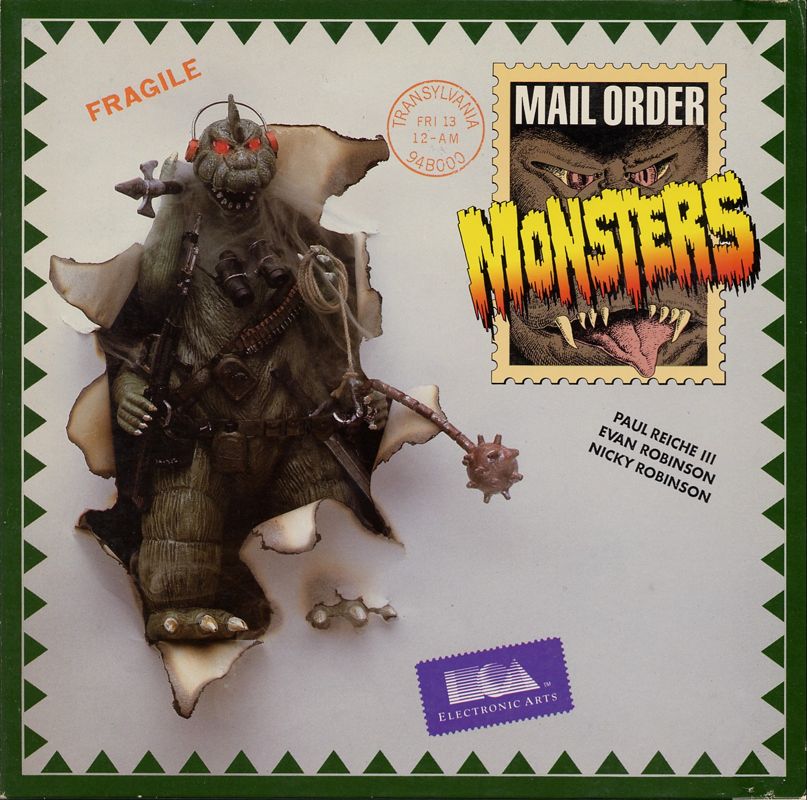
Mail Order Monsters is tagged as a strategy/arcade hybrid in various database, but after a cursory look it was obvious that the game is fully arcade. However, this game by Paul Reiche is both a spiritual sequel to Crush, Crumble and Chomp and a transitory game between the two Archon and Star Control – I simply can’t skip it.
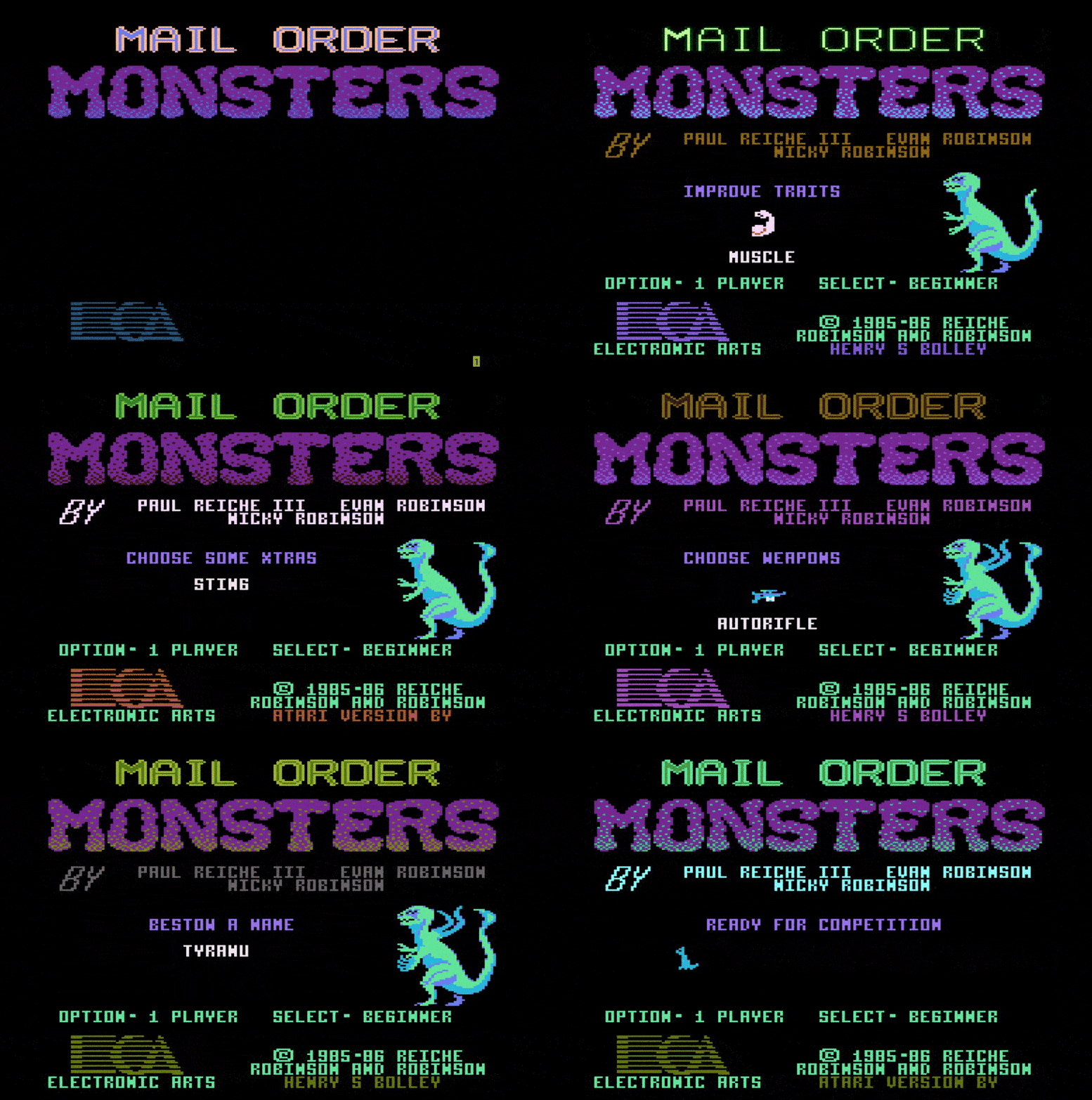
Mail Order Monsters includes 3 game modes, improperly labelled as if they were difficulty levels:
- The beginner mode is just a duel between two pre-built monsters: pick one in a list and go with it
- The intermediate mode allows you to customize your monster by allocating 500 psychons between the monster itself (a pterasaur does not come with the same default kit as an arachnid), perks, stats, weapons and equipment. Once you’ve built your monster, you can use it for one battle.
- Finally, the Tournament mode is a campaign mode where you build your first monster with 250 psychons and earn more currencies to improve your monster or recruit new ones from the battle.
Intermediate
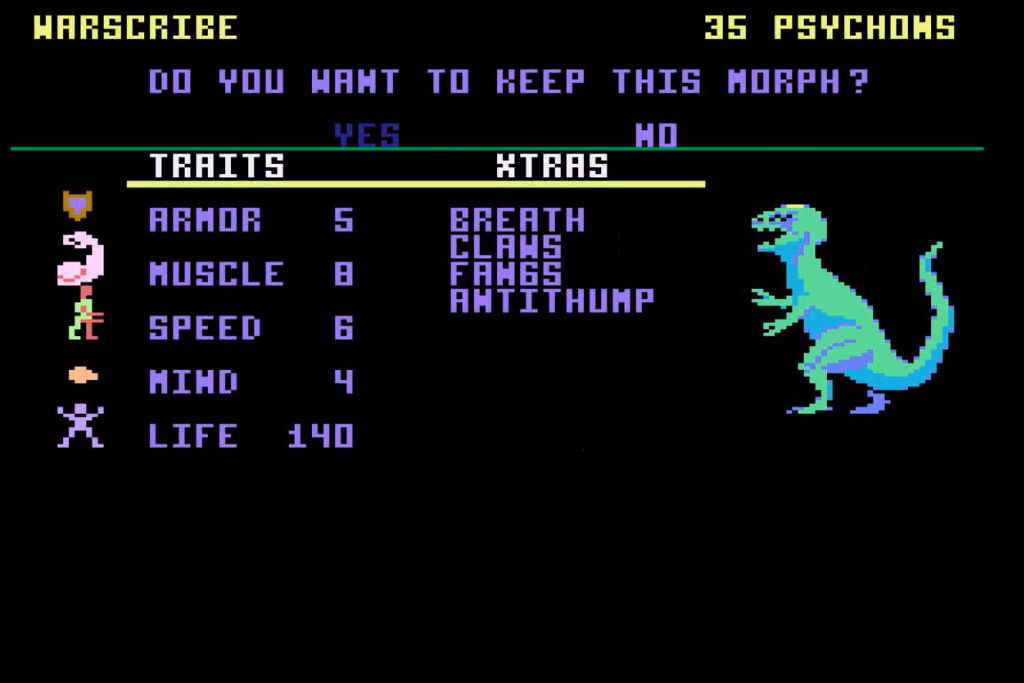
Let’s start with the intermediate level. With a large budget of 500 psychons, I can get myself a T-rex shaped monster to which I add muscles, speed and a breathing attack in addition to the claws, fangs and “antithump” defense that came with the dino package. ROAAAARRR!
I am facing RRR III, a hominid monster equipped with a powerful long-range neutralizer, and choose the capture the flag game mode, in which the first player to capture the 8 flags in order wins the game:
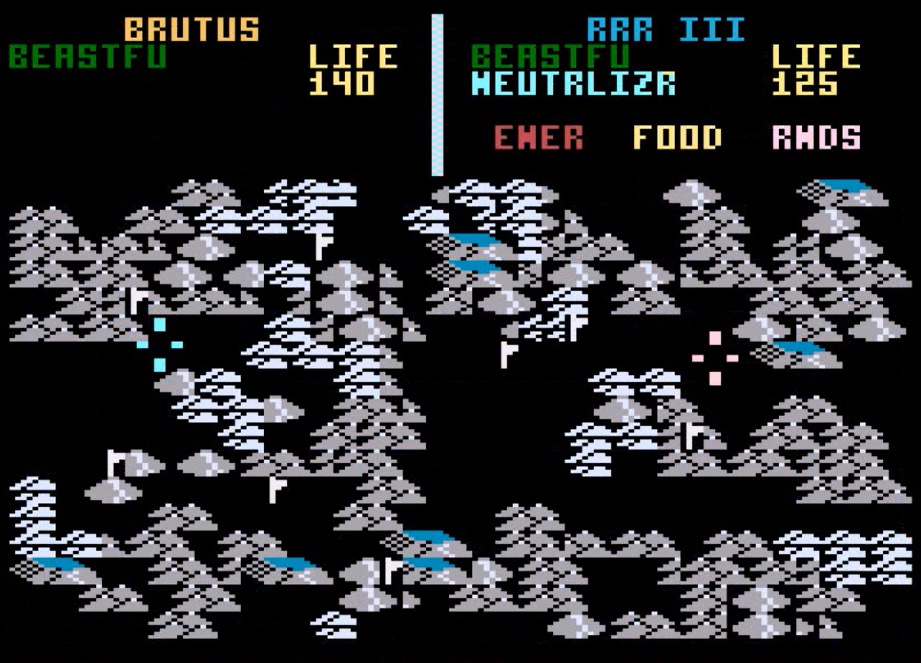
The problem of this game mode is that the two monsters cannot fight each other. Instead, each of the flags (whose “number” is only revealed during the tactical phase) is defended by a weak guardian played by the opposing player:
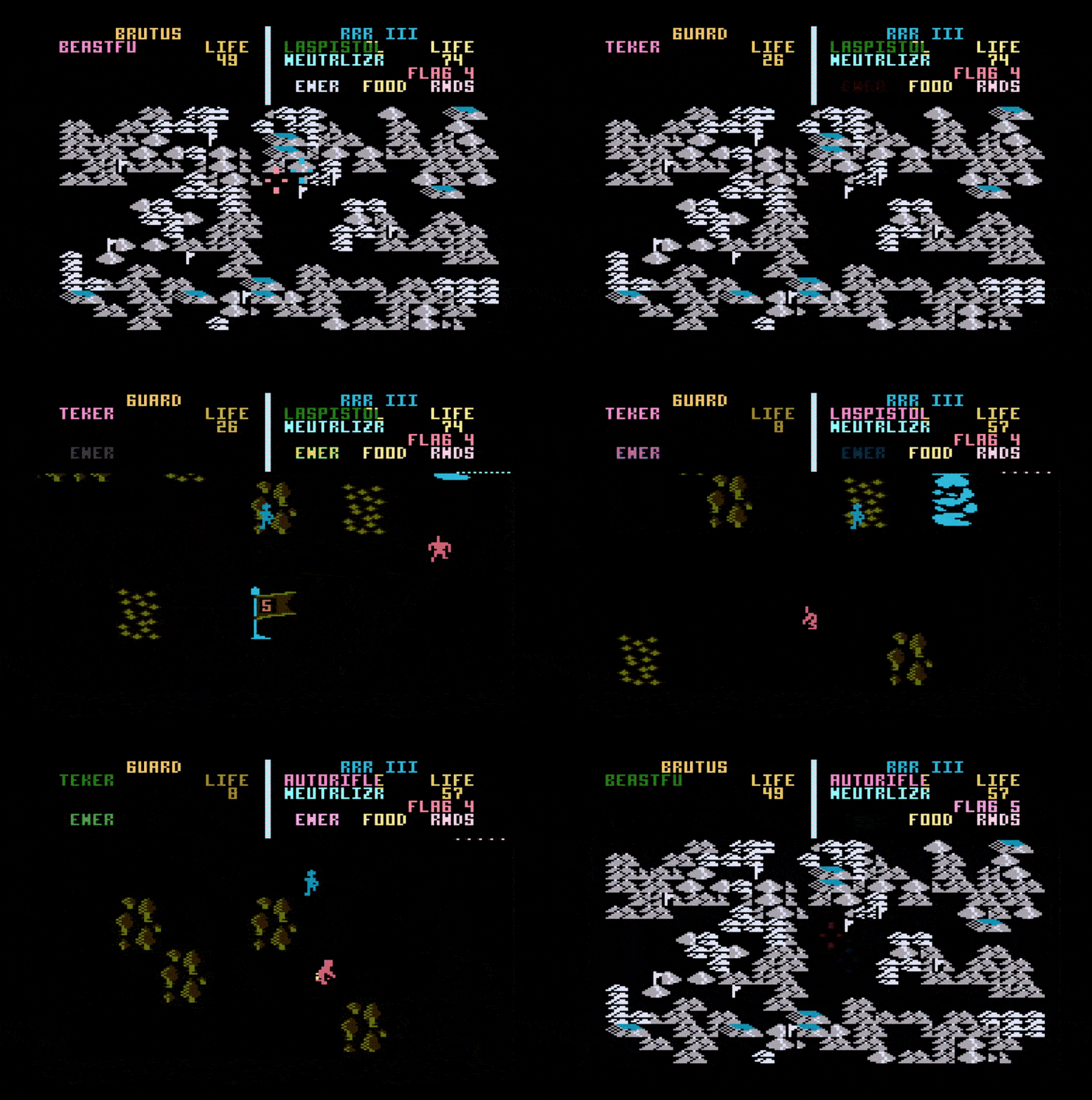
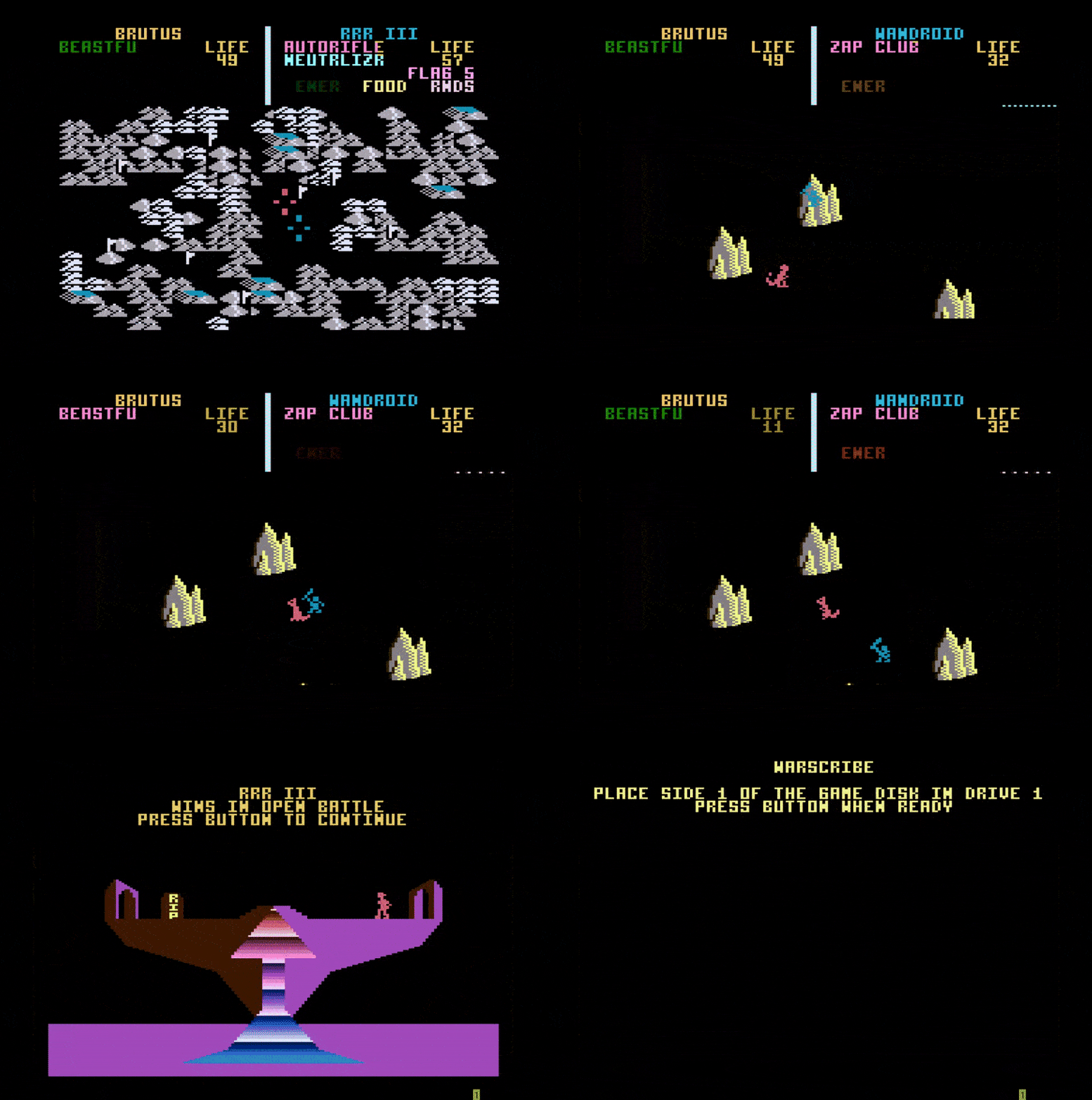
There are also random encounters on the map. The first one against a “Wandroid” badly wounds me as I realize I forgot to buy the food necessary for my breathing attack, and so I have to rely on my melee attack even though I am slower than my opponent. I still win this battle, but a second randomly encountered Wandroid finishes me off and with me the game. Very unsatisfying.
Tournament
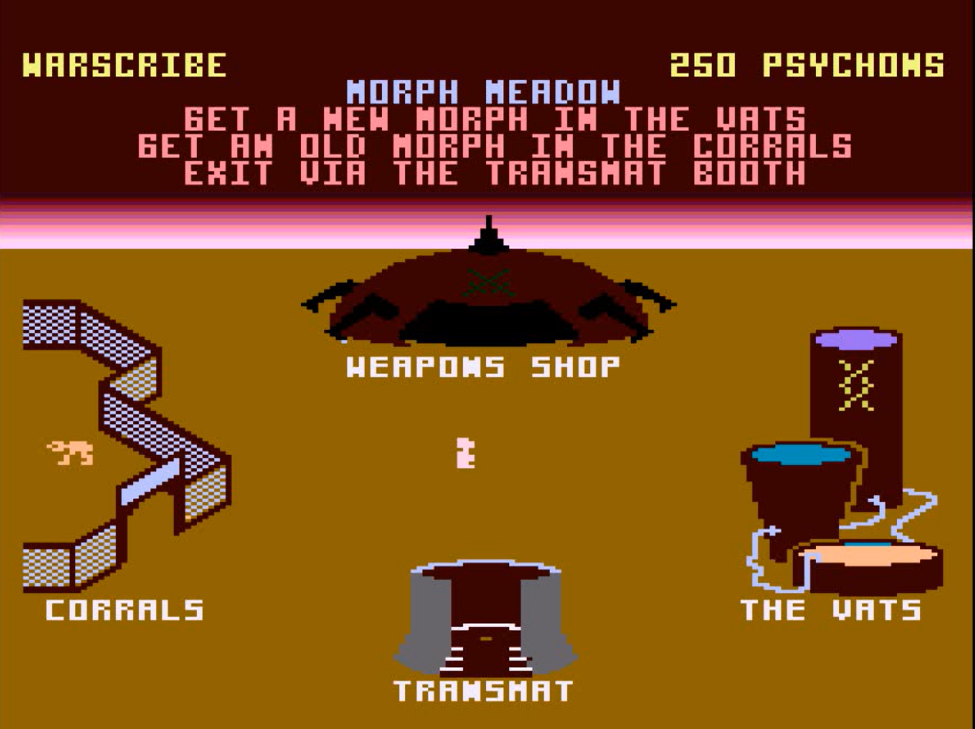
Well, this is the real-thing, except it starts with a meagre 250 Psychons which does not leave a lot of leeway in terms of customization. After a failed attempt to win with a gun-wielding hominid, I fall back on a lyonbear – a good compromise between speed and power – and I call him (or her, I did not ask) “Gilgalion”.
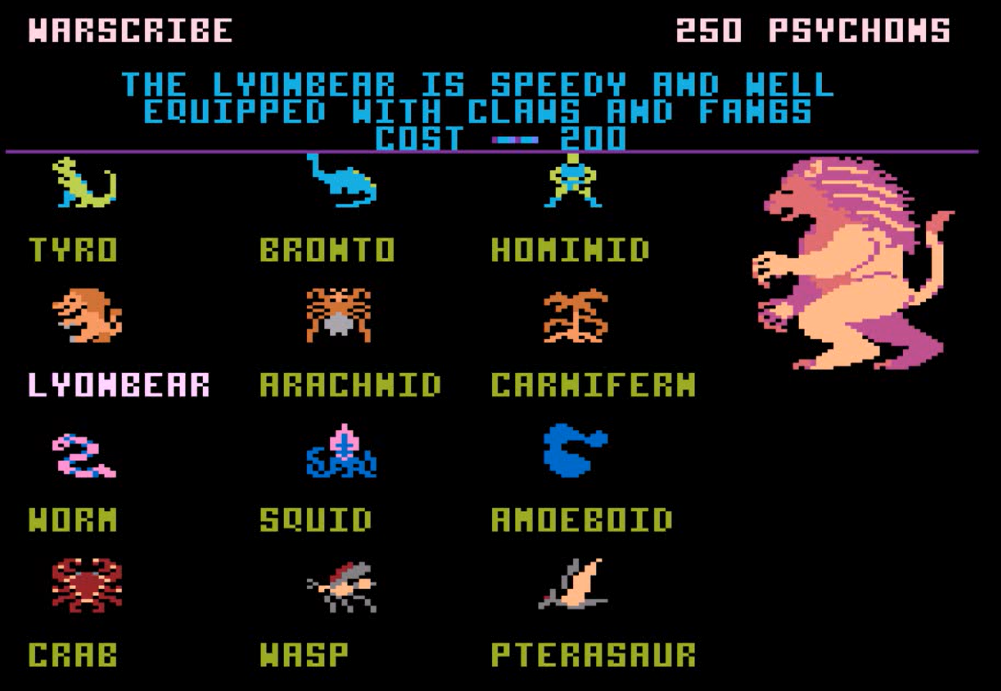
I am left with 50 psychons after buying Gilgalion, but happily enough improving its muscles is cheap (15/points), so now it hits like a truck.
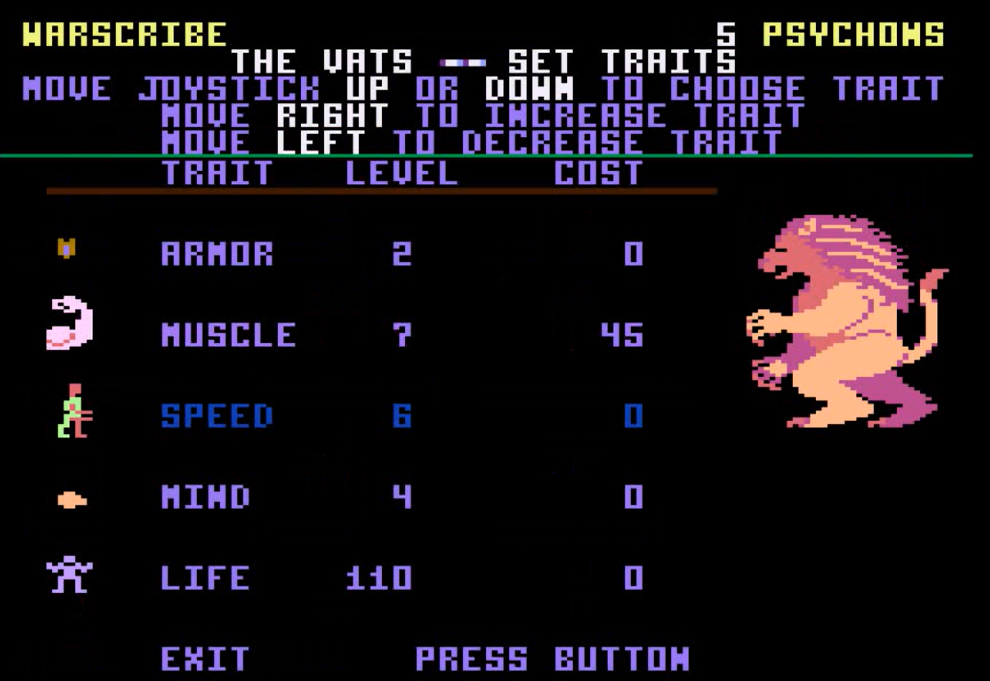
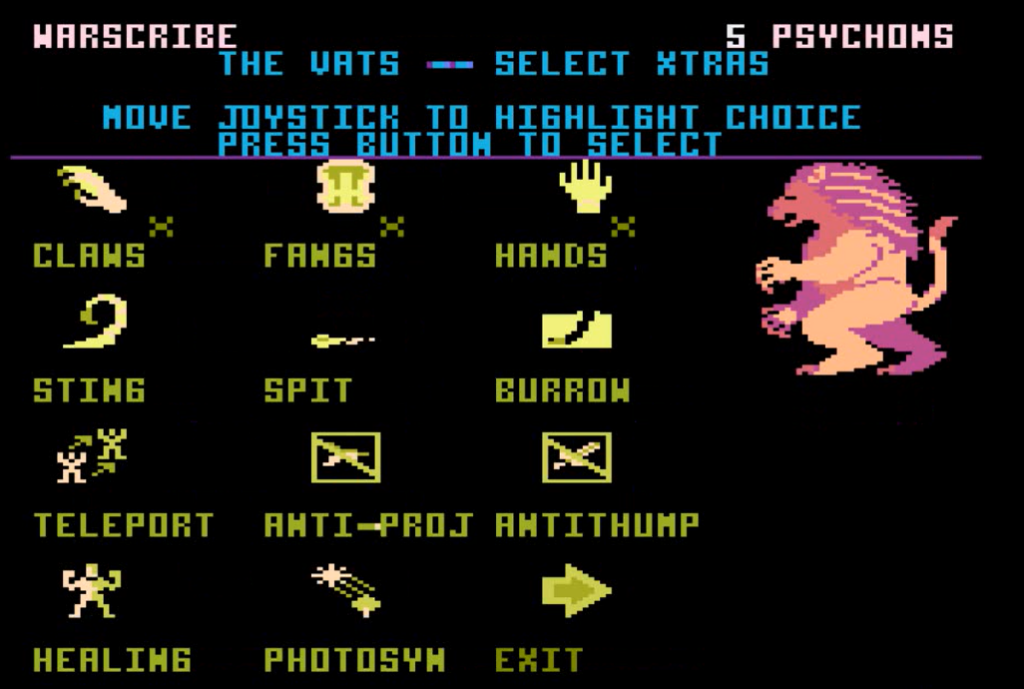
Lyonbears come with claws and fangs (further improving their melee damage) and also some hands that will allow me, further down the line, to equip it with weapons. For now, it will rely on monster-fu, which is what the game calls melee. The difference with the T-Rex is that this time my monster will be fast enough to catch its prey.
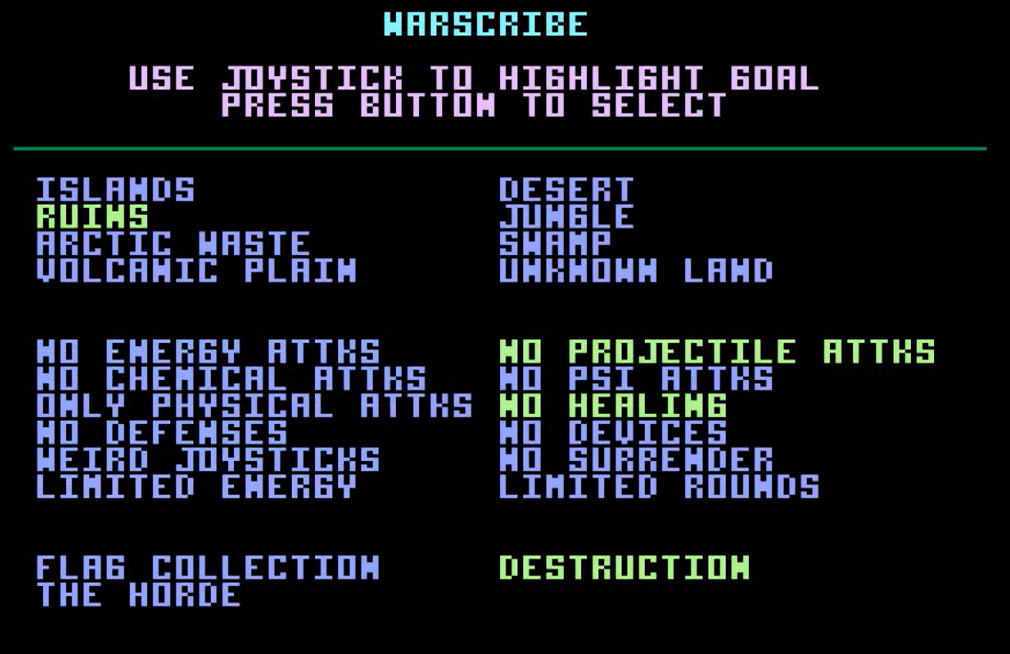
Before launching the first battle, both players can choose one rule modification. I don’t have ranged attacks, so I disallow projectile weapons while the computer decides to remove healing – well I did not have that capability so it’s perfect.
I am extremely lucky in this first battle. There is still a map in destruction mode with “neutral” cities to avoid – and my opponent (a plant-based carnifern) spawns right on top of one, immediately triggering a combat against an “urban defender” under my control.
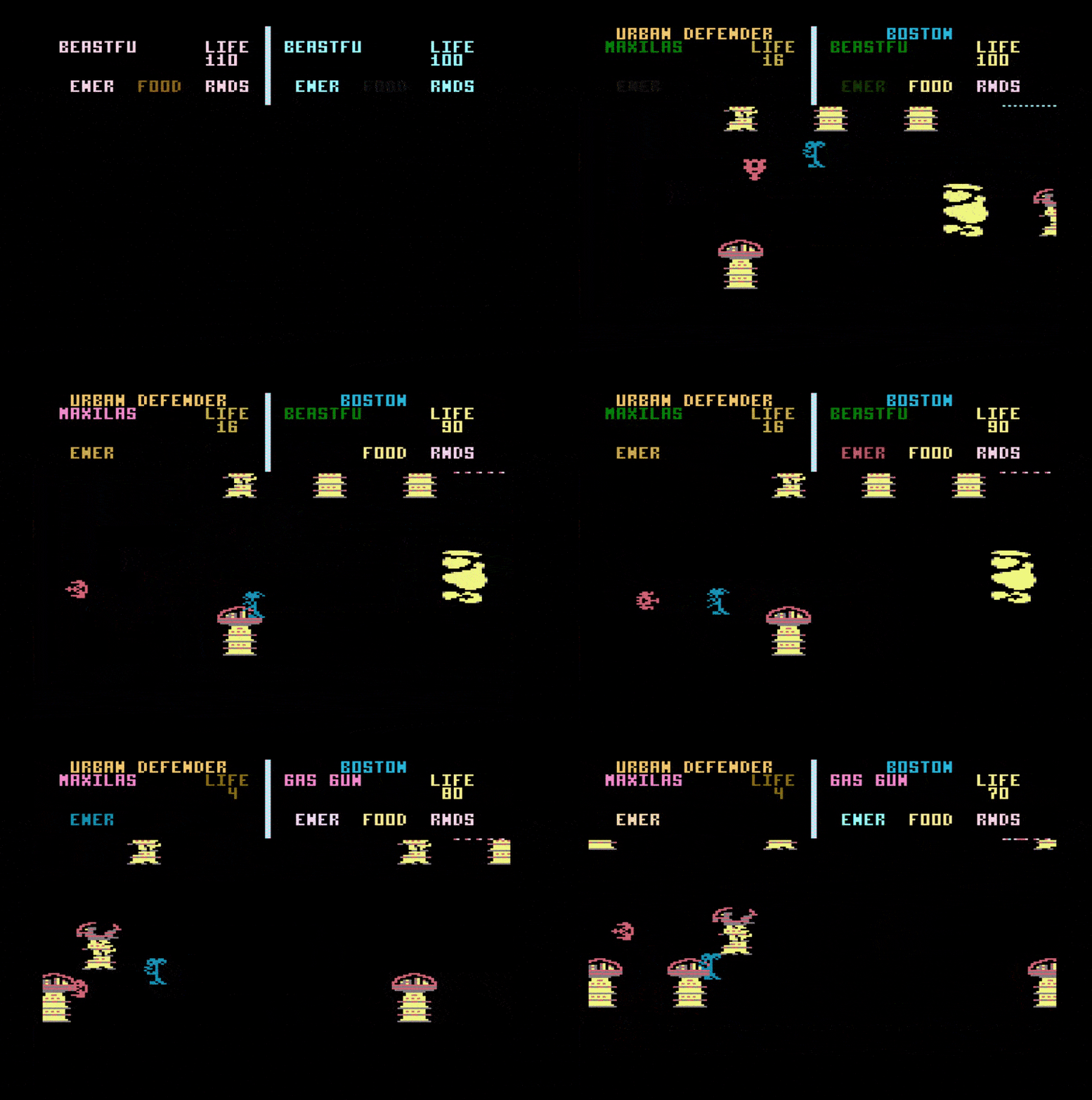
My opponent still defeats the urban defender thanks to its ranged attacks (apparently the gas gun is not considered a projectile), but the damage I inflicted sticks. Gilgalion then beelines for my opponent and mauls it in melee.
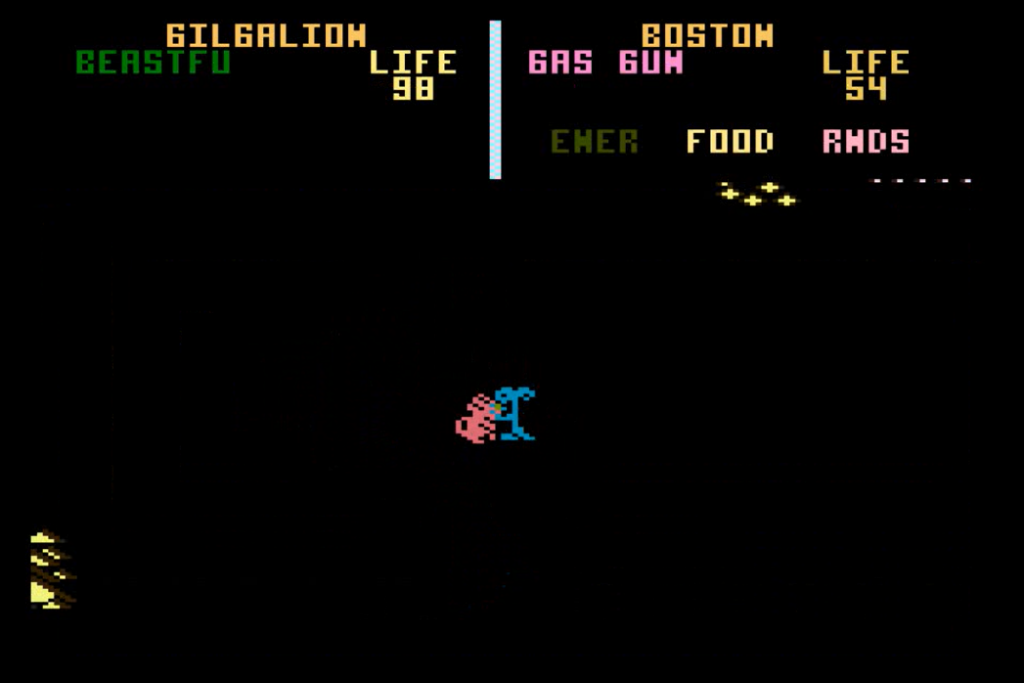
I am sent back to the preparation area with some 125 extra psychons and 3 victory points. The victory points are spent to improve the strength of Gilgalion, and I decide to buy an autorifle and 200 extra rounds.
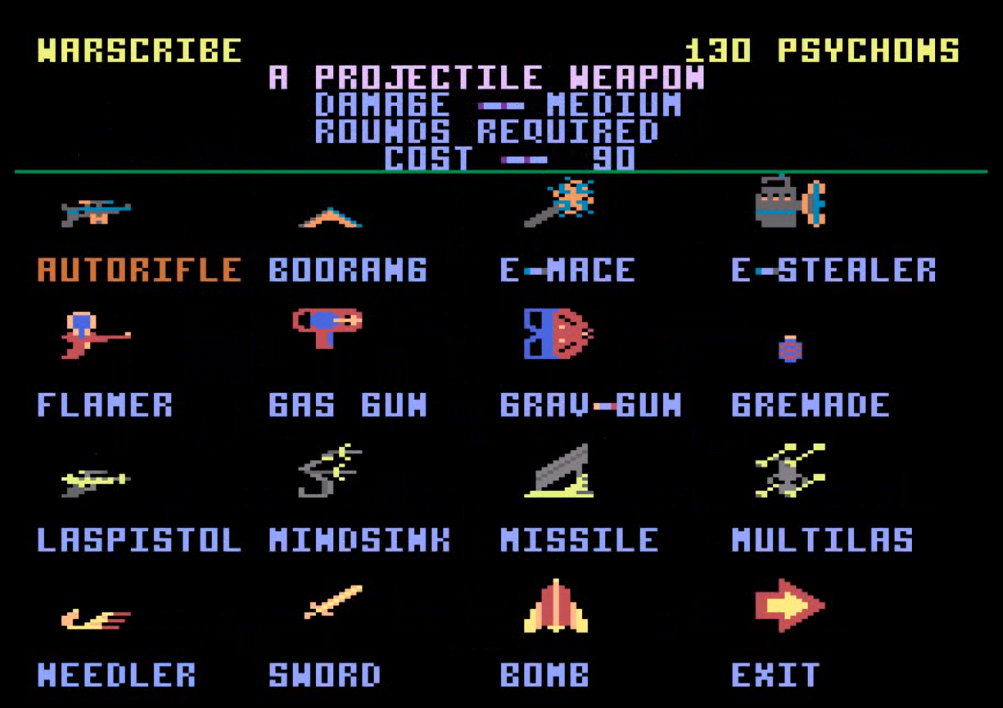
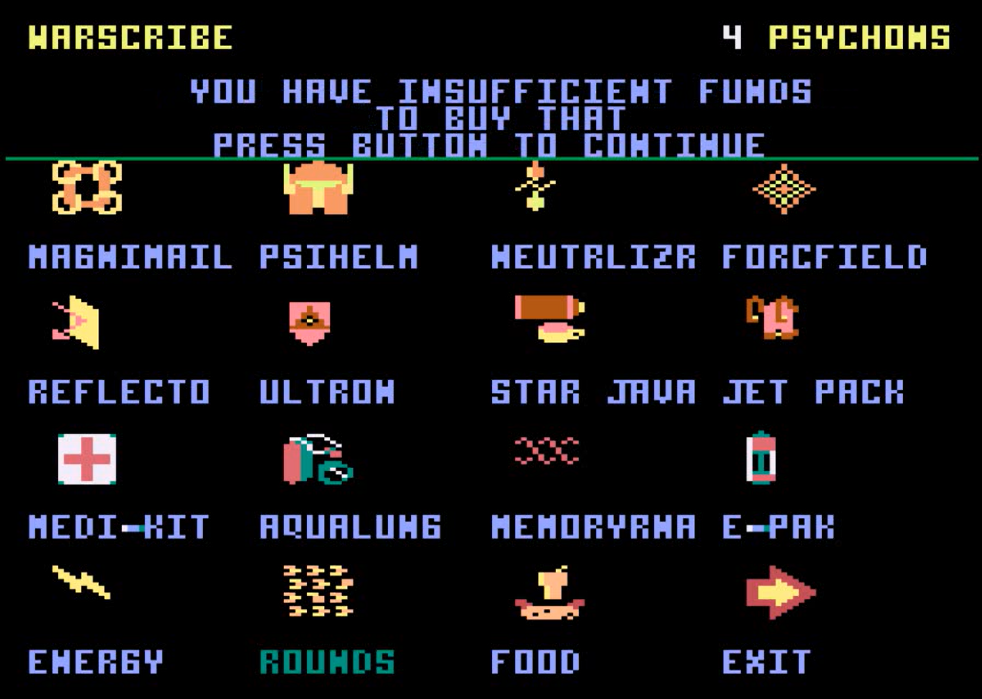
I launch a battle again and this time face a wasp monster, which is fast and easily dodges my bullets.
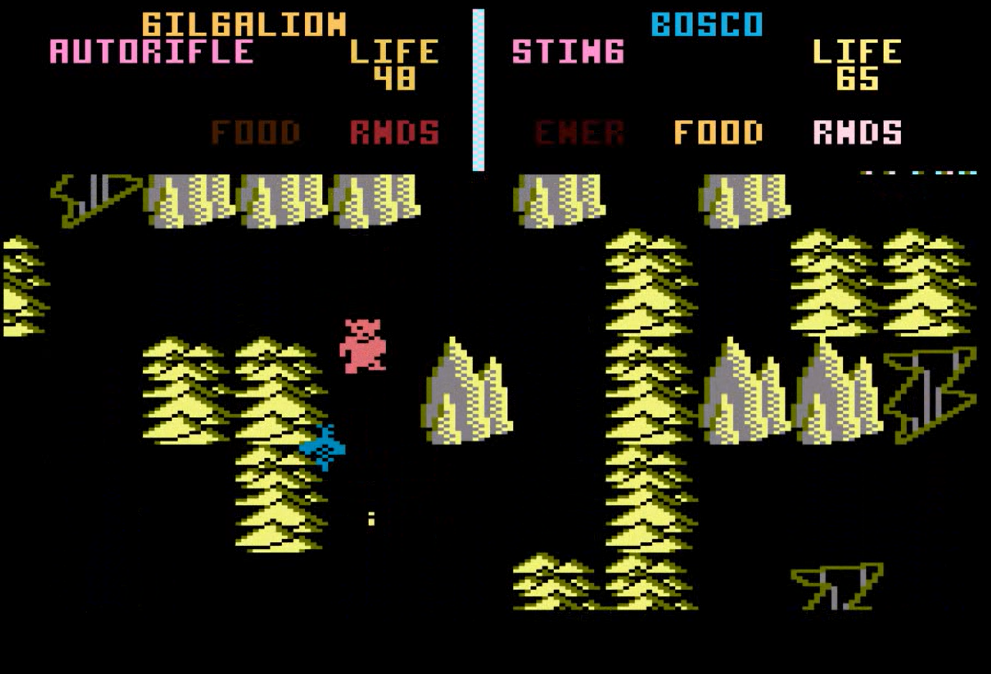
After several minutes of missing all my shots and seeing my life being chipped away, I switch to melee and just swat the giant wasp.
I return a third time to the preparation area… and realize that for some reason (bug?) I am now the owner the 45 000 psychons – more than I could possibly imagine to spend. That’s good however, because before retiring from my career as a monster breeder, I had one last thing to test: strategy weapons.
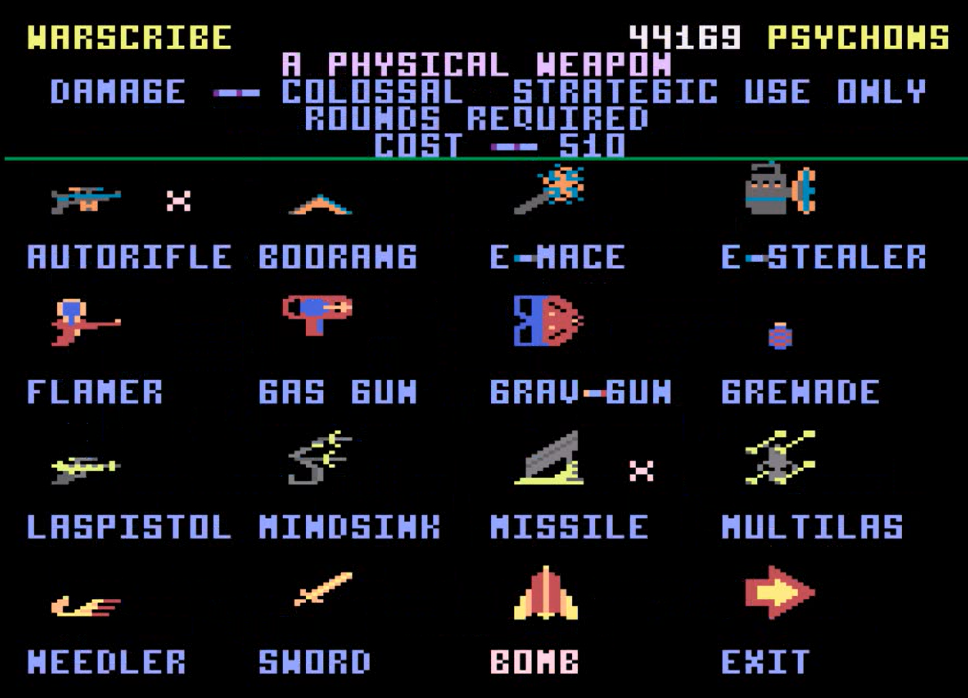
I launch the third battle, just to test the new weapon:
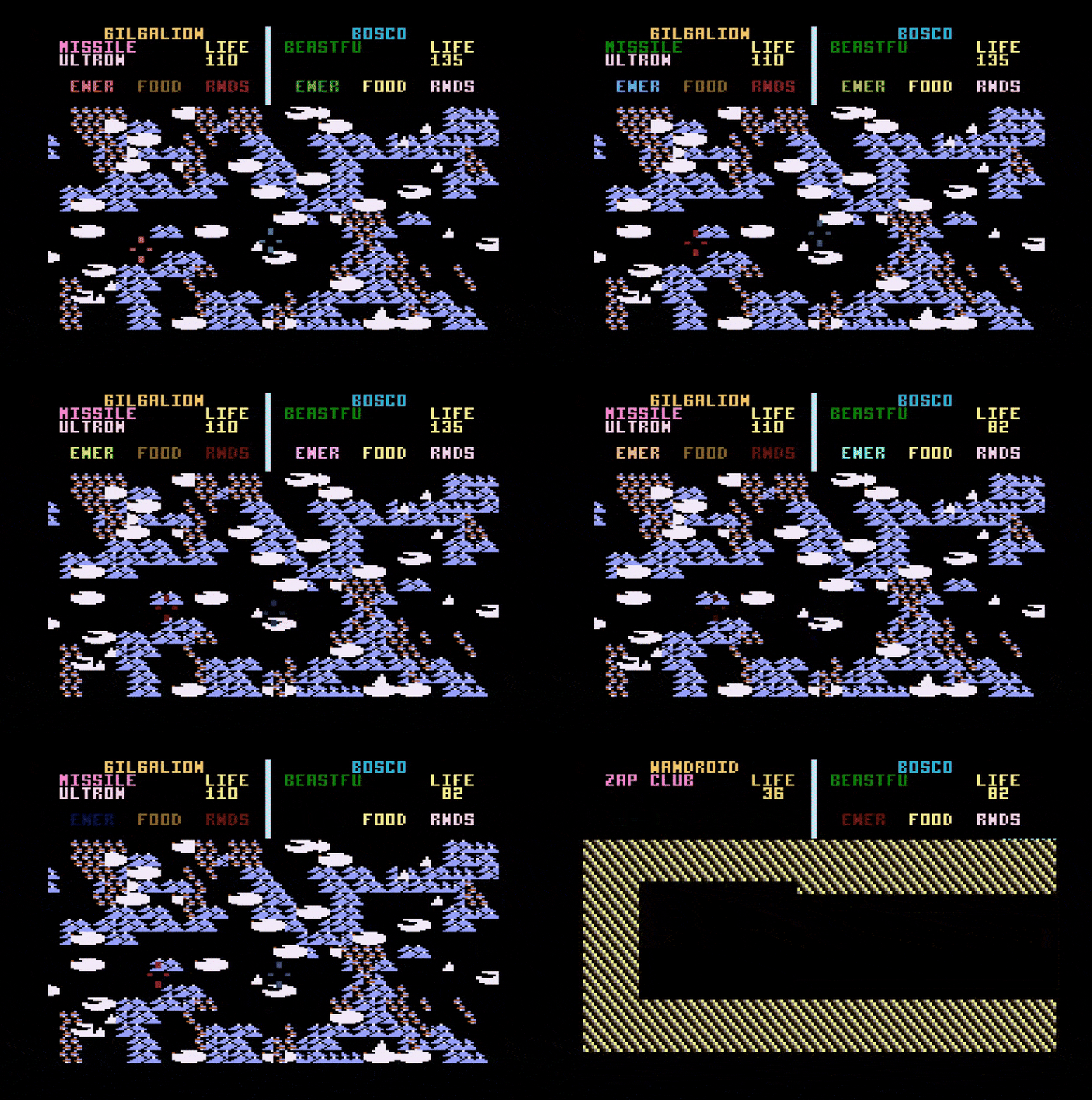
Well, it hurts indeed. I have no desire to finish the battle, however – shooting this missile was my last long term objective.
Ratings & Review
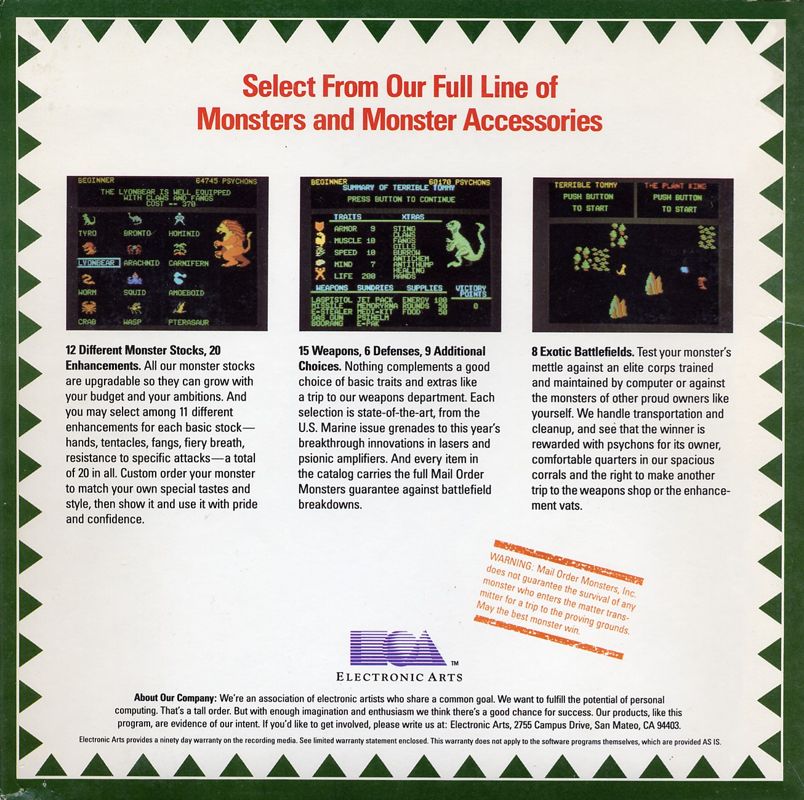
Mail Order Monsters by Paul Reiche III, Evan Robinson and Nicky Robinson, published by EA, USA
First release: January 1985 on Commodore 64, ported on Atari in 1986
Genre: Action-Strate… no wait – just action.
Average duration of a session: Variable
Total time played : Four hours.
Complexity: Low (1/5)
Final Rating: Obsolete
Context – After having followed Jon Freeman and Anne Westfall from Epyx to Freefall Associates, where he would contribute to the design of Murder on the Zinderneuf, Archon and Archon II, Paul Reiche III wanted to design, as he explained, “different kind of games”. Leaving Freeman and Westfall to milk Archon, he joined forces with a former co-worker at TSR, Evan Robinson and his wife Nicky – which means Reiche was third wheel for the second time. The Robinsons had worked on a stillborn port of the forgotten Picnic Paranoia, Nicky knew how to run a company and both Evan and Paul knew how to code and design – the team was complete. Paul in particular wanted to make a game about fighting monsters.
It is unclear how work was distributed between the Robinson and Reiche – Mail Order Monsters is very similar to the other Reiche works in design, but the Robinsons were competent designer in their own right as they would design several years down the line the outstanding Centurion: Defender of Rome. From Reich’s interview however, the initial design was to have a “gritty” game, but either due to the pressure of Electronic Arts or through a natural evolution, Mail Order Monsters became light-hearted – the manual is a good read for instance. I don’t have more details on the production of the game, which was released on Commodore 64 in January 1985.
Traits – In my experience, three conditions are necessary for Action-Strategy games to be absolutely great: the action phase is interesting in itself, the action phase has a strategic impact, and the strategic layer of the game impacts (“diversifies”) the action phase. I feel none of the games I played so far perfectly nailed it, but Mail Order Monsters managed to avoid the obstacle by not having a genuine strategic layer at all. If we exclude the two strategic weapons which turn the strategic layer into another action layer, here is an assessment of the strategic layer for each game mode:
- In the Destruction game mode, the strategic layer is just there to justify random encounters with “neutral” monsters, encounters that are – again – random, so nothing strategic about them. In theory, one player can wait for his opponent to come to him in order to choose the terrain, in which case the other player can simply… wait as well, because there is no time pressure. Actually, the best strategy is probably to wait for the other player to come and maybe trigger a random encounter, so I suppose that in multiplayer both players quickly agree to just beeline for the other one,
- In the Flag Capture game mode, the players can’t interact! Even worse, to win a player must go through a gauntlet of at least 8 battles and probably much more – the best strategy is therefore to just wait for the other player to die. In hotseat, this is a game mode that must have usually been launched exactly once,
- Finally, in the cooperative mode “the horde“, I can imagine a strategy where you first identify the various enemies in the horde and then try to fight the one your monster is the most suited for. In practice, the horde is a dreadful game mode where you spend a good chunk of your time looking at the computer battling the computer (in solitaire) or looking at your buddy battling an AI (in multiplayer).
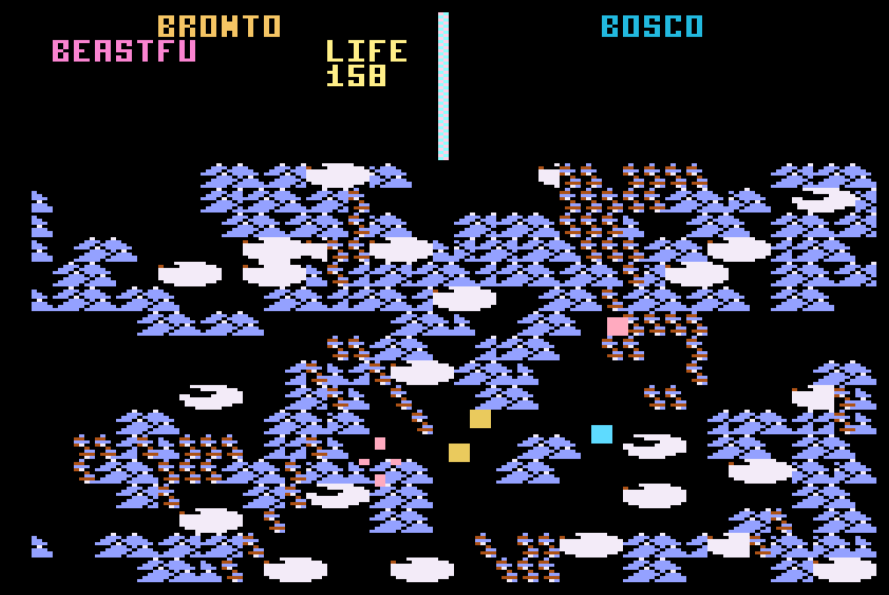
This makes Mail Order Monsters an almost pure action game, and I am afraid it’s not a very good one. Many monsters rely on melee or very short range combat which does not work well given the size of the map and the visual feedback, and the rate of fire of ranged attack feels much slower than in Archon. But the worse by far is that, unlike in Archon where no unit would take more than 6 hits to destroy another (and most would take 2-4), there are many combinations of armor/weapons/items where a monster only chip away 1-4 damage every attack, against a pool of HPs that can go way above 100 – I interrupted many battles where I found myself in this situation. All-in-all, the relative importance of melee combat, the slowness of attacks and the frequent discrepancy between damage HP often turn the action phase of Mail Order Monsters into a slog; I had the most fun with the “neutral” monsters simply because they are very low HP and usually wield a powerful weapon!
Finally, there’s the high customization capability of the game (base monster and then stats! perks! weapons! sundries!). I can certainly praise the game for it, though as I just said it is a bit devoid of purpose given the stale gameplay, and certainly is a cause of unbalanced action phases… Oh well. Paul Reiche will fix all that, and more, in Star Control!
Did I make interesting decisions? Yes, because customization is fun, but I did not have to overthink it a lot
Final rating: Obsolete.
Ranking at the time of review: 115/178. I had more fun in Beast War, which is saying a lot. In 1985, you should realistically stick to Archon.
Reception
EA games knew what they were doing, and Mail Order Monsters was well covered at its release. However, the reviews were all across the board. The best review I could find comes from James Delson in Family Computing, who praised it highly in August 1985 :”Mail-Order Monsters is one of the year’s best so far. Its play and combat system and concept won approval from a wide range of playtesters“. With the exception of that review, all the reviews I found are split in two camps:
- those who thought that the combats were flawed, but Mail Order Monsters was still somehow a good game,
- those who thought that the combats were flawed, so of course with a lacklustre core feature the game is a doozy,
In the first category, we find for instance Arnie Katz writing for Ahoy! (November 1985) or Steve Panak for Analog Computing (April 1987): “Overall, Mail Order Monsters more than pulled its weight. Although I felt the battle portion of the game was flawed, its other favorable traits certainly make up for that.”
In the second category, we find among other Commodore Users (September 1985) which concludes that due to combat the game is “a deathly bore to play” even though “in every other aspect it’s excellent”. The game ends with a rating of 1/5 in “interest” and “value for money“. Andy Eddy of Atari Explorers in March 1987 takes an even stronger stance, and mirrors my point of view quite closely: “The concept behind the program is reasonable: it is in the execution that it falls short. The graphics leave a great deal to be desired, and the actual combat segments are quite anticlimactic. Strategy counts for little, so the winner in most cases is the faster of the two monsters. I had hoped to find in Mail Order Monsters an extension and expansion of the arcade-like battle segments featured in Archon. but found, instead, clumsiness and frustration.”
Mail Order Monsters still left excellent memories to some players, as it is a somewhat frequent subject of nostalgic articles, with more often than not a call for a remake – for instance Levi Buchanan writing for IGN in 2009. I believe this ship has sailed.
The game might not have been incredibly successful, because Reiche explained having financial difficulties after the release of the game. This led him and the Robinsons to make the safe World Tour Golf (1985), apparently successful – after which Reiche left to design Star Control. That’s a story for another time.
3 Comments
I played the C-64 version a ton as a kid. It was an innovative, fun concept, but it did have an exploit I was able to use to rarely require my monster to engage in combat. Since the opposing monster mirrored your moves on the expansive map, you could direct them to intersect with the robot enemies scattered throughout that you’d be able to control as if they were your own. This either defeated the opposing monster or so badly damaged them that you could easily take down the rest of their health when your monster finally met up with them.
Although that ship has indeed sailed in the age of Monster Rancher, Pokémon, and clones, I would indeed love a spiritual successor to Mail Order Monsters. They were able to eventually and effectively bring Archon to the modern era with Archon Classic, so I’d love to see someone do the same for Mail Order Monsters, particularly with the exploits and other flaws fixed.
“a transitory game between the two Archon and Star Control”
Only in the sense that Reiche made it between Archon II and Star Control. In terms of actual gameplay, Star Control is derived directly from Archon II, not from MOM.
I don’t believe Star Control to be closer to Archon than it is to MOM at the strategic level. The “action phases” of the 3 games are fairly similar (even if the MOM is poorly balanced) and if anything the one of MOM is a bit closer to Star Control than to Archon, eg the map “loops” when you go straight up, one of the weapons allows you to steal energy [= ammo] from the enemy,… I reckon SC was built on the experience of Archon, Archon 2 and MOM. I don’t have a direct quote for that however.