Hellwig 1780 – Veterini 1793 – Hellwig 1803 – Opiz 1806 – Firmas-Périès 1809 – Reiswitz Sr. 1812
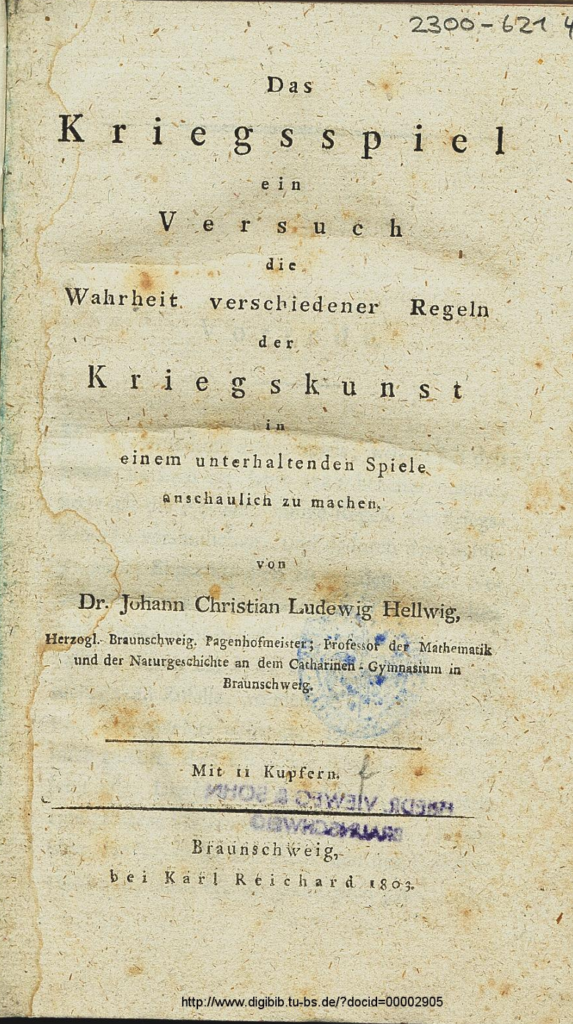
This is the second edition of Hellwig’s wargame, in which he removes the trappings of Chess.
This version comes from the library of the University of Braunschweig.
As usual, I uploaded a copy on the archives.
The quality of the pages is mediocre, and the OCR struggled. Translation errors and missing lines are extremely likely.
# The War Game (*Das Kriegsspiel*)
**An Attempt to Illustrate the Truth of Various Rules of the Art of War through an Entertaining Game**
By Dr. Johann Christian Ludwig Hellwig,
Ducal Brunswick Page-master; Professor of Mathematics and Natural History
at the Catharineum Gymnasium in Brunswick.
With 11 copperplate engravings.
Brunswick, Karl Reichard, 1803.
—
## Preface (*Vorrede*)
When I invented this game — of which I made the first attempt public in the year 1780 — my intention was to give sensory illustration to some rules of the art of war, and thereby to be of use to the student of that art. A secondary intention was to provide those who have no need of such instruction with an agreeable entertainment through a game in which nothing depends on chance, but everything on the skill of the player. Experience has taught me that I have not missed my mark. This encouraged me to bring the game to a greater degree of perfection. How far the attempt corresponds to the inventor’s intentions must, since he cannot possibly be entirely impartial, be left to others to judge.
— Even if one were to find that this game stands at a lower level of perfection than I flatter myself it does, experience has nonetheless taught me that it gives sensory illustration to many rules of the art of war, and that it has been very helpful to beginners in this science in attaining insight into the important truths of that doctrine. This agreeable experience was not mine alone. A scholar distinguished in that field — the Ducal Brunswick *Obristlieutenant* Mauvillon — convinced himself of this through some of his own pupils. This persuaded him — though he had initially been prejudiced against the game as a means of contributing to the formation of a young soldier — to make himself thoroughly acquainted with it. He became an eager defender of it. Only death prevented him from translating it into French, in order to make known to foreign countries an invention that seemed to him anything but insignificant.
Allow me to cite some of the propositions whose truth the game confirms. One must above all cover the flanks of the armies, and seek to maintain the connection between their various corps. — After gains are made, one must advance cautiously so as not to lose them again. To that end, the inevitable disorders of the victorious army following even a successful battle must first be set right before one can think of further important operations. — A battle is here, as in nature, subject to many unforeseen accidents; and even with the best preparations it may turn out badly. One must therefore think in advance of where and how one could withdraw, so that the retreat does not degenerate into a shameful flight. — One must seek to dislodge the enemy from his advantageous position more by diversions and by threatening his communications than by attacking him straight on. — One must tempt him to detach forces, and then attack him where he has thereby weakened himself. — One must not engage in battle without first having made arrangements to exploit the victory properly.
— One must not count on the enemy failing to do something merely because the enterprise seems to border on impossibility; a shrewd commander often chooses just such a point of attack and surprises the enemy. One must seek to draw the enemy’s attention away from the true point of attack. — In the case of defence, one must not confront the enemy directly head-on, but take a position to one side of him. — In the case of attack, one must operate against the enemy’s flanks and rear, and not attack the front — unless one wishes to deceive him, to prevent him from thinking of his flanks and rear, and to pin him to his post. — A beaten army must seek to execute its retreat eccentrically, in order to slow the pursuit of the victor. — Without compelling reasons one must not attack the enemy’s centre. For even if one succeeds in splitting it, this compels the beaten enemy to make an eccentric retreat, which in turn hampers one’s own advance. — One must threaten the enemy’s flanks from the outset, so as to prevent him from making
**[UNCLEAR] …to intercept him and make a useful eccentric retreat. — The retreat of a corps that serves merely to occupy the enemy’s front must not be eccentric but parallel to the front, because through this occupation one aims to divert the enemy’s attention from one’s own flanks. But if this intention lapses, the rule of the eccentric retreat applies once more. — The cordon system is faulty: he who wishes to hold everything loses everything. — In war, even the smallest events deserve the commander’s full attention; nothing is trivial to him. — Even in the most desperate circumstances, the commander must lose neither his courage nor his head. By this he will be in a position to exploit the negligences into which the opponent too easily falls through the advantages already gained.
I have yet to play a game in which the importance of these and many other rules was not made so vivid that they impressed themselves indelibly upon the memory. The teacher thereby had occasion to bring in instructive parallels from military history, and to provide the pupil with an entertaining lesson.
Let this suffice to encourage an attempt to convince oneself through personal experience of the truth of what I say. A hindrance to this attempt might be the impression that learning the game is encumbered by too many difficulties. Evidence for this might seem to lie in the large number of the game’s rules; but experience shows the contrary. The Ducal pages at Brunswick, at an age between 13 and 15 years, have learned the game — for the most part merely by watching — and all play it to a respectable degree of perfection, finding in it an extraordinarily engaging entertainment. It is, of course, not everyone’s business to learn an art from a book alone, without oral instruction. I may therefore not expect that everyone will learn this game from my description, however clearly I have sought to make everything; but at most places there will be someone with sufficient ability and patience to think through these rules, and to explain enough of them verbally to others that they can thereafter help themselves further with this description.
Since I believe myself to be sufficiently acquainted with the imperfections of this game — my paternal fondness for it notwithstanding — and since I have hinted at these in the description through various remarks, a request to be shown those imperfections would cause only unnecessary trouble. But with unfeigned gratitude I will acknowledge it if someone were to suggest means by which the imperfections might be remedied without thereby producing still greater ones, and without causing inconveniences during play. For example, the ratio of firing ranges to day-marches is not what it would need to be to correspond to reality. But I have found no means of making it so without either enlarging the game board excessively, or introducing inconveniences into play through some modification.
Complete war games with an immovable terrain of 1,617 squares cost, when ordered through me, five and a half pistoles; with a terrain that can be altered in 63 different ways, 7 pistoles; and with a terrain made of assembled squares, comprising 2,000 squares, arranged so that it can be changed in every possible way — whether according to an arbitrary or a natural plan — 10 pistoles. Smaller and larger versions can also be made.
Brunswick, 9th October 1802.
*The Author.*
—
## Table of Contents (*Inhalt*)
**General Considerations, §§ 1–10**
– Difficulties encountered in attempting to represent the operations of war through a game, § 1.
– The division of war with respect to its theater, § 2.
– The most important subjects of the art of war, § 3.
– The various types of troops, § 4.
– On the theater of war, § 5.
– On the implements required for war, § 6.
– Requirements of an army that differ from these, § 7.
– The aim of war, and by what means it is naturally concluded, §§ 8–10.
**Chapter One. On the nature of the board on which the theater of war is depicted, §§ 11–25.**
– Size of the surface; how terrain types are distinguished, § 11.
– Terrain passable without obstacle, § 12.
– Impassable high mountains, § 14.
– Marsh and bog, §§ 15–16.
– Narrow roads, § 17.
– Bodies of water, § 18.
– Buildings, towns, and villages, § 19.
– Provinces, § 20.
– Fortresses, §§ 21–23.
– Lines of communication, § 24.
– Means of determining the smallest part of terrain, § 25.
**Chapter Two. On the nature of the pieces, §§ 26–32.**
– The material of which they are made, § 26.
– Infantry, § 27. Cavalry, § 28.
– Each piece represents a troop, not a single soldier, § 29.
– Artillery, § 30. Why no cuirassiers, § 31.
– Marking the troops on the board, § 32.
**Chapter Three. On the changes that troops can make to their position, §§ 33–61.**
– What one’s turn consists of; the aim of the game, § 33.
– First- and second-class changes, § 33a.
– Changing the front; real movement; the strike, § 33b.
– Adjacent, side, and angle squares, § 34. Side rectangle, § 35. Front rectangle, § 36.
– Rectangle of the reversed front and wings, § 37.
– Front changes of the first and second class, §§ 38–39a.
– Movement of infantry, §§ 40–41. Dragoons, §§ 43–44.
– Light cavalry, §§ 45–47. Movement on rough terrain, §§ 48–49.
– Direction of front, § 50. Enemy piece movement, § 51.
– Striking a piece, § 52. How infantry strikes, § 53. How cavalry strikes, §§ 53–55.
– How many pieces can be struck per move, § 57.
– Cavalry striking flank and rear, § 58. Note on cavalry vs. infantry, § 59.
– No simultaneous front-change and strike, §§ 60–61.
**Chapter Four. On small arms fire, §§ 62–70a.**
– Overview, §§ 62–63. When the frontal firing advantage ceases, §§ 64–65.
– Infantry fires and strikes in the same move, § 66.
– Why cavalry cannot fire, § 69. Artillery-crew infantry firing, § 70.
**Chapter Five. On bridges and pontoon wagons, §§ 71–81.**
– Bridges and pontoon wagons, §§ 71–73. Wagon blocks its square, § 74.
– When it can move, § 75. Nature of its movement, §§ 76–81.
**Chapter Six. On Artillery, §§ 82–117d.**
– Description of the gun; three gun types, §§ 82–87.
– Marking artillery on the board, § 88. Artillery blocks terrain, § 89.
– Three changes: turning, moving, firing, §§ 90–94.
– Turning, §§ 95–96. Moving, §§ 97–98. Firing range by type, §§ 99–101.
– Effect of artillery fire, § 102. Artillery as combined arms, § 103.
– Artillery duels; silencing, §§ 104–111d.
– Range tables, §§ 112–115. Cavalry operating guns, §§ 116–117.
– Battery combinations, § 117a. Spiking a gun, §§ 117b–c.
**Chapter Seven. On bridges in the vicinity of artillery, §§ 118–124.**
**Chapter Eight. On the simultaneous movement of several pieces (corps movement), §§ 125–139.**
**Chapter Nine. On fortifications, §§ 140–183.**
**Chapter Ten. On bridge construction, demolition, and ruining, §§ 184–208.**
*[The Table of Contents in the scanned copy ends here. The book continues through at least Chapter Eighteen.]*
—
## General Considerations (*Allgemeine Betrachtungen*)
### § 1.
The subjects of war are so great in variety and so particular in nature that a complete sensory representation of them through a game is impossible. Even where one does not have to struggle against impossibilities, difficulties still arise that are enormously obstructive to a successful execution of this idea. These difficulties lie not so much in the invention of the rules as in certain other circumstances. The board cannot be made as large as it would need to be for day-marches, firing ranges, and the like to be in proper proportion; the available space and a reasonable price both impose restrictions. But these restrictions can be kept modest enough that the most important rules of the art of war can still be vividly illustrated.
### § 2.
In respect of its theater, war is divided into offensive war, conducted in enemy territory, and defensive war, conducted on one’s own ground. In the latter the defender enjoys better knowledge of the terrain, uses it more advantageously, and obtains supplies more easily — advantages that must appear in the War Game.
### § 3.
The most important subjects of the art of war are: choosing a position; attacking the enemy in his; defending one’s own; retreating without disadvantage; and cutting off the enemy’s retreat or supply.
### § 4.
The different troop types: infantry moves more slowly than cavalry but can pass terrain cavalry cannot. Cavalry is faster on open ground. Artillery fires by cannon shot from a fixed position.
### §§ 5–7.
For the War Game one needs a surface divided into small squares representing the theater of war. The essential terrain features — roads, rivers, mountains, forests, towns, fortresses, depots — must all be represented. Additionally, the supply depot, magazine, and headquarters of each side must be indicated.
### §§ 8–10.
The aim of war is to damage the enemy in every possible way and ultimately compel him to submit or be destroyed. In the War Game this is achieved when the enemy’s principal piece is placed in a position from which it cannot escape capture.
—
## Chapter One: On the Game Board
### §§ 11–13.
The board is divided by two sets of intersecting parallel lines into small squares, each 14 lines wide. The large game board contains 1,617 such squares. Terrain types are distinguished by color. The plain terrain passable without obstacle is the default; all other types are marked distinctively.
### § 14. Impassable High Mountains
Impassable high mountain terrain is shown by squares divided diagonally into triangles. Several varieties exist: wholly impassable peaks are a darker shade; difficult but traversable highland is lighter. The distinction determines which troop types may enter and at what movement cost.
### §§ 15–16. Marsh and Bog
Boggy terrain is shown by a distinctive color. Some marsh squares are wholly impassable; others are passable only to infantry, at reduced movement.
### § 17. Narrow Roads
Narrow roads and defiles restrict passage to one piece at a time. A formation cannot spread out; it must move in column.
### § 18. Bodies of Water
Rivers and lakes are generally impassable except at bridges, fords, and pontoon crossings marked on the terrain.
### § 19. Towns and Villages
Built-up areas provide defensive cover equivalent to a field fortification. Artillery can fire into them normally; infantry cannot strike defenders inside by direct assault.
### §§ 20–24. Provinces, Fortresses, and Communication Lines
Provinces define the operational area. Fortresses are the strongest fixed points on the board, requiring a siege to reduce. Lines of communication connect each army to its supply base; cutting them is a key operational objective.
### § 25. The Square as the Minimum Unit
The individual square is the smallest unit of terrain. All movement, range, and tactical calculations are expressed in squares.
—
## Chapter Two: On the Game Pieces
### §§ 26–29. General Description; Infantry and Cavalry
The pieces are flat tablets or blocks, each with a marked front indicating facing direction. Each piece represents a tactical unit — a battalion, squadron, or battery — not a single soldier. **Infantry** pieces are the most versatile arm, moving through terrain inaccessible to other types and able to fire and strike in close combat. **Cavalry** pieces represent mounted troops. Three types are distinguished: line cavalry, **Dragoons** (*Dragoner*, who can dismount to fight as infantry), and **light cavalry** (*Rauterei*), which has the widest movement range of any piece.
### §§ 30–31. Artillery and Cuirassiers
**Artillery** pieces represent a cannon with crew. Their form distinguishes them from all other pieces. **Cuirassiers** are not given a separate piece, as their tactical distinction from other cavalry is insufficient to warrant the added complexity.
### § 32. Marking Troops
Each side’s pieces are distinguished by color. Within each side, the different arms are further distinguished by the form of the pieces.
—
## Chapter Three: Movement and Combat
### § 33. The Turn; the Aim of the Game
A player’s turn (*Zug*) consists of making exactly one **change** (*Veränderung*) to his pieces. The aim is to place the opponent’s principal piece in a position from which it cannot escape — analogous to checkmate. An announced threat must be answered on the opponent’s next turn.
Changes fall into two classes: **first-class** changes directly threaten or harm the opponent (capturing a piece, firing, placing the opponent in check). **Second-class** changes reposition one’s own pieces without direct threat. A player must make a first-class change if one is available; only when none exists may he make a second-class change.
### §§ 33b–37. Fronts and Rectangles
Every piece has a **front** — a direction it faces. All movement and firing are calculated relative to this facing. The squares surrounding a piece are classified as: **adjacent** (sharing a full side), **angle** (touching only at a corner), and organized into **front rectangle** (squares ahead), **side rectangle** (squares to each flank), and **rear rectangle**. The exact composition of each rectangle for each facing is given in the engraved tables.
A **change of front** (rotation without movement) belongs to the second class and may only be made when no first-class change is available.
### §§ 40–49. Movement of Each Troop Type
**Infantry** (§§ 40–41) may make one of three day-marches per turn: forward, right-flank, or left-flank. It cannot retreat without first changing front on a prior turn.
**Dragoons** (§§ 42–44) may dismount in the same turn they move, acting as infantry thereafter. They cannot remount in the same turn they dismount.
**Light cavalry** (§§ 45–47) can reach far more squares per turn than infantry — up to 64 different positions — making it the fastest arm and ideal for flanking and cutting communications.
On **rough terrain** (§§ 48–49) movement is reduced according to the terrain type. A piece in a narrow road must follow the road; it cannot spread to adjacent squares.
### §§ 50–55. Striking a Piece
A piece **strikes** by moving into the square occupied by an enemy. The enemy piece is removed. This is always a first-class change. **Infantry** can strike an enemy in the front rectangle at close range. **Cavalry** can strike from a wider range of squares and may in some configurations strike more than one enemy piece per turn (§ 57), and can attack from the enemy’s flank or rear (§ 58), where the defensive benefit is reduced.
### §§ 60–61. Restrictions
A piece cannot both change its front and strike in the same turn. Rotation and attack are always separate actions on separate turns.
—
## Chapter Four: Small Arms Fire
### §§ 62–70a.
In addition to the strike, infantry can **fire** at a distance within its firing arc. A hit removes the enemy piece just as a strike does, and belongs to the first class. The frontal firing advantage of infantry ceases when the terrain blocks line of sight or the angle places the target outside the strict front rectangle. Under certain conditions infantry can both fire and strike in the same turn (§ 66). Cavalry cannot fire with small arms (§ 69); dismounted Dragoons can. Infantry attached to an artillery piece follows special firing rules (§ 70) set out in Chapter Six.
—
## Chapter Five: Bridges and Pontoon Wagons
### §§ 71–81.
The **pontoon wagon** (*Brückenwagen*) is a moveable bridging piece. While in transit it blocks its own square, making it impassable to all other pieces. Once deployed across a water obstacle it creates a crossing passable to all troop types. It moves slowly and only over terrain accessible to wheeled vehicles. It cannot be moved once deployed as a bridge until formally dismantled (Chapter Ten).
Detailed movement tables (§§ 76–81) specify the exact squares reachable by the wagon in each configuration, covering cases where bridges are occupied, unoccupied, or blocked by obstacles.
—
## Chapter Six: On Artillery
### §§ 82–88. Description; Three Gun Types
The artillery piece (*Geschütz*) represents a cannon with crew. Three types are represented: **cannon** (*Kanone*, longest range, flat trajectory), **howitzer** (*Haubitze*, medium range, higher angle), and **mortar** (*Mörser*, shortest range, very high angle capable of reaching targets behind walls and in fortifications). Each type is externally distinct; all are marked on the board by their side’s color.
### § 89. Artillery Blocks Its Square
An artillery piece occupying a square renders it impassable to all other pieces, friendly or enemy, while it remains there.
### §§ 90–101. The Three Positional Changes; Firing Range
Unlike other pieces, artillery has three distinct positional changes: **turning** (rotating to a new facing, §§ 95–96), **moving** (advancing along the board, §§ 97–98), and **firing**. Each consumes the player’s turn.
Firing range varies by gun type; the engraved tables specify for each gun type and each facing exactly which squares are within range. Cannon have by far the longest range, several times the infantry day-march. Mortars have the shortest range but uniquely can reach pieces sheltering in fortifications.
### §§ 102–111d. Effect; Artillery Duels; Silencing
A hit removes the enemy piece exactly as a strike does. When both sides’ guns are within each other’s range and arc, a duel ensues. The gun at closer range or in the more advantageous position fires first; the other may be **silenced** (*geschwankt*) rather than destroyed in certain configurations, preventing it from firing that turn. The exact outcomes are specified in the tables of Tab. VI–VII.
A gun just occupied by its crew cannot fire until the **following turn**.
### §§ 112–117d. Range Tables; Cavalry Operating Guns; Batteries; Spiking
Comparative range tables (§§ 112–115) relate each gun type’s range to the infantry march and small-arms range. Cavalry that occupies the artillerists’ square may fire the gun at reduced effectiveness (§§ 116–117). Multiple adjacent guns form a **battery** with coordinated fire arcs (§ 117a). A gun can be **spiked** before abandonment (§§ 117b–c), marked with a special token; a friendly piece may un-spike it by spending a full turn on the operation.
—
## Chapter Seven: Artillery and Bridges
### §§ 118–124.
A pontoon bridge adjacent to a gun position enables extended fire across the water obstacle. A wagon occupying the artillerists’ square prevents the gun from firing until it is moved. The tables specify which gun–bridge configurations enable or block fire in each case.
—
## Chapter Eight: Corps Movement
### §§ 125–139.
Multiple pieces forming a geometric **rectangle** on the board may be moved simultaneously, representing the march of an entire corps. Two movement types apply: **real movement** (the whole rectangle translates by one march in one direction) and **pivoting** (*Schwenkung*, the rectangle wheels around a corner, the outer wing sweeping a wide arc).
A rectangle movement is **impossible** if any square in its path is blocked by impassable terrain, an enemy piece, or a non-member friendly piece. Pivots are restricted by the movement allowance of the outermost piece. When a rectangle must pass through a narrow road it reverts to a column, moving piece by piece.
—
## Chapter Nine: Fortifications
### §§ 140–183.
A field **fortification** (*Verschanzung*) is constructed during play by a piece spending its turn to dig in. It differs from a permanent fortress (Chapter One). The fortification marker remains on the square even after the constructing piece departs; any friendly piece entering an empty fortification gains its benefits immediately.
A fortified piece cannot be struck by normal close combat; the attacker must **storm** the position (§§ 182–183), succeeding only with a sufficient numerical advantage. Artillery fire penetrates fortifications normally. A fortification can be **demolished** by an adjacent piece (spending a turn) or **fired down** by artillery; firing it down belongs to the first class of changes (§ 177). Certain fortifications within permanent fortress perimeters cannot be demolished by ordinary means.
—
## Chapter Ten: Bridge Operations
### §§ 184–208.
**Construction** (*Brückenschlagen*, §§ 184–194): The pontoon wagon must be adjacent to the water obstacle before construction begins. The process takes several turns; during construction the wagon is immobile. The completed bridge is passable to all troop types.
**Demolition** (*Brückenabbrechen*, §§ 195–203): The constructing side may take up its bridge, restoring the wagon to mobility. This requires several turns and cannot be done safely under enemy fire.
**Ruining** (*Brückenruiniren*, § 204): Enemy artillery can destroy a bridge permanently. A ruined bridge cannot be repaired; a new crossing must be established elsewhere. Small arms fire cannot ruin bridges (§ 206).
**Loading and unloading** (§§ 205–206): The pontoon wagon can be embarked on a boat for water transport, with specific rules for the loading procedure and the turns required.
—
## Chapters Eleven through Fifteen: Advanced Rules
*(PDF pages approximately 156–174, §§ 209–258)*
These chapters extend the rules of Chapters Three through Ten to cover the detailed interactions between the game’s elements in complex situations.
### Chapter Eleven: Towns and Villages in Play (§§ 209–218)
Infantry and cavalry occupying a town gain a defensive bonus equal to a field fortification: they cannot be struck by direct close combat and must be stormed. Artillery fire penetrates all buildings regardless of this bonus. A town set on fire by artillery (*in Brand geschossen*) loses its defensive value; pieces inside must evacuate or be removed. Towns on communication lines have operational significance: holding a town that straddles the enemy’s supply route effectively cuts that route (§§ 216–218).
### Chapter Twelve: Obstacles and Isolated Pieces (§§ 219–232)
While a town’s defensive bonus applies only to close combat, the **physical obstruction** of a building applies to movement regardless of occupation: a piece cannot move through a building square as if it were open ground (§§ 222–228). An isolated piece — separated from the main body by obstacles or enemy pieces — cannot form part of a rectangle, cannot participate in corps movement, and is particularly vulnerable (§§ 229–232).
### Chapter Thirteen: Separated Pieces as Obstacles (§§ 233–240)
Even a single piece, whether friendly or enemy, blocks the square it occupies. A rectangle attempting to move through a square held by a single enemy piece cannot complete the group movement; the player must first clear the square individually (striking the enemy piece as a first-class change) before the rectangle can proceed (§§ 236–240).
### Chapter Fourteen: Fortresses and Communication Lines (§§ 241–252)
A fortress on a communication line that falls into enemy hands severs that line, cutting off supply. A side whose line is severed cannot benefit from resupply or reinforcement rules for as long as the line remains cut (§§ 245–249). When a side holds two parallel supply routes, both must be cut to impose the penalty; holding one open preserves operational continuity (§§ 250–252).
### Chapter Fifteen: Fortress Sieges (§§ 253–258)
A siege is formally begun by announcement when the besieger has occupied squares on three sides of the fortress. From that turn, a countdown begins. When it expires, the fortress falls: the garrison is removed and the besieger takes possession. The besieged side can break the siege by a **sortie** (attacking the encircling pieces from inside) or by a relief force breaking through from outside. If the encirclement is broken before the countdown expires, the siege is lifted and must be re-established from the beginning.
—
## Chapter Sixteen: On the Manner of Playing the Game
*Etwas von der Manier, das Spiel zu spielen — PDF page 175, § 259*
This chapter is Hellwig’s strategic commentary. He addresses the player directly, explaining not what is *permitted* but what is *wise*.
**§ 259.** The player on his turn must decide among the changes available to him. This decision is almost never trivial. Even a position that looks simple usually contains several candidates; the player who sees the most and evaluates them most clearly will win most often.
Hellwig’s strategic advice:
– **Use your first-class changes.** Never make a second-class change when a first-class is available. A player who fails to press his advantage will find it has vanished by his opponent’s next turn.
– **Coordinate the arms.** Infantry, cavalry, artillery, and bridges work together. A gun unsupported by infantry is vulnerable to cavalry; cavalry without infantry support cannot hold a position. The combination of arms is the essence of the game.
– **Control communication lines.** Cutting the enemy’s supply is often more decisive than destroying individual pieces. A player whose line is cut cannot recover; one who cuts the enemy’s line wins operationally even if tactically inferior.
– **Think two turns ahead.** A threat on turn N forces the opponent to respond on turn N+1, gaining the initiative. Chaining threats is the fundamental offensive technique.
– **Fortifications are not static.** A player who fortifies and waits gives the opponent time to prepare an overwhelming attack. Fortifications must be part of an active defensive plan, not a substitute for one.
—
## Chapter Seventeen: Advanced Fortress Siege Rules
*(PDF pages approximately 177–179, §§ 260+)*
**The fortress ditch and its bridge.** As soon as no bridge spans the outermost ditch of a fortress, no troops — besiegers or a relief force — can cross it without first constructing one (several turns under fire). Rules for fortress investment:
1. Once the outer ditch has no bridge, the fortress is fully isolated.
2. When a fortress is formally invested (*gesperrt*), the besieging player announces it; the garrison cannot thereafter be reinforced.
3. If the encirclement is broken by a relief force before the countdown expires, the siege is lifted and the countdown resets.
4. The garrison may attempt a **sortie** — attacking the encircling pieces from within — to break the investment. A successful sortie lifts the siege; a failed one leaves the garrison weaker.
—
## Chapter Eighteen: Some Practical Cases (*Einige praktische Fälle*)
*(PDF page approximately 180)*
This final chapter of text provides **worked examples** illustrating how the rules interact in realistic tactical situations. Hellwig walks through specific board positions, explaining which moves are legal, which are optimal, and why. The cases include:
– Artillery defending a river crossing against an advancing enemy corps.
– Cavalry attempting to turn a flank while a fortified enemy centre holds.
– A rearguard action in which bridges must be demolished before the pursuing enemy can cross.
– A combined infantry–artillery–cavalry assault on a fortified village.
—
## The Copper Plates (*Kupfertafeln*)
The book concludes with **11 copper-engraved plates** (Tab. I–XI). These are large-format game board grids with squares numbered and terrain features marked. They serve as:
1. **Range and movement tables**: each plate is cross-referenced in the rules, showing which squares fall within a piece’s movement range, firing range, or rectangle for a given facing direction.
2. **Specimen boards**: some plates show complete example terrain layouts usable for play.
The plates are graphical rather than textual and are not transcribed here; they are visible in the original PDF (pages approximately 215–232).